
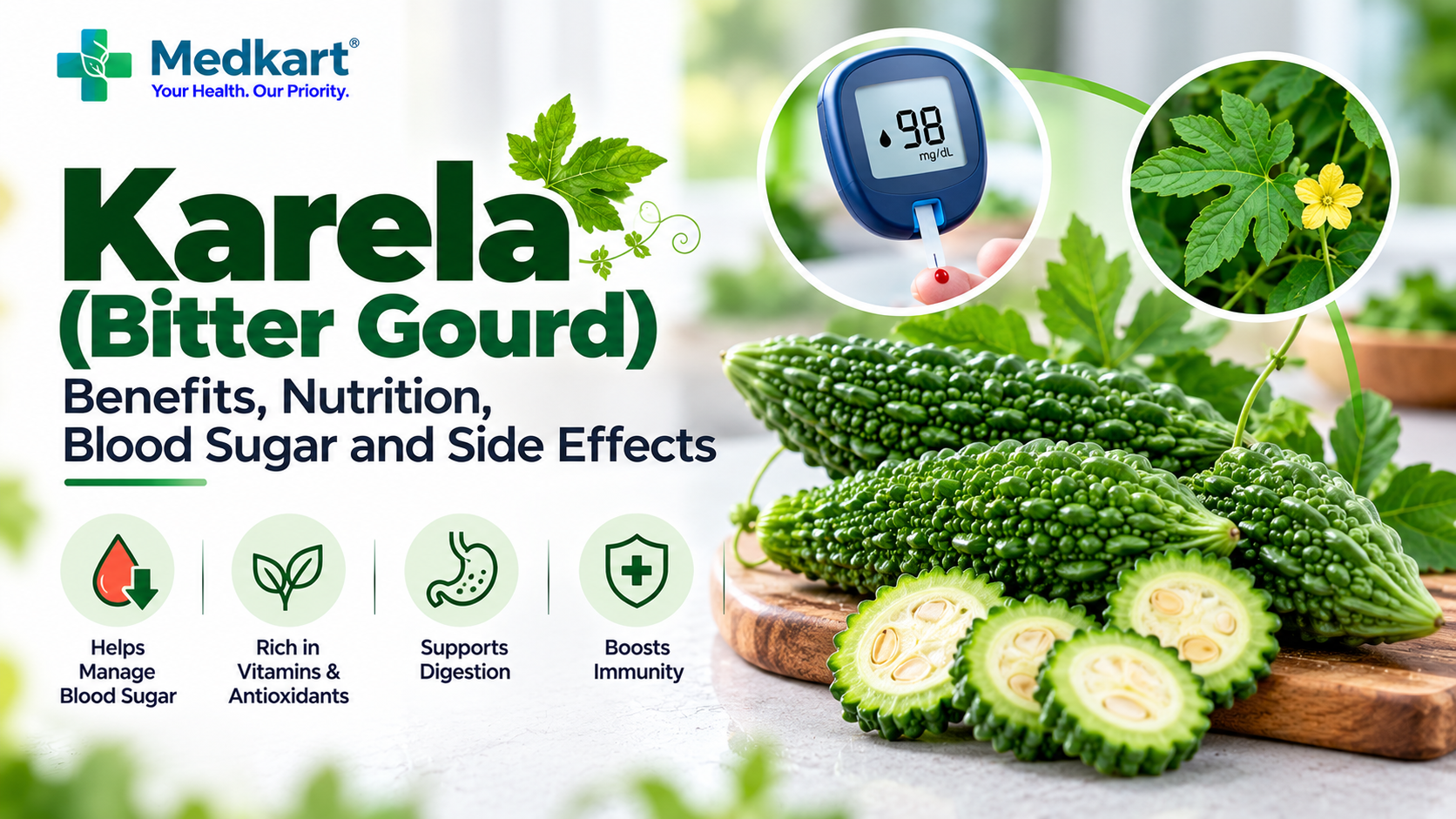
Karela is the Indian name for the fruit of Momordica charantia, a plant also called bitter gourd and bitter melon. The unripe fruit is cooked as a vegetable, crushed into juice, dried into powder, and sold in capsules.
Most of the interest in karela is about blood sugar. That interest is old, and the clinical evidence behind it is thinner than the reputation suggests. This article sets out what the retrieved reviews say, what 100 g of karela contains, and what side effects have been reported.
What Are the Benefits and Uses of Karela?
Karela is used both as a food and as a traditional preparation. A 2022 review in Frontiers in Pharmacology[1] records that the unripe fruits are eaten as a vegetable, and that karela juice is made by crushing and straining them.
The same review notes that capsules and tablets are sold containing powdered fruit or extracts, and that a decoction of the aerial parts is used in some places.
As a food, its measurable contributions are fibre and vitamin C. The claims made for it beyond that belong to the blood sugar section below.
What Is the Nutritional Value of Karela?
Karela is mostly water and very low in energy. The United States Department of Agriculture database[2] records these figures for raw bitter gourd pods.
| Nutrient | What 100 g of raw karela provides |
| Energy | Raw pods provide 17 kcal, or 71 kJ, per 100 g. |
| Water | Water makes up 94 g of every 100 g. |
| Carbohydrate | Carbohydrate by difference is 3.7 g per 100 g. |
| Fibre | Total dietary fibre is 2.8 g per 100 g. |
| Protein | Protein is 1 g per 100 g. |
| Fat | Total fat is 0.17 g per 100 g. |
| Vitamin C | Vitamin C is 84 mg per 100 g. |
| Folate | Total folate is 72 micrograms per 100 g. |
| Potassium | Potassium is 296 mg per 100 g. |
Those figures come from a United States database rather than an Indian one. The ICMR-NIN Indian Food Composition Tables were sought for this article and could not be read, because the published file carries no extractable text.
What Does Karela Contain That Has Been Studied?
Three compounds account for most of the research interest. The Frontiers in Pharmacology review names charantin, a mixture of two sterol glucosides, and vicine, a pyrimidine nucleoside found in the seeds.
The third is polypeptide-p, which the review describes as a small protein reported to lower blood glucose in people with diabetes.
Where a compound sits in the fruit matters for safety. The review reports a mildly toxic lectin in the seeds and in the outer rind.
The quantities are the awkward part. The review puts the charantin amounts used in research at the equivalent of 180 g to 315 g of fruit.
Does Karela Lower Blood Sugar?
The retrieved reviews do not agree, and that disagreement is the honest answer.
A Cochrane review[3] found four randomised trials covering 479 participants, each running up to three months. It reported no statistically significant difference in glycaemic control against placebo, and no significant change against glibenclamide or metformin either.
A 2024 meta-analysis in Frontiers in Nutrition[4] pooled nine randomised trials covering 414 participants. Those trials ran for 4 to 16 weeks, and the review found no significant effect on fasting glucose or on HbA1c.
A 2025 meta-analysis in Metabolism Open[5] reached a different figure. Across 25 trials it reported reductions in HbA1c and in fasting blood glucose that were statistically significant. It graded its own HbA1c finding as very low certainty and its glucose finding as low.
Two of the three found nothing, and the third rates its own confidence as low. That is not a basis for treating karela as a blood sugar medicine.
Also Read: Understanding Blood Sugar Levels
How Much Karela Has Been Used in Studies?
There is no established amount, and no retrieved source sets one for general use.
What the trials used varied enormously. The Metabolism Open review records interventions from 300 mg to 60,000 mg daily. They were given as powders, capsules, extracts and juices, over periods of 3 to 26 weeks.
That is a description of what researchers gave participants. It is not a quantity for anyone to take, and the two hundredfold spread is part of why the results are hard to read.
No retrieved source states a time of day for karela, or a duration for taking it outside a trial. This article therefore does not give one.
What Side Effects Can Karela Cause?
The reported effects are mainly digestive. The Cochrane review lists diarrhoea and abdominal pain among the adverse effects in its trials, and records that no serious adverse effects were reported in any of them.
The Frontiers in Nutrition meta-analysis found a similar pattern. Headache and gastrointestinal complaints were the most common events reported.
Both reviews qualify this. Cochrane notes that adverse effect reporting in the trials was incomplete, so an absence of serious events across a few short studies proves less than it appears to.
Who Should Be Careful with Karela?
Several groups are named in the retrieved reviews. The cautions attach to particular parts of the plant rather than to karela as a whole.
| Situation | What to do |
| Pregnancy | The Frontiers in Pharmacology review states that bitter gourd preparations should be omitted during pregnancy. It cites uterine bleeding reported in pregnant animals and hormonal activity shown in laboratory work. |
| Glucose-6-phosphate dehydrogenase deficiency | The same review states that vicine causes favism in people with this deficiency. |
| Young children | That review records hypoglycaemic coma in two children aged three and four. They had drunk a tea made from the leaves and vines before eating. |
| Anyone taking diabetes medicines | Ask a doctor or pharmacist before adding a karela preparation, because the trials tested it against those medicines rather than with them. |
| Preparations from parts other than the fruit | The review advises caution with decoctions made from seeds and other parts of the plant. |
Can Karela Interact with Medicines?
The retrieved evidence does not settle this, and the practical answer follows from what the trials were actually doing.
The studies in the Cochrane review compared karela preparations against glibenclamide and metformin, which means they were tested as alternatives rather than as additions.
No retrieved review reports what happens when a karela preparation and a prescribed diabetes medicine are taken together. That gap matters, because both are being taken for the same purpose.
Anyone taking Glycomet or another prescribed diabetes medicine should ask a doctor or pharmacist before starting a karela supplement. A prescribed medicine should not be reduced to make room for one.
Where Can You Buy Karela Products Online?
Medkart sells Ayurvedic preparations containing karela, alongside its wider range of medicines, and highlights quality credentials for its generic medicine range.
Listed products include Karela Capsule from Himalaya and Dabur Glycodab tablets. Amree Plus capsules from Aimil and Ashtamrut SF Diabetes Juice also carry it. Availability, pack size and price differ between products and can change.
Medkart lists these preparations and does not test or approve them. Nothing here establishes that any of them lowers blood sugar. Medkart’s medicine comparison tools can be used to compare listed options on:
- Active ingredient
- Strength
- Dosage form
- Manufacturer
- Pack size
- Current price
A supplement taken for blood sugar should be discussed with the doctor or pharmacist who manages the prescription.
Key takeaways
- Karela, bitter gourd and bitter melon are names for the fruit of Momordica charantia.
- Raw karela provides 17 kcal per 100 g and is about 94 percent water.
- It is a useful source of vitamin C and dietary fibre.
- Two of three retrieved reviews found no significant effect on blood sugar.
- The third found an effect but rated its own evidence as low certainty.
- Trials have used amounts from 300 mg to 60,000 mg daily, which is a research range rather than a recommendation.
- Diarrhoea, abdominal pain and headache are the side effects most often reported.
- Bitter gourd preparations should be omitted during pregnancy, on the review retrieved here.
FAQs
Q. Do karela capsules contain the same thing as the vegetable?
Not necessarily. The Frontiers in Pharmacology review describes marketed capsules and tablets as carrying either powdered fruit or concentrated extracts, which are not the same material. The Metabolism Open review found daily amounts across its trials spanning a two hundredfold range. The Frontiers in Nutrition authors called for standardised dosing before firm conclusions are drawn.
Q. Does cooking karela change its nutrients?
Yes, considerably for vitamin C. The USDA database[6] records 33 mg per 100 g in boiled drained pods, against 84 mg in the raw fruit. Folate falls from 72 to 51 micrograms and fibre from 2.8 g to 2 g. The energy figure barely moves, at 19 kcal.
Q. Does karela help with weight loss?
The pooled trials do not show it. The Frontiers in Nutrition meta-analysis reported a mean difference in body weight of one kilogram favouring bitter melon, and a BMI difference of 0.42. Neither reached statistical significance, because the confidence interval crossed zero in both cases.
Q. Does karela lower blood pressure?
Not on the pooled evidence. Blood pressure was among the outcomes the Frontiers in Nutrition meta-analysis examined, alongside glucose, lipids and body measurements. The review found no statistically significant improvement across the outcomes it combined.
Q. Does karela affect liver or kidney tests?
The pooled trial data did not show changes. The Frontiers in Nutrition review reports no significant differences in ALT, AST or creatinine across the trials it combined. Those trials ran for 16 weeks at most, so they say nothing about years of use.
Q. Why do the studies on karela disagree so much?
Size, length and preparation all differ. The three reviews drew on trials with a few hundred participants each, running for weeks rather than years. The preparations were not comparable with one another, and the certainty ratings attached to the positive findings were low or very low.
References
- https://pmc.ncbi.nlm.nih.gov/articles/PMC9152207/
- https://fdc.nal.usda.gov/portal-data/external/168393
- https://www.cochrane.org/evidence/CD007845_momordica-charantia-type-2-diabetes-mellitus
- https://pmc.ncbi.nlm.nih.gov/articles/PMC10808600/
- https://pmc.ncbi.nlm.nih.gov/articles/PMC12630335/
- https://fdc.nal.usda.gov/portal-data/external/168394
Medical disclaimer: This article gives general information only. It does not replace advice from a doctor or pharmacist. No medicine or supplement should be started, stopped or changed without advice from the prescriber or a qualified pharmacist.
Leave a Reply