







Authentic Product

India's Leading Generic Pharmacy

Secure Payment
By SUN PHARMACEUTICAL INDUSTRIES LTD
MRP
₹
64.88
₹55.15
15 % OFF
₹3.68 Only /
TabletCheck Delivery
--
Composition
Content Reviewed By:
Dr. Rajesh Sharma
, (MBBS)
Written By:
Ms. Priyanka Shah
, (B.Pharm)
Most side effects do not require any medical attention and disappear as your body adjusts to the medicine. Consult your doctor if they persist or if you’re worried about them.

Electrolytes and acid–base balance
Monitor regularlyDiamox 250 can cause metabolic acidosis and disturbances in electrolytes, including reductions in sodium and potassium levels, due to its carbonic anhydrase–inhibiting and diuretic effects.
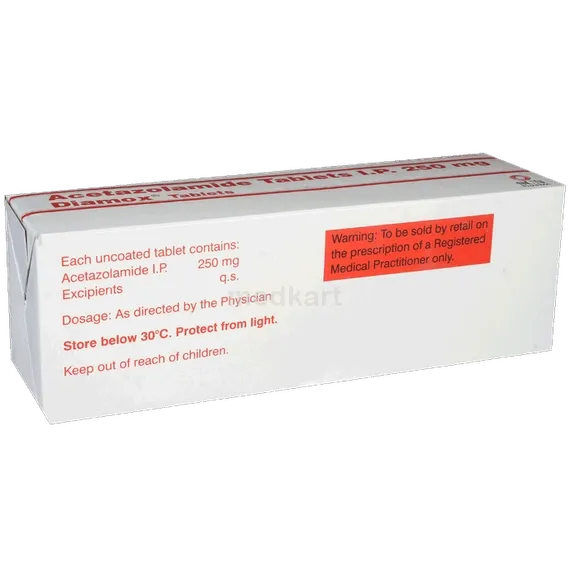
DIAMOX 250MG TABLET 15'S reduces the pressure inside the eyes, known as intraocular pressure. This helps to reduce the risk of damage to the optic nerve responsible for normal vision. If the pressure in the eye is not controlled, it can gradually lead to blindness. DIAMOX 250MG TABLET 15'S effectively controls ocular hypertension and certain types of glaucoma by decreasing the pressure in the eyes.
You should not take DIAMOX 250MG TABLET 15'S if you have or ever had cirrhosis, severe liver or kidney disease, an electrolyte imbalance, adrenal gland failure, or an allergy to DIAMOX 250MG TABLET 15'S or sulfa drugs. Also, let your doctor know if you are pregnant, planning to conceive or are breastfeeding to avoid any harmful effect on your baby.
DIAMOX 250MG TABLET 15'S is effective if used in the dose and duration advised by your doctor. Do not stop taking it even if you see improvement in your condition. If you stop using DIAMOX 250MG TABLET 15'S too early, the symptoms may return or worsen.
No, you should not stop using DIAMOX 250MG TABLET 15'S suddenly without talking to your doctor. This is because if you stop the medication before completing the treatment, your symptoms may return or even worsen. Use DIAMOX 250MG TABLET 15'S in the dose and duration advised by your doctor to get maximum benefit of DIAMOX 250MG TABLET 15'S.
If you forget a dose of DIAMOX 250MG TABLET 15'S, take it as soon as you remember. However, if it is almost time for your next dose, take it in the regular schedule instead of taking the missed dose. Do not double the dose to make up for the missed one as this may increase the chances of developing side effects.
Diamox 250 is a prescription medicine that contains acetazolamide as its active ingredient. Acetazolamide is a carbonic anhydrase inhibitor used to reduce elevated pressure in the eye (intraocular pressure), manage certain types of edema, treat specific seizure disorders, help reduce intracranial pressure in conditions such as idiopathic intracranial hypertension, and prevent or treat acute mountain sickness. The 250 designation refers to the strength of acetazolamide in each tablet, but the exact dosing regimen must be determined by a healthcare professional.
Diamox 250 is most commonly prescribed for glaucoma to lower intraocular pressure, either as a short‑term or adjunctive therapy when other treatments are insufficient. It may also be used to manage edema associated with congestive heart failure or certain drug‑induced or hormonal causes, as an adjunct to other diuretics. In neurology, it can be used for specific seizure disorders and for idiopathic intracranial hypertension to reduce cerebrospinal fluid pressure. Additionally, it is used in the prevention and treatment of acute mountain sickness in people ascending to high altitude, under medical guidance.
Diamox 250 works by inhibiting the enzyme carbonic anhydrase in various tissues, including the eye, kidney, and central nervous system. In the eye, this inhibition reduces the formation of aqueous humor, thereby lowering intraocular pressure. In the kidneys, it decreases bicarbonate reabsorption, leading to increased excretion of bicarbonate, sodium, water, and potassium, which contributes to its diuretic effect and can cause a mild metabolic acidosis. In the brain and cerebrospinal fluid, these changes help reduce intracranial pressure and can influence neuronal excitability, which is relevant in certain seizure disorders and idiopathic intracranial hypertension.
Diamox 250 should be taken exactly as prescribed by your doctor. The dose, frequency, and duration depend on the condition being treated, your age, kidney function, and other medical factors. Tablets are usually swallowed with water and may be taken with or without food, according to your prescriber’s instructions. You should not change the dose, take it more often, or stop it abruptly without consulting your doctor. If you are unsure about your dosing schedule, ask your prescriber or pharmacist for clarification rather than guessing or adjusting it yourself.
Common side effects of Diamox 250 include increased urination, tingling or numbness in the hands, feet, or around the mouth (paresthesia), changes in taste, decreased appetite, nausea, mild stomach upset, and fatigue. Some people may also experience headache, dizziness, or a feeling of being unwell. These effects are often dose‑related and may lessen as the body adjusts. However, if side effects are persistent, bothersome, or worsening, you should contact your healthcare provider to discuss whether dose adjustment or an alternative treatment is needed.
Serious but less common side effects of Diamox 250 include severe skin reactions (such as Stevens–Johnson syndrome or toxic epidermal necrolysis), blood disorders (including agranulocytosis, aplastic anemia, or thrombocytopenia), significant metabolic acidosis, kidney stones, severe electrolyte disturbances (such as marked hypokalemia or hyponatremia), and liver dysfunction. Warning signs can include rash, blistering or peeling skin, unexplained bruising or bleeding, persistent sore throat or fever, severe fatigue, yellowing of the skin or eyes, dark urine, severe abdominal or flank pain, difficulty breathing, or irregular heartbeat. If any of these occur, seek urgent medical attention and inform your doctor that you are taking acetazolamide.
Diamox 250 is contraindicated in people with known hypersensitivity to acetazolamide, sulfonamides, or any component of the formulation. It should not be used in patients with severe kidney disease, severe liver disease (including cirrhosis), marked electrolyte disturbances such as significant hyponatremia or hypokalemia, or in those with marked adrenal gland insufficiency. It is generally avoided in patients with hyperchloremic acidosis. Caution and specialist supervision are required in individuals with a history of kidney stones, chronic lung disease, diabetes, or blood disorders. Your doctor will review your medical history and laboratory results before deciding whether Diamox 250 is appropriate for you.
Use of Diamox 250 during pregnancy requires careful risk–benefit assessment by a specialist. Acetazolamide crosses the placenta, and data in humans are limited. Animal studies have shown potential risks at high doses. For this reason, it is generally avoided in pregnancy unless the potential benefit to the mother clearly outweighs possible risks to the fetus, such as in certain sight‑threatening or life‑threatening conditions where alternative options are inadequate. If you are pregnant, think you may be pregnant, or are planning a pregnancy, you should inform your doctor before starting or continuing Diamox 250 so that an individualized decision can be made.
Acetazolamide is excreted into breast milk in small amounts. Limited data suggest that low maternal doses may result in relatively low exposure for the breastfed infant, but comprehensive safety data are lacking. The decision to use Diamox 250 while breastfeeding should be made by your doctor after weighing the benefits of treatment for the mother against any potential risk to the infant. If it is used, the infant should be monitored for poor feeding, unusual drowsiness, or inadequate weight gain, and any concerning symptoms should be reported promptly to a pediatrician.
Yes, Diamox 250 can interact with several other medicines. It may enhance the effects and toxicity of certain antiepileptic drugs, such as phenytoin and carbamazepine, and can increase the risk of salicylate toxicity when used with high‑dose aspirin. It may reduce the clearance of some drugs and alter the effects of lithium, other diuretics, and medications that affect acid–base or electrolyte balance. Combining Diamox 250 with other carbonic anhydrase inhibitors is generally avoided due to additive side effects. Always inform your doctor and pharmacist about all prescription medicines, over‑the‑counter products, and herbal supplements you are taking so that potential interactions can be assessed and monitored.
If you miss a dose of Diamox 250, follow the instructions provided by your prescriber or pharmacist. In general, if it is close to the time of your next scheduled dose, you should skip the missed dose and resume your regular dosing schedule. Do not take a double dose to make up for a missed one, as this may increase the risk of side effects such as electrolyte imbalance or excessive diuresis. If you are unsure what to do, contact your healthcare provider or pharmacist for individualized advice rather than guessing or altering your regimen on your own.
Good
tarif Malek
•
Reviewed on 15-01-2024
(5/5)
Excellent Customer service
Ashish Makwana
•
Reviewed on 12-01-2024
(5/5)
Best medicine 💊
Mohit Tanna
•
Reviewed on 30-01-2024
(5/5)
Medkart is very good for generic medicines
DD Sanghavi
•
Reviewed on 14-07-2023
(3/5)
Best service ever.. I used to come down all the way from kerla to get medicines frm here
Mint Raj
•
Reviewed on 15-05-2023
(5/5)
SUN PHARMACEUTICAL INDUSTRIES LTD
Country of Origin -
India

MRP
₹
64.88
₹55.15
15 % OFF
Quick Links
Medkart's sole intention is to ensure that its consumers get information that is expert-reviewed, accurate and trustworthy. However, the information contained herein should NOT be used as a substitute for the advice of a qualified physician. The information provided here is for informational purposes only. This may not cover everything about particular health conditions, medicines, generic alternatives, all possible side effects, drug interactions, warnings, alerts, lab tests, etc. Please consult your doctor and discuss all your queries related to any disease or medicine. We intend to support, not replace, the doctor-patient relationship.
10 Lakh+
Happy customers
35000+
Pin-codes Covered
75 Lakh+
Orders Delivered

Authentic Products
All WHO-GMP Certified Medicines

©2025 Medkart Pharmacy. All Rights Reserved