
Authentic Product

India's Leading Generic Pharmacy

Secure Payment

By PHARMED
MRP
₹
295
₹250.75
15 % OFF
₹25.08 Only /
Tablet
Check Delivery
--

Content Reviewed By:
Dr. Sanjay Mehta
, (MBBS)
Written By:
Ms. Kavita Desai
, (B.Pharm)
Most side effects are mild and settle over time. Uncommon effects like high blood calcium need prompt medical attention if you notice their symptoms.

Other medical conditions
Use under medical supervisionPeople with hypercalcemia, hyperparathyroidism, sarcoidosis, tuberculosis, or other granulomatous diseases may have increased sensitivity to vitamin D and a higher risk of elevated blood calcium when using MGD3 tablet.
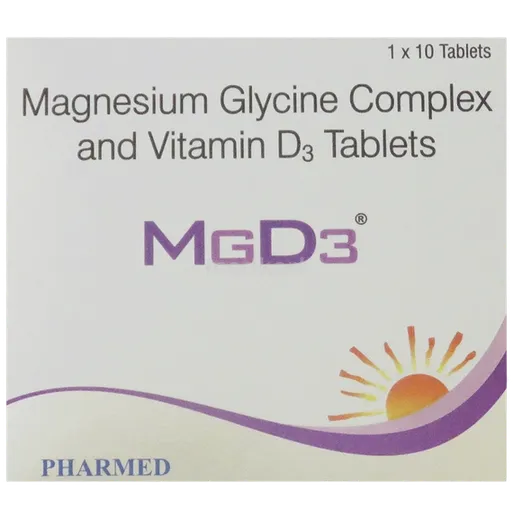
MGD3 Tablet 10'S is a medicine containing Vitamin D3 (Cholecalciferol), used to treat and prevent Vitamin D deficiency.
It helps in the treatment and prevention of Vitamin D deficiency, osteoporosis, and rickets. It supports bone health and calcium absorption.
Take MGD3 Tablet 10'S as directed by your doctor. It is usually swallowed whole with water.
Common side effects of MGD3 Tablet 10'S may include constipation, nausea, vomiting, and abdominal pain.
MGD3 Tablet 10'S should only be used during pregnancy if clearly directed by a doctor.
MGD3 Tablet 10'S can be taken with or without food, but taking it with food may improve absorption.
The recommended dosage of MGD3 Tablet 10'S will be determined by your doctor based on your individual needs.
Store MGD3 Tablet 10'S at room temperature, away from direct sunlight and moisture.
MGD3 Tablet 10'S can interact with certain medications, such as antacids and some anticonvulsants. It is important to inform your doctor about all your medications to avoid any potential interactions.
If you miss a dose of MGD3 Tablet 10'S, take it as soon as you remember. However, if it is almost time for your next dose, skip the missed dose and continue with your regular dosing schedule.
Yes, an overdose of MGD3 Tablet 10'S can be harmful and may lead to symptoms like nausea, vomiting, weakness, and confusion. Seek immediate medical attention if you suspect an overdose.
Vitamin D3 content can vary by brand. Always check the label or consult a doctor for the precise dosage.
The time it takes to see results from MGD3 Tablet 10'S can vary from person to person. Some people may notice improvements within a few weeks, while others may take longer.
MGD3 Tablet 10'S should only be given to children under the advice of a doctor. The dosage will vary based on the child's age and weight.
Before taking MGD3 Tablet 10'S, tell your doctor about all your medical conditions, allergies, and all the medications you are taking.
MGD3 tablet is mainly used for the prevention and treatment of vitamin D deficiency. It helps maintain normal calcium and phosphate levels, supports healthy bones and teeth, and is often used in conditions such as osteoporosis, osteopenia, rickets, and osteomalacia. It may also be prescribed for people at high risk of deficiency, such as those with limited sun exposure, malabsorption disorders, or certain chronic illnesses, as determined by a doctor.
MGD3 tablet contains vitamin D3 (cholecalciferol), which is converted in the liver and kidneys to its active form. This active form increases the absorption of calcium and phosphate from the intestine, reduces their loss from the kidneys, and supports proper bone mineralization. By improving vitamin D status, MGD3 helps maintain strong bones and normal muscle function and contributes to overall mineral balance.
Ideally, vitamin D supplementation at therapeutic doses should be guided by a blood test and medical advice. In some situations, low-dose vitamin D may be used empirically, but higher or prolonged dosing without confirming deficiency can increase the risk of excessive vitamin D and high blood calcium levels. It is advisable to consult a healthcare professional, especially if you have chronic illnesses, take other supplements, or plan to use MGD3 for an extended period.
At recommended doses, MGD3 tablet is usually well tolerated and many people do not experience side effects. If vitamin D intake becomes excessive, symptoms related to high blood calcium may occur, such as nausea, vomiting, constipation, abdominal pain, loss of appetite, increased thirst, frequent urination, weakness, confusion, or kidney-related problems. Any unusual or persistent symptoms should be reported to a doctor promptly.
Caution is required in people with kidney disease, a history of kidney stones, hypercalcemia (high blood calcium), hyperparathyroidism, sarcoidosis or other granulomatous diseases, and in those taking other vitamin D or high-dose calcium supplements. Individuals with severe liver or kidney impairment may need adjusted regimens or different forms of vitamin D. Always inform your doctor about your medical history and all medicines and supplements you are taking before starting MGD3.
MGD3 tablet may be used during pregnancy when vitamin D deficiency is confirmed or when a doctor considers supplementation necessary. Adequate vitamin D is important for maternal bone health and fetal skeletal development. However, excessive vitamin D intake during pregnancy can be harmful. Pregnant women should not self-medicate with high-dose vitamin D and should follow the exact regimen recommended by their obstetrician or physician.
Vitamin D3 passes into breast milk. MGD3 tablet can be used during breastfeeding if prescribed by a doctor to correct or prevent deficiency in the mother. The healthcare provider will consider the mother’s vitamin D status, dietary intake, and any additional vitamin D given directly to the infant. Both maternal and infant supplementation should be coordinated to avoid excessive total vitamin D exposure.
MGD3 tablet is often used together with calcium supplements in the management of osteoporosis or significant vitamin D deficiency, as vitamin D improves calcium absorption. However, taking high doses of both without medical supervision can increase the risk of high blood calcium and kidney stones. The decision to combine MGD3 with calcium, and the exact doses, should be made by a healthcare professional based on your clinical condition and test results.
Yes, MGD3 tablet can interact with certain medicines. Examples include some anticonvulsants (such as phenytoin, carbamazepine), glucocorticoids, rifampicin, orlistat, cholestyramine, and some weight-loss or cholesterol-lowering agents that affect fat absorption, which may reduce vitamin D levels or absorption. Thiazide diuretics can increase the risk of high blood calcium when used with vitamin D. Always inform your doctor and pharmacist about all prescription drugs, over-the-counter medicines, and supplements you use before starting MGD3.
If you miss a dose of MGD3 tablet, take it as soon as you remember, unless it is almost time for your next scheduled dose. In that case, skip the missed dose and take the next dose at the regular time. Do not take a double dose to make up for a missed one, as this may increase the risk of excessive vitamin D intake over time. If you frequently forget doses, discuss with your doctor or pharmacist about strategies to improve adherence.
Vitamin D3 is fat-soluble, and its absorption is generally better when taken with food that contains some fat. In many cases, MGD3 tablet is recommended to be taken with a meal or snack, unless your doctor advises otherwise. If you have specific digestive or absorption issues, your healthcare provider may give you tailored instructions on how best to take the tablet.
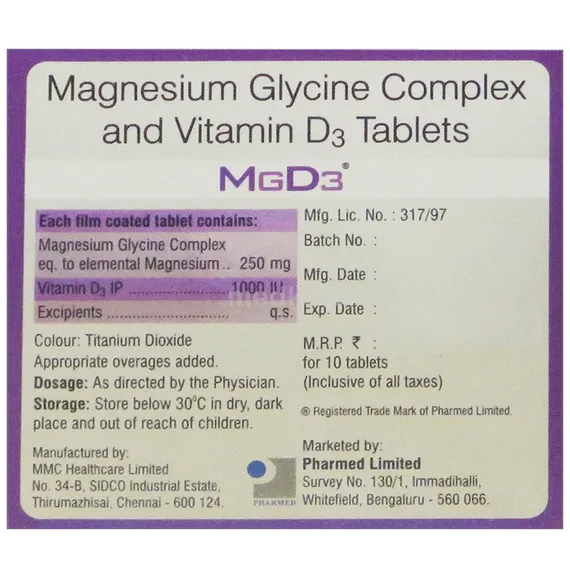
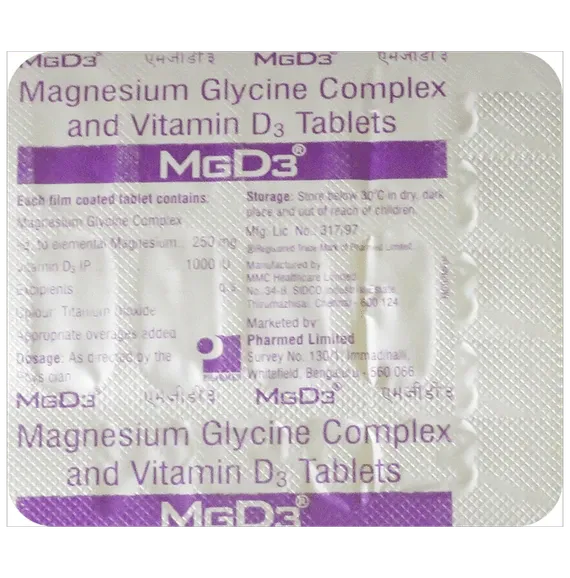
MGD3 Tablet 10's contains Cholecalciferol D3 1000 IU + Elemental Magnesium 250 MG. It is a vitamin D3 supplement; and mineral supplement (magnesium).
Commonly reported side effects of MGD3 Tablet 10's include well tolerated at recommended doses; and diarrhoea and abdominal cramps are the commonest, dose-related effects. Not everyone gets side effects. Tell your doctor or pharmacist if any effect persists or worries you.
MGD3 Tablet 10's is listed at Rs. 250.75 on Medkart. Prices can change — check the product page for the current price and pack size.
Not to be combined with other vitamin D sources without advice, as toxicity is cumulative; and Accumulates dangerously in kidney impairment — avoid unless directed. Tell your doctor about all other medicines you take before starting MGD3 Tablet 10's.
The dose of MGD3 Tablet 10's depends on your condition, age, weight and other medicines you take, so it must be decided by your doctor. Follow the dose and duration on your prescription and do not change it on your own.
A generic medicine is one with the same active composition as the branded product — for MGD3 Tablet 10's that is Cholecalciferol D3 1000 IU + Elemental Magnesium 250 MG. Medkart lists generic options by composition so you can compare. Ask your doctor or pharmacist before switching from MGD3 Tablet 10's.
MGD3 Tablet 10's contains Cholecalciferol D3 1000 IU + Elemental Magnesium 250 MG, a vitamin D3 supplement; and mineral supplement (magnesium). It is used for preventing and treating vitamin D deficiency.
MGD3 Tablet 10's is listed as not requiring a prescription. Check with your pharmacist if unsure.
MGD3 Tablet 10's is manufactured by Pharmed.
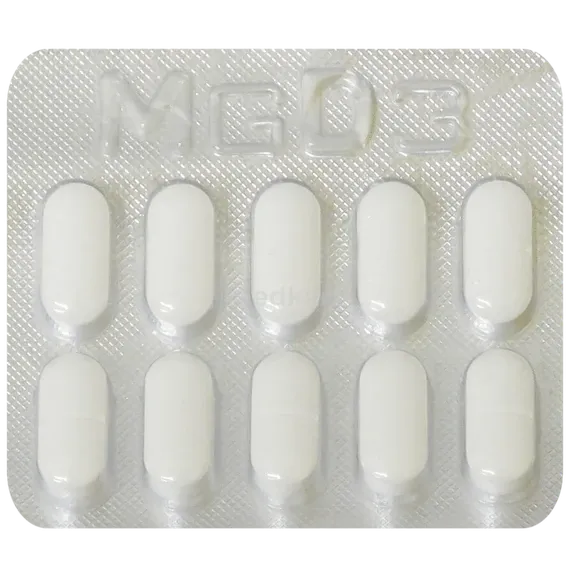
MGD3 Tablet 10's is supplied as a tablet and is taken by the oral route.
MGD3 Tablet 10's contains Cholecalciferol D3 1000 IU + Elemental Magnesium 250 MG. It is used for preventing and treating vitamin D deficiency; supporting calcium absorption and bone health; adjunct in rickets, osteomalacia and osteoporosis management; and preventing and treating magnesium deficiency; also used as an antacid and laxative depending on the salt. The benefit you get depends on the condition your doctor prescribed MGD3 Tablet 10's for.
Whether MGD3 Tablet 10's can be taken daily, and for how long, depends on your condition and must be decided by your doctor. Do not start, extend or repeat a course of MGD3 Tablet 10's on your own.
The timing of MGD3 Tablet 10's depends on the dose your doctor prescribes and on the other medicines you take. Follow the timing on your prescription or ask your pharmacist.
MGD3 Tablet 10's is listed as not requiring a prescription, but it is still safest to check with a doctor or pharmacist before taking it, especially alongside other medicines.
Do not take MGD3 Tablet 10's during pregnancy or while breastfeeding without asking your doctor. Safety depends on the medicine, the stage of pregnancy and your own health.
Check with your doctor before drinking alcohol while taking MGD3 Tablet 10's. Alcohol can add to side effects such as drowsiness and can affect how some medicines work.
Store MGD3 Tablet 10's in its original pack, below 25°C unless the pack states otherwise, away from direct sunlight and moisture, and out of the reach of children. Do not use it after the expiry date on the pack.


Same day dilevery available, Urgent response, Free home delivery above 500
Vikas Yadav
•
Reviewed on 09-07-2023

(5/5)
Geniune medicines available at good discounts
Vaishali Parikh
•
Reviewed on 05-12-2022
(5/5)
Got medicine which I was searching from yesterday thanks
Donisalya vines
•
Reviewed on 18-02-2024
(5/5)
Genuine product....
Saurav
•
Reviewed on 11-01-2024
(5/5)
Best pharmacy for all type medicine specialy for generic medicine
Sandeep kumar Mudotiya
•
Reviewed on 13-01-2024
(5/5)
PHARMED
Country of Origin -
India
MRP
₹
295
₹250.75
15 % OFF
Quick Links

Medkart's sole intention is to ensure that its consumers get information that is expert-reviewed, accurate and trustworthy. However, the information contained herein should NOT be used as a substitute for the advice of a qualified physician. The information provided here is for informational purposes only. This may not cover everything about particular health conditions, medicines, generic alternatives, all possible side effects, drug interactions, warnings, alerts, lab tests, etc. Please consult your doctor and discuss all your queries related to any disease or medicine. We intend to support, not replace, the doctor-patient relationship.
10 Lakh+
Happy customers
35000+
Pin-codes Covered
75 Lakh+
Orders Delivered

Authentic Products
All WHO-GMP Certified Medicines






©2025 Medkart Pharmacy. All Rights Reserved









 10's_1.webp)