
Authentic Product

India's Leading Generic Pharmacy

Secure Payment

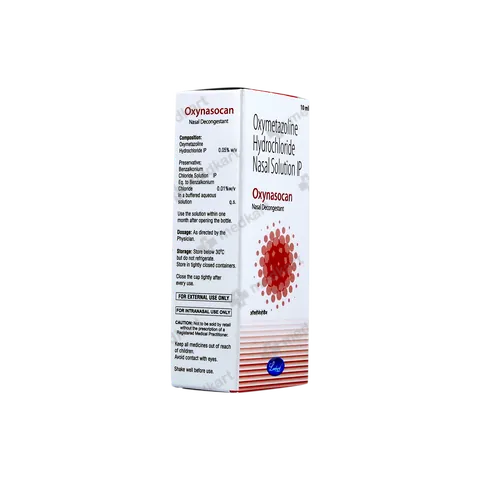
By EMAMI LIMITED (ZANDU)
MRP
₹
80
₹76
5 % OFF

Check Delivery
--

Composition

Content Reviewed By:
Dr. Manoj Shah
, (MBBS)
Written By:
Ms. Priyanka Shah
, (B.Pharm)
While Sitopaladi Churna is generally considered safe, some individuals may experience mild side effects. These can include: * **Digestive Issues:** Mild stomach upset, gas, or bloating can occur, especially with higher doses. * **Allergic Reactions:** Rarely, individuals may be allergic to one or more of the ingredients (like Talispatra, Pippali). Symptoms can include skin rash, itching, or hives. * **Increased Kapha:** In some individuals with a Kapha imbalance, it might slightly increase Kapha. This is rare because of the warming nature of other ingredients. * **Blood Sugar Fluctuations:** Due to the presence of sugar (Sharkara), individuals with diabetes should monitor their blood sugar levels closely and consult their doctor before use. **Important Considerations:** * If any adverse reactions occur, discontinue use and consult with a healthcare professional. * This information is not a substitute for professional medical advice. Always consult with a qualified healthcare provider for any health concerns or before making any decisions related to your health or treatment.

Metabolic Conditions (including Diabetes and Obesity)
Use with cautionMany sitopaladi formulations contain a substantial amount of sugar, which can contribute to increased blood glucose and caloric intake.
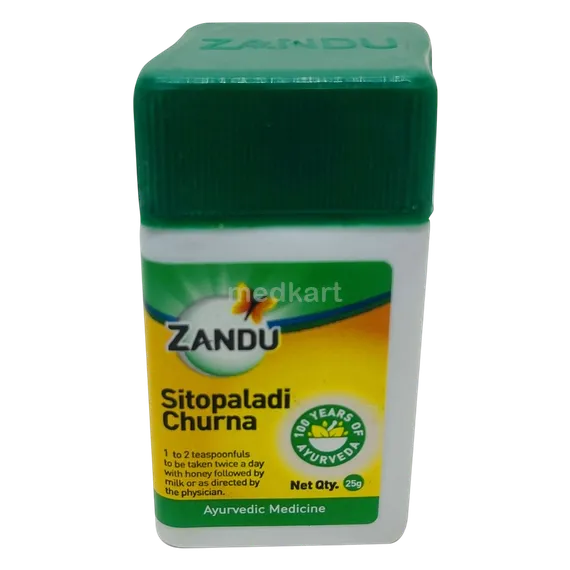
Sitopaladi Churna is an Ayurvedic medicine that is useful in respiratory problems and cough.
Its main ingredients are Sitopala (Mishri), Vanshlochan, Pippali, Cardamom, and Cinnamon.
It is useful in diseases like cough, cold, bronchitis, and weak digestive power.
Generally, 1-3 grams is taken twice a day with honey or ghee, or as directed by the physician.
Generally, it does not have any serious side effects, but some people may experience heartburn or acidity.
Store it in a cool and dry place, away from direct sunlight.
Yes, it is safe for children, but the dosage should be determined by the physician.
Sitopaladi Churna is a natural Ayurvedic medicine, while other cough medicines may contain chemical elements.
It can be taken on an empty stomach, but it is better to take it after food, especially if you have acidity problems.
It should be taken until the symptoms subside, or as directed by the physician.
Diabetic patients should consume Sitopaladi Churna with caution as it contains Mishri. It is advisable to consult a physician.
You can use other Ayurvedic cough medicines or home remedies, but it is better to consult a physician.
It is safe to consult a doctor before using Sitopaladi Churna during pregnancy.
The ingredients present in Sitopaladi Churna are believed to help boost immunity.
Taking Sitopaladi Churna with honey can make it more effective, especially for cough and cold.
Sitopaladi is a classical Ayurvedic polyherbal formulation, usually supplied as a powder (churna). Traditional formulations commonly include sugar, bamboo manna (vanshlochan), long pepper (pippali), cardamom, and cinnamon. In Ayurveda it is mainly used for respiratory complaints such as cough, cold, sore throat, and congestion, and is believed to balance Vata and Kapha doshas. In modern practice it is used as a complementary remedy for mild upper respiratory symptoms, usually alongside standard medical care rather than as a sole treatment.
Traditional Ayurvedic practice supports the use of sitopaladi for cough, cold, and throat irritation, and many people report symptomatic relief. Some ingredients, such as long pepper and cinnamon, have shown anti-inflammatory and antioxidant properties in preclinical and small clinical studies. However, high-quality, large-scale clinical trials specifically evaluating sitopaladi for cough and cold are limited. It should therefore be considered a complementary option for mild symptoms and not a substitute for evidence-based treatment in moderate or severe respiratory illness.
Sitopaladi is commonly used in children in traditional practice, but rigorous pediatric safety and efficacy data are limited. Children are more vulnerable to dosing errors, sugar load, and potential interactions with other medicines. Parents should not self-prescribe sitopaladi for infants or young children without consulting a pediatrician or qualified Ayurvedic physician. Any child with high fever, breathing difficulty, poor feeding, lethargy, or persistent cough should be evaluated urgently by a medical professional, regardless of herbal use.
Many sitopaladi formulations contain a high proportion of sugar, which can raise blood glucose levels. For people with diabetes or prediabetes, or those on carbohydrate-restricted diets, this may be problematic. Such patients should consult their treating physician before using sitopaladi. In some cases, an alternative formulation with reduced or no added sugar may be recommended, or sitopaladi may be avoided altogether depending on glycemic control and overall treatment goals.
Herbal formulations like sitopaladi can potentially interact with prescription medicines through effects on metabolism, absorption, or additive pharmacological actions, although specific interaction data for sitopaladi are limited. To minimize risk, patients should inform their doctor and pharmacist about all herbal and Ayurvedic products they use. Particular caution is advised in people taking medicines with a narrow therapeutic index (for example, certain anticoagulants, antiepileptics, or antiarrhythmics) and in those on multiple chronic medications.
Sitopaladi is generally well tolerated in traditional use when taken in appropriate amounts. Possible side effects, based on its ingredients and clinical experience, may include mild gastrointestinal discomfort, such as bloating or stomach upset, and, rarely, hypersensitivity reactions like rash, itching, or swelling. Because of its sugar content, it may contribute to elevated blood glucose or dental caries with frequent use. Any occurrence of breathing difficulty, facial or tongue swelling, severe abdominal pain, or persistent vomiting should be treated as a medical emergency and evaluated immediately.
Safety data for sitopaladi in pregnancy are limited, and controlled studies in pregnant women are not available. Some of its ingredients, such as long pepper and cinnamon, may have pharmacological effects that are not fully characterized in pregnancy. Therefore, routine or unsupervised use in pregnancy is not recommended. Pregnant women should consult their obstetrician or a qualified Ayurvedic physician before using sitopaladi or any other herbal formulation, and should not use it as a substitute for medical evaluation of cough, fever, or breathing problems.
There is insufficient high-quality evidence regarding the excretion of sitopaladi components into breast milk and their effects on the nursing infant. While it is sometimes used in traditional practice during lactation, caution is advisable. Breastfeeding women should discuss any use of sitopaladi with their healthcare provider, especially if the infant is premature, has low birth weight, or has underlying health problems. If the baby develops rash, diarrhea, poor feeding, or unusual sleepiness, medical advice should be sought promptly.
Sitopaladi is not known to have sedative properties and is not typically associated with drowsiness or impaired psychomotor performance. However, individual responses can vary, and some people may feel unwell due to their underlying illness rather than the product itself. Anyone who experiences dizziness, lightheadedness, or reduced alertness while taking sitopaladi should avoid driving or operating machinery and seek medical advice to determine the cause.
Sitopaladi powder should be stored in a cool, dry place, away from direct sunlight and moisture, in a tightly closed container to prevent clumping and contamination. It should be kept out of reach of children. Because herbal products can vary widely in quality, it is important to choose sitopaladi from reputable manufacturers that follow good manufacturing practices, provide clear labeling of ingredients, batch numbers, and expiry dates, and ideally have some form of quality certification. Products with unusual odor, color change, visible contamination, or past their expiry date should not be used.


Value for money I got a good discount on medicines
shilpa purohit
•
Reviewed on 04-09-2023

(5/5)
Good for generic medicine, quality medicine with affordable rate
nitesh vekariya
•
Reviewed on 03-02-2024
(5/5)
Good. Provides medicines at reasonable rates.
Jiji Varughese
•
Reviewed on 08-02-2024

(4/5)
Had a good experience when I went for purchasing medicine. Appreciate the service
Chitrang Shah
•
Reviewed on 07-11-2022
(5/5)
Great experience wonderful experience nice palce for low cost medicine
vast chance
•
Reviewed on 10-06-2023
(5/5)
EMAMI LIMITED (ZANDU)
Country of Origin -
India
MRP
₹
80
₹76
5 % OFF
Quick Links

Medkart's sole intention is to ensure that its consumers get information that is expert-reviewed, accurate and trustworthy. However, the information contained herein should NOT be used as a substitute for the advice of a qualified physician. The information provided here is for informational purposes only. This may not cover everything about particular health conditions, medicines, generic alternatives, all possible side effects, drug interactions, warnings, alerts, lab tests, etc. Please consult your doctor and discuss all your queries related to any disease or medicine. We intend to support, not replace, the doctor-patient relationship.
10 Lakh+
Happy customers
35000+
Pin-codes Covered
75 Lakh+
Orders Delivered

Authentic Products
All WHO-GMP Certified Medicines






©2025 Medkart Pharmacy. All Rights Reserved








 10's_1.webp)