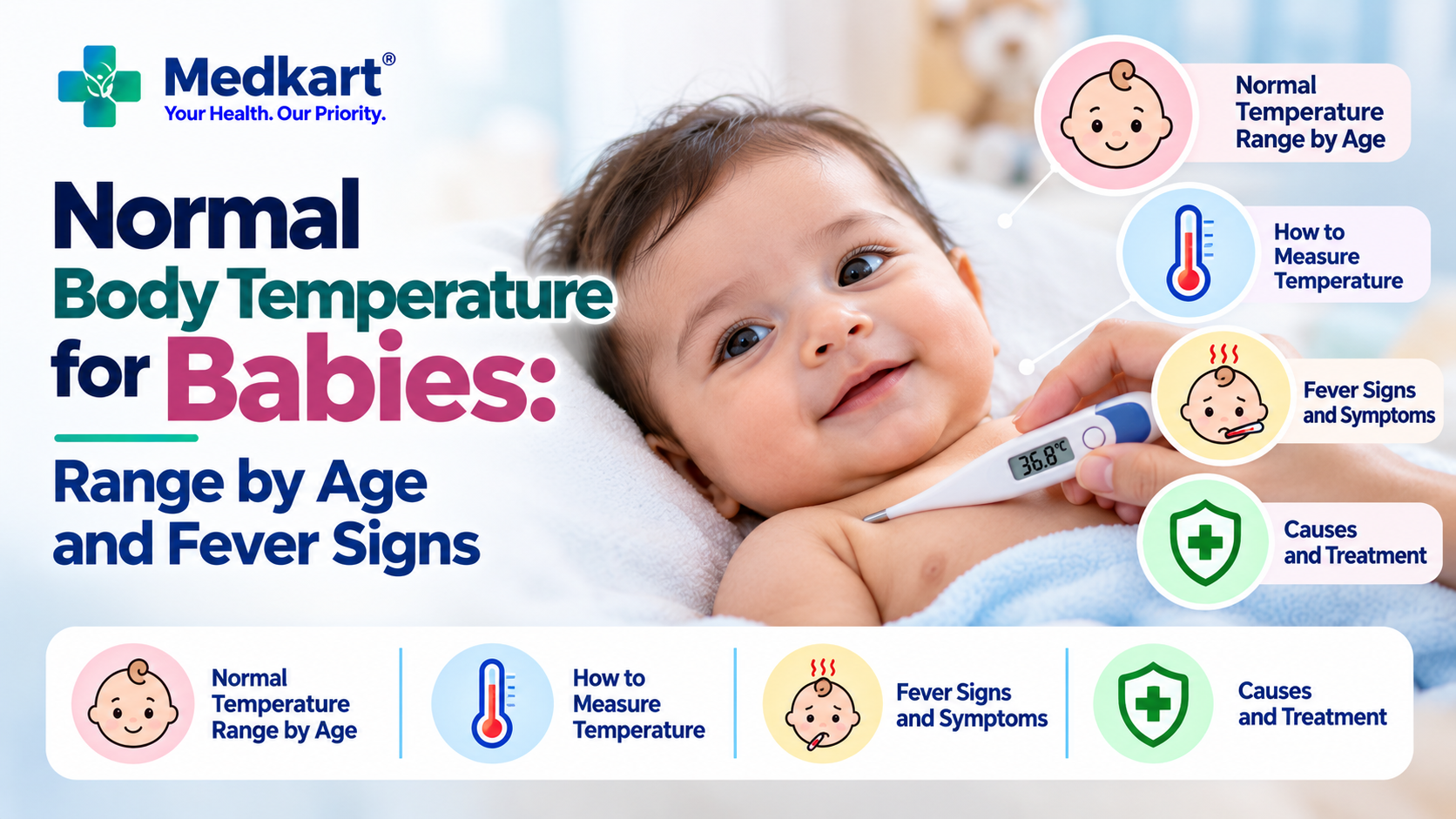
A baby’s temperature is a number with conditions attached. The same child reads differently depending on where the thermometer sits, and the number that matters most changes with age rather than staying fixed.
Two facts shape everything below. A temperature of 38C in a baby under three months is treated as urgent whatever else is happening. Above six months the height of the reading stops deciding how worried anyone should be.
What Is a Normal Body Temperature for a Baby?
For newborns there is a defined band. A World Health Organization technical brief[1] describes normothermia in a newborn as 36.5C to 37.5C. It gives 36.5C to 37.4C as the safe range the warm chain is designed to hold.
Beyond the newborn weeks the sources stop giving a single figure. The NHS[2] says a normal temperature varies from child to child, and defines the threshold for concern rather than the norm.
Why the Reading Changes with the Thermometer Site
MedlinePlus[3] sets different thresholds for different sites, which tells you the sites are not interchangeable. It gives 38C measured rectally, 37.5C in the mouth and 37.2C under the arm as the points at which a child is considered to have a fever.
A reading is therefore incomplete without the site it came from.
What Is the Normal Temperature Range by Age?
The table sets out what each source states for each stage. It describes what the guidelines say and is not a tool for deciding how ill a child is.
| Age or situation | What the sources say |
| Newborn | The WHO gives 36.5C to 37.5C as normothermia, and calls 36.5C to 37.4C the safe range. |
| Under 3 months | NICE[4] treats a temperature of 38C or higher as placing a baby in a high-risk group for serious illness. |
| 3 to 6 months | NICE treats 39C or higher as placing a baby in at least an intermediate-risk group. |
| Over 6 months | NICE states that height of body temperature alone should not be used to identify serious illness in this group. |
| Young infants in India | The IMNCI chart booklet[5] treats an axillary temperature of 37.5C or above, or feeling hot to touch, as a sign to act on. |
| Any age, low reading | The IMNCI booklet treats a temperature below 35.5C, or feeling cold to touch, as a sign in the same group. |
What Temperature Is a Fever in a Baby or Child?
The NHS gives one number for children generally. It describes a high temperature as 38C or more, and notes that a normal temperature is different for every child.
India’s programme sets its thresholds lower and by age. The IMNCI chart booklet, from the Ministry of Health and Family Welfare, uses 37.5C in the armpit as a danger sign in a young infant. It defines high fever in older children as above 38.5C.
How Should a Baby’s Temperature Be Measured?
NICE is specific about both site and device. In infants under four weeks it says to measure with an electronic thermometer in the armpit.
From four weeks to five years it allows three options. Those are an electronic thermometer in the armpit, a chemical dot thermometer in the armpit, or an infra-red tympanic thermometer in the ear.
Two methods are ruled out. NICE says not to use the oral and rectal routes routinely in children aged nought to five years. It also states that forehead chemical thermometers are unreliable and should not be used by healthcare professionals.
One more NICE line is worth knowing before any appointment. It states that a parent’s reported perception of a fever should be considered valid and taken seriously.
Also Read: Roseola in the early stages
What Are the Signs of Fever in a Baby?
The NHS describes what carers notice alongside the reading. It names a child who feels hotter than usual to touch on the forehead, back or stomach, who feels sweaty or clammy, or whose cheeks are flushed.
The NHS lists poor appetite, unusual behaviour and signs of dehydration among the reasons to seek advice, separately from any figure.
NICE puts the limit of the number plainly. Beyond six months it directs clinicians away from using the height of the temperature on its own, and towards a structured assessment of other signs.
Can a Baby’s Temperature Be Too Low?
Yes, and in a newborn that is the more dangerous direction. The WHO brief describes hypothermia as the condition the warm chain exists to prevent, and names complications including low blood sugar, breathing problems and late-onset sepsis.
The Indian programme treats it as an emergency sign. The IMNCI booklet places a temperature below 35.5C, or a baby who feels cold to touch, alongside the features that call for immediate treatment.
Where a young infant’s temperature is below 36.5C, the booklet directs skin-to-skin contact to warm the baby while other care is arranged.
The WHO brief defines neonatal hyperthermia as a body temperature above 37.5C in a newborn, and names incubators, radiant warmers and makeshift heat sources among its common causes.
What Do the Guidelines Say About Managing a Fever?
Several familiar measures are not recommended. NICE states that tepid sponging is not recommended for treating fever, and that children with fever should not be underdressed or over-wrapped.
The purpose of medicine is comfort rather than the number. NICE says to consider paracetamol or ibuprofen in a child who appears distressed, and not to use these agents with the sole aim of reducing body temperature.
It is equally clear on combining them. NICE says not to give both agents at the same time, and to consider alternating them only if distress persists or returns before the next dose is due. It also records that these medicines do not prevent febrile convulsions.
Age limits apply before any of that. The NHS advises against paracetamol for babies under two months, and against ibuprofen for babies under three months or under 5 kg. This article gives no amounts for either.
When Should You See a Doctor?
Call 112 or seek urgent advice if your baby is under three months with a temperature of 38C or above, or three to six months with 39C or above. Those two thresholds do not wait for other symptoms.
| Situation | What to do |
| Under 3 months, temperature 38C or above | Seek urgent advice. The NHS names this threshold, and NICE places these babies in a high-risk group. |
| 3 to 6 months, temperature 39C or above | Seek urgent advice. NICE places them in at least an intermediate-risk group. |
| A baby who feels cold, or reads below 35.5C | Seek urgent care. The IMNCI booklet treats this alongside its other danger signs. |
| Fever lasting five days or more | Contact a doctor. The NHS names this duration specifically. |
| Fever with a rash, poor feeding or unusual behaviour | Contact a doctor. The NHS lists all three separately from the reading. |
| A rash that does not fade when pressed, a stiff neck or a first seizure | Call 999 or go to A&E. The NHS treats these as emergencies. |
| Cold hands and feet, mottled skin, drowsiness or breathing difficulty | Call 999 or go to A&E. The NHS names these among the same emergency signs. |
What This Article Cannot Tell You
It cannot say whether a particular fever is serious. NICE built a structured assessment for exactly that judgement, and it depends on breathing, circulation, colour and responsiveness rather than on a figure.
It cannot give a normal figure for an individual child. The NHS says normal varies from child to child, and the WHO band above describes newborns rather than toddlers.
It cannot tell you how much medicine to give. That depends on weight and age, and it belongs with a doctor or pharmacist.
It also cannot describe every setting. The Indian figures here come from the older IMNCI chart booklet, because the 2023 edition is published as a scanned file with no extractable text.
Where Can You Buy Thermometers and Fever Medicines on Medkart?
Medkart sells medicines online alongside health care devices, and lists a digital thermometer among them.
Fever medicines for children are listed by composition. Products containing paracetamol include Fepanil syrup, and products containing ibuprofen include Brufen Junior from Abbott.
Rehydration products sit alongside them, including ORS Powder from Cipla and Electral from FDC. Availability, pack size and price differ between products and can change.
Nothing here says any of these treats the condition, and no amount for a child should be worked out from a product page. Medkart lists these products and does not test or approve them. Medkart’s medicine comparison tools can be used to compare listed options on:
- Active ingredient
- Strength
- Dosage form
- Manufacturer
- Pack size
- Current price
It is also possible to search by name, browse the full medicine list, or find the nearest Medkart store.
Key takeaways
- The WHO gives 36.5C to 37.5C as the normal range for a newborn, and no source gives one figure for older children.
- MedlinePlus sets fever thresholds by site, at 38C rectal, 37.5C oral and 37.2C under the arm.
- The NHS describes a high temperature in a child as 38C or more.
- NICE places babies under three months with 38C or above in a high-risk group for serious illness.
- Above six months, NICE says the height of the temperature alone should not be used to judge serious illness.
- NICE advises an electronic thermometer in the armpit under four weeks, and rules out routine oral and rectal readings under five.
- The IMNCI booklet treats an axillary reading of 37.5C or above, or below 35.5C, as a danger sign in a young infant.
- NICE advises against tepid sponging, against underdressing or over-wrapping, and against giving paracetamol and ibuprofen together.
FAQs
Q. Is an ear thermometer accurate enough for a newborn?
Not for the first four weeks, on the NICE recommendations. The guideline names the infra-red tympanic thermometer only from four weeks of age, and restricts younger infants to an electronic thermometer in the armpit. For a newborn the guideline settles on the armpit.
Q. Are forehead strip thermometers reliable?
The guideline is blunt about one kind. It describes forehead chemical thermometers as unreliable and says healthcare professionals should not use them. Nothing retrieved here assesses the infra-red forehead scanners sold for home use, so that question is open rather than answered.
Q. Does a higher reading mean a more serious illness?
Past six months the guideline says to stop reading it that way. It directs clinicians not to use the height of body temperature on its own to identify serious illness in children older than six months, and towards other features instead. Below six months the thresholds above do carry weight on their own.
Q. Why do the Indian and British thresholds differ?
They are built for different jobs. The IMNCI booklet is a field tool for health workers using armpit readings and a touch test, so it sets a lower trigger at 37.5C for young infants. The NHS figure of 38C describes children generally. Both move the threshold down as the child gets younger.
Q. Should a feverish baby be undressed to cool down?
The guideline advises against both extremes. Stripping a feverish child down and piling blankets on are ruled out in the same recommendation, and cooling with a damp sponge is ruled out in the next one. Neither appears among the measures NICE supports.
Q. What if my baby feels hot but the thermometer reads normal?
That is worth saying out loud at the appointment. The guideline treats what a parent has noticed as evidence in its own right, not as something a device overrules. It is part of the assessment rather than an impression to be corrected.
References
- https://cdn.who.int/media/docs/default-source/mca-documents/nbh/enc-course/revised-resources/supplemental-materials/keeping-the-newborn-warm/thermalprotection.pdf
- https://www.nhs.uk/conditions/fever-in-children/
- https://medlineplus.gov/ency/article/003090.htm
- https://www.nice.org.uk/guidance/ng143/resources/fever-in-under-5s-assessment-and-initial-management-pdf-66141778137541
- https://nhm.gov.in/images/pdf/programmes/child-health/guidelines/imnci_chart_booklet.pdf
Medical disclaimer: This article gives general information about body temperature in babies and children and is not a diagnosis. It cannot tell any parent whether a fever is serious, because that judgement needs a clinician and an examination rather than a reading. A baby under three months with a temperature of 38C or above needs urgent advice, and no medicine should be started, stopped or changed, or any amount given to a child, without advice from the prescriber or a qualified pharmacist.
Leave a Reply