
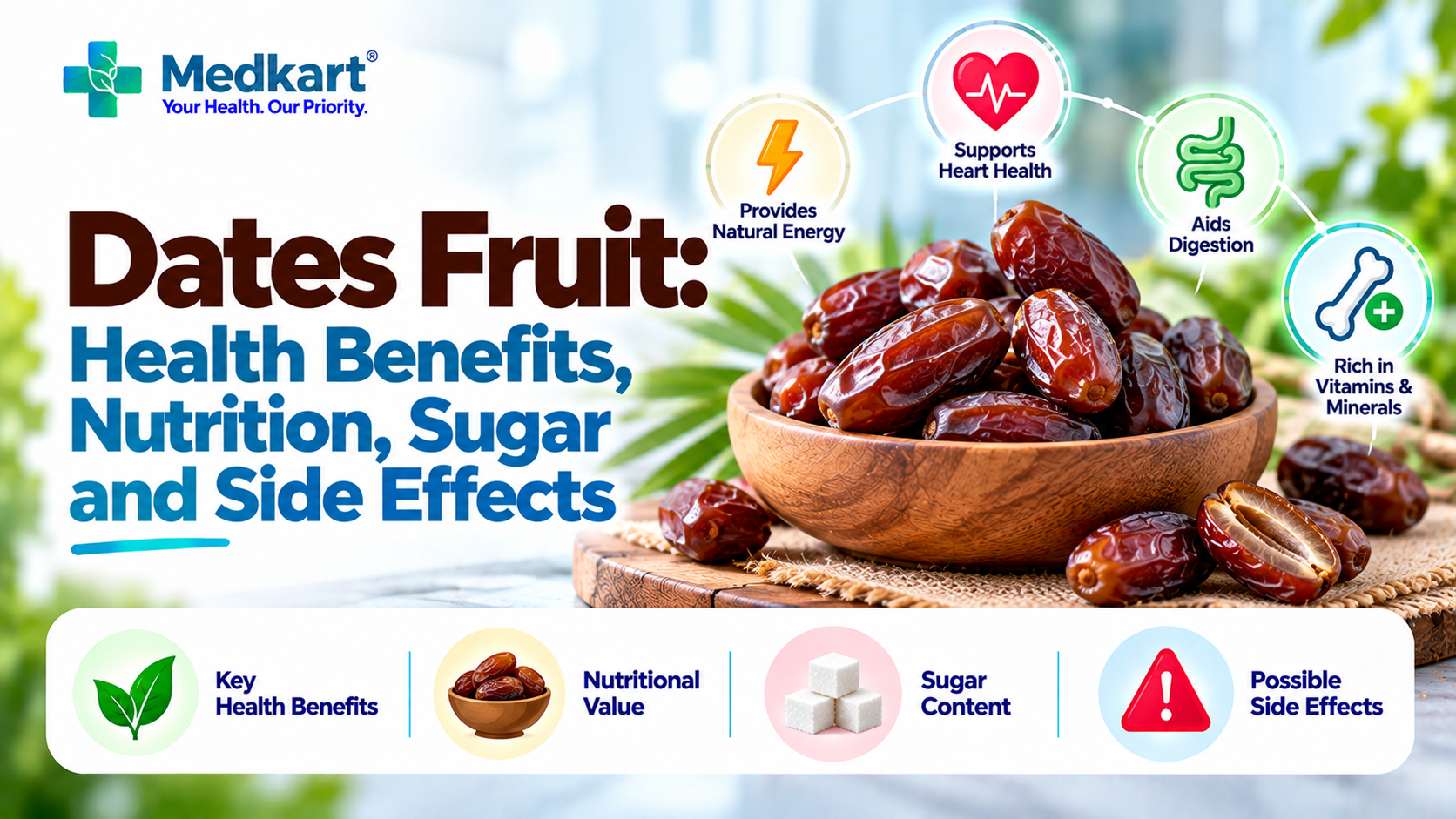
Dates are the fruit of the date palm, Phoenix dactylifera, sold in India mostly dried rather than fresh. They are dense in sugar, dense in fibre, and light in almost everything else.
That combination is what makes them interesting. A food that is two thirds sugar by weight would normally be assumed unsuitable for anyone watching blood glucose, and the measured evidence does not support that assumption. This article sets out the figures, the evidence, and where it runs out.
What Are Dates, and Where Do They Grow in India?
Dates come from the date palm, grown in hot, dry regions. India grows them and imports a great deal more.
The Indian Council of Agricultural Research[1] reports that India is the largest importer of dates, taking about 38% of the world market. Domestic cultivation is concentrated in the Kutch-Bhuj area of Gujarat, with newer plantations in Barmer and other districts of Rajasthan.
The varieties matter later in this article. The ICAR page names Barahi, Khuneizi, Khalas and Medjool among those cultivated, and different varieties behave differently in the blood glucose studies below.
What Is the Nutritional Value of Dates?
Dates are concentrated because the water has gone. The United States Department of Agriculture database records these figures for medjool dates[2], with deglet noor[3] given for comparison.
| Nutrient | What 100 g of dates provides |
| Energy | Medjool dates provide 277 kcal per 100 g, and deglet noor 282 kcal. |
| Carbohydrate | Carbohydrate by difference is 75 g per 100 g in both varieties. |
| Total sugars | Medjool contains 66.5 g of sugars per 100 g, and deglet noor 63.4 g. |
| Fibre | Medjool provides 6.7 g of fibre per 100 g, and deglet noor 8 g. |
| Protein | Protein is 1.81 g per 100 g in medjool and 2.45 g in deglet noor. |
| Fat | Fat is negligible, at 0.15 g per 100 g in medjool. |
| Potassium | Medjool provides 696 mg per 100 g, and deglet noor 656 mg. |
| Magnesium | Magnesium is 54 mg per 100 g in medjool and 43 mg in deglet noor. |
| Water | Water makes up 21.3 g of every 100 g in medjool, which is what makes the rest so concentrated. |
Those figures are per 100 g, which is a large handful rather than a snack. Variety also changes the numbers, and neither USDA entry describes fresh dates.
How Much Sugar Is in Dates?
Two thirds of the weight, near enough. The USDA figures put total sugars at 66.5 g per 100 g in medjool dates and 63.4 g in deglet noor.
For context on daily intake, the NHS[4] advises adults to have no more than 30 g of free sugars a day. It does not classify the sugars in dried fruit as free sugars on that page, so the comparison is a scale rather than a rule.
The NHS does give dried fruit its own advice. It states that it is better for teeth to eat dried fruit as part of a meal rather than as a between-meal snack.
Do Dates Contain Protein?
Very little. Medjool dates carry 1.81 g of protein per 100 g and deglet noor 2.45 g, which is low for a food of that energy density.
Dates are a carbohydrate food with useful minerals attached. Anyone eating them for protein has chosen the wrong food, and the fat content is negligible too.
What Are the Health Benefits of Dates?
The defensible benefits are the fibre and the minerals. Medjool dates carry 6.7 g of fibre per 100 g and deglet noor 8 g, which is substantial for a fruit. Both are also high in potassium.
The magnesium and vitamin B6 contents are worth noting alongside them. Medjool dates provide 54 mg of magnesium and 0.249 mg of vitamin B6 per 100 g.
Beyond composition, the retrieved evidence narrows to two areas. Those are blood glucose response and childbirth, and both are covered below. No clinical trial of other health outcomes from eating dates was retrieved for this article.
Also Read: Understanding Blood Sugar Levels
Can People with Diabetes Eat Dates?
The measured glycaemic response is lower than the sugar content suggests. A 2011 study in Nutrition Journal[5] tested five date varieties in 13 healthy volunteers and 10 people with type 2 diabetes.
Glycaemic index values ran from 46.3 to 55.1 in the healthy group and from 43.8 to 53.0 in the diabetes group. The study found no statistically significant difference between the two groups, and none between the five varieties.
Variety matters more across a wider sample. A 2016 study in Annals of Saudi Medicine[6] tested 17 varieties in 19 people. It found glycaemic index values from 42.8 to 74.6, with a mean of 55.2.
That study also reports glycaemic load, which depends on portion. For a serving of three average-sized dates the glycaemic load ranged from 8.5 to 24 across the varieties tested.
Two limits matter. The Nutrition Journal participants were managed by diet or metformin alone, so the findings do not extend to people using insulin or several medicines. Both studies also tested dates at one stage of ripeness.
Do Dates Help with Labour in Late Pregnancy?
This is the most studied claim, and the evidence is large but weak. A 2024 review in BMC Pregnancy and Childbirth[7] pooled 48 trials reported across 55 publications.
The pooled findings favoured dates on several measures. Gestation was shorter by about two days, and cervical dilatation on admission was greater by 1.15 cm. The need for labour induction was lower, with a risk ratio of 0.48.
The quality assessment is the part that matters. The reviewers describe the overall evidence quality as unacceptable and note high risk of bias in most studies. They conclude that more well-designed investigations are needed before this can be called effective and safe care.
Their safety comment is also cautious. They record no side effects in the four trials that looked for them, while stating that the safety of the practice remains questionable. They flag glucose metabolism in people with diabetes.
What Are the Side Effects, and Who Should Be Careful?
Dates have no dramatic toxicity in the retrieved sources. The cautions follow from the sugar, the energy density and the potassium.
| Situation | What to do |
| Managing diabetes | Discuss portions with the doctor or dietitian managing it. Glycaemic index varied from 42.8 to 74.6 across varieties in the Saudi study. |
| Watching energy intake | Weigh the portion. Medjool dates carry 277 kcal per 100 g, and the water has already been removed. |
| Dental health | The NHS advises eating dried fruit with a meal rather than between meals, to reduce the risk of tooth decay. |
| Pregnancy | Raise it with the clinician managing the pregnancy. The 2024 review describes the safety evidence as still questionable. |
| Kidney disease with potassium restriction | Check with the treating team. Dates carry 656 to 696 mg of potassium per 100 g. |
No source retrieved for this article reports serious adverse effects from eating dates as a food.
Where Can You Buy Nutritional Supplements on Medkart?
Dates are a grocery item rather than a pharmacy one. Medkart sells the nutritional supplements that cover some of the same ground, alongside its wider range of medicines.
Iron and folate products are among them, including Daily Iron from Systopic. Availability, pack size and price differ between products and can change.
A food is not a substitute for a prescribed medicine such as metformin, sold as Glycomet among other brands, and nothing here says dates treat anything. Medkart’s medicine comparison tools can be used to compare listed options on:
- Active ingredient
- Strength
- Dosage form
- Manufacturer
- Pack size
- Current price
It is also possible to browse the full medicine list or find the nearest Medkart store.
Key takeaways
- Dates are the dried fruit of Phoenix dactylifera, and India imports about 38% of the world market.
- Medjool dates provide 277 kcal and 66.5 g of sugars per 100 g, with 6.7 g of fibre.
- Protein is low, at 1.81 g per 100 g in medjool and 2.45 g in deglet noor.
- Measured glycaemic index ran from 42.8 to 74.6 across 17 varieties, averaging 55.2.
- One study found no significant difference in glycaemic index between people with and without type 2 diabetes.
- Glycaemic load for three dates ranged from 8.5 to 24 depending on the variety.
- Pooled trials in late pregnancy favoured dates, but the reviewers rated the evidence quality as unacceptable.
- The NHS advises eating dried fruit with a meal rather than between meals, for the sake of teeth.
FAQs
Q. How many dates count as one serving?
The Saudi study used three average-sized dates as its serving for calculating glycaemic load. That is a useful anchor, because the same serving produced a glycaemic load anywhere from 8.5 to 24 depending on which variety was eaten. Portion and variety together decide the effect.
Q. Do dates need to be soaked before eating?
No source retrieved for this article addresses soaking. The studies opened here fed dates directly, and none tested whether soaking changes the sugar content, the texture or the glycaemic response. The practice is common, but nothing retrieved supports or contradicts it.
Q. Are dates good for constipation?
The fibre content is real, and the outcome evidence is not here. Deglet noor dates carry 8 g of fibre per 100 g and medjool 6.7 g, which is high for a fruit. No trial testing dates for constipation was retrieved for this article, so the fibre figure is the honest answer rather than a claim.
Q. Are dates a good source of iron?
Less than their reputation suggests. The USDA records 0.90 mg of iron per 100 g in medjool dates and 1.02 mg in deglet noor, which is modest. A hundred grams is also far more than a usual portion. Anyone treating iron deficiency needs a diagnosis and a plan from a doctor rather than a fruit.
Q. Are fresh dates the same as dried ones?
The figures above do not describe fresh dates. Both USDA entries opened for this article cover dried varieties, and no record for fresh dates was retrieved. Fresh fruit contains far more water, so the per-100-g figures for sugar and energy would not carry across.
Q. Do dates cause weight gain?
No trial retrieved for this article measured that. What is established is the energy density: 277 kcal in 100 g of medjool dates, with very little water left to fill the stomach. Whether that leads to weight gain depends on the rest of the diet, which no study opened here examined.
References
- https://icar.org.in/en/node/5899
- https://fdc.nal.usda.gov/portal-data/external/168191
- https://fdc.nal.usda.gov/portal-data/external/171726
- https://www.nhs.uk/live-well/eat-well/food-types/how-does-sugar-in-our-diet-affect-our-health/
- https://pmc.ncbi.nlm.nih.gov/articles/PMC3112406/
- https://pmc.ncbi.nlm.nih.gov/articles/PMC6074203/
- https://pmc.ncbi.nlm.nih.gov/articles/PMC10759543/
Medical disclaimer: This article gives general information only. It does not replace advice from a doctor, pharmacist or dietitian. Anyone managing diabetes, kidney disease or a pregnancy should get individual advice before changing what they eat, and no medicine or supplement should be started, stopped or changed without advice from the prescriber or a qualified pharmacist.
Leave a Reply