
Authentic Product

India's Leading Generic Pharmacy

Secure Payment

By ELAN PHARMA INDIA PRIVATE LIMITED
MRP
₹
99.8
₹84.83
15 % OFF
₹5.66 Only /
CAPSULE
Check Delivery
--

Content Reviewed By:
Dr. Anil Gupta
, (MBBS)
Written By:
Mr. Ankit Jain
, (B.Pharm)
Common side effects of Rinifol Capsule may include nausea, vomiting, diarrhea, constipation, abdominal pain, loss of appetite, and changes in taste. Less common side effects could involve allergic reactions such as skin rash, itching, or swelling, as well as headache, dizziness, fatigue, and dark stools. In rare cases, serious side effects like severe allergic reactions (anaphylaxis), liver problems, or neurological issues may occur. Consult your doctor if you experience any persistent or severe side effects.

General precautions
Medical supervision advisedRinifol capsules should be used as a supplement and not as a replacement for a balanced diet or definitive treatment of underlying diseases.
Rinifol Capsule 15's is primarily used for the treatment and prevention of folic acid deficiency and related anemia. It is also important during pregnancy and helps prevent certain birth defects.
The main ingredient in Rinifol Capsule 15's is Folic Acid (Vitamin B9).
Yes, Rinifol Capsule 15's is generally safe and recommended during pregnancy as it is crucial for fetal development. However, always consult a doctor before taking it.
Common side effects of Rinifol Capsule 15's may include nausea, upset stomach, gas, or diarrhea. If these side effects persist or become severe, consult a doctor.
Rinifol Capsule 15's should be stored at room temperature, away from direct sunlight and moisture. Keep it out of reach of children and pets.
Rinifol Capsule 15's can interact with certain medications, such as some anticonvulsants and antimalarial drugs. It's important to inform your doctor if you are taking any other medications.
The dosage of Rinifol Capsule 15's depends on your individual needs and the doctor's instructions. Typically, it is taken once a day.
If you miss a dose of Rinifol Capsule 15's, take it as soon as you remember. If it is close to the time for your next dose, skip the missed dose and continue with your regular dosing schedule. Do not double the dose.
Rinifol Capsule 15's can be taken with or without food, but it is important to take it regularly.
Symptoms of an overdose of Rinifol Capsule 15's may include abdominal pain, nausea, vomiting, diarrhea, and confusion. If you suspect an overdose, seek immediate medical attention.
Consult a doctor before giving Rinifol Capsule 15's to children. The dosage may vary for children.
Rinifol Capsule 15's is generally safe for breastfeeding women, but it is advisable to consult a doctor before taking it.
The duration for which Rinifol Capsule 15's should be taken depends on your condition and the doctor's instructions. Some people may need to take it for a few weeks, while others may need to take it for longer periods.
Folic acid is important for hair health, and Rinifol Capsule 15's may help in preventing hair loss if it is caused by a folic acid deficiency.
Rinifol Capsule 15's does not typically cause acne, but some individuals may experience this reaction. Consult a doctor if you notice any unusual symptoms.
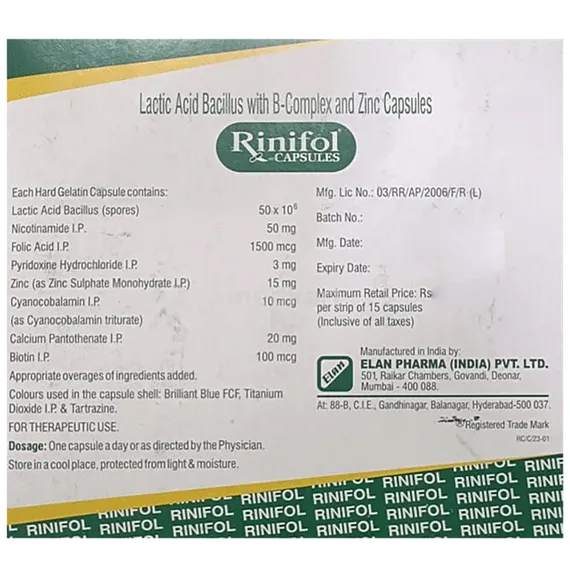
Rinifol capsule is a multivitamin and mineral supplement primarily used to prevent or treat deficiencies of folic acid, B‑complex vitamins, and certain trace elements such as zinc. It is often prescribed in nutritional deficiency states, as an adjunct in some types of anemia related to folate or combined B‑vitamin deficiency, and in conditions where nutritional requirements are increased, such as chronic illness, malabsorption, or poor dietary intake.
Rinifol capsule works by supplying essential vitamins and minerals that participate in key metabolic pathways. Folic acid supports DNA synthesis and normal red blood cell formation. B‑complex vitamins act as coenzymes in energy production, nerve function, and the synthesis of neurotransmitters. Trace elements like zinc contribute to immune function, wound healing, and normal growth. By correcting or preventing deficiencies, Rinifol helps restore normal physiological functions.
Rinifol capsules are generally taken by mouth with water, preferably after food. Taking the capsule after a meal may reduce the likelihood of gastrointestinal discomfort such as nausea or abdominal pain. However, the exact timing and regimen should follow the advice of the prescribing healthcare professional and the instructions provided with the specific product.
Short‑term use of multivitamin preparations like Rinifol is often safe in adults when taken as directed, but long‑term or unsupervised daily use is not recommended. Excessive or prolonged intake of certain vitamins or minerals can lead to imbalances, mask underlying conditions such as vitamin B12 deficiency, or interact with other medicines. It is advisable to consult a doctor or pharmacist before starting or continuing Rinifol for extended periods.
Rinifol capsule is usually well tolerated at recommended doses. Possible side effects are generally mild and may include nausea, abdominal discomfort, bloating, constipation or diarrhea, and a metallic or unusual taste. Rarely, hypersensitivity reactions such as skin rash, itching, swelling, or breathing difficulty may occur in individuals allergic to any component. If severe or persistent side effects develop, the medicine should be stopped and medical advice sought promptly.
Folic acid and many B‑vitamins contained in Rinifol are important for a healthy pregnancy and for reducing the risk of certain fetal neural tube defects. However, the exact composition and strength of Rinifol can vary by brand, and excessive doses of some components may not be appropriate in pregnancy. Therefore, pregnant women should not self‑medicate with Rinifol. Use should only be under medical supervision, with the dose and duration tailored by the obstetrician or treating physician.
Many vitamins and minerals present in Rinifol pass into breast milk and are necessary for both maternal health and infant development. In usual therapeutic doses, such supplements are often considered compatible with breastfeeding. However, because formulations differ and high doses of certain vitamins may not be desirable, breastfeeding women should use Rinifol only on the advice of a healthcare professional, who will weigh the benefits against any potential risks.
Yes, components of Rinifol can interact with some medicines. For example, folic acid may influence the effect of certain antiepileptic drugs, and zinc can affect the absorption of some antibiotics if taken at the same time. High doses of B‑vitamins may also interfere with specific laboratory tests. Patients should inform their doctor and pharmacist about all prescription medicines, over‑the‑counter products, and herbal supplements they are taking so that potential interactions can be assessed and dosing schedules adjusted if necessary.
Patients with kidney or liver impairment should use Rinifol capsule cautiously and only under medical supervision. Some vitamins and minerals are metabolized or excreted through the liver and kidneys, and impaired organ function may alter their handling in the body, potentially leading to accumulation or reduced effectiveness. The doctor may adjust the regimen, limit the duration of therapy, or choose an alternative product based on the severity of organ dysfunction and the patient’s overall clinical status.
The suitability of Rinifol capsule for children depends on the child’s age, body weight, nutritional status, and the specific formulation and strength of the product. Adult‑strength capsules may not be appropriate for younger children. Pediatric use should only be on the recommendation of a pediatrician, who can determine whether a pediatric formulation or a different dosing strategy is more suitable and safe for the child.
If a dose of Rinifol capsule is missed, it can usually be taken as soon as it is remembered, unless it is almost time for the next scheduled dose. In that case, the missed dose should be skipped and the regular dosing schedule resumed. Two doses should not be taken at the same time to make up for a missed dose. If multiple doses are missed or if there is uncertainty about how to proceed, medical advice should be sought.
No, Rinifol capsule cannot replace a balanced and varied diet. It is intended as a supplement to correct or prevent specific vitamin and mineral deficiencies and to support medical treatment in certain conditions. A nutritious diet rich in fruits, vegetables, whole grains, proteins, and healthy fats remains the primary source of essential nutrients. Rinifol should be used as part of a comprehensive approach that includes dietary counseling and lifestyle modification, rather than as a stand‑alone solution.


Proper medicine at big saving rate
Mukesh Jain
•
Reviewed on 24-01-2024

(5/5)
Genuine handling person
Naresh Jangid
•
Reviewed on 30-03-2024
(5/5)
Best
Vishva Ukani
•
Reviewed on 07-01-2024
(5/5)
So good it's give information with medicine
sunil Nayi
•
Reviewed on 21-04-2024
(5/5)
Good place to get your generic medicines.
shreyas potdar
•
Reviewed on 09-04-2024
(5/5)
ELAN PHARMA INDIA PRIVATE LIMITED
Country of Origin -
India
MRP
₹
99.8
₹84.83
15 % OFF
Quick Links

Medkart's sole intention is to ensure that its consumers get information that is expert-reviewed, accurate and trustworthy. However, the information contained herein should NOT be used as a substitute for the advice of a qualified physician. The information provided here is for informational purposes only. This may not cover everything about particular health conditions, medicines, generic alternatives, all possible side effects, drug interactions, warnings, alerts, lab tests, etc. Please consult your doctor and discuss all your queries related to any disease or medicine. We intend to support, not replace, the doctor-patient relationship.
10 Lakh+
Happy customers
35000+
Pin-codes Covered
75 Lakh+
Orders Delivered

Authentic Products
All WHO-GMP Certified Medicines






©2025 Medkart Pharmacy. All Rights Reserved










 10's_1.webp)