
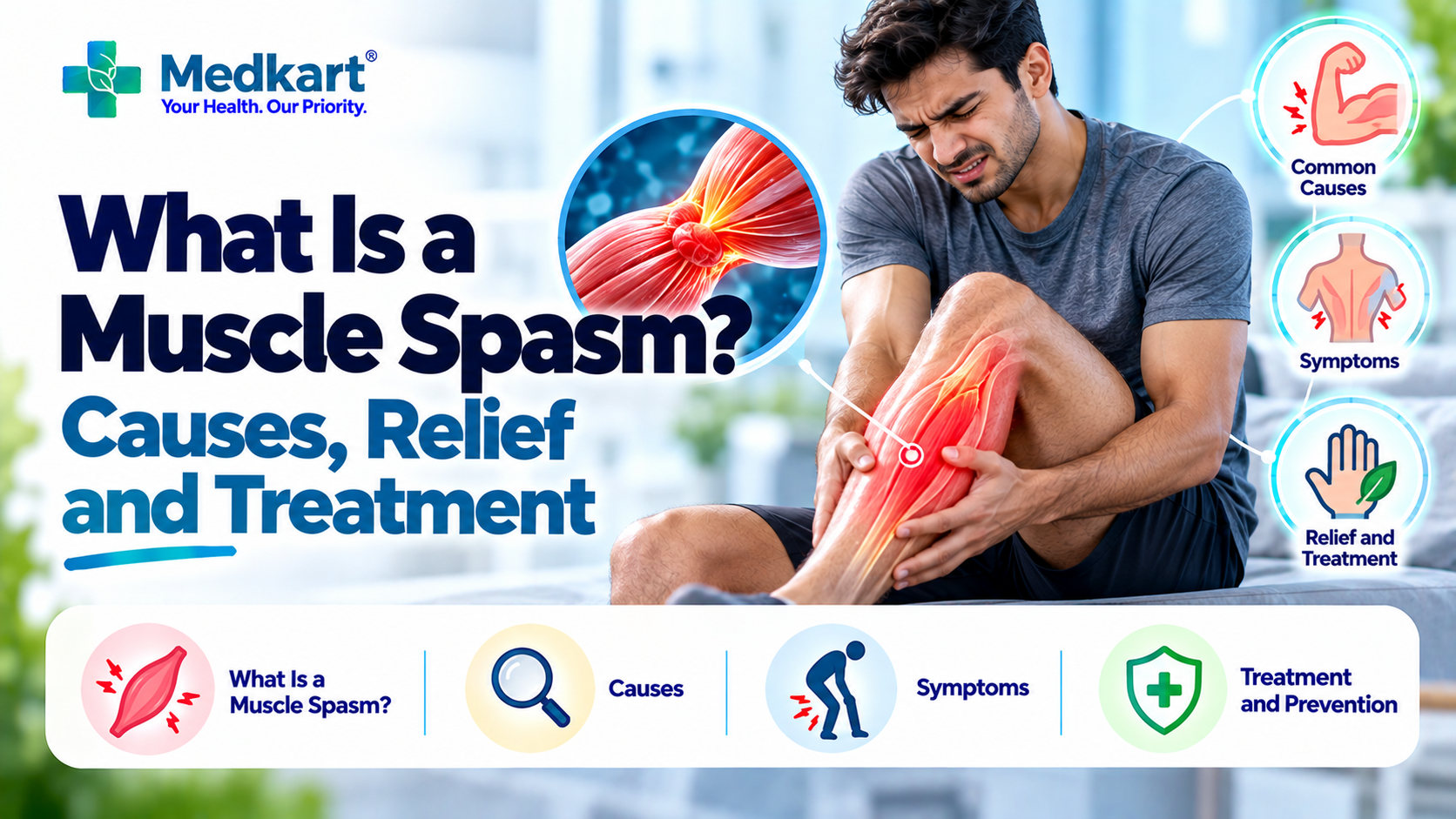
A muscle spasm is a muscle tightening on its own and refusing to let go. It is a symptom rather than a diagnosis, and most episodes pass within a few minutes.
Two things are worth knowing before the rest. The word covers several events that doctors keep apart, and the familiar stretching advice has weaker evidence behind it than its popularity suggests.
What Is a Muscle Spasm, and What Does It Feel Like?
MedlinePlus[1] describes a muscle cramp as a muscle that tightens without the person trying to tighten it, and then does not relax. The American Academy of Neurology[2] calls them involuntary and generally painful contractions of a muscle or muscle group.
| Feature | What the sources say |
| The sensation | The NHS[3] describes a muscle tightening and causing sudden pain that can make movement difficult. |
| Where it is felt | The AAN records that idiopathic cramps are usually most prominent in the lower leg and foot muscles. |
| When it happens | The same review notes that cramps are more evident at night. |
| What follows | The NHS records that the muscle may stay sore for up to 24 hours afterwards. |
| What sets it off | The AAN describes cramps as caused by ectopic discharges from nerves or nerve terminals. |
| What it disturbs | A survey of United States adults[4] links frequent night cramps with difficulty falling asleep and difficulty staying asleep. |
Spasm, Cramp and Spasticity Are Not the Same Thing
The everyday word covers three events the literature separates. The AAN review excluded muscle spasms, dystonia and muscle pains from its analysis, as phenomena not consistent with muscle cramps.
Spasticity is different again. MedlinePlus[5] describes it as stiff or rigid muscles with increased muscle tone, and names stroke, multiple sclerosis and spinal cord injury among its causes.
How Long Does a Muscle Spasm Last?
The NHS gives a range of a few seconds to 10 minutes. Soreness can continue for up to 24 hours after the episode has ended.
That range is also a threshold. The NHS lists cramps lasting longer than 10 minutes among the reasons to see a GP. Duration is one of the few features a person can use without a test.
What Causes Muscle Spasms?
The retrieved causes fall into three groups. The first is the muscle itself, where MedlinePlus names overuse and injury, and the NHS names overexertion in the heat.
The second is the internal environment. MedlinePlus names dehydration and low levels of sodium, potassium and calcium, alongside an underactive thyroid, kidney failure and alcohol use.
The third is circumstance. Both sources name pregnancy, MedlinePlus adds menstruation, and the NHS names ageing, alcohol-related liver disease, and medicines including statins and diuretics.
Often no cause is found. The AAN calls these idiopathic muscle cramps. The survey of United States adults states plainly that the mechanism behind night cramps is poorly understood.
Why Do Muscle Spasms Happen During Exercise?
Exercise cramps are studied separately from the night-time kind. A 2025 cross-sectional study in the Brazilian Journal of Physical Therapy[6] examined 21,460 cyclists entering a South African race.
A history of exercise-associated cramps was reported by 30.5%, and 18.6% had one in the previous year. The quadriceps were affected most often, at 47.7%, followed by the calf at 27.8% and the hamstring at 20.4%.
Its risk factors were not the ones usually named. Reporting a chronic disease raised the prevalence ratio to 1.36, and using medication before or during the event raised it to 1.41.
How Can a Muscle Spasm Be Relieved When It Happens?
The NHS describes stretching and massaging the affected muscle, and standing and putting weight on the leg. MedlinePlus describes stopping the activity and stretching the muscle that has cramped.
Heat and cold are used in sequence rather than together. MedlinePlus describes applying heat at first, then ice once the pain improves.
Painkillers are for afterwards, not during. The NHS is explicit that paracetamol and ibuprofen will not help while a cramp is happening, because they take too long to work. They do help with the soreness that follows.
Also Read: Magnesium glycinate and what it is used for
Do Stretches and Exercises Prevent Muscle Spasms?
Here the sources disagree, and the disagreement is worth stating. The NHS says regular calf-stretching exercises may help to reduce cramps, while adding that they may not stop them completely.
The AAN reached a different conclusion from the same territory. A randomised trial of 191 patients compared calf stretching three times a day against a sham exercise. It found no benefit on cramp frequency or on the number of cramp-free nights.
Its verdict was therefore a non-verdict. The review graded the evidence on calf stretching as insufficient to support or refute it, its Level U rating, and made no recommendation either way.
Neither position says stretching is harmful. What neither offers is a promise that a prevention routine will work, and a reader who has tried one without success is not doing it wrong.
What Treatment Is Available for Spasms That Keep Coming Back?
The first step is finding a cause. MedlinePlus lists blood tests of calcium, potassium and magnesium, along with kidney and thyroid function tests.
Medicines come second and carry real caution. The AAN found quinine derivatives likely effective, its Level A rating, and still advised against routine use because of the potential for toxicity. It reserved them for very disabling cramps, where nothing else has relieved the symptoms and side effects are monitored.
Three other options carry weaker support. Naftidrofuryl, diltiazem and vitamin B complex were rated possibly effective, at Level C, on single studies each. Magnesium preparations and gabapentin were judged probably not effective.
This article gives no amounts for any of them. The NHS notes that a GP may consider quinine tablets where exercise has not helped, with the risks weighed first.
When Should You See a Doctor?
Book an appointment if your cramps disturb your sleep, if they come with numbness or swelling, or if a single episode lasts over 10 minutes. Those are the three the NHS names.
| Situation | What to do |
| Cramps that wake you at night | See a GP. The NHS names sleep disturbance among its reasons to seek advice. |
| Numbness or swelling with the cramps | See a GP. The NHS lists both alongside the cramps themselves. |
| A single episode lasting over 10 minutes | See a GP. This sits outside the range the NHS describes as usual. |
| Back spasm with numbness in both legs | Go to A&E or call 999. The NHS[7] treats this as an emergency. |
| Back spasm with loss of feeling around the genitals or bottom | Go to A&E or call 999. The NHS names it among the same emergency signs. |
| Back spasm with a change in bladder or bowel control | Go to A&E or call 999. The NHS lists it with the others. |
| Spasms after starting a new medicine | Speak to the prescriber rather than stopping it. Statins and diuretics are among those the NHS names. |
What This Article Cannot Tell You
It cannot say why any individual is getting spasms. The same symptom follows from overuse, from mineral levels, from thyroid or kidney problems, from medicines and from nothing identifiable.
It cannot say whether a given pattern is harmless. Frequent cramps were associated with several long-term conditions in the survey of United States adults, and an association is not a cause.
It cannot promise that a prevention routine will work, because the evidence on stretching is rated insufficient.
It also cannot describe the Indian picture. No Indian prevalence figure for muscle cramps could be retrieved, so every number above comes from elsewhere.
Where Can You Buy Pain Relief and Supplements on Medkart?
Medkart sells medicines online and highlights quality credentials for its generic range. Products containing paracetamol and ibuprofen are listed, including Brufen from Abbott, which the NHS describes as useful for the soreness afterwards rather than during.
Among nutritional supplements, Medkart lists mineral products such as magnesium bisglycinate. The AAN review judged magnesium probably not effective for cramps, and that finding stands whatever a product page says. Rehydration options include ORS Powder from Cipla and Electral from FDC.
Nothing here says any of these treats the condition, which is a judgement for the prescriber. Medkart lists these products and does not test or approve them. Availability and price can change. Medkart’s medicine comparison tools can be used to compare listed options on:
- Active ingredient
- Strength
- Dosage form
- Manufacturer
- Pack size
- Current price
It is also possible to search by name, browse the full medicine list, or find the nearest Medkart store.
Key takeaways
- A muscle spasm is a muscle contracting without being told to and not relaxing again.
- The NHS puts the usual length at a few seconds to 10 minutes, with soreness for up to 24 hours.
- Spasm, cramp and spasticity describe different events, and the AAN review kept them apart.
- Named causes include overuse, heat, dehydration, low minerals, thyroid and kidney problems, pregnancy and some medicines.
- Among 21,460 cyclists, 30.5% had a history of exercise-associated cramps, most often in the quadriceps.
- The AAN rated the evidence on calf stretching as insufficient, against NHS advice that it may help.
- Quinine was rated likely effective and still advised against for routine use, because of toxicity.
- Cramps that disturb sleep, come with numbness or swelling, or last over 10 minutes need a GP.
FAQs
Q. Is a muscle twitch the same as a spasm?
They are described separately. The AAN review names cramp-fasciculation syndrome among the conditions commonly associated with cramps, which makes twitching and cramping related rather than identical. A twitch that keeps recurring is worth mentioning to a doctor, because the review lists nerve conditions in that group.
Q. Do mineral supplements stop night cramps?
The evidence retrieved here does not support that. Two trials assessed by the AAN led it to judge magnesium preparations probably not effective. Low mineral levels are still listed by MedlinePlus among the causes of cramps, which is why blood tests come first.
Q. Are frequent cramps a sign of a serious illness?
They can accompany one, without proving it. The survey of United States adults found frequent night cramps to be more common in people reporting high blood pressure, heart failure, stroke, arthritis or cancer. That is an association across a population rather than a finding about any one person.
Q. How common are cramps in older people?
Common enough that the reviews treat it as expected. The AAN cites a study of 365 outpatients aged 65 or over in the United Kingdom, half of whom reported frequent cramps. A review of 515 older veterans found a similar figure, with half of those affected cramping at least weekly.
Q. Why do cramps happen in pregnancy?
The sources record that they do without explaining why. Both MedlinePlus and the NHS list pregnancy among the situations in which cramps occur, and the AAN notes they are frequent in late pregnancy. None of them sets out a mechanism, and the AAN excluded pregnancy cramps from its treatment analysis altogether.
Q. Does drinking more water prevent cramps during sport?
It is widely done and thinly tested. The AAN states that hydration is frequently used by patients, particularly for exercise-associated cramping, and that no formal studies support its use. The 2025 cycling study pointed instead at chronic illness, medication use and recent injury.
References
- https://medlineplus.gov/ency/article/003193.htm
- https://www.aan.com/globals/axon/assets/6900.pdf
- https://www.nhs.uk/conditions/leg-cramps/
- https://pmc.ncbi.nlm.nih.gov/articles/PMC5460850/
- https://medlineplus.gov/ency/article/003297.html
- https://pmc.ncbi.nlm.nih.gov/articles/PMC12771305/
- https://www.nhs.uk/conditions/back-pain/
Medical disclaimer: This article gives general information about muscle spasms and is not a diagnosis. It cannot tell any individual what is causing their spasms, how serious they are, or which treatment suits them, because those decisions need a doctor and the right tests. Anyone with the emergency signs described here should seek immediate care rather than self-treat, and no medicine or supplement should be started, stopped or changed without advice from the prescriber or a qualified pharmacist.
Leave a Reply