
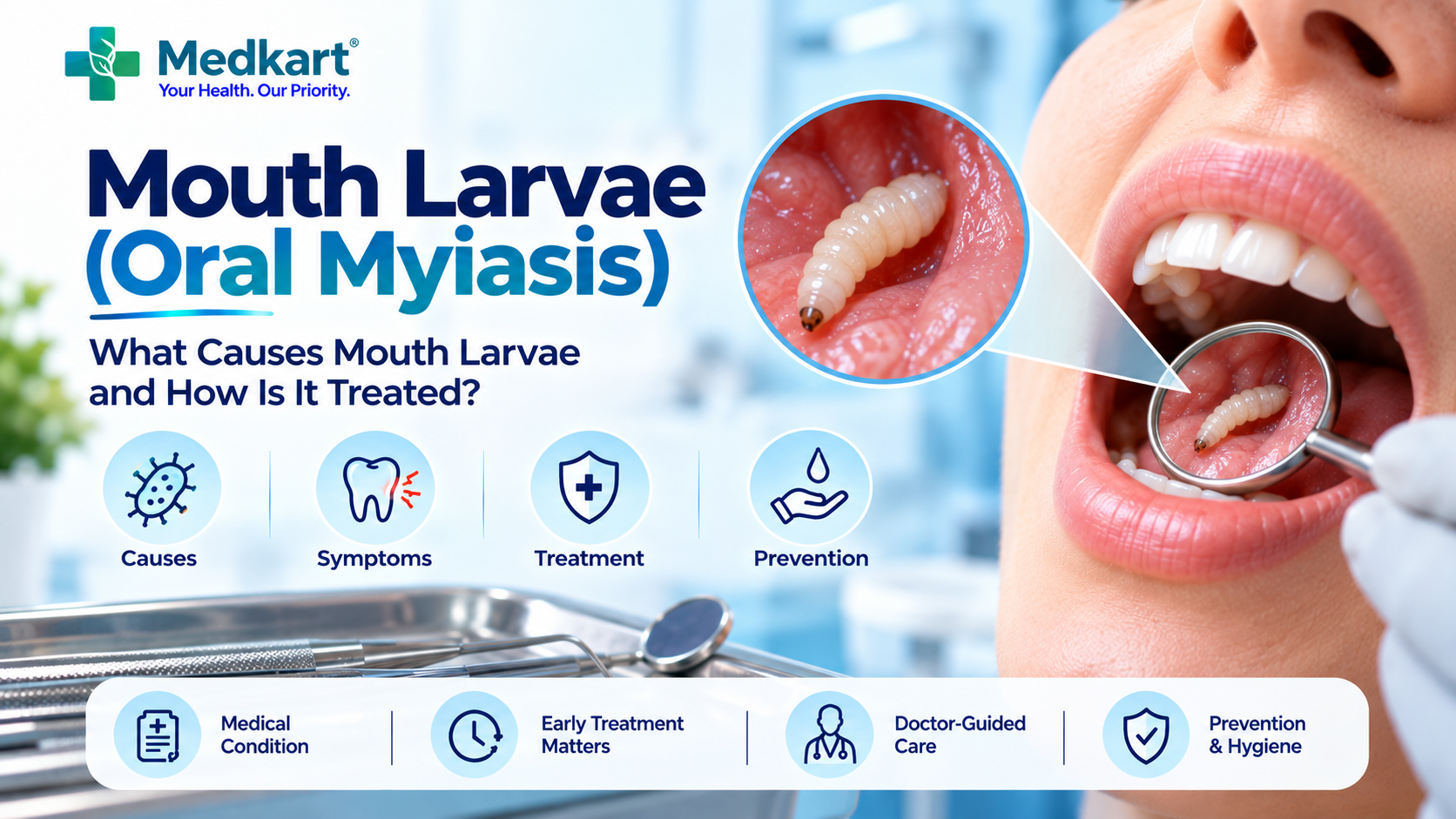
Mouth larvae is the everyday phrase for oral myiasis, an infestation of mouth tissue by fly larvae. It is rare, and India accounts for the largest reported share of cases.
Two things frame the rest of this article. It follows a wound or a mouth that cannot be kept clean, rather than anything a person has eaten. And the sources are counts of individual cases rather than a treatment guideline.
What is oral myiasis, and what do the sources call it?
The United States Centers for Disease Control[1] defines myiasis as infection with the larval stage of various flies. A second page from the same agency[2] calls it a parasitic infection of fly larvae in human tissue.
Oral myiasis is that infestation when it occurs in the mouth. A review of published cases[3] describes it as fly larvae deposited in tissue, and calls involvement of the mouth uncommon.
None of the retrieved sources uses the phrase mouth larvae. The agency pages use myiasis and the dental literature uses oral myiasis, so those are the terms used here.
What are the symptoms of oral myiasis?
The signs below are what the sources associate with the condition. They are not a test anyone can apply to themselves, and several overlap with ordinary dental problems.
| Feature | What the sources say |
| Larvae that can be seen or felt | The agency[4] names feeling or seeing maggots move in a wound or sore, or in the ears, nose, eyes or mouth. |
| A wound that gets worse quickly | It describes painful wounds or sores that worsen within a few days. |
| A foul smell | The same page describes larvae eating live tissue and causing a worsening, often painful and foul-smelling wound. |
| A lump or swelling | The agency[2] records that a lump develops in the tissue as the larva grows. |
| Where in the mouth | Across 157 published cases[3] the gum was affected in 29%, the palate in 25% and the lip in 21%. |
| In children | A review of paediatric cases[5] found the gum of the upper front region and the palate most often involved. |
A systematic review of the Old World screwworm fly[6] describes the disease as aggressive and destructive in its hosts.
Also Read: Mouth ulcer causes and treatment
What causes oral myiasis, and who is at higher risk?
Flies of several species cause it. The agency[1] names the human bot fly, the New World screwworm, the Old World screwworm and the tumbu fly, with other genera involved occasionally.
Infestation begins with eggs. The agency[2] describes flies dropping eggs on wounds or body openings, eggs carried in by biting mosquitoes or ticks, and eggs laid on damp clothing.
Not every species invades healthy tissue. Two genera named on that page lay eggs only in existing festering wounds, while screwworm larvae feed on flesh that is alive.
The risk sits with the wound rather than the mouth. An open wound is named as the risk factor[4], including breaks as small as a scratch, an insect bite or a recent operation.
Who this happens to is consistent across the reviews. The analysis of 157 cases[3] found it predominantly affects people with neurological or locomotor disability, of low socioeconomic status and with poor oral hygiene. Chemical dependence, earlier injuries and an inability to seal the lips appear on the same list. The screwworm review[6] adds old age and underlying disease, and nine reported cases occurred alongside advanced oral cancer[7].
How common is oral myiasis in India?
Rarely, and more often here than almost anywhere else. The analysis of English-language reports from 1990 to 2020[3] covered 157 people, of whom 41% were in India and 29.5% in Brazil.
The same analysis found men made up 67.5% of cases, at an average age of 41.9 years. A separate review of children[5] found 68 cases across 32 studies, aged between two and sixteen.
Under-reporting is likely. The screwworm review[6] summarised 291 human cases since 1909, and noted the fly is recorded in 44 countries while cases come from only 16.
Those are counts of published reports rather than rates. No Indian surveillance figure for oral myiasis was retrieved, so the share above describes the literature and not the population.
How is oral myiasis diagnosed?
The criterion is the larva itself. The agency[1] states that the diagnosis is made by finding fly larvae in tissue. The species is then identified by comparing spiracles, mouthparts and cuticular spines.
Identifying the fly matters, because species differ in whether they invade living tissue.
No blood test appears in any source opened here. The agency[2] advises seeing a healthcare provider for a proper diagnosis.
How is oral myiasis treated?
Removal comes first. The agency[2] describes treatment as surgical removal of the larvae, followed by daily cleaning of the wound while it heals.
Reported practice has varied. The analysis of 157 cases[3] records manual removal and surgical debridement, substances applied to suffocate the larvae, antibiotic treatment and ivermectin. Which of those applies, and in what amount, is decided by a prescriber.
There is no agreed protocol, and the reviewers say so. They call for one to be established, so that studies can be compared and health services offer the same approach.
No national clinical guideline for oral myiasis could be retrieved. What exists is case reports and reviews of them, a thinner evidence base than most conditions of this seriousness carry.
How can oral myiasis be prevented?
Covering wounds is the measure both agency pages name. They advise keeping open wounds clean and covered whatever their size or location[4], along with loose long-sleeved clothing, insect repellent and permethrin-treated clothing[2].
The same page[4] also names sleeping indoors with windows closed or screened.
Oral hygiene is the part specific to the mouth. The review of children[5] concludes that the condition can be prevented by reducing fly numbers, maintaining good hygiene and educating the people at risk.
Access is the harder half. The World Health Organization[8] states that most low and middle income countries lack sufficient services for oral health conditions, and that out-of-pocket costs are a major barrier.
When should you see a doctor?
If you see or feel something moving in your mouth or in a wound, treat it as urgent rather than waiting to see whether it settles.
| Situation | What to do |
| You see or feel larvae in the mouth, a wound or a sore | Contact your healthcare provider immediately, which is the agency’s wording[4]. |
| A mouth sore or wound is worsening over a few days | Get it looked at. Wounds that worsen within a few days are named among the signs[4]. |
| A wound in the mouth smells foul | Get it looked at. A worsening, painful and foul-smelling wound is described on the same page. |
| A lump in the mouth is growing | Get it examined. The agency[2] records a lump developing in tissue as the larva grows. |
| You care for someone who cannot describe symptoms | Check the mouth. The groups most affected include people with neurological or locomotor disability[3]. |
| An open wound anywhere is uncovered | Cover it. Untreated or open wounds are named as the risk factor[2]. |
| Larvae were removed and the wound is not healing | Go back. Daily wound cleaning after removal is part of the described recovery[2]. |
What this article cannot tell you
It cannot say whether anyone reading it has oral myiasis. That answer needs a clinician who can see the mouth, and a larva that can be examined and identified.
It cannot say what treatment suits an individual. No standard protocol exists, and removal is a clinical procedure rather than something done at home.
It cannot offer a timeline or an outcome. The reviews count cases and describe what was done, not how long recovery took for any one person.
It also cannot give an Indian rate. The 41% figure is a share of reported cases, and no population figure was retrieved.
Where can you buy prescribed medicines on Medkart?
Medkart lists no product that removes larvae, and nothing in this article suggests one exists. That part of the treatment happens in a clinic or a hospital.
Medkart sells medicines online, and a prescription medicine needs a valid prescription. Its personal care, elderly care and diabetes care ranges cover everyday needs, and nutritional supplements and health care devices are listed separately.
Nothing here says any of these treats the condition, and Medkart lists these products rather than testing or approving them. Notes on generic medicines, why generics cost less and bioequivalence testing sit on the same blog. Medkart’s medicine comparison tools can be used to compare listed options on:
- Active ingredient
- Strength
- Dosage form
- Manufacturer
- Pack size
- Current price
It is also possible to search by name, browse the full medicine list, or find the nearest Medkart store.
Key takeaways
- Oral myiasis is infestation of mouth tissue by fly larvae, and none of the retrieved sources uses the phrase mouth larvae.
- Across 157 published cases, 41% were in India and 29.5% in Brazil, with men making up 67.5%.
- The gum was the site involved most often, followed by the palate and the lip.
- An open wound is the named risk factor, including a scratch, an insect bite or a recent operation.
- Poor oral hygiene, neurological or locomotor disability and old age recur across the reviews.
- Diagnosis is made by finding the larvae in tissue and identifying the species under a microscope.
- Treatment is surgical removal of the larvae, followed by daily cleaning of the wound.
- No standard treatment protocol exists, and the reviewers of the literature call for one.
FAQs
Q. Can larvae get into a healthy mouth?
The sources point away from that. What they name repeatedly is an existing wound or sore, together with difficulty keeping the mouth clean. Species differ too, and some lay eggs only in decaying tissue.
Q. Is this caused by eating contaminated food?
Nothing retrieved describes it that way. The routes named are eggs laid on wounds and body openings, eggs carried in by biting insects, and eggs picked up from damp clothing. The problem is where the fly lays.
Q. Can the larvae be removed at home?
No source opened here supports doing that. Removal and the cleaning that follows are described as clinical work, and the tissue underneath has usually been damaged.
Q. Does ivermectin cure it?
It appears in the published record as one option among several, not as a settled answer. The review that catalogued treatments lists it beside manual removal, debridement, suffocating substances and antibiotics. No amount or schedule appears in this article, because that is a prescriber’s decision.
Q. Why are so many cases reported from India?
The honest answer is that nobody has measured it properly. The figure describes the share of published case reports, and reporting depends on who writes cases up. Warm climates, fly numbers and gaps in dental care are named as background in the reviews.
Q. Are children affected differently?
The paediatric review found 68 cases in children aged two to sixteen, with the upper front gum and the palate most involved. The risk factors named are the familiar ones, particularly difficulty keeping the mouth clean. A child who cannot explain a symptom depends on somebody else noticing.
Q. Is oral myiasis contagious?
Nothing in the retrieved sources describes person-to-person spread. The fly lays the eggs, so the exposure is environmental rather than passed between people. An untended wound shared by circumstance explains a cluster better than contagion does.
References
- https://www.cdc.gov/dpdx/myiasis/index.html
- https://www.cdc.gov/myiasis/about/index.html
- https://pubmed.ncbi.nlm.nih.gov/33125723/
- https://www.cdc.gov/new-world-screwworm/about/index.html
- https://pubmed.ncbi.nlm.nih.gov/34260982/
- https://pubmed.ncbi.nlm.nih.gov/31618203/
- https://pubmed.ncbi.nlm.nih.gov/31119420/
- https://www.who.int/news-room/fact-sheets/detail/oral-health
Medical disclaimer: This article gives general information about oral myiasis and is not a diagnosis. It cannot tell any individual whether they have it, how severe it is, or which treatment suits them, because those decisions need a doctor and the right examination. Anyone who sees or feels larvae in the mouth or in a wound should get medical help straight away rather than self-treat, and no medicine should be started, stopped or changed without advice from the prescriber or a qualified pharmacist.
Leave a Reply