
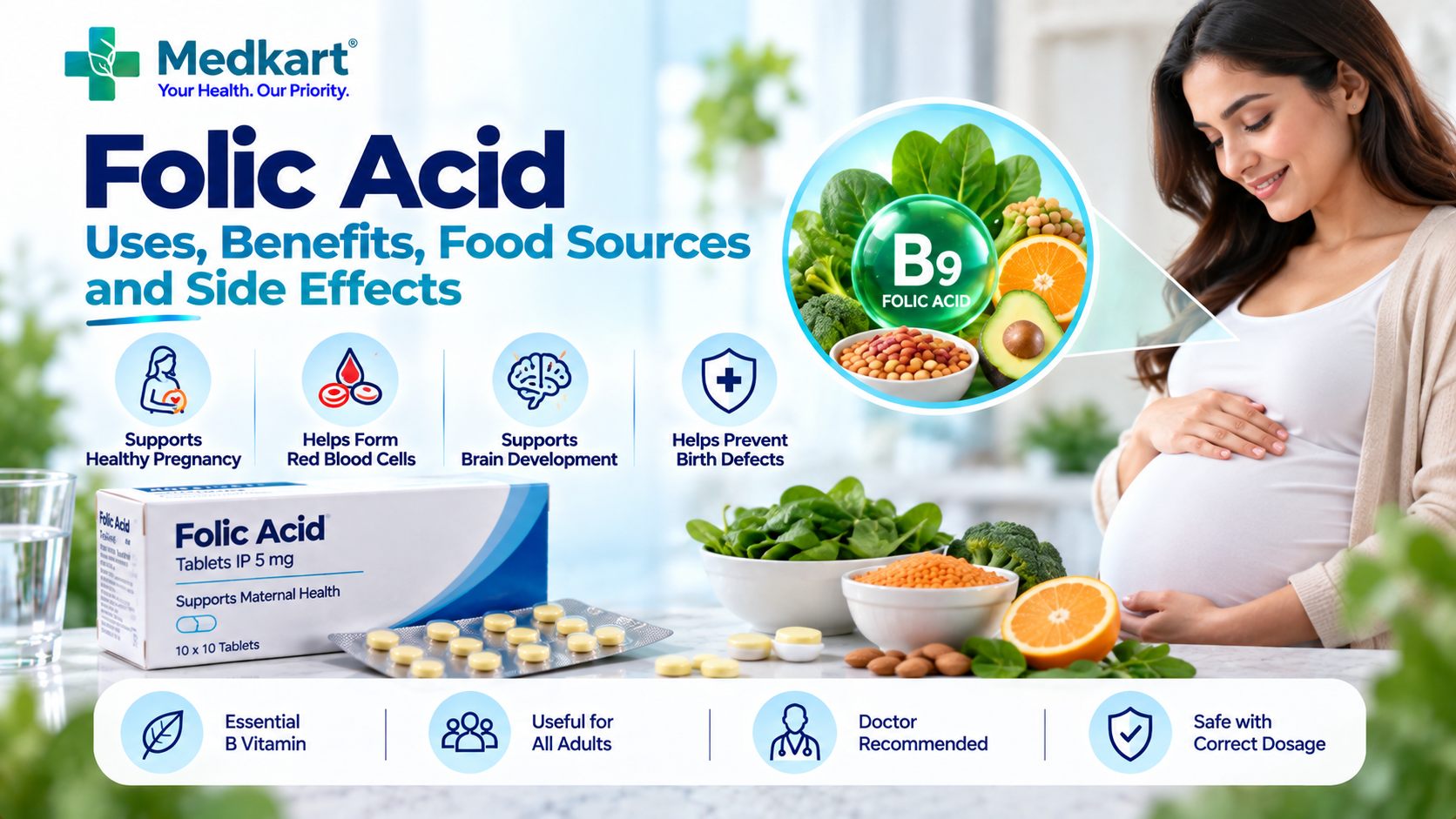
Folic acid is the manufactured form of a B vitamin the body cannot store for long. It is one of the few supplements with a hard timing rule attached, because its most important job is finished before most people know they are pregnant.
Two points shape the rest of this article. The amount that prevents a serious birth defect is small and specific, and the amount that starts causing a different problem is only a little higher.
What is folic acid, and how is it different from folate?
Folate is the form found in food and folic acid is the manufactured form used in supplements and fortified staples. MedlinePlus[1] lists folate, folacin and vitamin B9 among the names for the same vitamin.
The distinction matters on a label rather than on a plate. A tablet and a fortified packet of atta both carry folic acid, while spinach and lentils carry folate.
Neither is stored for long. The NHS[2] records that the body does not keep folate in reserve, so it is needed regularly rather than occasionally.
What does folic acid do in the body?
Two jobs are named consistently. MedlinePlus states that it helps the body make healthy new cells, and the NHS records that folate helps form healthy red blood cells.
The second job is the one behind the pregnancy advice. The NHS states that folate reduces the risk of birth defects called neural tube defects, such as spina bifida, in unborn babies.
Shortage shows up in the blood. The WHO[3] names folate deficiency among the causes of anaemia, alongside deficiencies of iron, vitamin A, vitamin B12 and riboflavin.
Why is folic acid important in pregnancy?
Because the window closes early. The NHS advises 400 micrograms daily for anyone pregnant or trying to conceive, taken until the twelfth week of pregnancy.
Starting before conception is the point. The NHS medicines page[4] states that supplements are ideally begun three months before conception. That is why the advice covers anyone who might become pregnant, not only those who already are.
Some pregnancies need considerably more. The NHS records that women at increased risk are advised 5 mg daily, a strength that is a prescription decision rather than a shelf choice.
What is the recommended daily intake for adults?
For adults generally the NHS gives 200 micrograms a day. That figure is for folate from food and applies outside pregnancy.
Supplements sit under a separate ceiling. The NHS states that doses higher than 1 mg can mask the symptoms of vitamin B12 deficiency. It puts 1 mg or less daily in the range unlikely to cause harm.
The gap between those numbers is smaller than it looks. The everyday requirement is 200 micrograms, the pregnancy supplement is 400 micrograms, and the point of concern begins at 1,000 micrograms.
When and for how long is it taken?
For pregnancy the duration is defined rather than open-ended. The NHS describes the supplement running through the first 12 weeks, having ideally started three months before conception.
Outside pregnancy the length depends on the reason. The NHS medicines page lists folate deficiency anaemia, dialysis and reducing the side effects of methotrexate among the reasons it is prescribed. Each carries its own course length.
Taking it is straightforward. The tablets are swallowed whole with a glass of water, and a missed dose is taken when remembered rather than doubled up at the next one.
Also Read: Diet for breastfeeding mothers
What foods are high in folate?
Green vegetables and pulses carry most of it. The table gives figures from the United States Department of Agriculture database.
| Food | Folate per 100 g |
| Raw spinach | The USDA records 194 micrograms of total folate per 100 g[5]. |
| Cooked lentils | Boiled lentils provide 181 micrograms per 100 g[6]. |
| Cooked chickpeas | Boiled chickpeas, or bengal gram, provide 172 micrograms per 100 g[7]. |
| Other leafy greens | The NHS names cabbage, kale, spring greens and spinach among its folate sources. |
| Other pulses | It also names peas, chickpeas and kidney beans. |
| Brassicas | Broccoli and Brussels sprouts appear on the same NHS list. |
Cooking and portion size both matter. Those figures are per 100 g, and the NHS list is qualitative rather than numerical, so the two describe the same foods in different ways.
Is folic acid added to food in India?
It is, and the amounts are set by regulation. The FSSAI fortification regulations[8] require fortified atta and fortified maida to contain added iron, folic acid and vitamin B12.
The folic acid level is specified. For fortified atta and maida the regulations set 75 to 125 micrograms per kilogram. Iron and vitamin B12 are set in the same table at their own levels.
Rice carries the same folic acid range. The regulations set 75 to 125 micrograms of folic acid per kilogram of fortified rice, with iron at a higher level to account for lower bioavailability.
What are the side effects of folic acid?
Most are digestive and mild. The NHS medicines page names bloating, wind, feeling sick and loss of appetite among the common effects.
Serious reactions are rare. It names anaphylaxis, with a swollen face, throat or tongue, an itchy rash and difficulty breathing, as the reaction needing emergency help.
The most consequential effect is not a symptom at all. Doses above 1 mg can hide the signs of vitamin B12 deficiency, which is why the ceiling exists and why B12 status matters before high-dose folic acid is started.
Who should be careful with folic acid?
The cautions are specific, and several concern other medicines.
| Situation | What the sources say |
| Vitamin B12 deficiency or pernicious anaemia | The NHS lists both among the reasons folic acid may not be suitable. |
| Cancer, unless advised otherwise | Named by the NHS among the situations needing medical advice first. |
| A coronary stent | Also named by the NHS among those situations. |
| Epilepsy medicines | The NHS advises checking with a doctor or pharmacist before combining them. |
| Methotrexate | Folic acid is prescribed alongside it to reduce side effects, which is a decision made by the prescriber. |
| Sulfasalazine, lithium or chloramphenicol | The NHS names these among the medicines to check before starting folic acid. |
| Children under 12 | The NHS states multivitamins containing folic acid are not recommended for this age group. |
Anyone on long-term medicine should take that list to a pharmacist rather than assume a vitamin is neutral.
Where can you buy folic acid on Medkart?
Medkart sells medicines and nutritional supplements online, and lists several folic acid products.
Listed options include Folvite from Wyeth, Fol 5 from Zydus Lifesciences, Foliheal 5 from Healing Pharma and Folcure from USV. Fa 5 from Anthus Pharmaceuticals and Folvite Active from Pfizer are listed as well.
Strengths differ between them, and the higher strengths are the ones a prescriber selects. Nothing here says any of these treats the condition a reader has, and Medkart lists these products rather than testing or approving them. Availability and price can change.
Medkart’s medicine comparison tools can be used to compare listed options on:
- Active ingredient
- Strength
- Dosage form
- Manufacturer
- Pack size
- Current price
It is also possible to search by name, browse the full medicine list, or find the nearest Medkart store.
Key takeaways
- Folate is the form in food and folic acid the manufactured form in supplements and fortified staples.
- The NHS gives 200 micrograms a day as the adult requirement, and the body keeps no long-term reserve.
- Anyone pregnant or trying to conceive is advised 400 micrograms daily until the twelfth week.
- Supplements are ideally started three months before conception, because the protective window is early.
- Women at higher risk are advised 5 mg daily, which is a prescription decision.
- Doses above 1 mg can mask the symptoms of vitamin B12 deficiency.
- Raw spinach carries 194 micrograms of folate per 100 g, cooked lentils 181 and cooked chickpeas 172.
- Indian regulations set 75 to 125 micrograms of folic acid per kilogram of fortified atta, maida and rice.
FAQs
Q. Is folic acid the same as iron and folic acid tablets?
They are not interchangeable. An iron and folic acid tablet carries both, and the combination is used where anaemia is the concern rather than pregnancy alone. The WHO treats iron shortage and folate shortage as separate causes of anaemia, so which one a person needs depends on why their blood count is low.
Q. Can folic acid be taken without being pregnant?
Yes, and several reasons for it have nothing to do with pregnancy. The prescribed uses set out above cover anaemia, dialysis and support alongside methotrexate. The everyday requirement is met from food for most people, so a supplement outside those situations is worth discussing first.
Q. Does cooking destroy folate in vegetables?
The figures in the table above already separate raw from cooked foods, which is a hint that preparation changes the number. No source retrieved for this article quantifies the loss for Indian cooking methods specifically, so the honest position is that the USDA values describe the foods as they were measured.
Q. Is fortified atta enough on its own?
Not for pregnancy, on these numbers. The Indian fortification level is set per kilogram of flour, which delivers a small daily top-up rather than a pregnancy supplement. Fortification and supplementation are doing different jobs.
Q. What happens if too much folic acid is taken?
The concern is concealment rather than poisoning. Above 1 mg daily, folic acid can hide the blood changes that reveal vitamin B12 deficiency, allowing nerve damage to progress unnoticed. That is why the NHS sets its ceiling at 1 mg for supplements taken without medical advice.
Q. Can it be taken alongside other vitamins?
Usually, with two cautions. The age limit noted in the table above applies to children, and anyone already prescribed a folic acid tablet risks doubling up by adding a multivitamin on top. A pharmacist can check the total across everything being taken.
References
- https://medlineplus.gov/folicacid.html
- https://www.nhs.uk/conditions/vitamins-and-minerals/vitamin-b/
- https://www.who.int/news-room/fact-sheets/detail/anaemia
- https://www.nhs.uk/medicines/folic-acid/
- https://fdc.nal.usda.gov/portal-data/external/168462
- https://fdc.nal.usda.gov/portal-data/external/172421
- https://fdc.nal.usda.gov/portal-data/external/173757
- https://www.fssai.gov.in/upload/uploadfiles/files/Compendium_Food_Fortification_Regulations_30_09_2021.pdf
Medical disclaimer: This article gives general information only. It does not replace advice from a doctor, pharmacist or dietitian. Anyone who is pregnant, planning a pregnancy, being treated for anaemia, or taking methotrexate or an epilepsy medicine should get individual advice before starting folic acid, and no medicine or supplement should be started, stopped or changed without advice from the prescriber or a qualified pharmacist.
Leave a Reply