
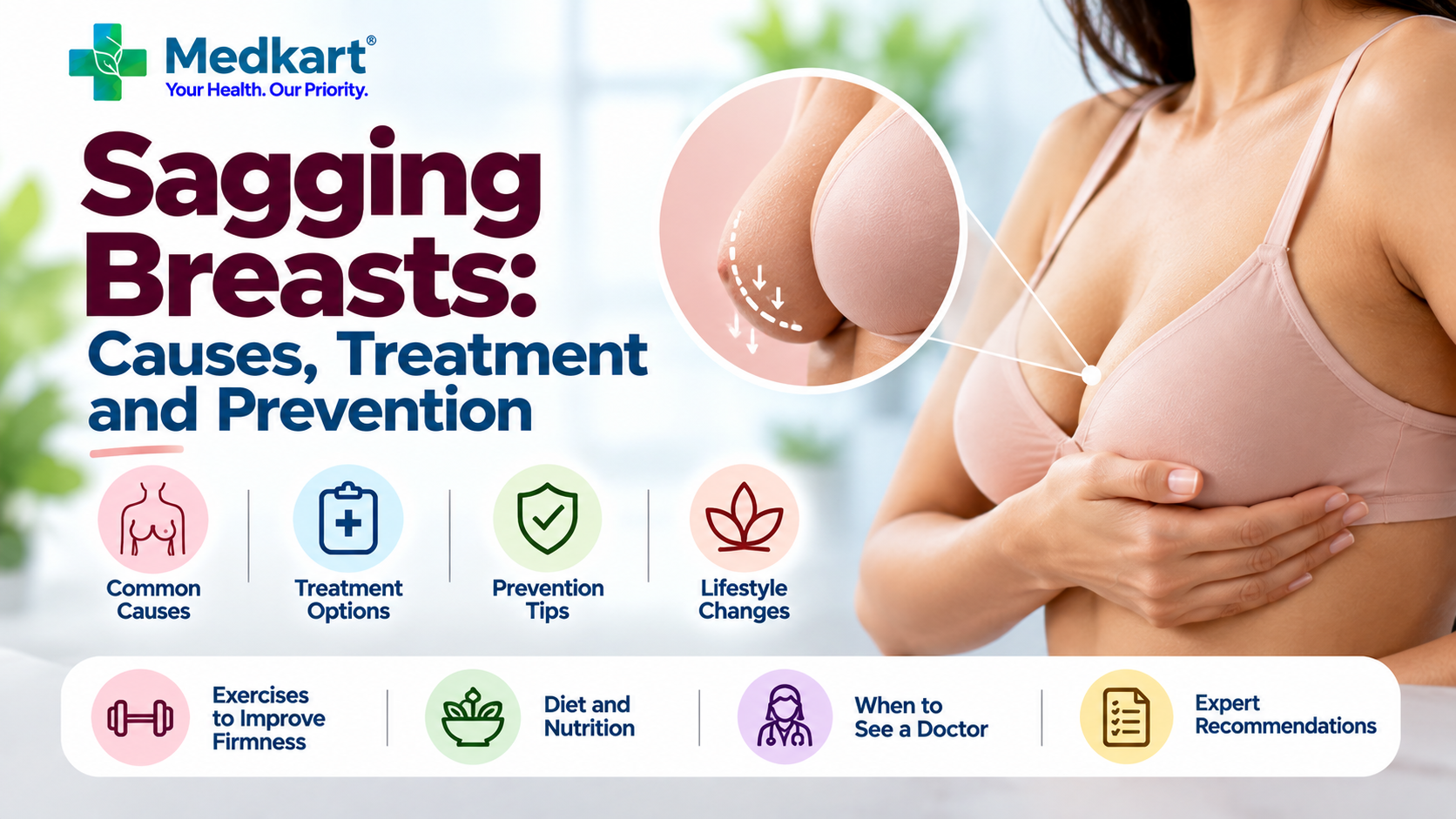
Breast shape changes over a lifetime, and the change surgeons call ptosis is the one most people mean by sagging. It is a normal structural change rather than a disease.
Two findings from the same research group shape this article. Breastfeeding was not a risk factor for sagging, and neither was a lack of regular upper body exercise. Between them they undo most of what circulates on this subject.
What Does Breast Sagging Mean?
Sagging is the everyday word for ptosis, which describes the position of the breast and the nipple relative to the fold beneath the breast. Plastic surgeons grade it from standardised photographs using a published classification[1].
That grading is done in a clinic rather than at home. It exists to plan an operation, and it is not a scale for anyone to measure themselves against in a mirror.
The change itself is common after pregnancy. In a review of 132 women attending for breast surgery, 85% of those who had been pregnant at least once reported a change in breast shape afterwards.
What Causes Breasts to Sag?
The clearest evidence comes from two studies of women attending plastic surgery clinics. The table sets out what they found, and it describes measured associations rather than a checklist for self-assessment.
| Factor | What the Sources Say |
| Age | The 2010 review of 132 women found age a significant independent risk factor for ptosis. |
| Number of pregnancies | The same review found the number of pregnancies significant, and a 2008 study[2] reported that risk rises with each one. |
| Body mass index | Higher body mass index was a significant risk factor in both studies. |
| Large weight loss | A history of losing more than 50 pounds was significant in the 2010 review. |
| Bra cup size | A larger cup size before pregnancy was significant in both studies. |
| Smoking | A history of smoking was a significant independent risk factor in both studies. |
| Breastfeeding | Neither study found breastfeeding to be an independent risk factor. |
Four of those seven are fixed or largely fixed. Smoking and body weight are the two that a person can act on, which is why the prevention section below is shorter than most people expect.
Does Pregnancy Change Breast Shape?
Pregnancy is the event most strongly associated with the change, and the direction is not uniform. In the 2010 review, 35% of women reported that their breasts had become smaller after pregnancy and 30% reported that they had become larger.
The 2008 study puts the pattern plainly. It concludes that the risk of ptosis increases with each pregnancy, so the count matters more than any single pregnancy does.
Also Read: Diet for breastfeeding mothers
Does Breastfeeding Cause Sagging?
This is the claim the research was designed to test, and it did not hold. The 2008 study in the Aesthetic Surgery Journal reviewed 93 women who had been pregnant and were seeking breast surgery, 54 of whom had breastfed.
Breastfeeding was not an independent risk factor for ptosis. Age, body mass index, number of pregnancies, bra size before pregnancy and smoking were, and breastfeeding was not.
The authors say what follows from that. They write that expectant mothers should be reassured that breastfeeding does not appear to have an adverse effect upon breast appearance.
The belief has a cost, which is why it matters. The same paper records that breastfeeding is avoided by many women because of concerns about breast appearance. The World Health Organization[3] recommends exclusive breastfeeding for the first six months, and links it to a reduced risk of ovarian and breast cancer in the mother.
Do Exercises Help with Sagging Breasts?
The one study that tested this found nothing. In the 2010 review, lack of participation in regular upper body exercise was examined alongside the other factors and was not a significant risk factor for ptosis.
That is a single finding in one clinic population, so it is not the last word. What can be said is that the claim about chest exercises has no support in the retrieved evidence, and one direct test against it.
Exercise remains worth doing for other reasons, but not as a way to change breast position.
What Treatment Options Exist?
Surgery is the only treatment described in the retrieved sources. An NHS trust leaflet[4] describes mastopexy as the removal of excess skin from sagging breasts, with the nipple area repositioned higher on the reshaped breast.
Breast reduction is the related operation. The same leaflet describes it as removing breast tissue and skin to form a smaller breast, again with the nipple moved higher.
The scars are permanent and predictable in location. The leaflet describes them around the nipple areola, down the middle of the breast and along the crease underneath it, and notes that they usually fade over time.
The risks are set out alongside. They include loss or reduction of nipple sensation, numbness, wound breakdown, fat necrosis and bleeding that occasionally needs a return to theatre. The leaflet also states that breastfeeding is not usually possible afterwards, because milk ducts are disrupted or lost.
How Can Sagging Be Prevented?
Only two of the risk factors are modifiable, and both appear in the studies above. Smoking is the first, identified as a significant independent risk factor in both.
Weight is the second, and it works in two directions. A higher body mass index was significant in both studies, and a history of losing more than 50 pounds was significant in the 2010 review. Large swings appear to matter as much as the level.
Nothing else in the retrieved evidence prevents it, and no source opened here supports a cream, a supplement, a massage or an exercise for the purpose.
When Should You See a Doctor?
See a GP about any change in the size or shape of one or both breasts, rather than assuming it is only sagging. The NHS[5] lists that change alongside the others below, and notes that most such symptoms have causes other than cancer.
| Situation | What To Do |
| A change in the size or shape of one or both breasts | See a GP. The NHS lists this among the changes to get checked. |
| A lump or swelling in the breast, chest or armpit | See a GP. The NHS names all three sites. |
| Dimpling of the skin, or skin that looks like orange peel | See a GP. The NHS lists this as a skin change to report. |
| A change in the shape of a nipple, or one turning inwards | See a GP. The NHS names inversion and a rash on the nipple. |
| Nipple discharge when not pregnant or breastfeeding | See a GP, particularly if there is blood in it. |
| Considering surgery | Ask the questions the NHS[6] sets out, and expect a cooling-off period after the consultation. |
| Feeling pressured into a procedure | Walk away. The NHS states plainly that you can, if you are not completely comfortable. |
What This Article Cannot Tell You
It cannot say why any individual’s breasts have changed shape. The factors above were measured across groups of women attending surgical clinics, and a group finding does not explain one person.
It cannot tell anyone whether to have surgery. That decision involves scarring, sensation, the effect on future breastfeeding and cost, and it belongs in a consultation rather than in an article.
It cannot promise that anything prevents the change. Two risk factors are modifiable on this evidence, and neither is described in the sources as a guarantee.
It also cannot describe the Indian picture. Both studies were conducted in clinic populations in the United States, and no Indian data on this were retrieved.
Where Can You Buy Quit-Smoking and Everyday Health Products on Medkart?
Medkart lists no product shown to change breast shape, and nothing in this article suggests otherwise. What it does list covers one of the two modifiable risk factors above.
Medkart sells medicines online and lists nicotine replacement products containing nicotine, in a second listed strength as well, including Nicotex from Cipla. Which form suits a person is a question for a pharmacist.
Its personal care and nutritional supplements ranges cover everyday needs, and ayurvedic products are listed separately. Availability and price can change.
Nothing here says any of these treats the condition, and Medkart lists these products rather than testing or approving them. Medkart’s medicine comparison tools can be used to compare listed options on:
- Active ingredient
- Strength
- Dosage form
- Manufacturer
- Pack size
- Current price
It is also possible to search by name, browse the full medicine list, or find the nearest Medkart store.
Key takeaways
- Sagging is the everyday word for ptosis, a change in breast and nipple position that surgeons grade from photographs.
- In a review of 132 women, 85% of those who had been pregnant reported a change in breast shape afterwards.
- Age, number of pregnancies, body mass index, large weight loss, cup size and smoking were significant risk factors.
- Breastfeeding was not an independent risk factor in either study.
- Lack of regular upper body exercise was not a significant risk factor either.
- Smoking and body weight are the two factors a person can act on.
- Mastopexy removes excess skin and repositions the nipple, leaving permanent scars in three places.
- Breastfeeding is not usually possible after that surgery, because milk ducts are disrupted or lost.
FAQs
Q. Does wearing a bra prevent sagging?
No source retrieved for this article tested it. The two studies opened here examined age, pregnancies, weight, cup size, smoking, breastfeeding and upper body exercise, and bra wearing was not among the factors they measured. The question is open rather than answered either way.
Q. Can sagging be reversed without surgery?
Nothing retrieved describes a non-surgical method that changes breast position. The only treatments the sources set out are operations, and the closest thing to prevention is the two modifiable risk factors. Products promising a lift have nothing behind them in the material opened here.
Q. Do creams or oils firm the breasts?
No study opened for this article assessed any topical product for this. Claims of that kind are common and none of them traces to the retrieved evidence. A pharmacist can check what is actually in a product before anyone spends money on it.
Q. Is sagging after weight loss different?
The 2010 review treated large weight loss as its own risk factor, significant at more than 50 pounds lost. That suggests the amount of change matters, not only the weight a person settles at. Anyone planning substantial weight loss can raise the question with the clinician supervising it.
Q. Does the change get worse with each child?
That is what the 2008 study concluded. Each additional pregnancy added to the risk in its analysis, which is why the count appeared as a risk factor while breastfeeding did not. The study cannot say how much change any individual will see.
Q. Is surgery available on the NHS or covered in India?
The retrieved NHS material treats these as cosmetic procedures, with the trust leaflet describing the operation and the NHS advice page setting out how to check a practitioner. No Indian coverage rules were retrieved for this article, so cost and eligibility here need checking locally.
References
- https://pubmed.ncbi.nlm.nih.gov/20354434/
- https://pubmed.ncbi.nlm.nih.gov/19083576/
- https://www.who.int/news-room/fact-sheets/detail/infant-and-young-child-feeding
- https://www.worcsacute.nhs.uk/leaflets/mastopexy-or-breast-reduction/
- https://www.nhs.uk/conditions/breast-cancer/symptoms/
- https://www.nhs.uk/tests-and-treatments/cosmetic-procedures/advice/before-you-have-a-cosmetic-procedure/
Medical disclaimer: This article gives general information about breast shape and is not a diagnosis. It cannot tell any individual why their breasts have changed or whether a change needs investigating, because that needs a doctor and an examination. Any change in the size or shape of a breast should be checked rather than assumed to be sagging, surgery carries permanent consequences that belong in a consultation, and no medicine or supplement should be started, stopped or changed without advice from the prescriber or a qualified pharmacist.
Leave a Reply