
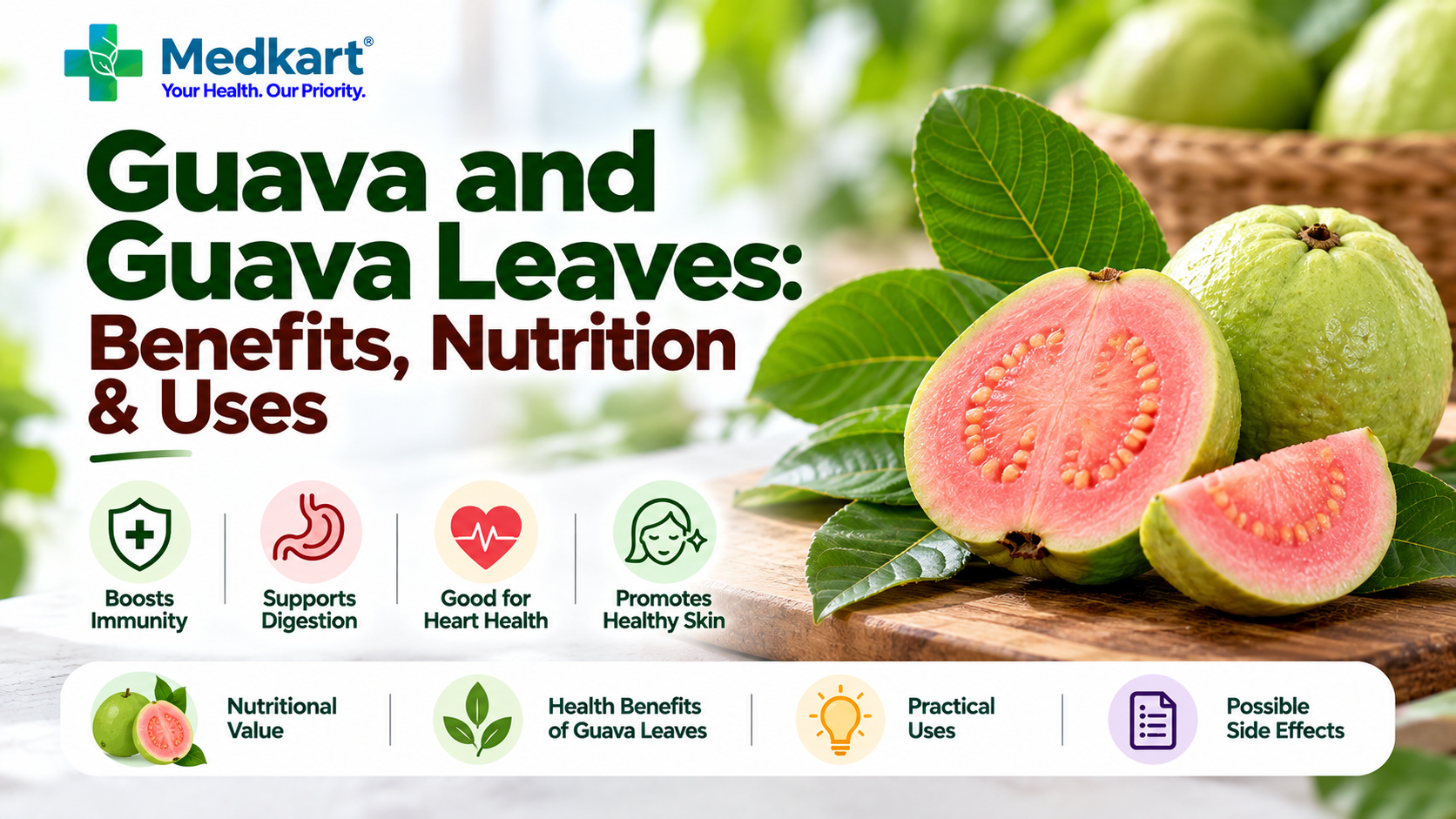
Guava is one of the few fruits where the leaf has been studied almost as closely as the fruit. The two behave differently, and the evidence behind them comes from different places.
Two findings frame what follows. Guava holds more vitamin C per 100 g than most fruits sold in India. In the one Indian trial that compared them, eating guava with the peel and eating it without produced opposite results.
What Is Guava, and Where Does It Grow in India?
Guava is the fruit of Psidium guajava, introduced to India in the seventeenth century. The National Horticulture Board[1] calls it the fourth most important fruit in India after mango, banana and citrus.
It grows almost everywhere. The board names Uttar Pradesh, Bihar, West Bengal, Maharashtra, Chhattisgarh, Tamil Nadu, Karnataka, Madhya Pradesh, Gujarat and Andhra Pradesh among the major producing states.
The season is longer than most people assume. In north India the board records peak harvesting in August for the rainy season crop. The winter crop peaks in November and December, and the spring crop in March and April.
What Is the Nutritional Value of Guava?
Guava is light in energy and unusually heavy in vitamin C and fibre. The United States Department of Agriculture[2] records these figures for raw common guava.
| Nutrient | What 100 g of raw guava provides |
| Energy | Raw guava provides 68 kcal per 100 g. |
| Vitamin C | Vitamin C is 228.3 mg per 100 g. |
| Fibre | Total dietary fibre is 5.4 g per 100 g. |
| Protein | Protein is 2.55 g per 100 g, which is high for a fruit. |
| Carbohydrate | Carbohydrate by difference is 14.32 g per 100 g. |
| Potassium | Potassium is 417 mg per 100 g. |
| Lycopene | Lycopene is 5,204 micrograms per 100 g. |
| Folate | Folate is 49 micrograms per 100 g. |
| Water | Water makes up 80.8 g of every 100 g. |
Two of those figures stand out from the rest of the fruit aisle.
How Much Vitamin C Is in Guava?
The USDA figure is 228.3 mg per 100 g of raw guava. That is several times what most citrus fruit carries.
Fibre sits alongside it at 5.4 g per 100 g. Between them, those two numbers account for most of guava’s reputation.
What Are the Health Benefits of Guava?
The composition is the firm part. Beyond it, one Indian trial has measured what eating guava does.
A 2016 randomised controlled study in the Journal of Clinical and Diagnostic Research[3] gave 45 healthy medical students in India 400 g of guava a day for six weeks. The three groups ate fruit with peel, fruit without peel, or nothing added.
The group eating guava without the peel saw significant falls in total cholesterol, triglycerides and LDL cholesterol. That is the clearest benefit signal in the retrieved evidence.
Also Read: Understanding blood sugar levels
Is Guava Good for Diabetes?
The same trial found the opposite effect from the peel, which is worth knowing before following the common advice to eat it. In the group eating guava with the peel, fasting plasma glucose, total cholesterol and triglycerides all rose significantly.
In the peeled group the fall in fasting glucose was not statistically significant. So on this evidence, peeling changed the direction of the result rather than the size of it.
A separate trial tested a concentrate rather than the fruit. A 2019 double-blind randomised study in Nutrients[4] gave 31 healthy adults a guava fruit extract made by supercritical carbon dioxide extraction. It measured a smaller rise in blood glucose at 30 and 90 minutes after a glucose load.
Its authors are careful about what that means. They note the small number of participants, and state that the effect in people with type 2 diabetes remains unknown.
What Are Guava Leaves Used For?
The leaf has a long traditional use for loose motions, and a small amount of clinical testing behind it. A 2024 systematic review in the Journal of the Science of Food and Agriculture[5] screened the literature and included 23 articles, of which only three were clinical trials.
One of those trials was run in India. A 2020 study in the Journal of Ayurveda and Integrative Medicine[6] treated 109 adults with acute infectious diarrhoea using a decoction of dried Sardar variety leaves.
The preparation was specific. Leaf powder was boiled in 120 ml of water until it reduced to 30 ml, then split into three doses a day for five days. Separate arms used six, ten or fourteen leaves.
The fourteen-leaf arm performed best. Patients regained normalcy in 72 hours against 120 hours in the control group, which received oral rehydration solution, and no adverse events were reported.
Do Guava Leaves Help with Blood Sugar?
This is where the leaf has its strongest file. A 2010 review in Nutrition and Metabolism[7] describes Guava Leaf Tea, a hot water extract of the leaf sold in Japan. It has been approved there as a food for specified health uses and recommended for people with pre-diabetes.
The mechanism was measured rather than assumed. The extract inhibited the enzymes that break down carbohydrate. Its 50% inhibitory concentrations were 0.6 mg/ml for alpha-amylase, 2.1 mg/ml for maltase and 3.6 mg/ml for sucrase.
The human result is modest and real. In normal and pre-diabetic subjects, a single serving of the tea reduced the rise in blood glucose after a carbohydrate load. It cut the area under the glucose curve by about 20%.
The review also reports the safety testing. It records no acute or chronic toxicity in rats, no genotoxicity, and no side effects during human trials lasting eight to twelve weeks.
When Is the Best Time to Eat Guava?
No source retrieved for this article sets one. The trial above fed guava daily for six weeks without specifying a time of day.
What the sources establish is the mealtime logic for the leaf. The tea was tested against a carbohydrate load, so its effect is tied to eating rather than to the clock.
For the fruit, the question has not been studied. Advice about eating guava at a particular hour comes from outside the retrieved evidence.
What Are the Side Effects, and Who Should Be Careful?
No retrieved source reports serious harm from eating ripe guava as a food. The cautions concern the peel, the leaf preparations and anyone whose blood glucose is being managed with medicine.
| Situation | What To Do |
| Managing diabetes with medicine | Discuss guava and any leaf preparation with the prescriber. Both the tea and the extract lowered measured blood glucose. |
| Eating guava with the peel | Raise it with a dietitian if lipids or glucose are being monitored. The Indian trial found rises in all three markers in the peel group. |
| Using guava leaf for loose motions | Treat rehydration as the priority. Oral rehydration solution was what the control group received in that trial. |
| Diarrhoea in a child, or lasting more than a few days | See a doctor. The trial above enrolled adults aged 18 to 60 only. |
| Expecting leaf preparations to be standardised | Check with a pharmacist. The reviewed clinical evidence for the leaf runs to three trials in total. |
Nothing retrieved here describes guava or its leaves as a treatment for any diagnosed condition.
Where Can You Buy Supplements and Medicines on Medkart?
Guava is a grocery item rather than a pharmacy one, and Medkart does not list it. Medkart sells medicines and nutritional supplements that cover some of the same ground.
Vitamin C is the obvious overlap, and Medkart lists products such as Limcee from Abbott. For the rehydration that the diarrhoea trial used as its comparator, listed options include ORS Powder from Cipla and Electral from FDC.
A fruit is not a substitute for a prescribed medicine such as metformin, sold as Glycomet among other brands. Medkart lists ayurvedic products as a separate category.
Nothing here says any of these treats the condition, and Medkart lists these products rather than testing or approving them. Availability and price can change. Medkart’s medicine comparison tools can be used to compare listed options on:
- Active ingredient
- Strength
- Dosage form
- Manufacturer
- Pack size
- Current price
It is also possible to search by name, browse the full medicine list, or find the nearest Medkart store.
Key takeaways
- Guava is the fourth most important fruit in India after mango, banana and citrus.
- Raw guava provides 228.3 mg of vitamin C and 5.4 g of fibre per 100 g, at 68 kcal.
- Protein is 2.55 g per 100 g, which is high for a fruit.
- In a six-week Indian trial, peeled guava lowered cholesterol, triglycerides and LDL significantly.
- In the same trial, guava eaten with the peel raised fasting glucose, cholesterol and triglycerides.
- Guava Leaf Tea cut the area under the glucose curve by about 20% after a carbohydrate load.
- A leaf decoction shortened acute diarrhoea to 72 hours against 120 hours on rehydration alone.
- A 2024 systematic review found only three clinical trials of guava preparations for diarrhoea.
FAQs
Q. Should guava be eaten with or without the peel?
The one trial that compared them favoured peeling, which reverses the usual advice. Over six weeks the peeled group improved on three lipid markers while the unpeeled group worsened on three markers. That is a single study in 45 young adults, so it is a reason to ask a dietitian rather than a settled rule.
Q. Can guava leaf tea replace a diabetes medicine?
Nothing retrieved supports that. The Japanese product carries a health-use approval for people with pre-diabetes, not for treating diagnosed diabetes. Its measured effect was on the rise in glucose after a meal rather than on long-term control. Any change to prescribed treatment belongs with the prescriber.
Q. How many guavas is 400 g?
The trial weighed the fruit rather than counting it, which is worth noting because guava size varies widely between varieties. A figure in grams is therefore more useful than a number of fruits. That amount was a research portion for six weeks rather than a daily recommendation.
Q. Are guava leaves safe to take every day?
The safety testing that exists covers a specific product. The 2010 review reports no toxicity in animal testing and no side effects in human trials of eight to twelve weeks, for a standardised hot water extract. Leaves picked and brewed at home are not that product, and no retrieved source tests them for daily long-term use.
Q. Is guava good for weight loss?
No trial retrieved for this article measured that. What is established is the composition, which pairs a low energy figure with a high fibre one for a sweet fruit. Whether it affects weight depends on the rest of the diet, which no study opened here examined.
Q. Does guava cause constipation?
Nothing retrieved for this article reports it. The diarrhoea trial specifically recorded that no constipation was observed in any group taking the leaf decoction. The fibre content of the fruit works in the opposite direction.
References
- https://nhb.gov.in/report_files/guava/GUAVA.htm
- https://fdc.nal.usda.gov/portal-data/external/173044
- https://pmc.ncbi.nlm.nih.gov/articles/PMC5071920/
- https://pmc.ncbi.nlm.nih.gov/articles/PMC6683095/
- https://pubmed.ncbi.nlm.nih.gov/38578668/
- https://pmc.ncbi.nlm.nih.gov/articles/PMC7329711/
- https://pmc.ncbi.nlm.nih.gov/articles/PMC2831039/
Medical disclaimer: This article gives general information only. It does not replace advice from a doctor, pharmacist or dietitian. Anyone managing diabetes should get individual advice before adding guava or a guava leaf preparation to their diet, diarrhoea that is severe or prolonged needs medical care rather than a home preparation, and no medicine or supplement should be started, stopped or changed without advice from the prescriber or a qualified pharmacist.
Leave a Reply