
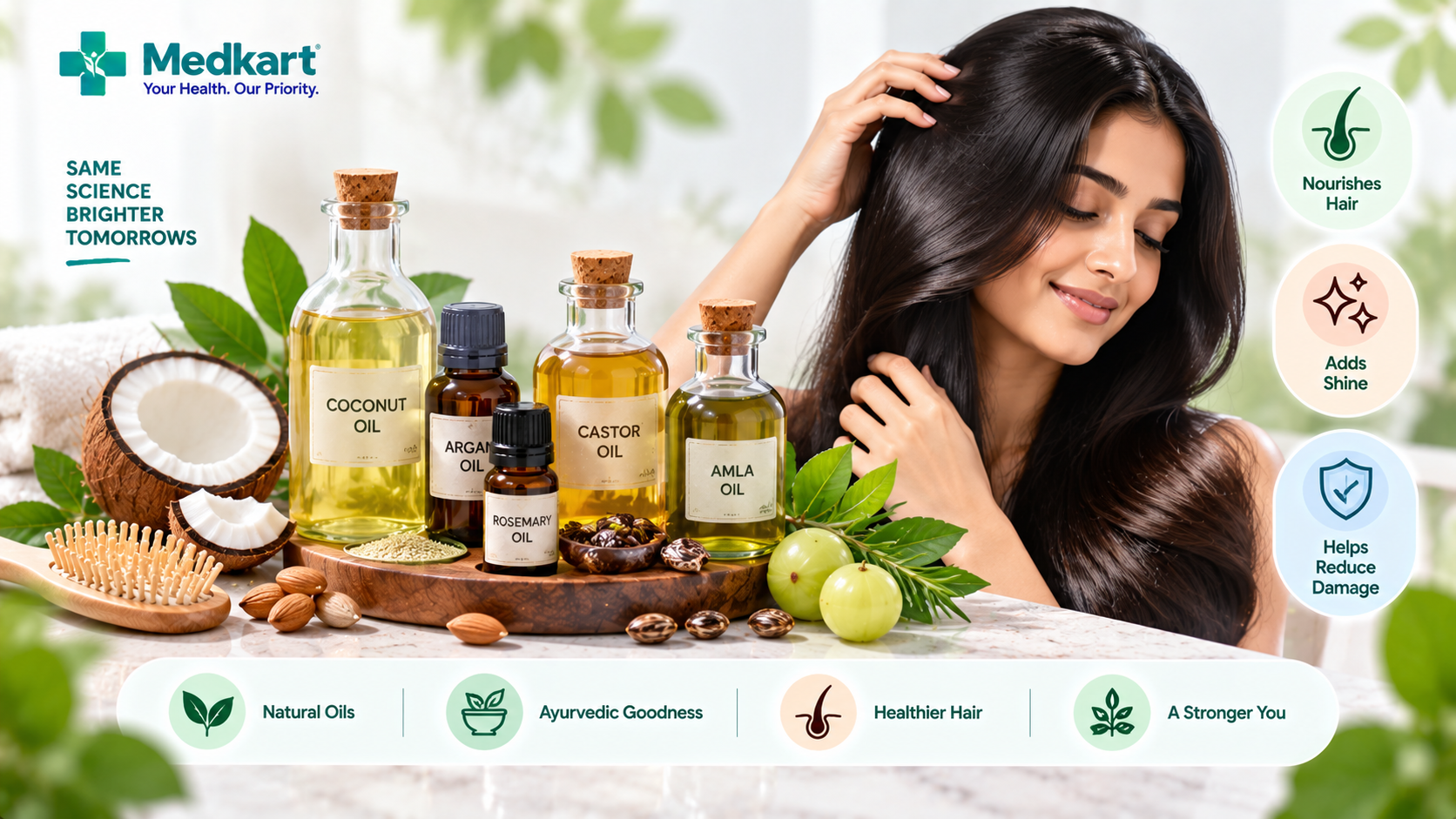
Oiling hair is one of the few grooming habits almost every Indian household already has. What most of us never got told is which oil does what, or why the order of the steps matters.
This guide covers fifteen oils, with the steps for each, what it is actually good for, and the one thing about it worth knowing before you start.
What this article covers
- Coconut oil
- Sesame oil
- Mustard oil
- Almond oil
- Castor oil
- Olive oil
- Argan oil
- Jojoba oil
- Sunflower oil
- Bhringraj oil
- Amla oil
- Brahmi oil
- Onion oil
- Rosemary oil
- Tea tree oil
The first nine are plain oils you can buy as a single ingredient. The next four are herbal oils, made by infusing a herb into a base. The last two are essential oils, which are used differently and never neat.
Why does oiling help hair?
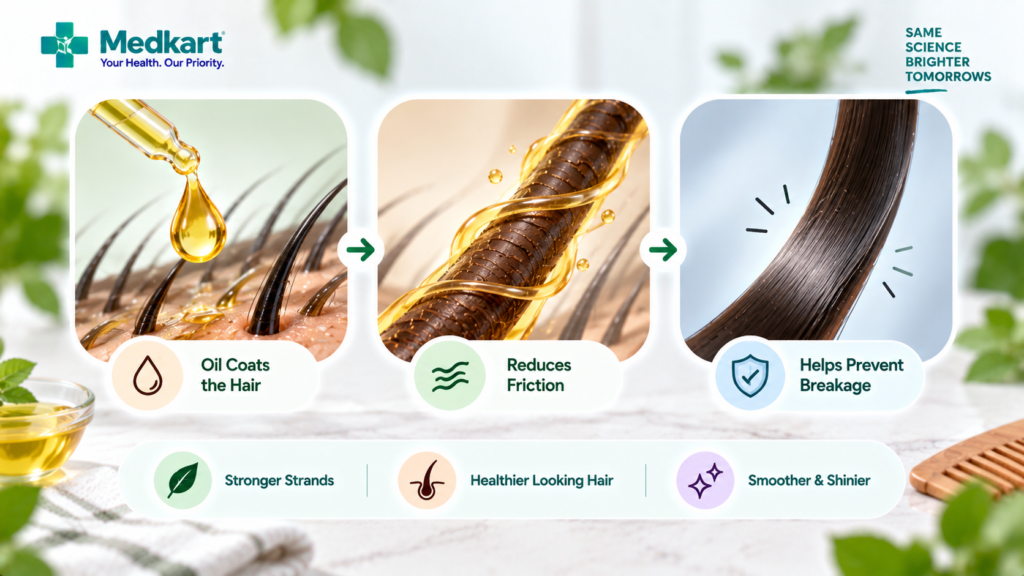
Hair is dead protein once it leaves the follicle, so nothing you put on it repairs it. What oil does is sit on and inside the shaft, reduce friction, and cut the damage that washing and combing cause.
One oil does measurably more than the others. A 2021 review in the Indian Journal of Plastic Surgery[1] reports that coconut oil was the only oil that reduced protein loss. That held for both damaged and undamaged hair, used before and after washing. Mineral oil and sunflower oil did not.
The reason is chemistry. The same review credits lauric acid, which has a high affinity for hair protein and a low enough molecular weight to penetrate to the cortex. Bulkier oils stay on the surface.
What does hair oil do for hair growth?
It protects the hair you already have rather than speeding up new growth. Growth happens at the follicle, below the skin, and an oil sitting on the shaft does not reach it.
What oiling changes is how much of that growth you keep. Cutting breakage means more length stays on your head instead of collecting in the comb.
So a hair growth routine is really a protective one. Oil before you wash, handle wet hair gently, comb from the ends upwards, and change one thing at a time so you know what made the difference.
Which hair oil should you choose?
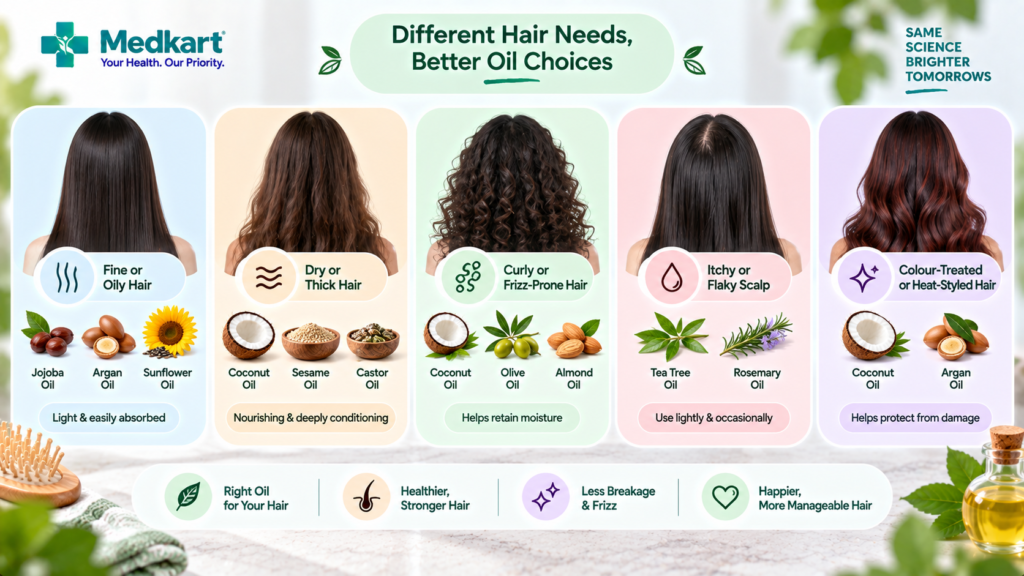
Match the oil to your hair rather than to the label on the bottle.
| If your hair is | What tends to suit it |
| Fine or quick to go oily | Lighter oils that absorb rather than sit: jojoba, argan, sunflower. A few drops on the mid-lengths and ends, not the scalp. |
| Thick, coarse or dry | Heavier oils hold up better: coconut, sesame, or castor thinned into a lighter oil. |
| Curly or frizz-prone | Any of the plain oils, applied to damp hair on the mid-lengths and ends, to seal water in before it escapes. |
| Itchy or flaking at the scalp | Keep oil light and occasional. Heavy oil on an already irritated scalp usually makes it worse, and a scalp that stays sore needs a doctor. |
| Colour-treated or heat-styled | Coconut oil before washing, since that is where the protein-loss benefit was measured. |
| Prone to matting or tangling | Do not leave neat virgin oil on for hours. The same review names plica polonica, a hair matting condition, as a risk of applying virgin oil directly. |
Before you start
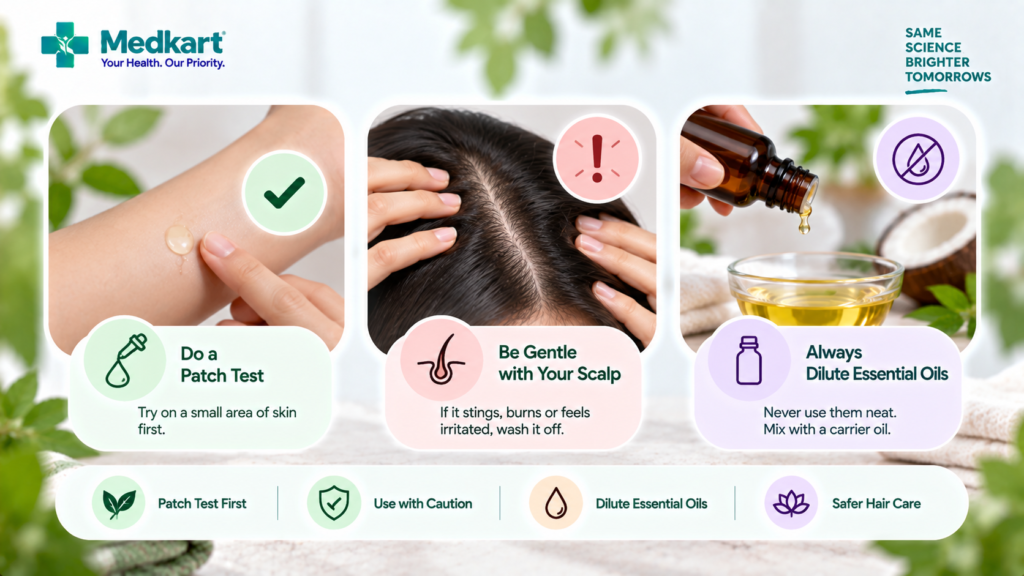
Try any new oil on a small patch of inner forearm first and leave it for a day. If the skin reacts, do not put it on your scalp.
Wash off anything that stings, burns or reddens the scalp. That is not the oil working.
Two cautions apply throughout. Almond oil is a nut product, so skip it entirely if you have a nut allergy rather than patch-testing it. And the two essential oils at the end of the list are never used neat. A 2025 review in Skin Appendage Disorders[2] records allergic contact dermatitis and scalp irritation among reactions reported to topical herbal preparations.
The Oils – 15 Types
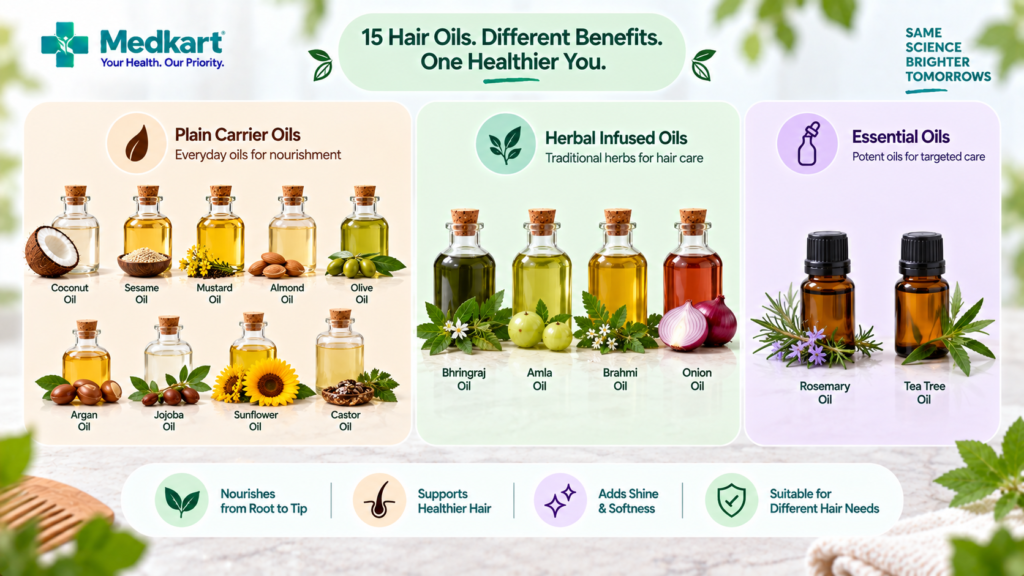
1. Coconut oil
Coconut oil is pressed from kernel and turns solid below about 24 degrees. It is the oil most Indian kitchens already have.
How to use it
- Warm two to three tablespoons between your palms until it runs clear.
- Part your hair and work it into the scalp for two or three minutes.
- Draw whatever is left down through the mid-lengths and ends.
- Leave it 30 minutes to an hour, then wash out with shampoo.
Benefits
- The one common oil measured to cut protein loss from washing
- Costs very little and is sold in every shop
- Doubles as a body and cuticle oil
Good to know: Use it before you wash, not only after. The protein-loss finding covers both, and pre-wash is the half most people skip.
2. Sesame oil
Sesame oil, or til oil, is pressed from sesame seeds. It is the traditional oil for a warm head massage in most of India.
How to use it
- Warm two tablespoons until comfortably warm, never hot.
- Massage into the scalp in slow circles for five minutes.
- Work the rest through to the ends and leave for an hour, or overnight if your hair is very dry.
- Wash out with shampoo. It takes two rounds.
Benefits
- Heavier and more warming than coconut oil in winter
- Cheap and available everywhere in India
- Good slip for a proper massage
Good to know: Buy plain sesame oil, not the dark toasted kind used for cooking. Toasted oil has a strong smell that clings to hair for days.
3. Mustard oil
Mustard oil, or sarson ka tel, is pressed from mustard seeds and has a sharp, unmistakable smell.
How to use it
- Warm one to two tablespoons.
- Work it into the scalp and hair, using less than you would coconut oil.
- Leave for 30 to 45 minutes.
- Wash out thoroughly. The smell needs shampoo, not just water.
Benefits
- Very inexpensive and widely stocked
- Thicker than most oils, so a little covers a lot
- Warms the scalp noticeably in cold weather
Good to know: The smell is the main reason people give up on it. Mixing it half and half with coconut oil keeps most of the feel and loses some of the pungency.
4. Almond oil
Sweet almond oil is pressed from almonds and is light, mild and almost odourless.
How to use it
- Warm a tablespoon between your palms.
- Massage into the scalp, or use a few drops on the ends alone if your hair is fine.
- Leave for 30 minutes to an hour.
- Wash out as usual.
Benefits
- Light enough for fine hair that heavier oils weigh down
- Mild smell that does not compete with anything
- Sold in every chemist in India
Good to know: This is a nut product. If you have a nut allergy, do not use it and do not patch-test it. Jojoba or sunflower oil does the same job without the risk.
5. Castor oil
Castor oil is pressed from castor seeds and is far thicker than any other oil here. It pours like syrup.
How to use it
- Mix one part castor oil into three or four parts coconut, sesame or almond oil.
- Warm the blend and work it into the scalp and ends.
- Leave for 30 minutes to an hour.
- Wash out with shampoo, twice if needed.
Benefits
- Acts as a moisturiser and coats the shaft heavily
- A small bottle lasts a very long time once diluted
- Adds noticeable weight and shine to fine, flyaway hair
Good to know: Never use it neat. Undiluted castor oil is difficult to wash out and is the oil most often behind a matted, tangled mess the next morning.
6. Olive oil
Olive oil is the same bottle you cook with, pressed from olives. It is medium weight and slightly green.
How to use it
- Warm two tablespoons.
- Apply mostly to the mid-lengths and ends, going light at the roots.
- Leave for 30 minutes.
- Wash out with shampoo.
Benefits
- Already in the kitchen, so nothing to buy
- Heavier than sunflower, lighter than castor
- Rinses out more easily than most thick oils
Good to know: Olive oil sits on the surface rather than penetrating, so it conditions the outside of the hair without doing what coconut oil does inside it.
Also Read: Mahabringraj Oil: The Natural Solution for Healthy Hair Growth
7. Argan oil
Argan oil is pressed from the kernels of a Moroccan tree. It is light, quick to absorb and sold in small bottles.
How to use it
- Put two or three drops on your fingertips.
- Rub your palms together and smooth it over damp mid-lengths and ends.
- Leave it in. There is nothing to wash out.
Benefits
- Absorbs fast enough to use on hair you are about to leave the house with
- Almost no smell
- A 30 ml bottle lasts months at three drops a time
Good to know: The 2021 review notes argan oil contains antioxidants but lacks scientific evidence for its conditioning claims. It is pleasant and convenient; the marketing runs ahead of the data.
8. Jojoba oil
Jojoba is technically a liquid wax, pressed from the seeds of a desert shrub. It feels closer to the scalp’s own oil than anything else here.
How to use it
- Warm three or four drops in your palm.
- Work into the scalp if it feels tight, or through the ends if they feel rough.
- Leave it in, or wash out after an hour if you prefer.
Benefits
- Light enough for oily hair and fine hair
- Keeps far longer than seed oils without turning
- Thins out heavier oils that feel like too much alone
Good to know: Because it is a wax rather than an oil, an open bottle is still fine a year later. Almond and sunflower oil are not.
9. Sunflower oil
Plain sunflower oil, pressed from the seeds. It is one of the lightest cooking oils and very cheap.
How to use it
- Warm a tablespoon.
- Apply to the scalp and hair, or use it as the base you dilute castor oil into.
- Leave for 30 minutes.
- Wash out with shampoo.
Benefits
- Extremely cheap and in most kitchens
- Light and easy to wash out
- Useful as a carrier for heavier oils and essential oils
Good to know: The 2021 review found sunflower oil did not reduce protein loss, and put that down to its bulky molecular structure. It conditions the surface but does not get inside the shaft.
10. Bhringraj oil
Bhringraj oil is made by infusing the herb Eclipta alba into a base oil, usually coconut or sesame. It is dark green and smells strongly herbal.
How to use it
- Warm two tablespoons.
- Section your hair and apply along the scalp, then through the lengths.
- Massage for five minutes and leave for at least an hour.
- Wash out with shampoo.
Benefits
- The classic Ayurvedic hair oil, easy to find in any Indian shop
- Comes ready-blended, so nothing to mix
- Strong herbal smell that some people genuinely like
Good to know: What you are buying is mostly the base oil. Check whether the base is coconut or a mineral oil, because that changes how it behaves more than the herb does.
11. Amla oil
Amla oil is Indian gooseberry infused into a base oil. It is one of the oldest hair preparations in India and usually comes dark and thick.
How to use it
- Warm one to two tablespoons.
- Work it into the scalp and along the hair.
- Leave for an hour, or overnight with a towel on the pillow.
- Wash out with shampoo.
Benefits
- Widely sold and inexpensive
- Heavier feel that suits coarse hair
- Traditional choice for a weekly oiling routine
Good to know: Many commercial amla oils are mineral oil with amla extract and colour added. Mineral oil does not penetrate hair, so read the base before you judge the oil.
12. Brahmi oil
Brahmi oil infuses Bacopa monnieri into a base oil. It is usually lighter than bhringraj and less strongly scented.
How to use it
- Warm a tablespoon or two.
- Apply to the scalp with fingertips and massage for a few minutes.
- Leave for 45 minutes to an hour.
- Wash out as usual.
Benefits
- Lighter than most Ayurvedic oils, so easier on fine hair
- Milder smell than bhringraj or mustard
- Often sold blended with bhringraj and amla in one bottle
Good to know: Brahmi is sometimes confused with gotu kola, a different plant sold under similar names. Check for Bacopa monnieri on the label if it matters to you.
13. Onion oil
Onion oil is red onion extract carried in a base oil. It became popular in India in the last few years and is now sold everywhere.
How to use it
- Apply one to two tablespoons to the scalp with an applicator bottle or fingertips.
- Massage for three to five minutes.
- Leave for 30 minutes to an hour, no longer.
- Wash out with shampoo. It usually takes two rounds.
Benefits
- Comes ready-made, so no chopping or straining
- Light enough for most hair types
- Widely stocked and often blended with amla or bhringraj
Good to know: The smell is the honest drawback. The 2025 review lists unpleasant odour as the main reported problem with onion preparations, and the reason people stop using them.
14. Rosemary oil
Rosemary oil is an essential oil, steam-distilled from the herb. It is highly concentrated and is never applied neat.
How to use it
- Add three to five drops to one tablespoon of coconut, jojoba or sunflower oil.
- Stir, then work the blend into the scalp only.
- Leave for 30 minutes.
- Wash out with shampoo.
Benefits
- A few drops go a long way, so one bottle lasts
- Sharp, clean smell that most people prefer to herbal oils
- Mixes into any plain oil you already own
Good to know: Neat essential oil on the scalp can cause a reaction even in people who tolerate it diluted. Dilute it every time, and keep it away from your eyes.
15. Tea tree oil
Tea tree oil is an essential oil distilled from the leaves of an Australian shrub. Like rosemary, it is used in drops rather than spoonfuls.
How to use it
- Add two to three drops to one tablespoon of a carrier oil.
- Apply to the scalp, not through the lengths.
- Leave for 20 to 30 minutes.
- Wash out with shampoo.
Benefits
- Very small quantities needed, so a bottle lasts months
- Distinct medicinal smell that fades after washing
- Blends into any of the plain oils above
Good to know: Tea tree oil is not put on the scalp neat under any circumstances. If the scalp is already broken, sore or weeping, leave it alone entirely and see a doctor.
What to expect, and how long it takes
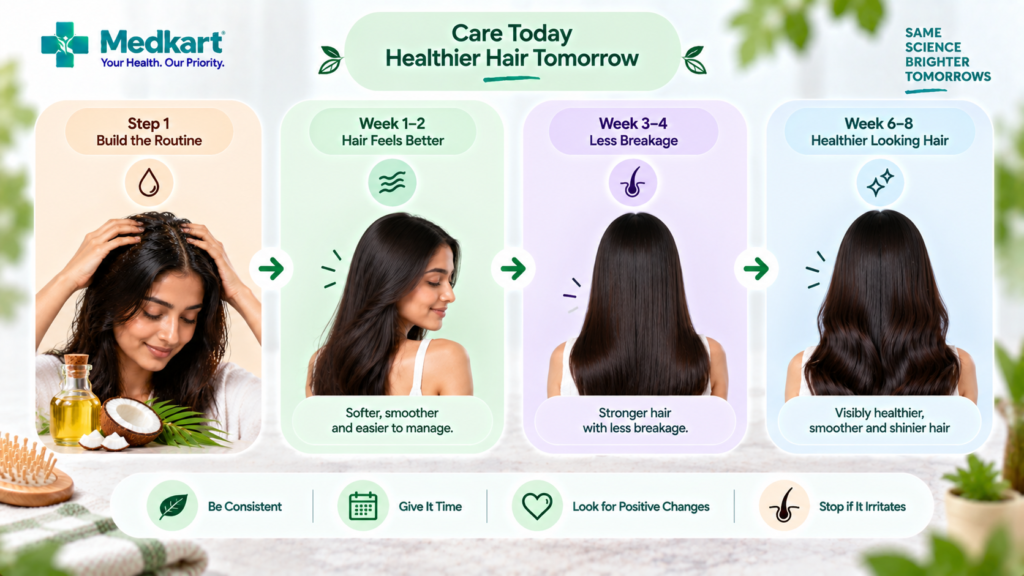
Oiling is grooming, not repair. It reduces the damage washing and combing do, and it makes hair easier to handle. It does not rebuild a damaged shaft, because hair is not living tissue.
Give any routine six to eight weeks before you judge it, and judge it on how the hair feels and behaves rather than on length. A week tells you nothing.
What would count as it not working? A scalp that itches or flakes more than before, hair that mats or tangles worse, or spots that stay sore. Any of those means stop, not persist.
When is oiling not enough?
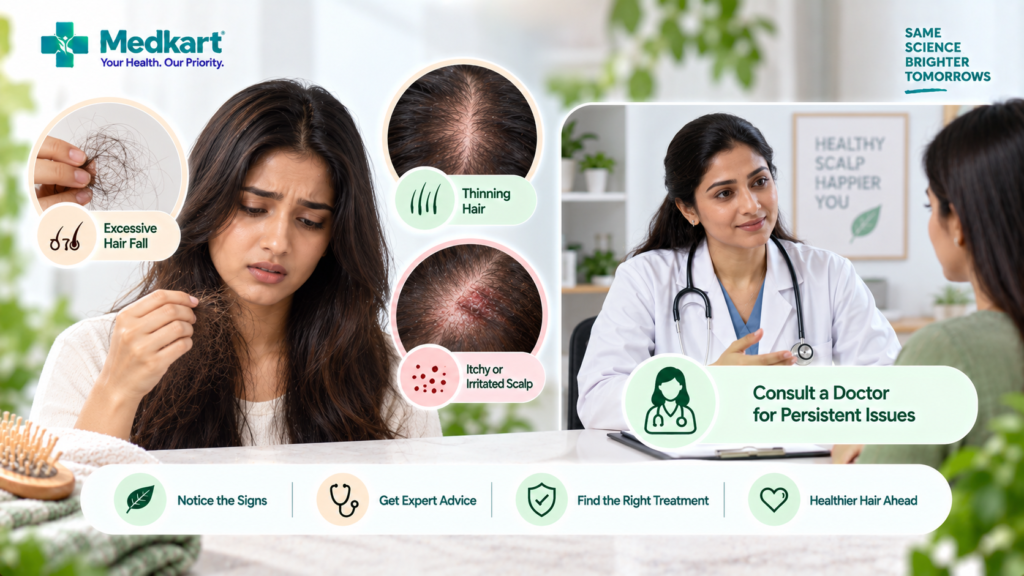
Oils work slowly where they work at all, and they suit upkeep rather than repair.
Hair that is falling out suddenly, coming out in patches, or thinning fast is a reason to see a doctor rather than to try the next oil. So is a scalp that is painful, weeping, bleeding or not settling. The 2025 review is explicit that people should discuss herbal preparations with a healthcare professional rather than assume they are a substitute.
If you want something more consistent than a kitchen blend, a formulated hair oil is a fair alternative. It is made to the same recipe every time and carries its own label, which a mix poured by hand does not.
Where can you buy hair oil on Medkart?
Medkart lists hair oils alongside its medicine range. The personal care category covers hair oils, cleansers and other topical preparations.
Hair oils listed on Medkart include:
- Keo Karpin hair oil, a blend with brahmi, amla, bhringraj and neem
- Indulekha Bringha oil, bhringraj and amla in a coconut base
- Avimee Keshpallav hair oil, with bhringraj, amla, brahmi and sesame
- Haironic hair oil, almond, coconut and olive oil with herbal extracts
- Red Onion hair oil, onion extract with almond and coconut oil
- HG Five hair oil, coconut, olive and almond oil with amla, bhringraj and brahmi
- Juene hair oil, argan, almond, coconut and jojoba oil with amla and bhringraj
Medkart states that the medicines it sells are sourced from WHO-GMP certified manufacturers. Its comparison tool places products side by side, and the medicines index lists what is in stock.
If you already use a prescribed scalp treatment, ask a pharmacist before adding an oil on top of it.
Key takeaways
- Hair is dead protein, so oil reduces damage rather than repairing it.
- Coconut oil is the one common oil measured to cut protein loss from washing.
- Lighter oils suit fine or oily hair, heavier oils suit thick or dry hair.
- Castor oil is always diluted into a lighter oil, never used neat.
- Almond oil is a nut product and is skipped entirely by anyone with a nut allergy.
- Rosemary and tea tree are essential oils and are used in drops, always diluted.
- Many commercial herbal oils are mineral oil with extract added, so read the base.
- Sudden, patchy or fast hair loss needs a doctor rather than another oil.
FAQs: Common Questions About Hair Oiling
Q. How often should you oil your hair?
Once or twice a week suits most people. Fine or quickly oily hair often does better with once a week on the ends only, while coarse or dry hair can take twice. If your scalp feels heavy, itchy or spotty after a few weeks, you are oiling too often or using too much.
Q. Should oil go on wet hair or dry hair?
Both work, for different reasons. On damp hair, oil helps seal water in, which is why curly hair usually does better that way. On dry hair before a wash, it coats the shaft and takes some of the damage that shampoo would otherwise do.
Q. Is leaving oil in overnight better?
Not necessarily, and for some hair it is worse. An hour is enough for most oils to do what they are going to do. Long overnight sessions with a thick or neat oil are also where matting and tangling most often start.
Q. Can you mix two oils together?
Yes, and it is often the best way to use the difficult ones. Castor oil is far easier diluted, and essential oils have to be. Keep a blend to two or three oils so you know what to drop if your scalp reacts.
Q. How do you get oil out of hair properly?
Shampoo dry hair before wetting it, which sounds wrong and works far better. Work the shampoo into the oiled hair first, then add water and lather. Heavier oils usually need a second round.
Q. Can oiling make hair look thicker?
Only in how it looks, not in how much hair there is. A light oil through the mid-lengths smooths the surface and catches the light, which makes fine hair read as denser in the mirror. It does not change the number of follicles, and too heavy an oil does the opposite and leaves hair looking flat.
Q. Does a hair care routine need more than oiling?
Yes, and the rest of it matters as much. Washing, drying and combing all decide how much hair survives the week, and no oil undoes rough handling on soaking wet hair. A wide-toothed comb and blotting with a towel rather than rubbing are the cheapest parts of the routine.
References
- https://pmc.ncbi.nlm.nih.gov/articles/PMC8719955/
- https://pmc.ncbi.nlm.nih.gov/articles/PMC12324729/
Medical disclaimer: This article describes hair oils and oiling practices in common household use. It is written for general interest and does not replace advice from a doctor or pharmacist. A scalp that is painful, spreading or not settling, or hair loss that is sudden or patchy, should be seen by a doctor rather than treated at home, and no medicine should be started, stopped or changed without advice from the prescriber or a qualified pharmacist.
Leave a Reply