
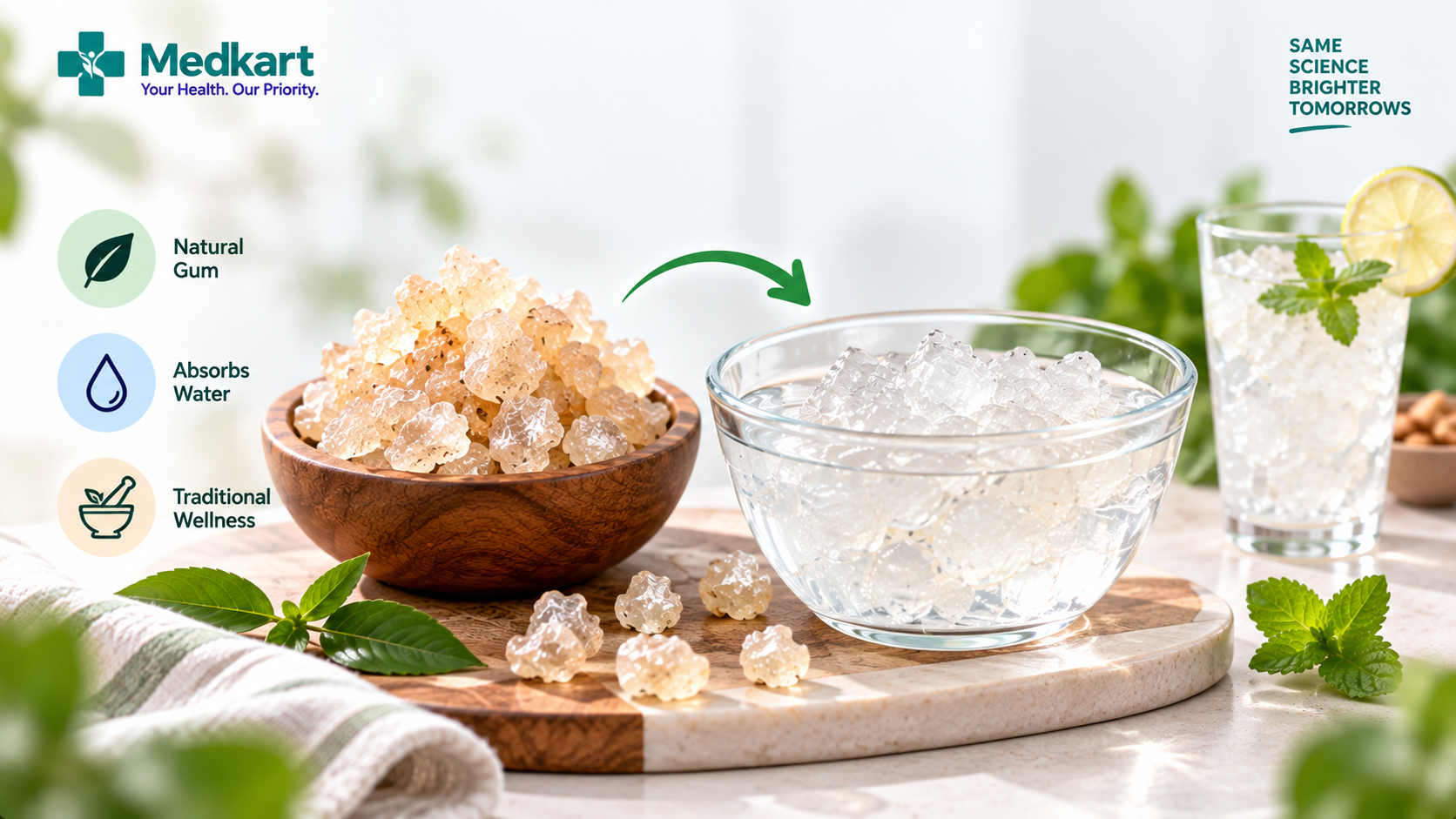
Gond katira is a dried gum that seeps from the stems of certain trees and shrubs, hardens into pale lumps, and swells a great deal when it meets water. It is sold loose in Indian shops and used to thicken food.
The name causes more trouble than the gum does. Indian food standards recognise two different exuded gums with overlapping common names, different botanical sources and different identity numbers. Which one sits in a given packet is a question only the label can answer.
What is gond katira?
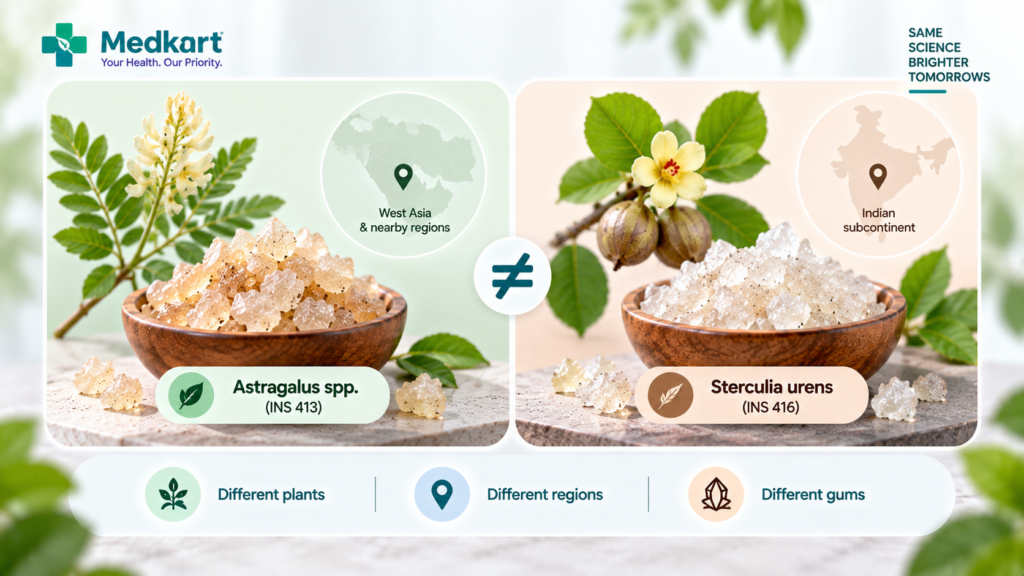
A dried gum exuded from a tree or shrub. Which one depends on the pack, because Indian food standards[1] specify each of the two separately.
- Tragacanth gum, INS 413: the dried gummy exudation of Astragalus strobiliferus or other species of Astragalus, family Leguminosae. The standard describes translucent, horny pieces 0.5 to 2.5 mm thick, white to pale yellow, odourless, with an insipid mucilaginous taste.
- Gum karaya, INS 416: the dried gummy exudation from the stems and branches of Sterculia urens and Sterculia villosa, family Sterculiaceae. The standard lists its common names as karaya, gum karaya, sterculia, gum sterculia, kadaya, katilo, kullo and kuterra.
The two come from different places. The EFSA panel that re-evaluated tragacanth[2] records its collection in Iran, Syria, Turkey and southwest Asia. The panel that re-evaluated karaya gum[3] records that Sterculia urens grows widely throughout the Indian subcontinent.
Among the requirements tragacanth gum must meet is a karaya gum test.
No source retrieved for this article establishes which of the two a packet labelled gond katira holds. The botanical name on the pack settles it.
What are the benefits and uses of gond katira?
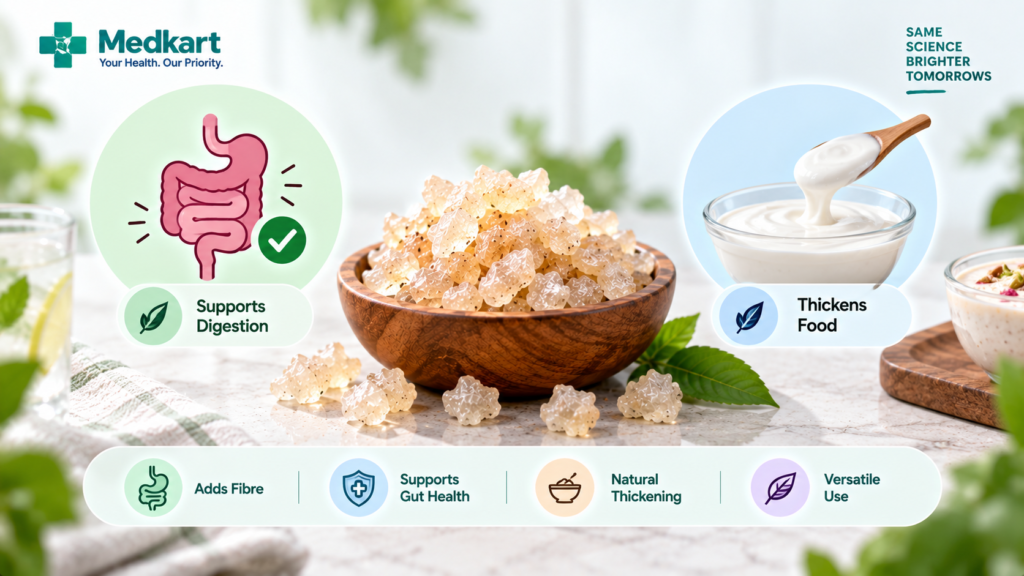
Both gums do two jobs: they thicken food and add bulk to stool.
| Use | What the evidence says |
| Constipation | The patient leaflet for a licensed sterculia medicine[4] describes the gum as a dietary fibre that relieves constipation. EFSA records bulk-forming laxative use of karaya gum at up to 12 g a day for adults. |
| A high-fibre diet | The same leaflet lists use by people who need a high fibre diet, for example in diverticular disease of the colon, and by people with a colostomy or an ileostomy. |
| After rectal or anal surgery | The leaflet lists this use, alongside use by someone who has swallowed something sharp, to reduce the chance of damage to the gut. |
| Thickening and stabilising food | Both EFSA opinions describe these gums as food additives used to thicken and stabilise. |
| Cooling the body in summer | No source retrieved for this article tests this use, which is the most common reason the gum is bought in India. |
What is the nutritional value of gond katira?
Very little, and that is rather the point. Both gums are large carbohydrate molecules that mostly pass through.
EFSA states that karaya gum is practically undigested, is not fermented by gut bacteria, and is most probably not absorbed unchanged in humans. It describes tragacanth as unlikely to be absorbed intact.
On composition, the tragacanth opinion puts protein at about 2 per cent, within a range of 0.5 to 3.4 per cent. Its sugar units vary widely between species, with arabinose from 1 to 51 per cent and galacturonic acid from 9 to 37 per cent.
A full nutrient profile is missing. No Indian food composition source and no United States FoodData Central entry could be retrieved for gond katira, so figures for energy, fat or vitamins are not given here.
How do you use gond katira?
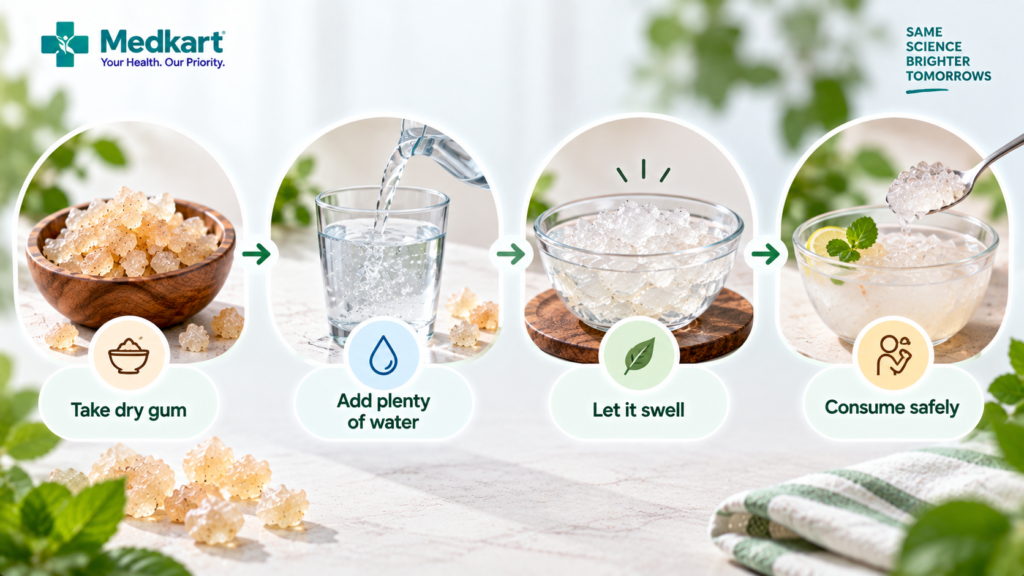
With plenty of liquid, and never dry. The licensed sterculia product’s leaflet is the clearest retrieved instruction.
It says the dry granules are placed on the tongue from the sachet, a spoon or the hand, or sprinkled onto soft food such as yoghurt. They are swallowed with plenty of water or a cool drink, and never chewed or crushed. They are taken after meals, and not just before bed or while lying down.
The reason sits in the swelling. EFSA records that karaya gum absorbs water and swells to more than 60 times its original volume, increasing about tenfold within the first hour. The NHS[5] advises drinking plenty of fluids with any bulk-forming laxative.
No retrieved source describes soaking loose gum overnight and drinking it, which is the preparation gond katira is best known for in India.
Also Read: Top 10 High Fiber Rich Foods for Better Digestion, Weight Loss & Overall Health
What is the recommended dosage of gond katira?
There is no published dose for loose gum. What exists is a dose for a licensed product built on the same gum.
The leaflet gives adults and the elderly 1 to 2 sachets, or 1 to 2 heaped 5 ml spoonfuls, once or twice a day after meals. That product is 62 per cent sterculia by weight, so the figure describes the granules rather than pure gum.
Tolerance studies give a sense of scale rather than a dose. EFSA reports 9,900 mg of tragacanth daily for 21 days without adverse effects in five volunteers. For karaya gum it reports 7,000 to 10,500 mg daily tolerated by most people. Abdominal discomfort appeared in seven of 89 volunteers taking 7,000 mg a day for four weeks.
A weight printed on a bag of gum is product information, not an instruction about how much to take.
How long can you take gond katira?
Not long without checking. The sterculia leaflet says that if the product has not worked after four days, it should be stopped and a doctor or pharmacist seen.
Anyone who does not feel better, or who feels worse, after four days is told to talk to a doctor.
No retrieved source sets a duration for loose gum eaten as a food.
What side effects can gond katira cause?
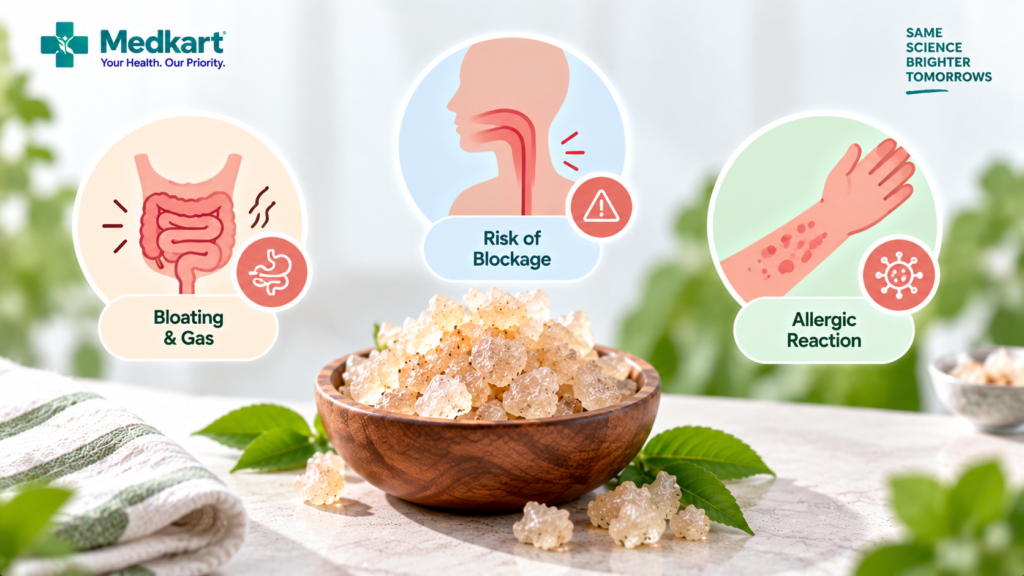
Wind, bloating and stomach pain are the ordinary ones. The sterculia leaflet lists a swollen stomach, flatulence, diarrhoea, nausea and abdominal pain.
Two entries on the same list are more serious. Blocked intestine and blocked oesophagus both appear on it.
Allergic reactions are listed as well. Skin rash, itching and nettle rash appear, along with swollen hands, feet or ankles. The most serious is difficulty breathing or swelling of the face, lips, tongue or throat, which calls for stopping at once and telling a doctor.
EFSA notes case reports of hypersensitivity to tragacanth, possibly linked to its protein content, and very few reports of allergy to karaya gum.
Who should be careful with gond katira?
Anything that already narrows or slows the gut is the main concern. Six situations call for care.
| Situation | What to do |
| A known blockage in the gut | The sterculia leaflet contraindicates the product in anyone told they have an intestinal blockage, faecal impaction, or total loss of muscle tone in the colon. |
| Ulcerative colitis | The leaflet says a doctor should be spoken to before the product is taken. |
| Difficulty swallowing | The gum swells rapidly and the leaflet warns that the gullet can block. It should not be taken lying down or at bedtime. |
| Children | The leaflet does not recommend it under 6 years, and allows 6 to 12 years only on a doctor’s instruction. |
| A low-salt diet or an intolerance to some sugars | The licensed granules carry 28.7 mg of sodium per 7 g sachet and contain sucrose. Other products will differ, so the pack should be read. |
| Regular prescribed medicines | The leaflet asks that a doctor or pharmacist be told about any other medicines being taken, including those bought without a prescription. |
On pregnancy the leaflet is reassuring but not blanket. The product can be taken while pregnant or breastfeeding, it says, and a doctor or pharmacist should be asked first.
Where can you buy gond katira or isabgol online?
Gond katira is sold as a food gum rather than as a pharmacy medicine, and Medkart does not list it under that name. The bulk-forming fibre it does list is isabgol.
Husky Isabgol Powder from Karnataka Antibiotics and Pharmaceuticals and Laxmi Isabgol Powder from Giriraj Enterprise are plain husk powders. Naturolax A from Piramal and Softovac SF from Lupin are combination powders built on isabgol husk.
These are different substances from gond katira, with their own labels and cautions. Sharing a bulk-forming action does not make two products interchangeable.
The ispaghula husk composition listing, the Ayurvedic products category and the Ayurvedic composition page show what is stocked. Availability, pack size and price differ between products and can change.
Medkart states that the medicines it sells are sourced from WHO-GMP certified manufacturers. Medkart’s medicine comparison tool sets products side by side, and the medicines index and search page show current stock. Points worth comparing on a fibre pack:
- Botanical name of the source plant
- Whether it is a single gum or a combination
- Amount per dose
- Manufacturer
- Pack size
Anyone taking regular medicines should speak to a doctor or pharmacist before adding a fibre supplement.
Key takeaways
- Indian food standards recognise two distinct gums with overlapping names, tragacanth as INS 413 and gum karaya as INS 416.
- Tragacanth comes from Astragalus species in west Asia, while gum karaya comes from Sterculia urens, which grows across the Indian subcontinent.
- The Indian standard for tragacanth gum includes a karaya gum test among its requirements.
- Both gums are largely undigested and unabsorbed, so they add bulk rather than nutrients.
- The clearest retrieved instructions come from a licensed sterculia medicine, not from loose gum.
- That leaflet gives adults 1 to 2 sachets or 1 to 2 heaped 5 ml spoonfuls, once or twice daily after meals.
- The gum is taken with plenty of fluid, never dry and never lying down, because the gullet can block.
- No retrieved source tests the summer cooling use, which is the most common reason the gum is bought in India.
FAQs: Common Questions About Gond Katira
Q. Is gond katira the same as gum ghatti or the other Indian gums?
No. The Indian standards set out several exuded gums side by side, each with its own botanical source and identity number. Gum ghatti from Anogeissus latifolia is listed separately, and the shared word gond simply means gum. Two gums that both soften into a jelly can still come from unrelated plants.
Q. What happens if the gum is swallowed without enough water?
The gullet can block. The gum draws in water and expands, and if that happens before it has reached the stomach, it expands in the wrong place. The sterculia leaflet names this outcome twice: once for taking too much, once for taking too little fluid with it.
Q. How long does a bulk-forming fibre take to work?
Longer than most people expect. The NHS says bulk-forming laxatives take up to three days, which is why raising the amount after one disappointing day tends to cause trouble rather than relief. Anything still not working after a few days is a reason to ask a pharmacist.
Q. Do the two gums behave the same way in the gut?
Not quite. EFSA describes karaya gum as practically undigested and not fermented by gut bacteria, so it passes through largely untouched. Tragacanth is partially fermented by gut bacteria, which produces short-chain fatty acids along the way. Both add bulk rather than nourishment.
Q. Why do stools sometimes look paler after taking a sterculia product?
This one is expected. The leaflet notes that it is not unusual for stools to look paler than normal. It puts this down to local contact with the sterculia itself, and says it does not indicate anything untoward. Pale stools that persist after the product is stopped are a different matter and should be mentioned to a doctor.
Q. Is tragacanth allowed in food outside India?
Yes. United States federal regulations[6] affirm gum tragacanth as generally recognised as safe in food, taken from species of Astragalus, with maximum levels set by food category. Those run from 1.3 per cent in fats and oils down to 0.1 per cent in all other foods. That is a United States standard, and an Indian source is needed to make the same claim here.
References
- https://fssai.gov.in/upload/uploadfiles/files/Chapter%203_Substances%20added%20to%20food.pdf
- https://pmc.ncbi.nlm.nih.gov/articles/PMC7009969/
- https://pmc.ncbi.nlm.nih.gov/articles/PMC13088887/
- https://assets.hpra.ie/products/Human/26374/0798c15d-543a-4043-b82e-8ef4be7c7f74.pdf
- https://www.nhs.uk/medicines/laxatives/
- https://www.govinfo.gov/content/pkg/CFR-2024-title21-vol3/xml/CFR-2024-title21-vol3-sec184-1351.xml
Medical disclaimer: This article gives general information only. It does not replace advice from a doctor or pharmacist. No medicine or supplement should be started, stopped or changed without advice from the prescriber or a qualified pharmacist.
Leave a Reply