
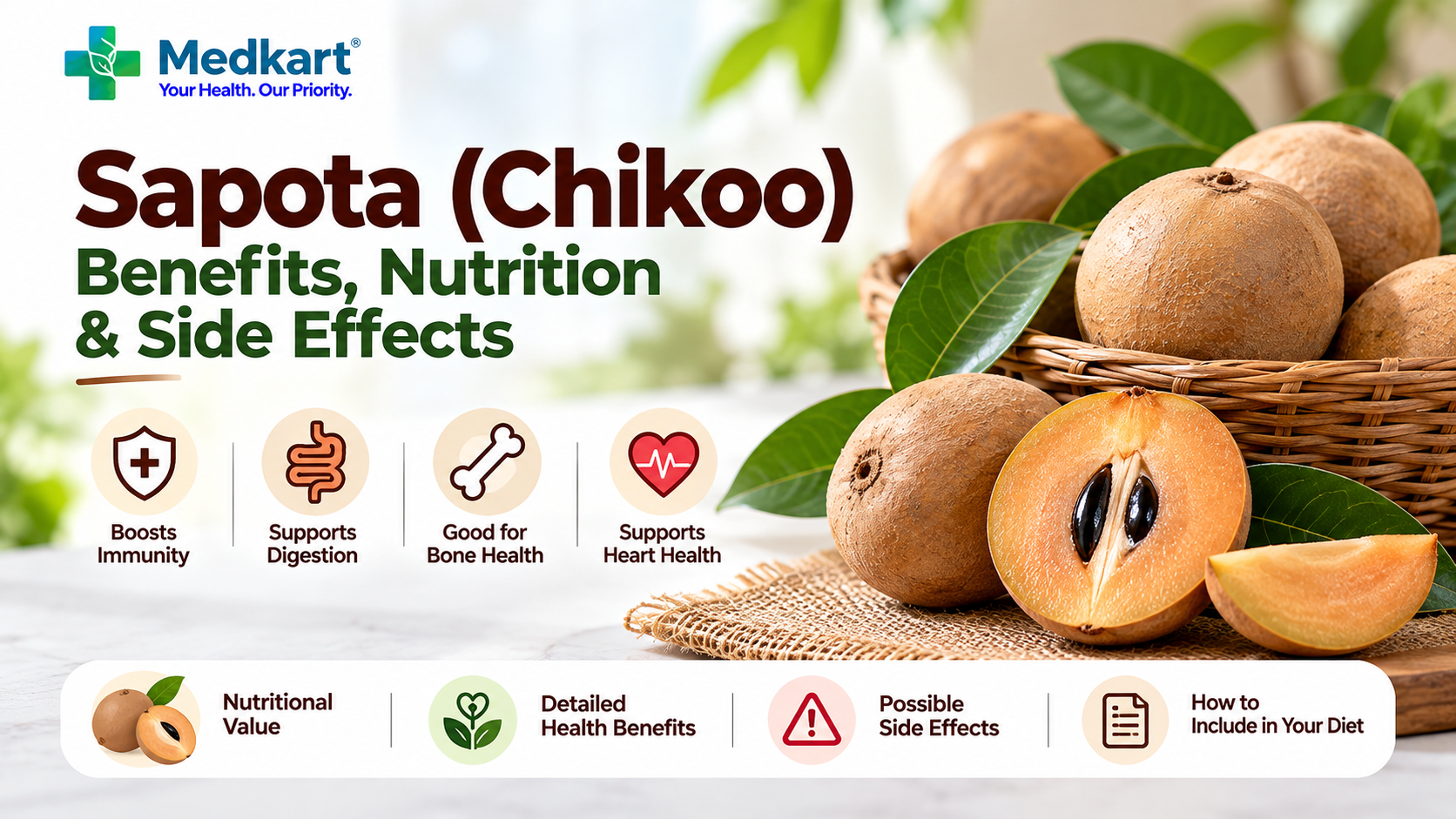
Chikoo is the Indian name for sapota, the brown grainy-skinned fruit of Manilkara zapota. It is sweet enough to be eaten as a dessert and dense enough in fibre to behave differently from most sweet fruits.
Two things in the research are worth knowing first. The figures for its sugar and fibre content disagree between sources. The single measured study of its effect on blood glucose also carries a spread far wider than the tidy numbers circulating online.
What Is Sapota, and Where Does Chikoo Grow in India?
Sapota is a tropical evergreen fruit crop grown across the warmer half of the country. The National Horticulture Board[1] records it as mainly cultivated in India for its fruit, in a warm and humid climate at around 70% relative humidity.
Six states carry most of it. The board names Gujarat, Maharashtra, Karnataka, Tamil Nadu, Andhra Pradesh and Kerala, and the varieties include Kalipatti, Cricket ball and Calcutta round.
The fruit is slow. The board records that a tree starts bearing from the third year after planting, with economic yields from the fifth. The fruit itself takes four months from flowering to maturity.
What Is the Nutritional Value of Chikoo?
Sapota is a fibre-heavy carbohydrate fruit with very little protein or fat. The United States Department of Agriculture[2] records these figures for raw sapodilla.
| Nutrient | What 100 g of raw sapodilla provides |
| Energy | Raw sapodilla provides 83 kcal per 100 g. |
| Carbohydrate | Carbohydrate by difference is 19.96 g per 100 g. |
| Fibre | Total dietary fibre is 5.3 g per 100 g. |
| Protein | Protein is 0.44 g per 100 g. |
| Fat | Total fat is 1.1 g per 100 g. |
| Water | Water makes up 78 g of every 100 g. |
| Vitamin C | Vitamin C is 14.7 mg per 100 g. |
| Potassium | Potassium is 193 mg per 100 g. |
| Calcium | Calcium is 21 mg per 100 g. |
| Iron | Iron is 0.8 mg per 100 g. |
The USDA entry carries no figure for total sugars. A 2026 review in Foods[3] gives 11% to 15% sugars for the fruit, so the sweetness is documented in the literature rather than in the food database.
How Many Calories Are in Chikoo?
Around 83 kcal per 100 g, which is moderate for a fruit and comes almost entirely from carbohydrate. A single sapota weighs well under 100 g in most cases, so a fruit carries less than that figure.
The energy is not the interesting part. Nearly a quarter of the carbohydrate is fibre, and that is what separates sapota from other fruits of similar sweetness.
What Is Chikoo Rich In?
Fibre first, at 5.3 g per 100 g in the USDA record. That is high for a fresh fruit and is the most defensible single claim about it.
Vitamin C and potassium follow, at 14.7 mg and 193 mg per 100 g. Calcium and iron are present in smaller amounts.
The fibre figure is itself disputed. The composition table in the glycaemic study below[4] lists 9.9 g of fibre per 100 g, nearly twice the USDA figure. Fruit composition varies with variety and ripeness.
What Are the Health Benefits of Sapota?
The defensible benefits are the fibre, the vitamin C and the potassium, all of which are matters of composition rather than of effect. Beyond those, the retrieved evidence thins quickly.
The Foods review lists gallic acid, chlorogenic acid, quercetin, catechin and myricetin among the fruit’s phenolic compounds. It reports antioxidant, anti-inflammatory and antimicrobial activity for extracts, and states that this work is laboratory and animal research.
The digestive claim sits in the same category. A 2019 study in BioMed Research International[5] tested chloroform and aqueous extracts of the fruit in animals. It reported protection against induced diarrhoea and up to 76% inhibition of induced ulcers.
Those were extracts given to animals, not fruit eaten by people. No human trial of eating sapota was retrieved for this article.
Also Read: Understanding blood sugar levels
Can People with Diabetes Eat Chikoo?
One study has measured this, and its result is less reassuring than its headline. A 2015 paper in Food Science and Technology tested nine tropical fruits in volunteers under the FAO and WHO protocol, with each fruit tested in at least six people.
Sapodilla came out with a glycaemic index of 37, classified as low, and a glycaemic load of 4 for a 70 g portion, also low.
The spread is the problem. The reported standard deviation was 27.9 against a mean of 37, wider than the gap between a low and a high glycaemic index. Individual responses varied enormously.
The portion is worth noting too. To deliver the 50 g of glycaemic carbohydrate the protocol requires, volunteers ate 312.5 g of sapodilla, far more than anyone eats at one sitting. Anyone managing diabetes should discuss portions with the clinician managing it.
How Is Chikoo Eaten and Ripened?
Ripe sapota is eaten fresh, and the unripe fruit is not worth eating. The Foods review records that unripe fruits have higher levels of tannins, which make them astringent and reduce palatability.
Commercial ripening is regulated in India, and the rules matter to shoppers. The FSSAI[6] states that calcium carbide, widely called masala, is banned for ripening fruit under the 2011 prohibition regulations.
Its reasoning is specific. The authority records that calcium carbide carries traces of arsenic and phosphorus, that these may leave residues on fruit, and that the acetylene gas released is harmful to handlers.
What is permitted instead is ethylene. FSSAI recognises it as a safe ripening agent, delivered through sources such as ethephon, which is the method the horticulture board describes for sapota.
What Are the Side Effects of Sapota?
No retrieved source reports serious harm from eating ripe sapota as a food. The cautions that exist concern the unripe fruit and the limits of the safety testing.
The tannins in unripe fruit are the first. Beyond astringency, no retrieved source quantifies a harm from them.
The second is a gap rather than a finding. The Foods review notes that cyanogenic glycosides have been identified in the plant, and states that long-term toxicity studies in humans should still be conducted.
Energy and carbohydrate are the everyday consideration. At 83 kcal and nearly 20 g of carbohydrate per 100 g, sapota is denser than a watery fruit. The glycaemic spread above means its effect is not uniform across people.
Who Should Be Careful with Sapota?
The cautions are specific rather than general.
| Situation | What To Do |
| Managing diabetes | Discuss portions with the doctor or dietitian managing it. The one measured study reported a very wide individual spread. |
| Watching energy intake | Weigh the portion. Sapota carries 83 kcal and 19.96 g of carbohydrate per 100 g. |
| Buying fruit that ripens suspiciously fast | Buy from a seller you trust. FSSAI bans calcium carbide for ripening and permits ethylene instead. |
| Eating unripe fruit | Leave it to ripen. The Foods review attributes the astringency of unripe fruit to its higher tannin content. |
| Relying on it for a health effect | Treat it as a food. The antioxidant and digestive findings come from extracts tested in laboratories and animals. |
No source retrieved for this article sets a daily amount of sapota for anyone.
Where Can You Buy Supplements and Medicines on Medkart?
Sapota is a grocery item rather than a pharmacy one, and Medkart does not list it. Medkart sells medicines and nutritional supplements that cover some of the same ground.
Fibre and iron are the relevant ones. Listed options include Laxmi Isabgol Powder, Softovac SF and iron products such as Daily Iron from Systopic. Medkart also lists ayurvedic products as a separate category.
A fruit is not a substitute for a prescribed medicine such as metformin, sold as Glycomet among other brands. Nothing here says any of these treats the condition, and Medkart lists these products rather than testing or approving them. Availability and price can change.
Medkart’s medicine comparison tools can be used to compare listed options on:
- Active ingredient
- Strength
- Dosage form
- Manufacturer
- Pack size
- Current price
It is also possible to search by name, browse the full medicine list, or find the nearest Medkart store.
Key takeaways
- Chikoo is sapota, the fruit of Manilkara zapota, grown mainly in Gujarat, Maharashtra, Karnataka, Tamil Nadu, Andhra Pradesh and Kerala.
- Raw sapodilla provides 83 kcal and 19.96 g of carbohydrate per 100 g.
- Fibre is the standout nutrient, at 5.3 g per 100 g in the USDA record.
- The USDA carries no total sugars figure, while a 2026 review reports 11% to 15% sugars.
- The two sources also disagree on fibre, at 5.3 g against 9.9 g per 100 g.
- The one measured study gave a glycaemic index of 37, low, but with a standard deviation of 27.9.
- Antioxidant and digestive findings come from extracts tested in laboratories and animals, not from eating the fruit.
- FSSAI bans calcium carbide for ripening fruit and recognises ethylene as the safe alternative.
FAQs
Q. How many chikoos can be eaten in a day?
No retrieved source sets a number. The glycaemic study used a 70 g portion to calculate its load figure, roughly one medium fruit. That was a research portion rather than a recommendation. Anyone with diabetes or a weight goal should settle the amount with a clinician rather than with a chart.
Q. Is chikoo good for constipation?
The fibre content is real and the outcome evidence is not here. Sapodilla carries 5.3 g of fibre per 100 g in the USDA record, which is high for a fresh fruit. No trial testing sapota for constipation in people was retrieved for this article, so the composition figure is the honest answer.
Q. Can the seeds be swallowed?
The seeds are large, black and flat, and nothing retrieved here describes them as edible. The Foods review covers the plant’s chemistry rather than seed safety, and the toxicology gap named above has not been closed. Nothing opened for this article supports swallowing them deliberately.
Q. Why do some chikoos taste chalky or bitter?
That points at ripeness rather than at a bad fruit. The Foods review attributes astringency in this fruit to the higher tannin levels found before ripening. A fruit picked too early and ripened in a hurry can therefore taste sharp even when the skin looks ready.
Q. Is sapota latex the same as chewing gum?
The species is the historical source of chicle, the latex once used as a chewing gum base, and the Foods review covers the plant beyond its fruit. The latex is a separate product from the flesh people eat. Nothing retrieved here describes eating the latex.
Q. Does chikoo help with weight gain?
No trial retrieved for this article tested that. What is established is the energy density, at 83 kcal per 100 g. Whether that adds or removes weight depends on the rest of the diet, which no study opened here examined.
References
- https://nhb.gov.in/report_files/sapota/SAPOTA.htm
- https://fdc.nal.usda.gov/portal-data/external/167759
- https://pmc.ncbi.nlm.nih.gov/articles/PMC13257147/
- https://www.scielo.br/j/cta/a/h36Tn5PvJkmv5356DRPhpZy/?lang=en
- https://pmc.ncbi.nlm.nih.gov/articles/PMC6925776/
- https://www.fssai.gov.in/upload/press_release/2023/03/640eb634762f0Press%20Release-%20Fruits%20English.pdf
Medical disclaimer: This article gives general information only. It does not replace advice from a doctor, pharmacist or dietitian. Anyone managing diabetes or a weight goal should get individual advice before changing what they eat, and no medicine or supplement should be started, stopped or changed without advice from the prescriber or a qualified pharmacist.
Leave a Reply