

Ciprofloxacin is the generic name of an antibiotic used for certain bacterial infections. It is a prescription medicine in India, sold under several brand names as tablets and as a liquid.
Those tablets are made by many different companies. The active ingredient is the same across them, but the strength, pack size and price are not.
What is ciprofloxacin?

Ciprofloxacin is an antibiotic. MedlinePlus[1] places it in a class of antibiotics called fluoroquinolones and explains that it works by killing bacteria that cause infections.
The NHS[2] describes it as a broad-spectrum antibiotic available only on prescription. The same page says the tablets and liquid are used only when no other antibiotic is suitable, because of a risk of serious and long-term side effects.
Its status in India is set by the Drugs Rules, 1945[3]. Ciprofloxacin hydrochloride appears at entry 113 in Schedule H, the schedule of prescription drugs. Rule 97 requires the pack to carry the symbol Rx and a warning against retail sale without a doctor’s prescription.
What are the main ciprofloxacin uses?

Ciprofloxacin is used for certain bacterial infections. MedlinePlus says it treats or prevents them, and names plague and inhalation anthrax among the infections covered.
DailyMed’s label[4] lists a long set of approved adult uses. They include urinary tract infections, lower respiratory tract infections, acute sinusitis, skin infections, bone and joint infections, infectious diarrhoea and typhoid fever.
The NHS names urinary tract infections, chest infections including pneumonia, skin and bone infections, sexually transmitted infections, and eye and ear infections.
Popular brands containing ciprofloxacin
Several ciprofloxacin brands are sold in India. The company names below are those shown on the Medkart listing for each pack.
| Brand Name | Active Ingredient | Available Strengths / Forms* | Manufacturer / Company |
| Ciplox | Ciprofloxacin | 250 mg and 500 mg tablets | Cipla Pharmaceutical Company Limited |
| Cifran | Ciprofloxacin | 500 mg tablets | Sun Pharmaceutical Industries Ltd |
| Ciprobid | Ciprofloxacin | 500 mg tablets | Cadila Pharmaceuticals Private Limited |
| Ciprodac | Ciprofloxacin | 500 mg tablets | Cadila Pharmaceuticals Private Limited |
| Alcipro | Ciprofloxacin | 500 mg tablets | Alkem Laboratories Limited |
| Zoxan | Ciprofloxacin | 500 mg tablets | F D C India Limited |
Examples of listed strengths and forms, not a complete catalogue. Product ranges can change.
Availability and pack size differ between products. The range sold under any one brand can change.
How is ciprofloxacin dosage decided?
There is no one dose that applies to every ciprofloxacin prescription. The infection, its severity and kidney function all come into it.
NHS guidance on how and when to take ciprofloxacin[5] describes tablets of 100 mg, 250 mg, 500 mg and 750 mg. There is also a liquid containing 250 mg in 5 ml. It gives a usual range of 250 mg to 750 mg twice a day. Children and people with kidney problems take lower amounts.
A strength such as ciprofloxacin 500 mg describes the amount of active ingredient in that product. It is product information, not a dosing instruction.
DailyMed sets different amounts and durations for each infection. For an acute uncomplicated urinary tract infection it gives 250 mg every 12 hours for three days. What applies to one person is a decision for the prescriber.
Why does antibiotic resistance matter?

Resistance grows when antibiotics are used where they are not needed. DailyMed states that using ciprofloxacin only for infections that are proven or strongly suspected to be bacterial reduces the development of drug-resistant bacteria.
MedlinePlus states that antibiotics such as ciprofloxacin will not work for colds, flu or other viral infections. It advises taking the medicine until the prescription is finished, even when the person feels better.
NHS guidance on common questions about ciprofloxacin[6] says it is very important to keep taking it until the course is finished. It also says a doctor should be told if there is no improvement after two to three days, or if things get worse at any point.
Also Read: Doctors must mention Reason while Prescribing Antibiotics
What are the common ciprofloxacin side effects?

Feeling sick and diarrhoea are the most commonly reported effects. NHS guidance on ciprofloxacin side effects[7] reports them in more than 1 in 100 people, along with a bad taste in the mouth.
MedlinePlus lists nausea, vomiting, diarrhoea, stomach pain, heartburn, pale skin and unusual tiredness among its common effects.
The NHS lists serious effects that happen in less than 1 in 100 people, and says to stop the medicine and contact a doctor about any of them, including:
- Pain or swelling in joints or tendons, often starting in the ankle or calf
- Pins and needles, tingling, numbness or burning pain, especially in the legs or arms
- Mood or behaviour changes, confusion, or problems with memory
- Diarrhoea with blood or mucus
- An irregular or fast heartbeat, or sudden breathlessness
DailyMed adds that diarrhoea caused by Clostridioides difficile can appear months after treatment ends, and that skin can react strongly to sun or ultraviolet light during treatment.
Why the fluoroquinolone warnings matter
Ciprofloxacin carries a boxed warning covering four risks. DailyMed names tendinitis and tendon rupture, peripheral neuropathy, central nervous system effects, and worsening of muscle weakness in myasthenia gravis.
MedlinePlus states that the tendon risk runs during treatment and for up to several months afterwards. It adds that nerve damage may not go away after the medicine is stopped. DailyMed advises avoiding ciprofloxacin in anyone with a known history of myasthenia gravis.
The European Medicines Agency[8] restricted this class of antibiotics after reviewing disabling and potentially long-lasting side effects. It advises stopping a fluoroquinolone and contacting a doctor at once at the first sign of tendon pain, joint swelling or nerve symptoms. The NHS states that ciprofloxacin is not prescribed for more than three months at a time.
Who should be careful with ciprofloxacin?
Most people can take it, but several situations need raising first. NHS guidance on who can and cannot take ciprofloxacin[9] says most adults and children aged 1 year and over can take or use it.
| Situation | What to do |
| A previous reaction to a fluoroquinolone | The NHS says to speak to a doctor first after any allergic reaction to ciprofloxacin, or any serious side effect with ciprofloxacin or another fluoroquinolone. DailyMed contraindicates it after hypersensitivity to ciprofloxacin or any quinolone. |
| Myasthenia gravis | DailyMed’s boxed warning covers worsening muscle weakness, and it says ciprofloxacin should be avoided in anyone with a known history of the condition. |
| Aorta problems | The NHS says to speak to a doctor first about an abdominal aortic aneurysm or another aorta problem, including where a family member has had one. |
| Heart rhythm problems | The NHS lists a fast, pounding or irregular heartbeat among the situations to raise before starting. |
| Mental health conditions | The NHS says to mention depression, anxiety, suicidal feelings or any other mental health condition first. |
| Epilepsy, kidney problems or diabetes | The NHS lists all three, and notes that ciprofloxacin can affect blood sugar. |
| Tendon or connective tissue disorders | The NHS lists previous tendon problems, rheumatoid arthritis, Behcet’s disease and Marfan syndrome among the situations to raise first. |
The NHS also says to mention pregnancy, plans to become pregnant, or breastfeeding. DailyMed contraindicates ciprofloxacin alongside tizanidine.
Generic ciprofloxacin vs brand-name ciprofloxacin
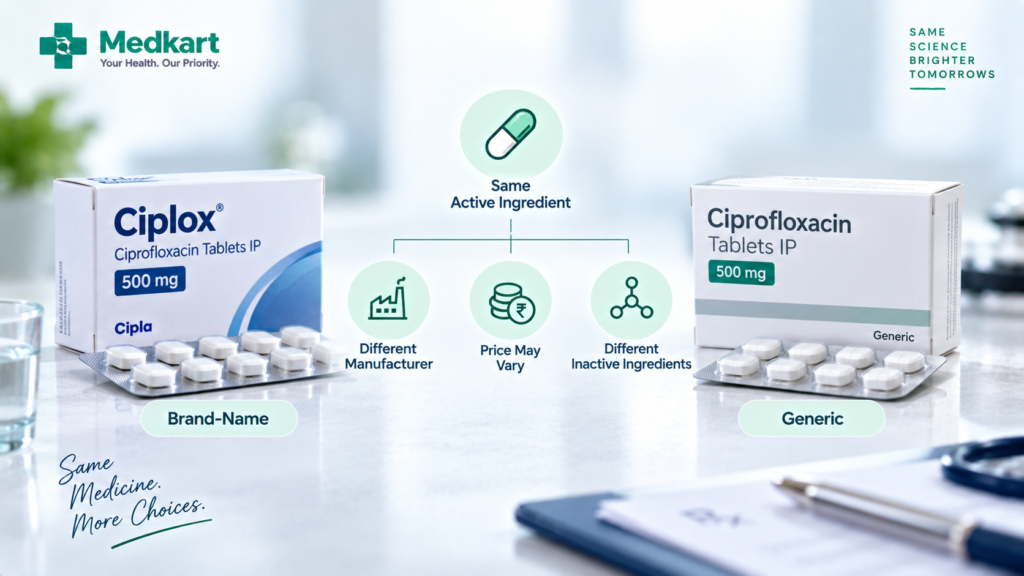
Generic and branded ciprofloxacin contain the same active ingredient. The US FDA[10] states that a generic medicine matches the brand-name medicine on active ingredient, strength, dosage form and route of administration, and is bioequivalent to it.
The FDA adds that approved generics provide the same clinical benefit and risks as their brand-name counterparts. That is the U.S. FDA standard, and an India-specific regulatory source is needed before making the same claim about an Indian product.
Products can still differ in manufacturer, inactive ingredients, appearance and price. The same active ingredient and strength alone do not prove that two products are interchangeable. A doctor or pharmacist should confirm any switch between brands.
Buy or compare ciprofloxacin tablets on Medkart
Medkart sells ciprofloxacin products online from several manufacturers and lists them as prescription items. Its composition listings for ciprofloxacin 500 mg and ciprofloxacin 250 mg show what is stocked at each strength. Medkart states that the medicines it sells are sourced from WHO-GMP certified manufacturers.
Medkart’s medicine comparison tool places products side by side, and the medicines index lists what is in stock. The details a reader can compare include:
- Active ingredient
- Strength
- Dosage form
- Manufacturer
- Pack size
- Current price
Any suggested alternative should be discussed with a doctor or pharmacist before changing a prescribed antibiotic.
Key takeaways
- Ciprofloxacin is an antibiotic in the fluoroquinolone group and works by killing bacteria.
- Ciprofloxacin hydrochloride is listed at entry 113 in Schedule H of India’s Drugs Rules, 1945, which makes it a prescription drug.
- The NHS states that ciprofloxacin tablets and liquid are used only when no other antibiotic is suitable.
- A strength such as ciprofloxacin 500 mg is product information, not an instruction about how much to take.
- Feeling sick and diarrhoea are among the most commonly reported side effects.
- The boxed warning covers tendinitis and tendon rupture, nerve damage, central nervous system effects and worsening of myasthenia gravis.
- Tendon pain, joint swelling or nerve symptoms are a reason to stop the medicine and contact a doctor at once.
- Antibiotics do not work for colds, flu or other viral infections, and a prescribed course is meant to be finished.
FAQs: Common Questions About Ciprofloxacin
Q. How quickly does ciprofloxacin start working?
Most people feel better within a few days. NHS guidance on common questions says how quickly it works depends on the infection. A bone infection can take a week or longer before there is any improvement. A doctor is the right person to tell if progress is slower than expected.
Q. What happens if a dose of ciprofloxacin is missed?
It depends on how close the next dose is. NHS guidance on how and when to take ciprofloxacin says a missed dose should be taken as soon as it is remembered, unless the next one is nearly due. In that case the missed dose is skipped and the normal schedule resumes. The same guidance says never to take a double dose to catch up.
Q. Why should dairy products be avoided around a dose?
Because they can stop the medicine working properly. NHS guidance on how and when to take ciprofloxacin says to avoid dairy products such as milk, cheese and yoghurt, because they affect how the medicine works. The same guidance says the tablets should be swallowed whole with plenty of water rather than chewed.
Q. Is it safe to drink alcohol while taking ciprofloxacin?
Yes. NHS guidance on common questions about ciprofloxacin states that alcohol can be drunk while taking it. Anyone unsure how that sits with their other medicines should ask a pharmacist.
Q. Can ciprofloxacin be given to a child?
Sometimes, and only on a prescription. The NHS says most adults and children aged 1 year and over can take or use ciprofloxacin. DailyMed approves it for children aged 1 to 17 years for complicated urinary tract infections and kidney infections. It notes a higher rate of joint and tissue problems in children. A doctor decides whether it is the right choice.
Q. What happens if too much ciprofloxacin is taken?
It can cause harm. The NHS says taking too much ciprofloxacin can cause feeling sick, being sick, diarrhoea, an irregular heartbeat, or seizures in people with epilepsy. Anyone who has taken more than the prescribed amount should contact a doctor, a pharmacist or a hospital straight away.
References
- https://medlineplus.gov/druginfo/meds/a688016.html
- https://www.nhs.uk/medicines/ciprofloxacin/about-ciprofloxacin/
- https://cdsco.gov.in/opencms/resources/UploadCDSCOWeb/2022/drug_rules/Drugs%20Rules,%201945%20(1).pdf
- https://dailymed.nlm.nih.gov/dailymed/drugInfo.cfm?setid=6fecbc15-915c-4434-b9e3-cfc1aa33a1ba
- https://www.nhs.uk/medicines/ciprofloxacin/how-and-when-to-take-or-use-ciprofloxacin/
- https://www.nhs.uk/medicines/ciprofloxacin/common-questions-about-ciprofloxacin/
- https://www.nhs.uk/medicines/ciprofloxacin/side-effects-of-ciprofloxacin/
- https://www.ema.europa.eu/en/news/disabling-potentially-permanent-side-effects-lead-suspension-or-restrictions-quinolone-fluoroquinolone-antibiotics
- https://www.nhs.uk/medicines/ciprofloxacin/who-can-and-cannot-take-or-use-ciprofloxacin/
- https://www.fda.gov/drugs/generic-drugs/generic-drug-facts
Medical disclaimer: This article provides general information and does not replace advice from a doctor or pharmacist. Ciprofloxacin is an antibiotic listed in Schedule H of India’s Drugs Rules, 1945, so ciprofloxacin products in India are prescription medicines. Brands with the same composition should only be substituted under the guidance of a healthcare professional or pharmacist because product details and approved indications can differ.
Leave a Reply