

Cetirizine is the generic name of an antihistamine used for allergy symptoms. It is a prescription medicine in India, sold under several brand names and in more than one form.
Tablets, syrups and drops are made by many different companies. The active ingredient is the same, but strength, pack size and price are not.
What is cetirizine?
Cetirizine is an antihistamine. MedlinePlus[1] explains that it works by blocking the action of histamine, a substance in the body that causes allergic symptoms.
The NHS[2] describes it as a medicine that helps the symptoms of allergies. MedlinePlus lists its oral forms as tablets, chewable tablets, capsules, orally disintegrating tablets and syrup.
Its status in India is set by the Drugs Rules, 1945[3]. Cetirizine hydrochloride appears at entry 104 in Schedule H, the schedule of prescription drugs. Rule 97 requires the pack to carry the symbol Rx and a warning against retail sale without a doctor’s prescription.
What are the main cetirizine uses?

Cetirizine is used for allergy symptoms. MedlinePlus lists relief of sneezing, a runny nose, itching of the nose or throat, and red, itchy or watery eyes. It also lists use for hives.
The NHS names hay fever, conjunctivitis, eczema, hives, reactions to insect bites and stings, and some food allergies.
DailyMed[4] describes an over-the-counter cetirizine tablet as temporarily relieving symptoms due to hay fever or other upper respiratory allergies. That is a United States label. It does not describe the approved indications of any Indian product.
Popular brands containing cetirizine

Several cetirizine brands are sold in India. The company names below are those shown on the Medkart listing for each pack.
| Brand Name | Active Ingredient | Available Strengths / Forms* | Manufacturer / Company |
| Cetzine | Cetirizine | 10 mg tablets | Dr Reddy’s Laboratories Limited |
| Alerid | Cetirizine | 10 mg tablets | Cipla Pharmaceutical Company Limited |
| Zyrtec | Cetirizine | 10 mg tablets | Dr Reddy’s Laboratories Limited |
| Okacet | Cetirizine | 10 mg tablets | Cipla Pharmaceutical Company Limited |
| CZ3 | Cetirizine | 10 mg tablets | Lupin Limited |
| Setimed | Cetirizine | 10 mg tablets | Zee Laboratories Ltd |
| Cetriz | Cetirizine | 10 mg tablets | Wellcure Lifesciences |
Examples of listed strengths and forms, not a complete catalogue. Product ranges can change.
Availability and pack size differ between products. The range sold under any one brand can change.
Cetirizine composition and available strengths
Cetirizine tablets are commonly sold at a strength of 10 mg. NHS guidance on how and when to take cetirizine[5] also describes a liquid labelled either 5 mg per 5 ml or 1 mg per 1 ml.
A strength such as cetirizine 10 mg describes the amount of active ingredient in that product. It is product information, not a dosing instruction.
Medkart’s listings for cetirizine 10 mg and cetirizine 5 mg show tablets, capsules and drops among the forms stocked.
How is cetirizine dosage decided?
There is no one dose that applies to every cetirizine prescription. Age, the product and the person all come into it.
DailyMed’s directions for a 10 mg over-the-counter tablet give one tablet once daily for adults and children aged 6 and over, with a limit of one tablet in 24 hours. Adults aged 65 and over, children under 6, and people with liver or kidney disease are directed to ask a doctor.
The NHS states that adults and children aged 12 and over usually take 10 mg once a day, and that children under 12 take a lower dose twice a day.
A prescriber decides what is appropriate for a particular person.
Also Read: Allergy Relief Tablets: Top Options for Fast Results
What are the common cetirizine side effects?
Sleepiness and tiredness are the most commonly reported side effects. NHS guidance on cetirizine side effects[6] reports them in more than 1 in 10 people.
The same page lists headaches, a dry mouth, feeling sick, feeling dizzy, diarrhoea, a sore throat, and sneezing or a blocked nose in more than 1 in 100 people. MedlinePlus lists drowsiness, excessive tiredness and dry mouth as its common effects.
The NHS advises contacting a doctor about bruising more easily than normal, or bleeding that takes longer than usual to stop. It advises emergency help for signs of a serious allergic reaction, including:
- Swelling of the lips, mouth, throat or tongue
- Breathing very fast or struggling to breathe
- A tight throat or trouble swallowing
- Skin, lips or tongue that look blue, grey or pale
- Sudden confusion, drowsiness or dizziness
Why drowsiness matters
Cetirizine is grouped with the non-drowsy antihistamines, and the NHS notes that some people still find it makes them feel quite sleepy. NHS guidance on common questions about cetirizine[7] says it seems more likely to cause sleepiness than loratadine, desloratadine or fexofenadine.
MedlinePlus warns that cetirizine may make a person drowsy, and says driving or operating machinery should wait until the effect is known. DailyMed adds that alcohol, sedatives and tranquillisers may increase drowsiness.
Can cetirizine interact with other medicines?
Yes. NHS guidance on taking cetirizine with other medicines[8] states that some medicines can increase the chance of side effects.
That guidance names three groups to check first: medicines that cause drowsiness, medicines that cause a dry mouth, and medicines that make it difficult to pass urine. DailyMed separately directs anyone taking tranquillisers or sedatives to ask a doctor or pharmacist first.
The NHS advises against taking two antihistamines together unless a doctor has recommended it. It says there is not enough information to establish that herbal remedies are safe with cetirizine.
Anyone on regular treatment should tell a doctor or pharmacist, including about herbal remedies and supplements.
Who should be careful with cetirizine?
Some people need advice before taking cetirizine at all. NHS guidance on who can and cannot take cetirizine[9] says most adults can take it, and sets out what needs a check first.
| Situation | What to do |
| A previous allergic reaction | The NHS says to mention any previous allergic reaction to cetirizine or to any other medicine. DailyMed states that the product should not be used by anyone who has reacted to it, to its ingredients, or to an antihistamine containing hydroxyzine. |
| Kidney failure | The NHS lists kidney failure among the conditions to raise before taking cetirizine. DailyMed directs people with liver or kidney disease to ask a doctor before use. |
| Epilepsy or seizure risk | The NHS lists epilepsy, or another health problem carrying a risk of seizures, as a reason to speak to a doctor or pharmacist first. |
| Difficulty passing urine | The NHS lists trouble passing urine among the situations that need advice before starting. |
| An allergy test coming up | The NHS says cetirizine can affect allergy test results, and that stopping it a few days beforehand may be needed. |
| Pregnancy or breastfeeding | NHS guidance on cetirizine in pregnancy and breastfeeding[10] says it can be taken in pregnancy and is one of the better antihistamine choices while breastfeeding. DailyMed says a health professional should be asked if pregnant, and that the product is not recommended while breastfeeding. |
The two sources differ on breastfeeding, so the advice for a particular product and person should come from a doctor or pharmacist.
The NHS also sets out UK age limits, with liquid on prescription from age 1 and tablets from age 6. In India the Schedule H listing means a prescription is required at any age.
Generic cetirizine vs brand-name cetirizine
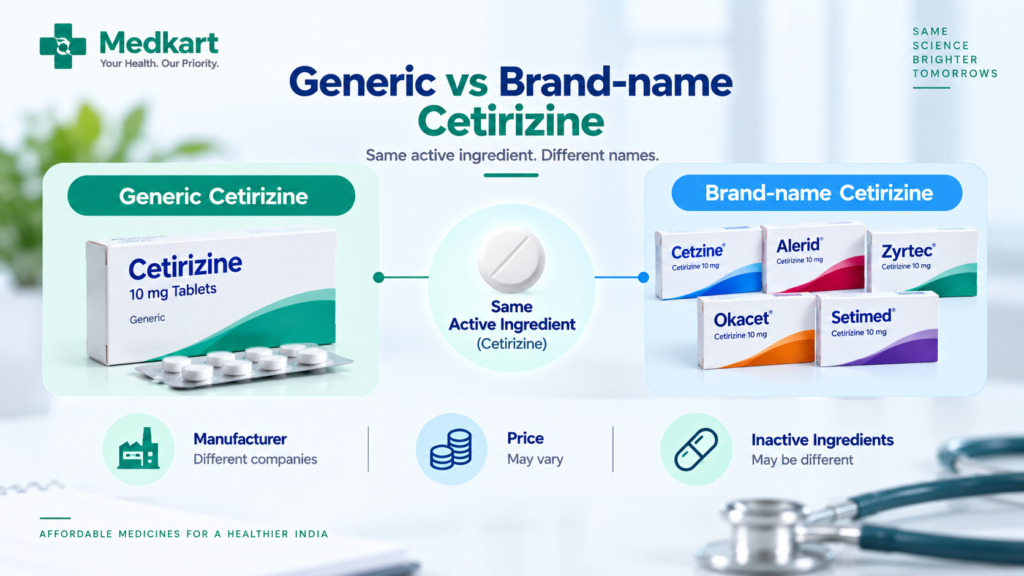
Generic and branded cetirizine contain the same active ingredient. The US FDA[11] states that a generic medicine matches the brand-name medicine on active ingredient, strength, dosage form and route of administration, and is bioequivalent to it.
The FDA adds that approved generics provide the same clinical benefit and risks as their brand-name counterparts. That is the U.S. FDA standard, and an India-specific regulatory source is needed before making the same claim about an Indian product.
Products can still differ in manufacturer, inactive ingredients, appearance and price. The same active ingredient and strength alone do not prove that two products are interchangeable. A doctor or pharmacist should confirm any switch between brands.
Buy or compare cetirizine tablets on Medkart
Medkart sells cetirizine products online in several brands and forms, including cetirizine tablets and branded packs such as Cetrine, and lists them as prescription items. Medkart states that the medicines it sells are sourced from WHO-GMP certified manufacturers.
Medkart’s medicine comparison tool places products side by side, and the medicines index lists what is in stock. The details a reader can compare include:
- Active ingredient
- Strength
- Dosage form
- Manufacturer
- Pack size
- Current price
Any suggested alternative should be discussed with a doctor or pharmacist before changing a prescribed medicine.
Key takeaways
- Cetirizine is an antihistamine that works by blocking the action of histamine.
- It is used for allergy symptoms such as sneezing, a runny nose, itchy or watery eyes, and hives.
- Cetirizine hydrochloride is listed at entry 104 in Schedule H of India’s Drugs Rules, 1945, which makes it a prescription drug.
- A strength such as cetirizine 10 mg is product information, not an instruction about how much to take.
- Sleepiness or tiredness is reported in more than 1 in 10 people taking cetirizine.
- Medicines that cause drowsiness, a dry mouth or difficulty passing urine should be checked with a pharmacist first.
- Kidney failure, epilepsy and an upcoming allergy test are among the reasons to seek advice before starting.
- Generic and branded cetirizine share the same active ingredient, but two individual products are not automatically interchangeable.
FAQs: Common Questions About Cetirizine
Q. How quickly does cetirizine start working?
Within about an hour. NHS guidance on common questions says a person should start to feel better within an hour of taking cetirizine. How often the medicine is needed after that is a question for the prescriber.
Q. What happens if a dose of cetirizine is missed?
It depends on how close the next dose is. MedlinePlus says a missed dose should be taken as soon as it is remembered, and skipped if it is almost time for the next one. Where a child takes a dose twice a day, the NHS says a missed dose can be given within four hours, and that a double dose should never be given to catch up.
Q. Do cetirizine tablets need to be swallowed whole?
Yes. The NHS says cetirizine tablets should be swallowed whole with a drink of water, milk or squash, and not chewed. It also says the liquid should be measured with the syringe or spoon supplied, because a kitchen spoon does not give the right amount.
Q. What happens if someone takes an extra cetirizine tablet by accident?
The NHS describes cetirizine as generally very safe and says an extra dose is unlikely to cause harm. It still advises seeking advice when a child has taken more than the recommended amount, or when an adult has symptoms such as a headache or a fast heartbeat.
Q. Can cetirizine be taken for a long time?
It can, but the NHS advises taking it only when it is needed. The same guidance says long-term use is unlikely to do harm, while noting a small risk of severe itching if the medicine is stopped suddenly after long daily use. MedlinePlus lists that itching among the effects to report to a doctor.
Q. Is cetirizine a brand name?
No. Cetirizine is the name of the active ingredient. A brand name is the name a company gives its own product containing that ingredient. The NHS lists Allacan, Benadryl Allergy, Piriteze Allergy and Zirtek Allergy as UK brand names for cetirizine, and Indian packs carry a different set again.
References
- https://medlineplus.gov/druginfo/meds/a623043.html
- https://www.nhs.uk/medicines/cetirizine/about-cetirizine/
- https://cdsco.gov.in/opencms/resources/UploadCDSCOWeb/2022/drug_rules/Drugs%20Rules,%201945%20(1).pdf
- https://dailymed.nlm.nih.gov/dailymed/drugInfo.cfm?setid=d78223ba-80d5-47f8-e053-2a95a90aebdb
- https://www.nhs.uk/medicines/cetirizine/how-and-when-to-take-cetirizine/
- https://www.nhs.uk/medicines/cetirizine/side-effects-of-cetirizine/
- https://www.nhs.uk/medicines/cetirizine/common-questions-about-cetirizine/
- https://www.nhs.uk/medicines/cetirizine/taking-cetirizine-with-other-medicines-and-herbal-supplements/
- https://www.nhs.uk/medicines/cetirizine/who-can-and-cannot-take-cetirizine/
- https://www.nhs.uk/medicines/cetirizine/pregnancy-breastfeeding-and-fertility-while-taking-cetirizine/
- https://www.fda.gov/drugs/generic-drugs/generic-drug-facts
Medical disclaimer: This article provides general information and does not replace advice from a doctor or pharmacist. Cetirizine is an antihistamine listed in Schedule H of India’s Drugs Rules, 1945, so cetirizine products in India are prescription medicines. Brands with the same composition should only be substituted under the guidance of a healthcare professional or pharmacist because product details and approved indications can differ.
Leave a Reply