
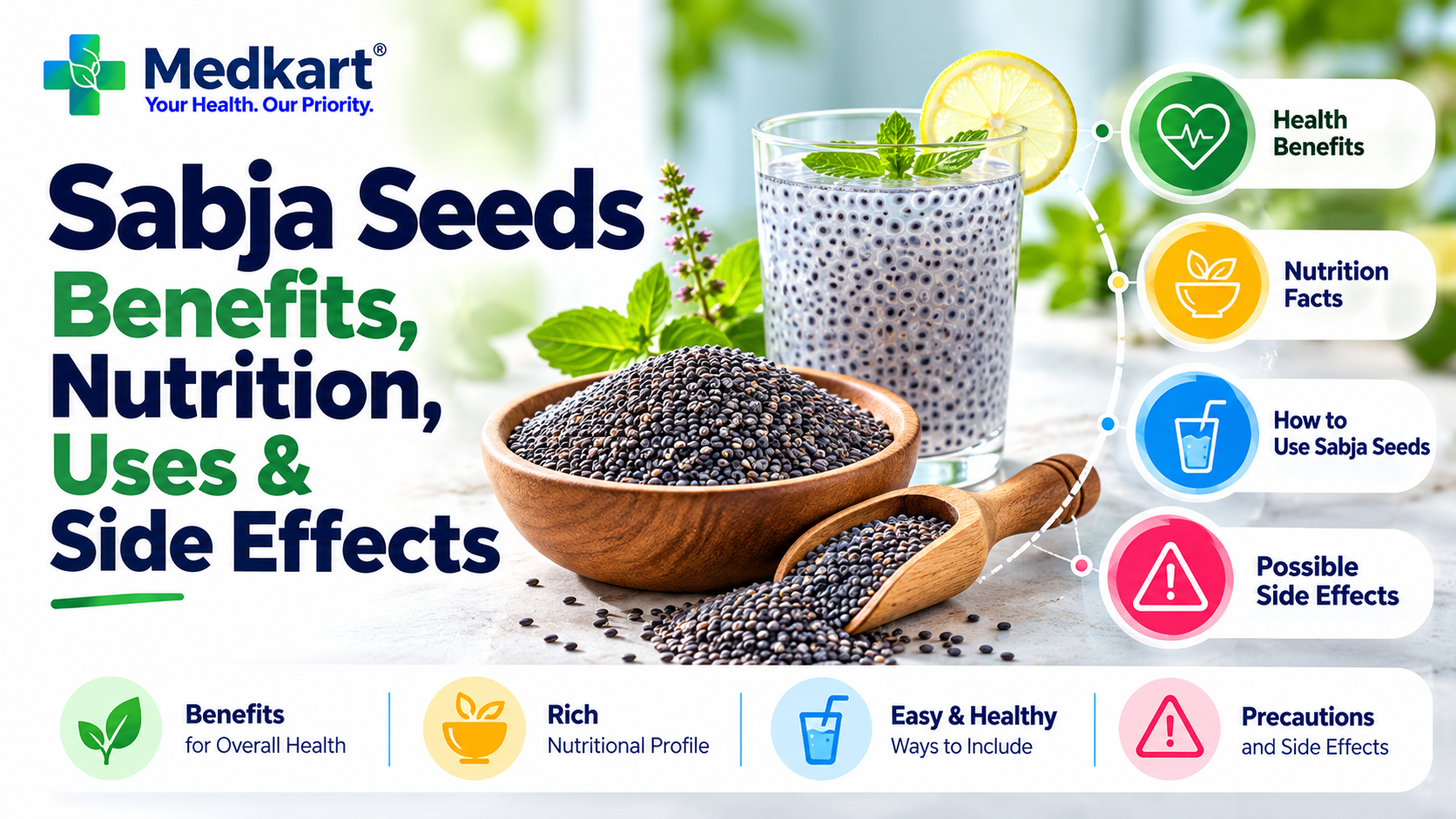
Sabja seeds are the seeds of sweet basil, sold in India for drinks and desserts. Most claims about sabja seeds benefits rest on their fibre and on the gel they form in water.
They are sold as a food rather than a medicine, so packs carry no dose. What published studies have tested, and in whom, is narrower than what is often said about them.
What Are Sabja Seeds?
Sabja seeds are the seeds of Ocimum basilicum, the sweet basil plant. A 2021 review in Foods[1] places it in the Lamiaceae, or mint, family.
The review describes the sabja seeds plant as an erect, strongly aromatic, branched herb that grows 30 to 90 cm high. It records that the plant comes from warm and tropical regions including India, where it has been cultivated for around 5,000 years.
The seeds carry a mucilage that forms a gel in water. The review puts the mucilage content at about 17 to 20%. A 2021 review of plant mucilage in Nutrients[2] describes basil seed mucilage as a natural source of polysaccharides and soluble fibre.
What Does Sabja Seeds Nutrition Include?
It includes protein, fibre, fat and carbohydrate in widely varying amounts. The Foods review gives these ranges per 100 g of seed:
- Protein: 11.4 to 22.5 g
- Dietary fibre: 7.11 to 26.2 g, soluble and insoluble
- Carbohydrate: 43.9 to 63.8 g
- Fat: 9.7 to 33.0% of the seed
The review names calcium and potassium among the minerals found in high amounts. Alpha-linolenic acid, a plant omega-3 fat, ranges from 0.3 to 66.0% of the seed oil across the samples it reviewed.
Sabja seeds nutrition figures describe 100 g of raw seed.
No Indian Food Composition Tables entry for sabja could be retrieved. The 2017 tables from the National Institute of Nutrition are published as one large file that could not be opened for this article.
What Are the Main Sabja Seeds Uses?
Food is the main use. The Foods review reports that in Iran and India the seeds are taken in sharbat drinks and in falooda-style frozen desserts.
The same review records traditional use for indigestion, ulcers, diarrhoea, sore throats and kidney disorders. Sabja seeds uses in the food industry go further, with the mucilage tested as a thickener and stabiliser in yoghurt, ice cream and puddings.
The tested sabja seeds benefits are a much shorter list.
| Use | What the evidence says |
| Inflammation and fever | The Foods review reports less paw swelling and lower fever in rats given basil seed oil. These were animal studies, not trials in people. |
| Blood sugar | The review reports inhibition of an enzyme linked to diabetes in laboratory tests. No human trial on blood sugar was retrieved for this article. |
| Weight and body fat | A randomised trial in people with non-alcoholic fatty liver disease[3] gave basil seeds for 12 weeks. Weight, BMI and body fat did not differ significantly from the control group. |
| Bacterial growth | The review reports activity of basil seed oil against Pseudomonas aeruginosa in the laboratory, at 100 mg of oil per ml. |
What Does the Clinical Evidence on Sabja Seeds Benefits Show?
It shows little effect in the one human trial retrieved for this article. Most sabja seeds benefits described in the Foods review come from animal and laboratory work.
The fatty liver trial enrolled 120 adults aged 27 to 74. They were split into four groups: basil seeds, psyllium, a mix of the two, and no supplement.
Seventy people were analysed at the end. Weight and BMI fell within most seed groups, but the differences between groups were not significant.
What Dosage of Sabja Seeds Has Been Studied?
The fatty liver trial used 10 g a day, taken as two 5 g portions. Each portion went into a glass of water 20 to 30 minutes before lunch and dinner. That was a research protocol for one group of patients, not a recommended intake.
The traditional answer to how to eat sabja seeds is soaked in water, as the Foods review describes.
No Indian or international authority retrieved for this article sets an amount for sabja seeds. A quantity on a pack or in a recipe is product information, not a dosing instruction.
When and for How Long Can Sabja Seeds Be Taken?
No source retrieved for this article names a best time of day. The Hong Kong Centre for Food Safety[4] notes that basil seeds are taken before meals for weight control, and the trial also gave them before meals.
The trial ran for 12 weeks. The Centre for Food Safety states that the health risk of eating basil seeds daily is not yet clear, and advises the public to restrict intake.
What Are the Sabja Seeds Side Effects?
Stomach complaints are the ones reported in people. In the fatty liver trial, eight participants withdrew because of constipation, nausea or stomach-ache.
The trial authors explain that basil seed and psyllium mucilage absorb water and turn sticky and viscous, which some participants found unpleasant.
The Centre for Food Safety also identifies estragole, a compound occurring naturally in basil, as having caused liver tumours in animals. It describes estragole as a potential genotoxic carcinogen.
Why Soaking and Liquid Matter
Sabja seeds swell considerably. A 2025 study in the International Journal of Pharmacy and Pharmaceutical Sciences[5] reports that the seed coat swells in water into a thick gel. It measured a swelling capacity of 31.51 ml per g over six hours.
No case of choking or blockage from basil seeds was retrieved for this article. A 2022 case report in the World Journal of Clinical Cases[6] describes a blockage caused by psyllium husk, a related seed fibre. It formed at the lower end of the oesophagus in a 76-year-old man with Parkinson’s disease.
He had taken about 5 g mixed with water, and the mass was removed by endoscopy.
Who Should Be Careful with Sabja Seeds?
People with swallowing problems, people planning long daily use and people on medicines that affect clotting have the clearest reasons for care.
| Situation | What to do |
| Difficulty swallowing or Parkinson’s disease | The psyllium case report authors warn that bulk-forming fibre may raise the risk of oesophageal blockage where the oesophagus moves poorly. Anyone in this group should ask a doctor before taking swelling seeds. |
| Daily use over months | The Centre for Food Safety advises restricting intake because the risk of daily consumption is unclear. A long course should be discussed with a doctor. |
| Medicines that affect clotting | The Foods review reports that basil seed fixed oil increased blood-clotting time to a degree comparable with aspirin. A pharmacist should be told before sabja is added alongside such medicines. |
| Pregnancy, breastfeeding and young children | No source retrieved for this article covers these groups. A doctor’s advice should come first. |
| Stomach upset after starting | Constipation, nausea and stomach-ache led to withdrawals in the fatty liver trial. Symptoms that persist are a reason to stop and seek advice. |
What Is Known About Sabja Seeds and Medicines?
Very little is known, because no interaction study for basil seeds was retrieved for this article.
The clotting finding in the Foods review is the nearest signal, and it is not from a human study.
If you take regular medicines, ask a pharmacist before adding sabja seeds, especially anything that affects blood clotting.
Fibre and Wellness Products on Medkart
No sabja seed product was found in Medkart’s catalogue while this article was being researched. Medkart lists related ranges in its nutritional supplements and Ayurvedic products categories, and the Ayurvedic composition listing shows what is stocked.
For a different seed fibre, Medkart lists Husky isabgol powder from Karnataka Antibiotics & Pharmaceuticals. Isabgol is psyllium husk, not sabja, and the two should not be treated as substitutes. Availability and pack sizes change.
Products from the diabetes care or heart care ranges appear in the medicines index and the A to Z list of all medicines. Medkart’s medicine comparison tool places products side by side.
Medkart highlights WHO-GMP certified medicines, and its store locator lists its pharmacies.
A doctor or pharmacist should be told before any seed or supplement is added to regular medicines.
Key takeaways
- Sabja seeds are the seeds of sweet basil, Ocimum basilicum, a plant of the mint family.
- Published ranges per 100 g put protein at 11.4 to 22.5 g and fibre at 7.11 to 26.2 g.
- Most reported sabja seeds benefits come from animal and laboratory studies rather than trials in people.
- A 12-week trial of 10 g a day found no significant effect on weight or body fat compared with control.
- The seeds are eaten soaked, and their coat swells into a thick gel in water.
- Reported sabja seeds side effects include constipation, nausea and stomach-ache.
- Hong Kong’s Centre for Food Safety advises restricting intake because the risk of daily use is unclear.
- People with swallowing problems or on medicines that affect clotting should check with a doctor or pharmacist first.
FAQs: Common Questions About Sabja Seeds
Q. Is the sabja seeds plant the same as tulsi?
No. The short answer to what are sabja seeds is that they come from sweet basil, Ocimum basilicum. Tulsi is a separate species, Ocimum sanctum, which an Indian trial in overweight young adults[7] gave as a leaf extract capsule. Results from tulsi leaves say nothing direct about sabja seeds.
Q. Is soaking part of how to eat sabja seeds, or can they be eaten dry?
Yes, soaking is part of it. No source retrieved for this article describes eating them dry. The traditional practice and the trial protocol both involve water, because the gel forms when the seed coat meets liquid. Anyone unsure how to prepare them should ask a pharmacist rather than experiment.
Q. Why did the trial find no effect on weight?
The authors offer two possible reasons. They note that the fibre dose was low, and that participants started at a normal or overweight body weight rather than an obese one. The result is therefore not a final verdict, though it is the human evidence available here.
Q. Do sabja seeds provide omega-3?
Yes, as alpha-linolenic acid, a plant omega-3 fat. The Foods review calls basil seeds a promising omega-3 source for vegetarians and vegans. Its share of the oil varies a great deal between samples, so the amount in any one pack is not known.
Q. Is estragole found only in basil?
No. The Centre for Food Safety lists bay leaf, fennel and star anise among the common food plants that also contain it. It adds that overseas authorities consider estragole from flavourings and herbal products at recommended doses not to pose a significant cancer risk. The open question is regular intake of the seeds themselves.
Q. Can sabja seeds replace medicine for diabetes or cholesterol?
No. Claimed sabja seeds benefits for blood sugar rest on laboratory tests in the Foods review. Its cholesterol findings come from animal work using seed oil from a related species, Ocimum sanctum. Neither shows the seeds can stand in for a prescribed medicine, and any change to treatment needs the prescriber’s agreement.
Q. Is a sabja drink suitable for children?
It depends on the child and on a doctor’s view, because the sources retrieved for this article do not address children. The swelling measured in the 2025 study, and the oesophageal case linked to a similar fibre, are reasons for care with anyone who may swallow quickly or with difficulty. A parent unsure about a child should ask a doctor.
References
- https://pmc.ncbi.nlm.nih.gov/articles/PMC8303141/
- https://pmc.ncbi.nlm.nih.gov/articles/PMC8539170/
- https://pmc.ncbi.nlm.nih.gov/articles/PMC5070040
- https://www.cfs.gov.hk/english/multimedia/multimedia_pub/multimedia_pub_fsf_08_04.html
- https://journals.innovareacademics.in/index.php/ijpps/article/view/55574
- https://www.wjgnet.com/2307-8960/full/v10/i7/2336.html
- https://pmc.ncbi.nlm.nih.gov/articles/PMC5539010
Medical disclaimer: This article gives general information only. It does not replace advice from a doctor or pharmacist. No medicine or supplement should be started, stopped or changed without advice from the prescriber or a qualified pharmacist.
Leave a Reply