
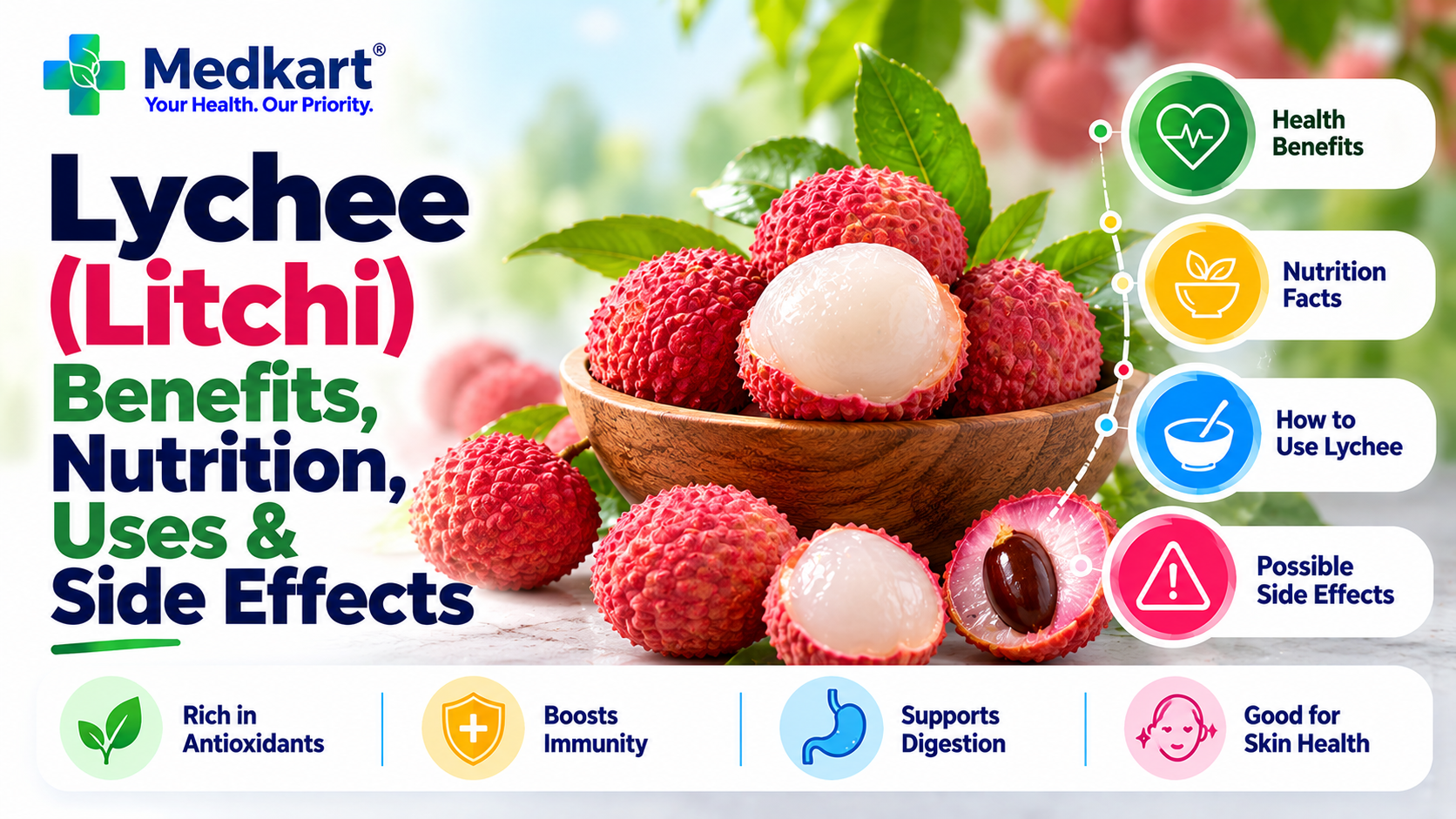
Lychee, also written litchi, is the fruit of Litchi chinensis. Most discussion of lychee fruit benefits centres on its vitamin C and its plant polyphenols.
In India it is a summer fruit from the northern and eastern states. It is also the fruit linked to a seasonal illness in children in Muzaffarpur, Bihar, so its safety needs as much space as its nutrition.
What Are the Main Lychee Uses?
Lychee is eaten for its pulp, and extracts from several parts of the plant are studied for possible health effects. A 2017 review in Nutrients[1] notes that litchi was placed on a list of functional foods in 2012.
That review names antioxidant, cancer preventive, antimicrobial and anti-inflammatory activity among the properties reported for the pulp, peel and seed.
A 2016 review in Pharmacognosy Reviews[2] covers lychee uses beyond the fruit itself. It reports work on leaf, flower, peel and seed extracts, mostly in rats, mice, hamsters and cell cultures.
Most claims about lychee fruit benefits therefore rest on laboratory and animal work rather than on people eating the fruit.
What Does Lychee Nutrition Look Like?
The figures most often quoted come from the United States Department of Agriculture database. The Nutrients review reproduces them for 100 g of fresh fruit:
- Energy: 66 kcal, the figure usually quoted for lychee calories
- Carbohydrate: 16.53 g
- Protein and fat: 0.83 g and 0.44 g
- Dietary fibre: 1.30 g
- Water: 81.76 g
Discussion of lychee fruit benefits usually starts with vitamin C, and that is where the sources disagree. Pharmacognosy Reviews gives 72 mg per 100 g and says that about nine peeled lychees meet an adult’s daily vitamin C requirement.
The Nutrients review quotes a separate study at 10.1 mg ascorbic acid equivalent per 100 g. Neither source explains the gap between the two analyses.
None of these figures is attributed to fruit grown in India. No Indian food composition entry for lychee could be retrieved for this article.
What Does the Evidence on Lychee Fruit Benefits Show?
Very little of it comes from people eating the fruit.
| Use | What the evidence says |
| Antioxidant and anticancer activity | The Nutrients review states that the biological activity of litchi components has mainly been studied as cytotoxicity in laboratory models. It presents this work as a basis for future translational studies. |
| Liver, heart and weight effects | Pharmacognosy Reviews reports liver protection from leaf extract in rats, and cardiovascular and anti-obesity effects from flower extract in hamsters and rats. |
| Exercise endurance | A double-blind trial[3] gave 59 regularly exercising men 200 mg a day of an oligomerised lychee fruit extract for 30 days. Running time at 80% of maximum heart rate rose by 3.87 minutes, but the extract was processed together with green tea extract. |
| Benefits of eating lychee as fruit | No source retrieved for this article tested whether eating fresh lychee improves a health outcome in people. |
The trial tested a processed extract at a fixed daily amount. Its result does not describe the benefits of eating lychee from the market.
How Much Lychee Is It Reasonable to Eat?
No source retrieved for this article sets a recommended amount of lychee for adults or children.
The nine-fruit figure in Pharmacognosy Reviews describes vitamin C content. It is nutrient information, not a serving recommendation.
The only quantity advice comes from India. A case-control study in The Lancet Global Health[4], carried out in Muzaffarpur, recommended minimising litchi consumption there, together with making sure children ate an evening meal.
When Should You Eat Lychee?
No source gives a best time of day. The Indian research does link illness to lychee eaten by children who had missed a meal.
A journal club in an Indian paediatrics journal[5] reviewed the Muzaffarpur study. It notes that the absence of an evening meal was associated with the disease and significantly modified the effect of eating litchi.
Those findings come from children admitted to hospital in one district. The sources do not say whether the same applies to well-fed adults elsewhere.
When Is Lychee Season in India?
Lychee season in India runs through May and June in the northern and eastern states. Scientists at the ICAR National Research Centre on Litchi in Muzaffarpur report this in Indian Horticulture[6].
They describe that period as hot and dry, with desiccating winds that can cause sunburn and cracking of the fruit.
The season also has a public health side. A CDC report[7] notes that the harvest in Muzaffarpur lasts about a month, and that the childhood illness there peaks in June and declines with the monsoon rains.
What Lychee Side Effects Are Reported?
The retrieved sources describe two kinds of lychee side effects: allergic reactions, and low blood sugar with brain injury in children in one region.
Allergy appears to be uncommon. A case report in a paediatric allergy journal[8] says very few reactions to lychee have been published.
It describes a 12-year-old girl with lip swelling, itching, widespread hives and breathing difficulty 30 minutes after a raw lychee. The authors also showed cross-reactivity between lychee and latex.
What Happened in Muzaffarpur?
The CDC report states that outbreaks of an unexplained neurological illness with high death rates have affected young children in Muzaffarpur since 1995. In 2014 the median blood glucose on admission was 48 mg/dL, and 62% of patients were at 70 mg/dL or below.
The Lancet study found that eating litchi was associated with illness, with a matched odds ratio of 9.6. Metabolites of hypoglycin A, MCPG or both were found in 48 of 73 urine samples from sick children and in none of 15 controls.
The Nutrients review describes both compounds as toxins that cause hypoglycaemic encephalopathy. Pharmacognosy Reviews notes that MCPG is present in lychee at a lower level.
Who Should Be Careful with Lychee?
Children in litchi-growing districts during the harvest carry the clearest warning in the sources.
| Situation | What to do |
| Children in litchi-growing areas | The Lancet study advised minimising litchi consumption in Muzaffarpur and making sure children receive an evening meal. The CDC report urges families of an ill child to seek prompt medical care. |
| Unripe or fallen fruit | The Indian journal club reports a matched odds ratio of 7.9 for eating unripe litchi. Fallen litchis had been eaten by 22 cases and by no controls. |
| Latex allergy | The case report authors suggest adding lychee to the foods that cross-react with latex. Anyone with a latex allergy should ask a doctor before eating it. |
| Swelling or breathing difficulty after eating it | These were the symptoms in the published allergy case. They need urgent medical attention rather than waiting to see if they settle. |
Can Lychee Interact with Medicines?
Yes. Pharmacognosy Reviews states that lychee may lower blood sugar and advises caution alongside insulin or diabetes medicines.
The same review says lychee may increase bleeding risk when taken with aspirin or with anticoagulants such as warfarin or heparin. Antiplatelet medicines are among those in Medkart’s heart care range.
No clinical interaction study was retrieved for this article.
If you take regular medicines, ask a pharmacist whether eating lychee is a concern for you.
Where Can You Buy Vitamin C Supplements Online?
Medkart lists vitamin C, the nutrient most often discussed with lychee, in several strengths. Its compositions include Vitamin C 500 mg, Vitamin C 1000 mg and Vitamin C 80 mg.
Limcee 500 mg tablets from Abbott appear among the 500 mg products. Availability, pack size and price differ between products, and ranges can change.
A strength on a pack is the amount of vitamin C in each tablet. It is product information, not a dosing instruction.
The nutritional supplements category and the medicines index show what is stocked, and Medkart’s medicine comparison tool places products side by side. Medkart states that its medicines are sourced from WHO-GMP certified manufacturers. Products can be compared on:
- Active ingredient
- Strength
- Dosage form
- Manufacturer
- Pack size
A doctor or pharmacist should be asked before a supplement is added to regular medicines.
Key takeaways
- Lychee is the fruit of Litchi chinensis, also written litchi.
- Lychee uses include eating the pulp as food and testing extracts of the leaf, flower, peel and seed in laboratories.
- Most reported lychee fruit benefits come from laboratory and animal studies rather than people eating the fruit.
- USDA figures quoted in a 2017 review put lychee calories at about 66 kcal per 100 g of fresh fruit.
- Published vitamin C figures in lychee nutrition data range from 10.1 mg to 72 mg per 100 g.
- Lychee season in India falls in May and June in the northern and eastern states.
- On how to eat lychee, the sources place the toxins mainly in the seed and tie unripe and fallen fruit to illness in children.
- Allergy to lychee is rare but can be severe, and a review warns of possible effects with diabetes and blood-thinning medicines.
FAQs: Common Questions About Lychee
Q. Is litchi the same fruit as lychee? -H3
Yes. Litchi and lychee are two spellings for the fruit of the same tree, Litchi chinensis. The Nutrients review and the Indian research mostly use litchi, while Pharmacognosy Reviews mostly uses lychee, and the ICAR centre in Muzaffarpur that studies the crop is named the National Research Centre on Litchi.
Q. Is there advice on how to eat lychee safely?
Yes. The nutrient figures quoted for the fruit refer to fresh fruit rather than the seed, and the Nutrients review places the main toxicity in the seed. The Muzaffarpur research also associated unripe and fallen fruit with illness in children.
Q. Where do most lychee calories come from?
Carbohydrate, going by the USDA figures. Each 100 g of fresh fruit carries 16.53 g of carbohydrate against less than 1 g each of protein and fat. The sources quoted here give no comparison with other fruits.
Q. Does the Muzaffarpur illness mean lychee is unsafe for everyone?
It depends on who is eating it and where. The illness was studied in young children admitted to hospital in one litchi-growing district, and the advice issued was aimed at that district. The Indian journal club judged the study well designed, but neither source extends the finding to adults who eat regular meals.
Q. Do lychee supplements offer the benefits of eating lychee fruit?
Not necessarily. The one human trial retrieved for this article used an oligomerised extract made with green tea extract and citric acid, and its endurance result belongs to that product. No retrieved source compared it with fresh fruit, so lychee fruit benefits cannot be read across from it.
Q. Can people with diabetes eat lychee?
It depends on their treatment, so it is a question for their doctor or dietitian. Pharmacognosy Reviews flags a possible fall in blood sugar for anyone on insulin or diabetes drugs. Because the review gives no amounts, it cannot tell anyone how much suits their medicines.
Q. What should someone do if their lips swell after eating lychee?
Get medical help quickly, especially if breathing becomes difficult. In the published case, a later test with half a lychee caused stridor within an hour. The girl’s second reaction followed a cake topped with fruit cocktail, which shows that lychee side effects can come from fruit hidden in mixed dishes.
References
- https://pmc.ncbi.nlm.nih.gov/articles/PMC5622752
- https://pmc.ncbi.nlm.nih.gov/articles/PMC4791990
- https://pmc.ncbi.nlm.nih.gov/articles/PMC3303472
- https://pure.psu.edu/en/publications/association-of-acute-toxic-encephalopathy-with-litchi-consumption/
- https://indianpediatrics.net/apr2017/apr-319-325.htm
- https://epubs.icar.org.in/index.php/IndHort/article/view/154091
- https://www.cdc.gov/mmwr/preview/mmwrhtml/mm6403a1.htm
- https://www.ebi.ac.uk/europepmc/webservices/rest/search?query=EXT_ID:12000501%20AND%20SRC:MED&resultType=core&format=json
Medical disclaimer: This article gives general information only. It does not replace advice from a doctor or pharmacist. No medicine or supplement should be started, stopped or changed without advice from the prescriber or a qualified pharmacist.
Leave a Reply