
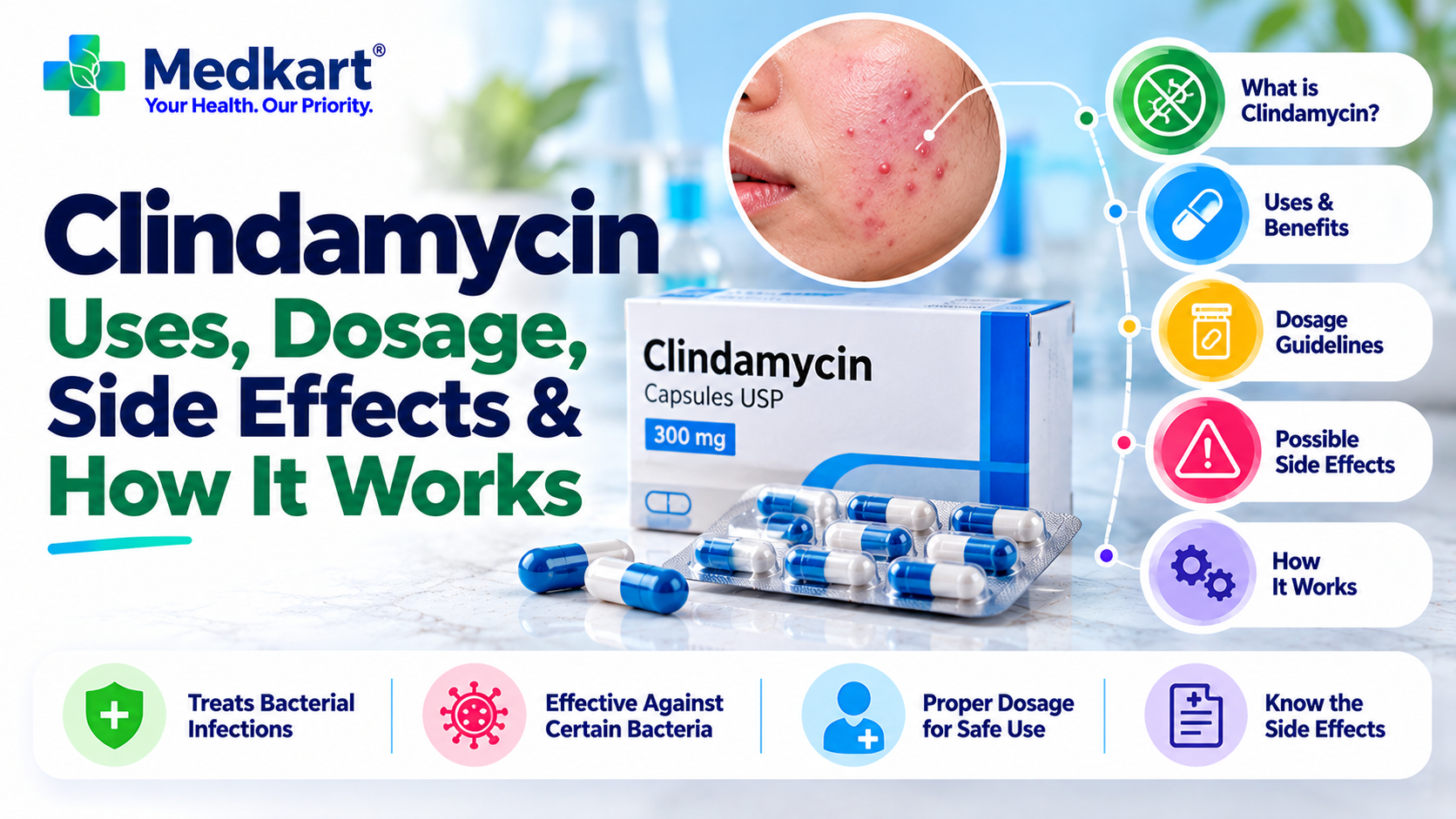
Clindamycin is the generic name of a prescription antibiotic used for selected bacterial infections. It is sold as capsules to swallow and as gels applied to the skin for acne.
Many companies in India make clindamycin products. The active ingredient is the same, but the form, strength, pack size and price are not.
What Is Clindamycin?
Clindamycin is an antibiotic that MedlinePlus[1] places in the lincomycin group and describes as a treatment for certain bacterial infections.
DailyMed[2] describes it as a semisynthetic antibacterial made by modifying lincomycin. MedlinePlus lists capsules and a liquid as the oral forms.
Topical clindamycin[3] comes as a foam, gel, solution, lotion or pledget, which is a medicated swab.
No Indian regulatory source on its schedule status could be opened for this article. Most details below come from U.S. sources, which do not describe any Indian product.
How Does Clindamycin Work?
It stops bacteria from making proteins, and DailyMed states that it does this by binding to the 50S subunit of the bacterial ribosome.
MedlinePlus says the result is that bacteria slow or stop growing. It adds that the medicine will not work for colds, flu or other viral infections.
What Are the Main Clindamycin Uses?
The main clindamycin uses are serious bacterial infections. DailyMed lists infections caused by anaerobic bacteria, and respiratory, skin and soft tissue infections caused by streptococci, pneumococci and staphylococci.
The label reserves it for people allergic to penicillin, or for cases where penicillin is unsuitable. It states that the medicine is not for nonbacterial infections, such as most upper respiratory tract infections.
Its uses extend beyond these, and MedlinePlus says it is sometimes used for acne, anthrax, malaria and toxoplasmosis, and to prevent endocarditis in people at risk.
How is clindamycin for pimples used?
It is mostly applied to the skin, and MedlinePlus states that topical clindamycin is used to treat acne. It notes that the capsules are also sometimes used for acne.
The NHS[4] includes clindamycin among the topical antibiotics for acne, which kill the bacteria behind inflamed, pus-filled spots.
A 2017 review by Indian dermatologists in the Indian Journal of Dermatology[5] says clindamycin is preferred combined with retinoids or benzoyl peroxide. Benzoyl peroxide, it adds, helps reduce resistance to topical antibiotics.
MedlinePlus also names combination products that pair clindamycin with tretinoin.
Popular brands sold in India
Several brands are sold in India, and the company names below are those shown on each Medkart listing. Medkart marks every pack as a prescription item.
| Brand Name | Active Ingredient | Available Strengths / Forms* | Manufacturer / Company |
| Dalacin C | Clindamycin | 300 mg capsules | Pfizer Pharmaceutical India Private Limited |
| Clindatime | Clindamycin | 300 mg capsules | Mankind Pharma Limited |
| Clindasure | Clindamycin | 300 mg capsules | Macleods Pharmaceuticals Private Limited |
| Clid | Clindamycin | 300 mg capsules | Bennet Pharmaceuticals Ltd |
| Camyda | Clindamycin | 300 mg capsules | Wallace Pharmaceuticals Private Limited |
| Clindate | Clindamycin | 300 mg capsules | Lucid Pharmatech LLP |
| Clindac A | Clindamycin | 1% w/w gel | Alkem Laboratories Limited |
Examples of listed strengths and forms, not a complete catalogue. Product ranges can change.
DailyMed lists U.S. capsules at 150 mg and 300 mg. Medkart’s listings for clindamycin 300 mg and clindamycin 150 mg include both capsules and injections.
How is clindamycin dosage decided?
There is no single clindamycin dosage for every prescription. The infection and its severity, the person’s age and weight, and the product all matter.
A strength such as clindamycin 300 mg is the amount of active ingredient in one capsule. It is product information, not a dosing instruction.
For adults with serious infections, the U.S. label on DailyMed gives 150 to 300 mg every six hours. For more severe infections it gives 300 to 450 mg every six hours.
For children the label gives 8 to 16 mg per kg of body weight a day, split into three or four equal doses.
MedlinePlus advises a full glass of water, 180 to 240 ml, or 6 to 8 oz, with capsules swallowed whole rather than split, chewed or crushed.
MedlinePlus says the foam and one gel brand are applied once a day, and the solution, lotion, pledgets and most gels twice a day.
What are the common clindamycin side effects?
Nausea, vomiting and a metallic or unpleasant taste are among the common clindamycin side effects listed by MedlinePlus. It also lists joint pain and vaginal discharge, burning, itching or swelling.
For the topical forms, MedlinePlus names dry or peeling skin, itching or burning, redness, oily skin, new blemishes and headache.
MedlinePlus advises urgent medical help for more serious effects, including:
- A rash, hives, or peeling or blistering skin
- Difficulty breathing or swallowing
- Yellowing of the skin or eyes
- Passing less urine
- New or worsening heartburn
DailyMed also warns of severe skin reactions, including Stevens-Johnson syndrome and toxic epidermal necrolysis, some of them fatal.
Why diarrhoea needs attention
DailyMed carries a boxed warning on Clostridioides difficile-associated diarrhoea, which ranges from mild diarrhoea to fatal colitis. It has been reported more than two months after treatment.
The label says it is more common, and may be more severe, in people over 60. MedlinePlus advises reporting watery or bloody stools, stomach cramps or fever promptly.
Why does antibiotic resistance matter?
Unnecessary use breeds resistant bacteria, and DailyMed states that prescribing clindamycin without a proven or strongly suspected bacterial infection raises that risk.
It adds that skipped doses or an unfinished course may weaken treatment and make resistance more likely. MedlinePlus advises finishing the prescription even after feeling better.
A 2016 pilot study in the Indian Journal of Dermatology[6] tested 52 acne bacteria strains from 80 Delhi patients and found 90.4% resistant to clindamycin.
The authors link this to long, widespread antibiotic use and to sale without prescription. It was a small single-hospital study, so its figures do not describe all Indian patients.
Who should be careful before starting?
Several situations need a doctor’s check before starting clindamycin.
| Situation | What to do |
| A previous allergic reaction | MedlinePlus advises telling the doctor about any allergy to clindamycin, to related antibiotics or to other medicines. |
| Colitis or other bowel disease | DailyMed advises caution in people with a history of gastrointestinal disease, particularly colitis. For the topical forms, MedlinePlus asks about inflammatory bowel disease or past severe diarrhoea with antibiotics. |
| Liver or kidney disease | MedlinePlus lists both among the conditions to mention. DailyMed says the body clears the medicine more slowly in moderate to severe liver disease, and that liver enzymes should be checked periodically when liver disease is severe. |
| Asthma, allergies or eczema | MedlinePlus lists these among the conditions the doctor should know about before treatment. |
| Pregnancy or breastfeeding | DailyMed states that clindamycin should be used in the first trimester only if clearly needed, and that it appears in breast milk. MedlinePlus advises calling the doctor if pregnancy begins during treatment. |
| Other regular medicines | DailyMed states that clindamycin may strengthen the effect of neuromuscular blocking agents. It also says medicines that inhibit or induce the CYP3A4 enzyme can raise or lower its levels. |
Anyone taking regular medicines should ask a pharmacist to check them against clindamycin first.
Generic vs brand-name clindamycin
Generic and branded clindamycin contain the same active ingredient. The US FDA[7] states that a generic matches the brand on active ingredient, strength, dosage form and route, and is bioequivalent to it.
The FDA adds that approved generics carry the same clinical benefit and risks. That is a U.S. standard, and an Indian source is needed before claiming the same for an Indian product.
Products can still differ in manufacturer, inactive ingredients, appearance and price. The same ingredient and strength alone do not prove two products are interchangeable. Any clindamycin alternative, another brand or another antibiotic, should be confirmed by a doctor or pharmacist.
Buy or compare clindamycin on Medkart
Medkart sells clindamycin capsules, gels and injections from several manufacturers, listed as prescription items. These include Dalacin C 150 mg capsules from Pfizer, Clindatime 150 mg capsules from Mankind Pharma and Clinlup gel from Lupin. The clindamycin 1% w/w listing groups the topical gels.
Medkart highlights WHO-GMP certified products across its range, and the medicines index lists what is in stock. Details a reader can compare on Medkart’s medicine comparison tool include:
- Active ingredient
- Strength
- Dosage form
- Manufacturer
- Pack size
- Current price
Any suggested alternative should be discussed with a doctor or pharmacist before changing a prescribed medicine.
Key takeaways
- Clindamycin is a lincomycin-group antibiotic that stops bacteria from making proteins.
- Its main uses are serious bacterial infections, and the U.S. label reserves it for people who cannot take penicillin.
- Topical clindamycin for pimples is preferred by Indian dermatologists in combination with a retinoid or benzoyl peroxide.
- A strength such as clindamycin 300 mg is product information, not an instruction about how much to take.
- Nausea, vomiting and a metallic taste are among the common clindamycin side effects of the capsules.
- Watery or bloody diarrhoea, during a course or weeks afterwards, needs prompt medical advice.
- A Delhi study found 90.4% of the acne bacteria strains it tested resistant to clindamycin.
- Generic and branded clindamycin share the same active ingredient, but two individual products are not automatically interchangeable.
FAQs: Common Questions About Clindamycin
Q. What is clindamycin hydrochloride, and is it a different medicine?
No. DailyMed describes clindamycin hydrochloride as a hydrated hydrochloride salt of the medicine, and that salt is what the capsules contain. A pack may show either name for the same active ingredient, and a pharmacist can confirm what a particular pack holds.
Q. What happens if a dose is missed?
It depends on how close the next dose is. MedlinePlus says a missed capsule should be taken once remembered, or skipped if the next is nearly due. A double dose should never be taken to catch up, and the same applies to the topical forms.
Q. Why should the capsules not be taken just before lying down?
Because the capsule can irritate the throat. MedlinePlus links the full glass of water to that risk and advises staying upright for 30 minutes after a dose. DailyMed likewise says the capsules should be taken at least 30 minutes before lying down.
Q. How does clindamycin work on pimples as well as on infections?
On the skin it has a second action. MedlinePlus explains that topical clindamycin slows the bacteria that cause acne and also decreases swelling. For the capsules, MedlinePlus describes the antibacterial action alone, without the effect on swelling.
Q. Can the gel be used alongside other skin products?
Yes, but some products can make its side effects worse. MedlinePlus warns that abrasive or medicated soaps and skin products containing alcohol may increase irritation. It also advises keeping the medicine away from the eyes, nose and mouth.
Q. Is there a clindamycin alternative for someone allergic to it?
Yes, but lincomycin is not one. DailyMed states that the medicine must not be used by anyone hypersensitive to it or to lincomycin, its parent compound. Choosing a different antibiotic depends on the infection, so that decision rests with the prescriber.
References
- https://medlineplus.gov/druginfo/meds/a682399.html
- https://dailymed.nlm.nih.gov/dailymed/drugInfo.cfm?setid=fadc321a-2291-4268-936f-0743fdddbe7f
- https://medlineplus.gov/druginfo/meds/a609005.html
- https://www.nhs.uk/conditions/acne/treatment/
- https://pmc.ncbi.nlm.nih.gov/articles/PMC5527713/
- https://pmc.ncbi.nlm.nih.gov/articles/PMC4763694/
- https://www.fda.gov/drugs/generic-drugs/generic-drug-facts
Medical disclaimer: This article provides general information and does not replace advice from a doctor or pharmacist. Clindamycin is a prescription antibiotic, and the clindamycin capsules and gels listed on Medkart are marked as prescription items. Brands with the same composition should only be substituted under the guidance of a healthcare professional or pharmacist because product details and approved indications can differ.
Leave a Reply