
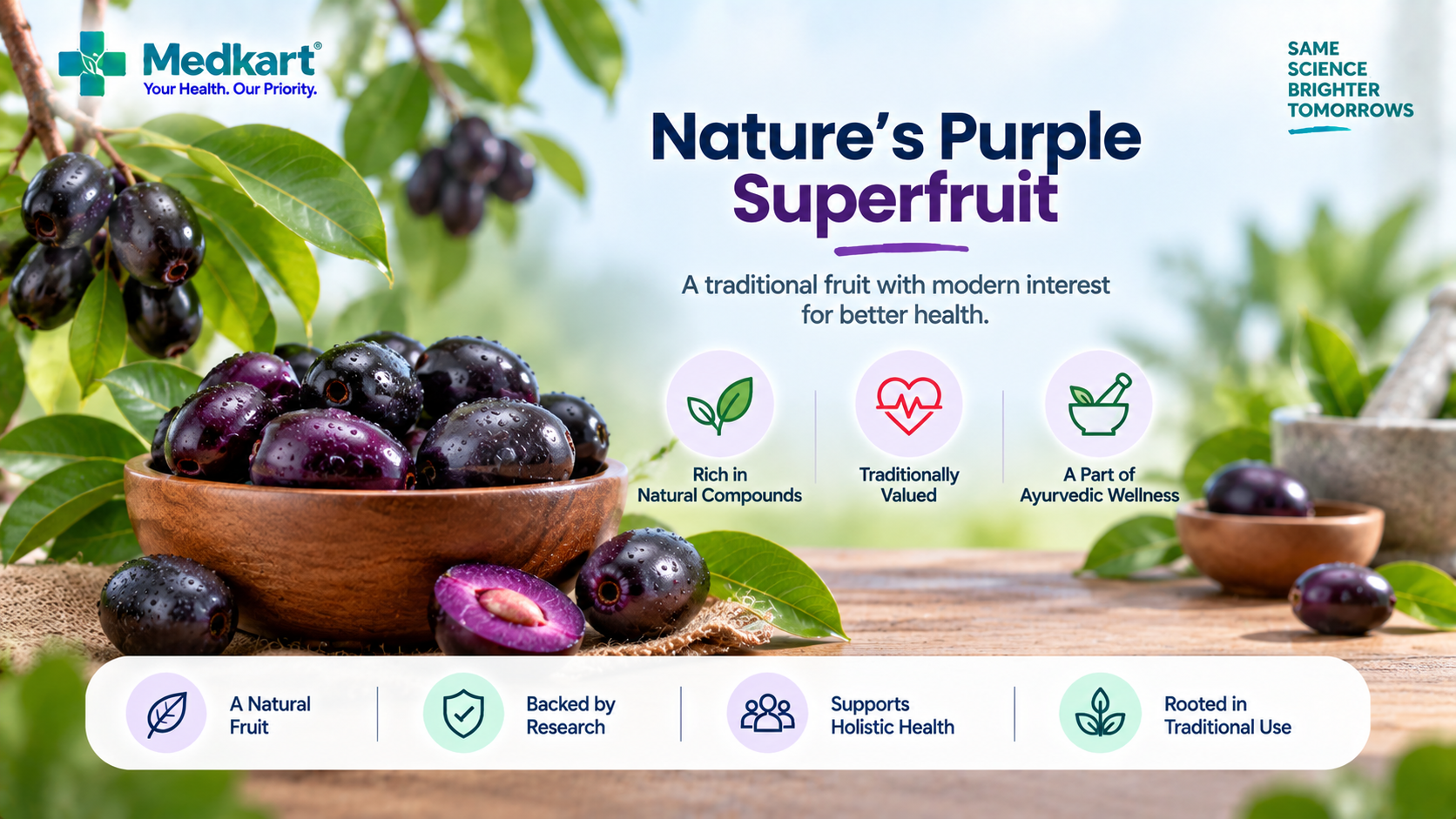
Jamun is the fruit of the tree Syzygium cumini. It is a small purple fruit, eaten fresh in season across India, and its leaves, seeds and bark have a long record of traditional use.
Most of what is written about jamun concerns blood sugar. The research behind those claims is uneven, and it matters which part of the plant a given study used.
What are the traditional uses of jamun?
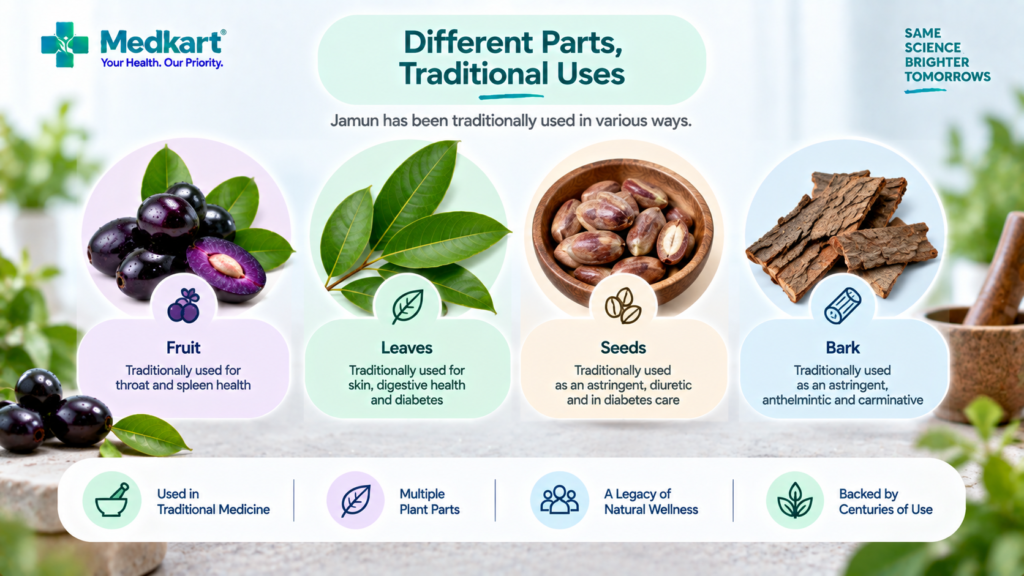
Different parts of the plant have different traditional uses. A 2015 review in Frontiers in Pharmacology[1] records the leaves being used for skin complaints, digestive complaints, constipation and diabetes.
The same review records the fruits being used for pharyngitis and disorders of the spleen, and the bark being used as an astringent, an anthelmintic and a carminative. It notes that the seeds are used as an astringent and a diuretic, and especially in the treatment of diabetes.
A review of the genus Syzygium[2] records S. cumini being used for diarrhoea, dysentery, menorrhagia, asthma and ulcers. That review draws mainly on animal models rather than studies in people.
What does jamun fruit contain?
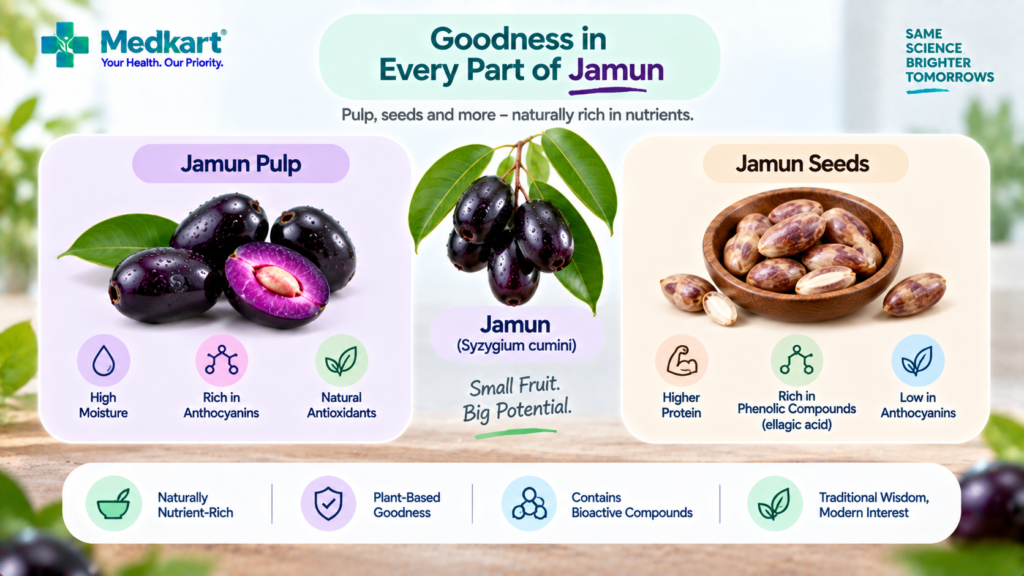
The pulp and the seed are not the same thing. A 2020 laboratory study of jamun pulp and seed[3] separated the two and measured each.
- Pulp: Reported at 83.51% moisture, with lower protein, lipid and carbohydrate content than the seed
- Seed: Reported at 62.25% moisture, with 19.96% protein, 2.47% lipids and 14.95% carbohydrates
- Phenolic compounds: Measured at 22.59 mg GAE per g in the seed against 1.56 mg GAE per g in the pulp
- Anthocyanins: A study of anthocyanin-enriched jamun extracts[4] found malvidin, petunidin, delphinidin, cyanidin and peonidin in the pulp, and no anthocyanins in the seed
The same anthocyanin study broke the pulp pigments down by proportion. It found malvidin at 44.4%, petunidin at 24.2%, delphinidin at 20.3%, cyanidin at 6.6% and peonidin at 2.2%. It also reported ellagic acid and ellagitannins at 0.5% in the seed against 0.17% in the pulp.
A separate study on extracting anthocyanin from jamun pulp[5] reported a total monomeric anthocyanin content of 10.58 mg per 100 g under its optimised extraction conditions. That is an extraction result rather than a food label figure.
Those numbers come from individual research papers, not from a national food composition table. Standard nutrient values for jamun would need an Indian food composition source.
What does the evidence say about jamun and blood sugar?
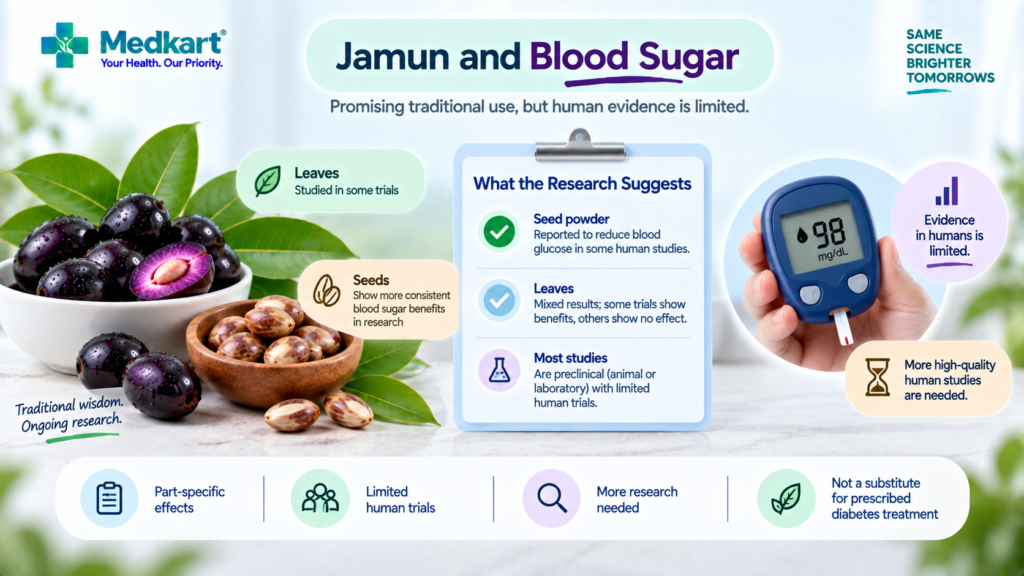
The picture depends on which part was tested, and on whether the study was in people. The table below sets out what the retrieved sources report.
| What was tested | What the evidence says |
| Seed powder in people | The 2015 review reports that capsuled seed powder given to patients with severe diabetes notably reduced blood glucose levels. |
| Leaves in people | The same review reports that a single dose of decocted dried leaves had no effect on serum glucose in young people with normal blood glucose. |
| Leaves across trials | A comprehensive review of guava and jamun leaves[6] reports reductions in fasting blood glucose across trials. It states the level of evidence is low, because of the small number of human studies and limitations including single-centre design, small sample sizes and poor methodological quality. |
| Seed extract in animals | The 2015 review describes reduced blood and urine glucose in diabetic rats given an ethanolic seed extract. Those are animal results. |
| The fruit pulp | The pulp research retrieved here is laboratory work on extracts, covering antioxidant and antimicrobial activity rather than blood glucose in people. |
The strongest human signal is for the seed, not for the fruit as it is eaten.
What the research does not show
The clinical evidence is thin. The 2015 review states that very limited data has come from clinical trials, despite the accumulated knowledge on the pharmacological properties of the plant.
Most of the remaining work is preclinical or laboratory based. The pulp and seed study tested extracts in vitro, and the review of the genus draws mainly on animal models.
No source retrieved for this article sets an amount of jamun to take, a time of day to take it, or a length of time to continue. Those figures would need a pharmacopoeial or regulatory source.
Also Read: What Is Shatavari? A Complete Guide to Its Uses and Health Benefits
What side effects can jamun cause?
The retrieved sources report little about side effects in people. The 2015 review states that S. cumini did not produce acute or chronic toxicity when given by mouth in the studies it surveyed.
It describes rodent work in which a hydroalcoholic leaf extract at doses as high as 2 g per kg produced no toxic effects. In the same work, chronic treatment for up to 180 days at 50, 100 and 250 mg per kg caused no haematological, biochemical or histological changes in target organs.
Those are animal findings. A record of side effects in people was not found in the sources retrieved for this article. Absence of a record is not the same as evidence of safety.
Who should be careful with jamun?
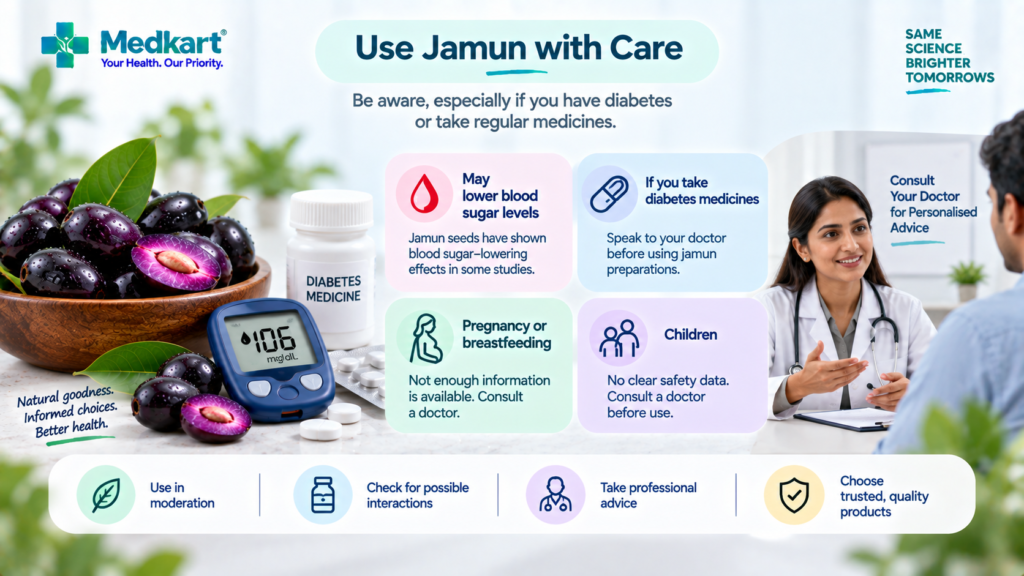
Blood sugar is where the caution sits. The concern is not the fruit at a meal, but concentrated preparations taken alongside treatment.
| Situation | What to do |
| Taking diabetes medicines | The 2015 review reports that seed powder reduced blood glucose in patients with severe diabetes. Anyone already taking glucose-lowering medicine should speak to a doctor before adding jamun preparations. |
| Living with diabetes | Blood glucose is the outcome most often studied with jamun. A doctor or pharmacist should be involved before it is used alongside prescribed treatment. |
| Pregnancy or breastfeeding | The sources retrieved for this article do not cover jamun in pregnancy or breastfeeding. That gap is itself a reason to ask a doctor first. |
| Children | The retrieved sources do not set an amount for children or report studies in them. |
| Concentrated products | Research used extracts and seed powder rather than the fruit as eaten. A product label and a pharmacist are the right guide for a concentrated preparation. |
If you take regular medicines, ask a pharmacist before adding a jamun preparation to them.
Can jamun affect diabetes medicines?
It may. The 2015 review reports that capsuled seed powder reduced blood glucose in patients with severe diabetes, which is the same direction of effect as a glucose-lowering medicine.
Where two things push blood glucose the same way, the combination is a question for a prescriber. It is not something to test at home by adding one to the other.
The retrieved sources do not describe formal interaction studies between jamun and named medicines. That is a gap in the evidence rather than a reassurance.
Where can you buy jamun products online?
Medkart does not sell jamun as a fresh fruit. It lists Ayurvedic preparations, and jamun appears among the ingredients of some of them.
Ashtamrut SF Diabetes Juice lists jamun, given as Syzygium cumini, among its key ingredients alongside karela, methi and amla. The Ayurvedic products category and the Ayurvedic composition listing show what is stocked. Medkart states that the medicines it sells are sourced from WHO-GMP certified manufacturers.
Medkart’s medicine comparison tool places products side by side, and the medicines index lists what is in stock. The details a reader can compare include:
- Active ingredient
- Strength
- Dosage form
- Manufacturer
- Pack size
- Current price
An Ayurvedic preparation taken alongside prescribed treatment should be discussed with a doctor or pharmacist first.
Key takeaways
- Jamun is the fruit of Syzygium cumini, known in English as the Indian blackberry.
- Traditional use covers the leaves, seeds, fruit and bark, with the seed most associated with diabetes.
- Laboratory work reports anthocyanins in the pulp and a much higher phenolic content in the seed.
- Human evidence on blood sugar comes mainly from seed powder and leaves, not from the fruit as it is eaten.
- A review of guava and jamun leaves rates the level of evidence as low.
- A 2015 review states that very limited data has come from clinical trials.
- No source retrieved for this article sets an amount of jamun to take or how long to take it.
- Anyone taking diabetes medicine should speak to a doctor before adding jamun preparations.
FAQs: Common Questions About Jamun
Q. What else is jamun called?
It has several names. The 2015 review gives jamun as the Indian name, black plum as the European one, jambolan in Spanish-speaking countries and jambolão in Brazil. The botanical name is Syzygium cumini, and older papers sometimes use Eugenia jambolana for the same plant.
Q. Does eating the fruit do the same as the seed powder used in studies?
There is no evidence retrieved here that equates the two. The human results in the 2015 review come from capsuled seed powder, which is a concentrated preparation of a different part of the plant. Eating the fruit in season is not the same intervention, and no source retrieved for this article measured it that way.
Q. Is the seed more active than the pulp?
By the laboratory measures used, yes. The study of anthocyanin-enriched extracts reported antioxidant capacity of 3,379 trolox equivalents per gram for the seed against 1,445 for the pulp. The 2020 study found total phenolic compounds far higher in the seed than in the pulp, though both figures come from laboratory assays rather than from people.
Q. Can jamun replace a diabetes medicine?
No. Nothing in the sources retrieved for this article supports using jamun in place of prescribed treatment, and the reviews describe the clinical evidence as limited. A prescribed medicine should only be stopped or changed on the advice of the prescriber.
Q. Why do laboratory results not always apply to people?
Because a compound that acts in a dish or in a rat may behave differently in the body. The reviews retrieved here make that point about jamun directly, describing the human data as very limited and rating the level of evidence as low. That is why the study type matters as much as the finding.
Q. Is jamun safe to eat as an ordinary fruit?
It is eaten as a seasonal fruit across India, and the toxicity work described in the 2015 review found no acute or chronic toxicity by mouth in animals. The retrieved sources do not raise a concern about the fruit as food. Concentrated preparations are a separate question, and one for a pharmacist.
References
- https://pmc.ncbi.nlm.nih.gov/articles/PMC4630574/
- https://pmc.ncbi.nlm.nih.gov/articles/PMC9179155/
- https://pmc.ncbi.nlm.nih.gov/articles/PMC7266875/
- https://pmc.ncbi.nlm.nih.gov/articles/PMC3351850/
- https://pmc.ncbi.nlm.nih.gov/articles/PMC4444889/
- https://pmc.ncbi.nlm.nih.gov/articles/PMC12213247/
Medical disclaimer: This article gives general information only. It does not replace advice from a doctor or pharmacist. No medicine or supplement should be started, stopped or changed without advice from the prescriber or a qualified pharmacist.
Leave a Reply