

Ibuprofen is the generic name of a painkiller that also reduces inflammation. It is a prescription medicine in India, sold under several brand names as tablets and as a liquid.
Those products are made by different companies. The active ingredient is the same across them, but the strength, pack size and price are not.
What is ibuprofen?
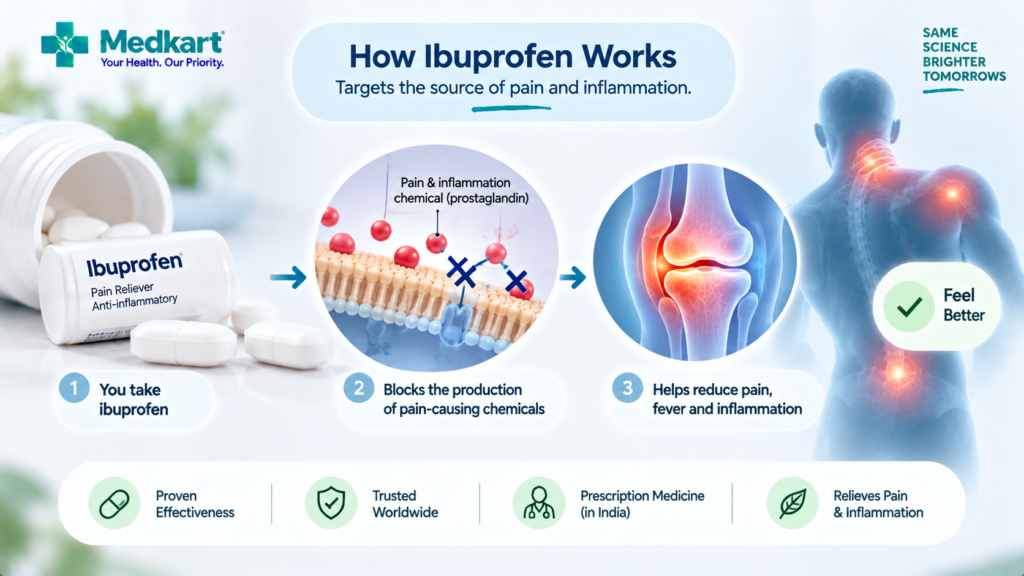
Ibuprofen is a non-steroidal anti-inflammatory drug. MedlinePlus[1] explains that it works by stopping the body’s production of a substance that causes pain, fever and inflammation.
The NHS[2] describes it as a painkiller that also reduces swelling and inflammation. It lists tablets and capsules, gels and sprays, liquid, and granules among the forms sold.
Its status in India is set by the Drugs Rules, 1945[3]. Ibuprofen appears at entry 244 in Schedule H, the schedule of prescription drugs. Rule 97 requires the pack to carry the symbol Rx and a warning against retail sale without a doctor’s prescription.
What are the main ibuprofen uses?

Ibuprofen is used for pain, fever and inflammation. The NHS names headaches and migraines, joint and muscle pain, pain after an injury, toothache, period pain and a high temperature.
DailyMed’s prescribing information[4] lists three approved uses for the tablets. They are relief of the signs and symptoms of rheumatoid arthritis and osteoarthritis, relief of mild to moderate pain, and treatment of primary dysmenorrhoea.
MedlinePlus separates prescription ibuprofen, used for arthritis pain and for mild to moderate pain, from non-prescription ibuprofen, used to reduce fever and relieve minor aches. That split describes United States products. In India ibuprofen sits in Schedule H, so that non-prescription category does not apply.
Popular brands containing ibuprofen
Several ibuprofen brands are sold in India. The company names below are those shown on the Medkart listing for each pack.
| Brand Name | Active Ingredient | Available Strengths / Forms* | Manufacturer / Company |
| Brufen 200 | Ibuprofen | 200 mg tablets | Abbott Health Care Private Limited |
| Brufen 400 | Ibuprofen | 400 mg tablets | Abbott Health Care Private Limited |
| Ibugesic 200 | Ibuprofen | 200 mg tablets | Cipla Pharmaceutical Company Limited |
| Ibugesic RTU | Ibuprofen | oral solution | Cipla Pharmaceutical Company Limited |
| Ibuprofen | Ibuprofen | 400 mg tablets | Torque Pharmaceuticals Pvt Ltd |
Examples of listed strengths and forms, not a complete catalogue. Product ranges can change.
Availability and pack size differ between products. The range sold under any one brand can change.
Ibuprofen composition and available strengths
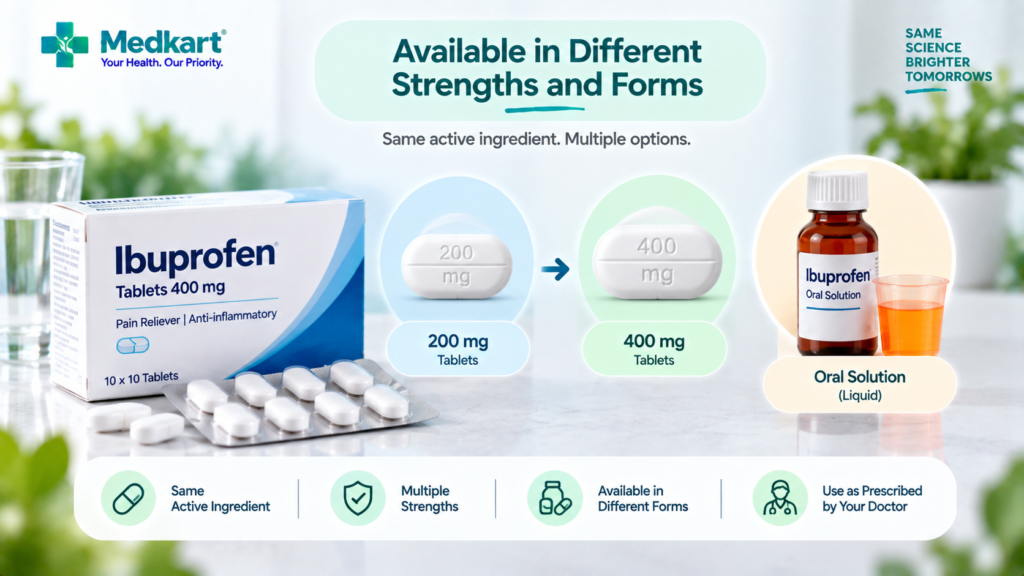
Ibuprofen tablets are commonly sold at strengths of 200 mg and 400 mg. NHS guidance on how and when to take ibuprofen[5] describes both strengths as tablets and capsules, alongside gel, spray, liquid and granules.
DailyMed’s prescribing information describes prescription tablets at 400 mg, 600 mg and 800 mg. Those higher strengths belong to a United States label, not to Indian products.
A strength such as ibuprofen 400 mg describes the amount of active ingredient in that product. It is product information, not a dosing instruction.
Medkart’s listings for ibuprofen 400 mg and ibuprofen 200 mg show tablets and an oral solution among the forms stocked.
Also Read: Ibugesic Plus: Dosage Instructions, Benefits & Side Effects
How is ibuprofen dosage decided?
There is no one dose that applies to every ibuprofen prescription. The condition, the strength and the length of treatment all come into it.
DailyMed’s prescribing information gives 400 mg every four to six hours as needed for mild to moderate pain. For rheumatoid arthritis and osteoarthritis it gives 1,200 to 3,200 mg a day, with 3,200 mg as the maximum. It also says to use the lowest effective dose for the shortest duration.
The NHS describes smaller amounts for the pharmacy strengths. It gives one or two 200 mg tablets up to three times a day, or one 400 mg tablet up to three times a day. It also asks for at least four hours between doses.
Those two sets of figures describe different products in different countries. MedlinePlus advises swallowing the tablet whole rather than chewing or crushing it. What applies to one person is a decision for the prescriber.
What are the common ibuprofen side effects?
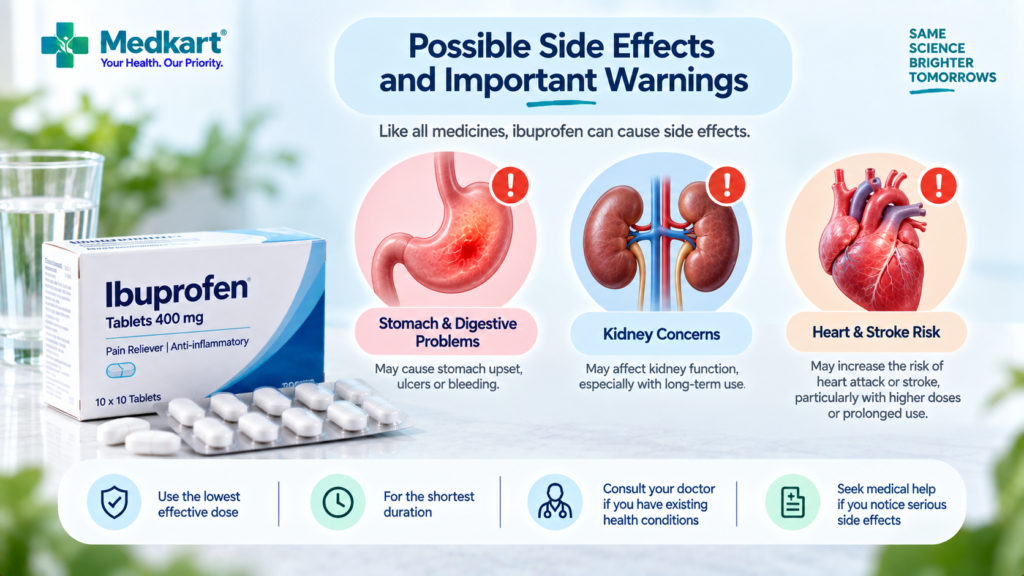
Stomach upset is the most commonly reported problem. NHS guidance on ibuprofen side effects[6] lists indigestion and stomach aches, feeling sick or being sick, headaches, a rash, dizziness, and diarrhoea or constipation.
MedlinePlus lists constipation, wind, bloating, dizziness, nervousness and ringing in the ears among its common effects.
The NHS lists serious effects that need urgent attention, including:
- Stomach ulcers or bleeding, with tummy pain, vomiting blood, or stools that are black and tar-like
- Kidney problems, with blood in the urine or swelling of the ankles, feet or hands
- Shortness of breath or unusual paleness
- A swollen throat or tongue, a raised itchy rash, or difficulty breathing
The NHS states that the risk of serious side effects is higher on a high dose, or when ibuprofen is taken for a long time.
Why the stomach and heart warnings matter
Ibuprofen belongs to a drug class that carries two standing warnings. MedlinePlus states that people who take NSAIDs other than aspirin may have a higher risk of a heart attack or a stroke than people who do not take them.
The same warning says NSAIDs such as ibuprofen may cause ulcers, bleeding, or holes in the oesophagus, stomach or intestine. DailyMed carries both points as a boxed warning, and adds that gastrointestinal bleeding can happen at any time during use and without warning symptoms.
MedlinePlus notes that the risk is higher with long-term use, higher doses, older age, smoking and drinking alcohol. DailyMed adds that the cardiovascular risk may increase with the duration of use.
Who should not take ibuprofen?
Several groups are told not to take it at all. NHS guidance on who can and cannot take ibuprofen[7] says most adults can use it, and then sets out the situations where it is not suitable.
| Situation | What to do |
| A past reaction to aspirin or an NSAID | The NHS lists a previous allergic reaction to ibuprofen, aspirin or another NSAID among the situations where ibuprofen is not suitable. DailyMed contraindicates it in anyone with a history of asthma, hives or allergic reactions after aspirin or an NSAID. |
| A stomach ulcer, now or in the past | The NHS lists a current or past stomach ulcer among the situations where ibuprofen is not suitable. DailyMed’s boxed warning covers bleeding, ulceration and perforation of the stomach or intestines. |
| Heart, liver or kidney conditions | The NHS lists all three among the situations where ibuprofen is not suitable. DailyMed warns that NSAIDs can bring on or worsen high blood pressure, and that long-term use can injure the kidneys. |
| Pregnancy or trying to conceive | The NHS lists both among the situations where ibuprofen is not suitable. MedlinePlus advises avoiding ibuprofen at around 20 weeks of pregnancy and later. |
| Heart bypass surgery | DailyMed contraindicates ibuprofen for pain around the time of coronary artery bypass graft surgery. |
| Other regular medicines | The NHS says to check with a doctor or pharmacist before taking ibuprofen alongside anticoagulants, steroid medicines, antidepressants or blood pressure medicines. |
The NHS also says anyone who is breastfeeding should check with a pharmacist or doctor before using ibuprofen.
Generic ibuprofen vs brand-name ibuprofen
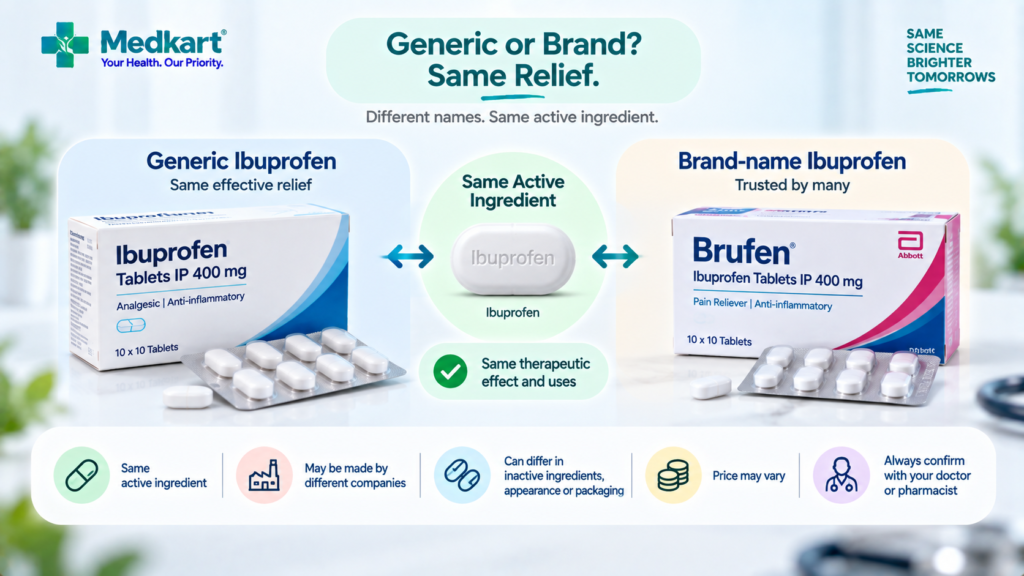
Generic and branded ibuprofen contain the same active ingredient. The US FDA[8] states that a generic medicine matches the brand-name medicine on active ingredient, strength, dosage form and route of administration, and is bioequivalent to it.
The FDA adds that approved generics provide the same clinical benefit and risks as their brand-name counterparts. That is the U.S. FDA standard, and an India-specific regulatory source is needed before making the same claim about an Indian product.
Products can still differ in manufacturer, inactive ingredients, appearance and price. The same active ingredient and strength alone do not prove that two products are interchangeable. A doctor or pharmacist should confirm any switch between brands.
Buy or compare ibuprofen tablets on Medkart
Medkart sells ibuprofen products online in several brands and pack sizes, including Brufen 400 mg in a pack of 15, and lists them as prescription items. Medkart states that the medicines it sells are sourced from WHO-GMP certified manufacturers.
Medkart’s medicine comparison tool places products side by side, and the medicines index lists what is in stock. The details a reader can compare include:
- Active ingredient
- Strength
- Dosage form
- Manufacturer
- Pack size
- Current price
Any suggested alternative should be discussed with a doctor or pharmacist before changing a prescribed medicine.
Key takeaways
- Ibuprofen is a non-steroidal anti-inflammatory drug used for pain, fever and inflammation.
- Ibuprofen is listed at entry 244 in Schedule H of India’s Drugs Rules, 1945, which makes it a prescription drug.
- A strength such as ibuprofen 400 mg is product information, not an instruction about how much to take.
- Indigestion and stomach ache are among the most commonly reported side effects.
- NSAIDs other than aspirin carry a stated risk of heart attack and stroke.
- The same class can cause ulcers, bleeding or perforation in the stomach or intestine, sometimes without warning symptoms.
- The risk of serious effects rises with higher doses, longer use, older age, smoking and alcohol.
- A past reaction to aspirin or an NSAID, a stomach ulcer and pregnancy are among the reasons ibuprofen is not suitable.
FAQs: Common Questions About Ibuprofen
Q. Can ibuprofen be taken at the same time as paracetamol?
For adults, yes. NHS guidance on common questions about ibuprofen[9] says adults can take ibuprofen at the same time as paracetamol if needed. It adds that it is worth trying them separately first, to see whether one alone relieves the pain. That advice covers two different medicines, not two NSAIDs, which the NHS advises against combining.
Q. How long can ibuprofen be taken for?
Not long without advice. The NHS says ibuprofen tablets and capsules should not be taken for more than 10 days unless a doctor advises it. It also says the smallest dose needed should be taken for the shortest time needed. Pain still there after that point is a reason to see a doctor.
Q. Should ibuprofen be taken with food?
Yes. MedlinePlus advises taking ibuprofen with food to prevent stomach upset. The NHS says tablets and capsules should be swallowed with water, ideally with or after food. Neither source presents food as a substitute for the drug class precautions.
Q. What happens if too much ibuprofen is taken?
It can be dangerous. The NHS advises getting advice when more than the recommended amount has been taken, because an ibuprofen overdose can sometimes cause harm. The right step is to contact a doctor, a pharmacist or a hospital straight away rather than waiting to see what develops.
Q. Can ibuprofen be given to a child?
That is a decision for a doctor. MedlinePlus describes non-prescription ibuprofen being given to children and infants every six to eight hours, with no more than four doses in 24 hours. Those directions describe United States products, and the NHS keeps its advice for children on a separate page. In India ibuprofen is a Schedule H medicine, so a prescriber decides whether a child takes it at all.
Q. Do ibuprofen gels and sprays carry the same risks as the tablets?
They are less likely to cause side effects. NHS guidance on ibuprofen side effects says side effects are less likely with the gel or spray than with tablets, capsules, liquid or granules. That is a statement about likelihood, not a claim that the skin preparations carry no risk. A pharmacist can say which form suits a situation.
References
- https://medlineplus.gov/druginfo/meds/a682159.html
- https://www.nhs.uk/medicines/ibuprofen-for-adults/
- https://cdsco.gov.in/opencms/resources/UploadCDSCOWeb/2022/drug_rules/Drugs%20Rules,%201945%20(1).pdf
- https://dailymed.nlm.nih.gov/dailymed/drugInfo.cfm?setid=0396bfec-afe1-460c-8141-e8ad877b4bc0
- https://www.nhs.uk/medicines/ibuprofen-for-adults/how-and-when-to-take-ibuprofen/
- https://www.nhs.uk/medicines/ibuprofen-for-adults/side-effects-of-ibuprofen/
- https://www.nhs.uk/medicines/ibuprofen-for-adults/who-can-and-cannot-take-ibuprofen/
- https://www.fda.gov/drugs/generic-drugs/generic-drug-facts
- https://www.nhs.uk/medicines/ibuprofen-for-adults/common-questions-about-ibuprofen-for-adults/
Medical disclaimer: This article provides general information and does not replace advice from a doctor or pharmacist. Ibuprofen is a non-steroidal anti-inflammatory drug listed in Schedule H of India’s Drugs Rules, 1945, so ibuprofen products in India are prescription medicines. Brands with the same composition should only be substituted under the guidance of a healthcare professional or pharmacist because product details and approved indications can differ.
Leave a Reply