
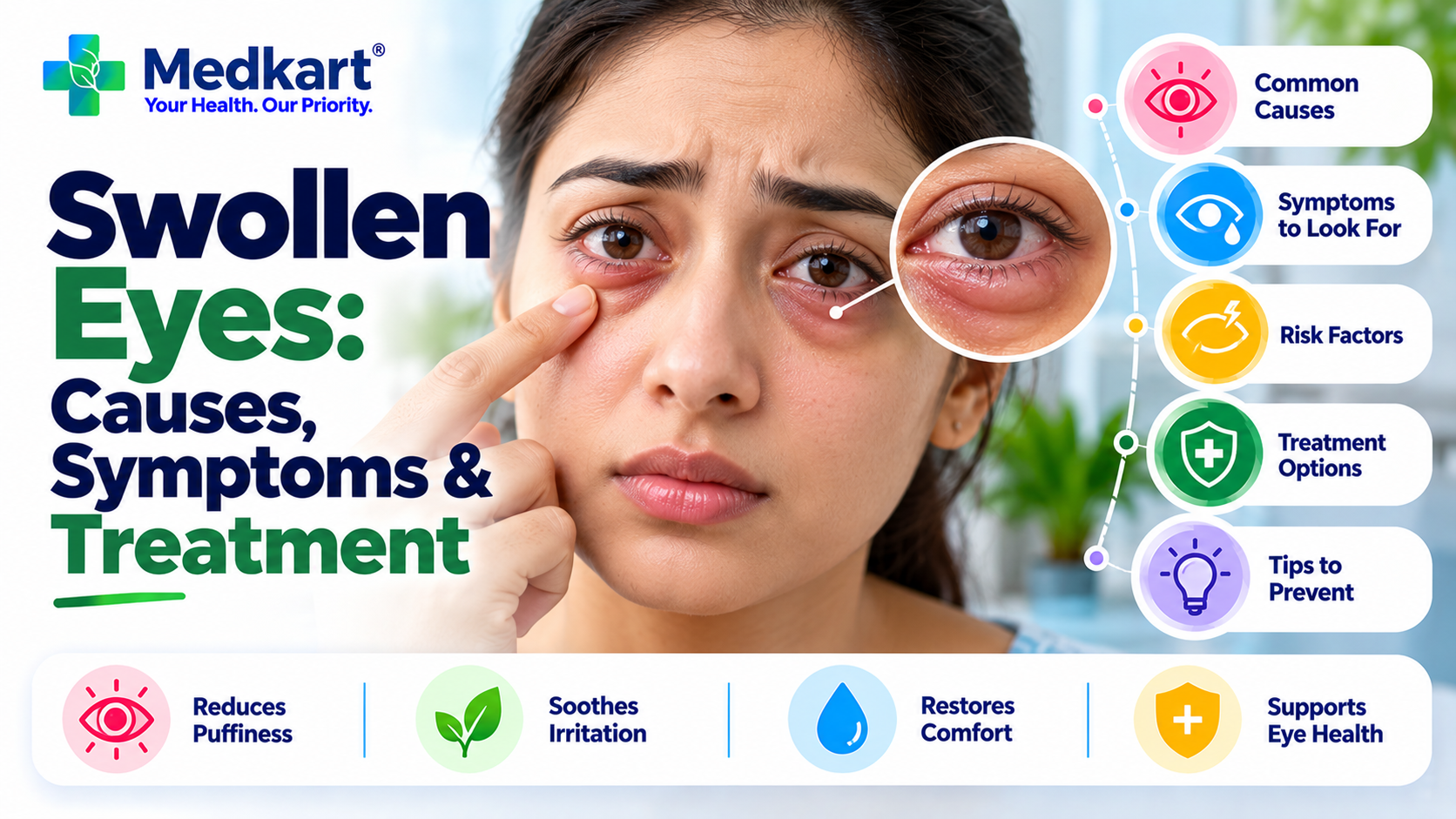
Swollen eyes are a common reason to look up health information. The swelling is a sign rather than a single disease, and it has several possible causes.
Most causes sit in the eyelid or the thin layer covering the eye, while a few involve deeper infection or a condition elsewhere in the body.
What Are Swollen Eyes?
Swollen eyes are not a diagnosis in their own right, and the phrase describes swelling of the eyelids or the tissue around the eye.
The NHS[1] places a swollen eyelid under eyelid problems, and MedlinePlus[2] uses the term puffy eyelids when describing allergic conjunctivitis.
No retrieved source uses swollen eyes as a clinical term, so this article follows each source’s wording.
Which Swollen Eyes Symptoms Do the Sources Describe?
Itching, lumps, crusts, redness, bulging and fever, each linked to a different cause.
| Feature | What the sources say |
| Itching and morning puffiness | MedlinePlus lists intense itching or burning, red eyes and puffy eyelids, most often in the morning, among the symptoms of allergic conjunctivitis. |
| A painful lump on the eyelid | The NHS stye page[3] describes a small, painful lump with swollen, red skin around it that may fill with yellow pus, usually in one eye. |
| Crusts at the lash line | The NHS blepharitis page[4] lists swollen, itchy eyelids with flakes or crusts around the roots of the lashes. |
| A red, hot, painful eyelid | The NHS lists a hot, painful and swollen eyelid under cellulitis. |
| Bulging eyes | The NHS overactive thyroid page[5] lists red, swollen or pulled-back eyelids and bulging eyes among the features of thyroid eye disease. |
| Fever with swelling | MedlinePlus[6] describes painful eyelid swelling, bulging, pain on eye movement and fever in orbital cellulitis, an infection of the fat and muscles around the eye. |
These swollen eyes symptoms are features the sources link to particular causes, not a test anyone can apply to themselves.
Why Are My Eyes Swollen?
The sources name several swollen eyes causes, and most sit in or on the eyelid. The NHS lists a stye or a meibomian cyst, also called a chalazion. It also names allergy, blepharitis, conjunctivitis, insect bites and injury.
The NHS conjunctivitis page[7] describes conjunctivitis as an infection or an allergic reaction, and notes that sticky discharge or grittiness tends to point to infection. MedlinePlus explains that allergic swelling follows contact with pollen, dust mites, pet dander or mould.
Some causes lie outside the eye. The NHS states that thyroid eye disease affects around 1 in 4 people whose overactive thyroid comes from Graves’ disease. In children with nephrotic syndrome, a kidney condition, the NHS[8] says swelling usually shows first around the eyes.
MedlinePlus notes that orbital cellulitis in children often starts from a sinus infection.
How Are Swollen Eyes Diagnosed?
By finding the cause, since no retrieved source sets diagnostic criteria for the swelling itself. Diagnosis is therefore described here cause by cause.
For orbital cellulitis, MedlinePlus lists a blood count, a blood culture and a CT or MRI scan, while for children with nephrotic syndrome the NHS describes urine dipstick tests for protein.
A 2024 Raipur study[9] used a case definition for acute conjunctivitis. It required redness, watering, discomfort and pain, with or without swelling, and no history of injury.
How Common Are Swollen Eyes in India?
No national figure for swollen eyes in India was retrieved for this article, but Indian research does record swelling during eye infection outbreaks.
A 2024 study in Intervirology[10] examined 128 patients from a 2023 conjunctivitis outbreak in eastern Uttar Pradesh. Eyelid swelling was recorded in 94.5 per cent, and the virus identified was coxsackievirus A24.
The Raipur survey covered 951 people in Chhattisgarh after the 2023 outbreak. It found an attack rate of 32.5 per cent, rising to 49.0 per cent in rural areas.
It also found that 51.4 per cent sought treatment from pharmacies without a prescription, while only 21.1 per cent saw an ophthalmologist.
What Is the Usual Swollen Eyes Treatment?
Swollen eyes treatment follows the cause, with every medicine below chosen and its amount set by a doctor or pharmacist.
For a stye, the NHS describes a warm compress made with a clean flannel. For blepharitis it describes daily eyelid cleaning, and says a GP may prescribe antibiotic cream, drops or tablets.
For allergic conjunctivitis, MedlinePlus says a provider may prescribe antihistamine or anti-swelling drops. It adds that mild steroid drops need an ophthalmologist referral first, so eye pressure can be measured.
The NHS states that antibiotics will not work for conjunctivitis caused by a virus or an allergy.
MedlinePlus states that most orbital cellulitis needs a hospital stay with antibiotics through a vein. For thyroid eye disease, the NHS says mild symptoms often improve as the thyroid is treated.
What Do the Sources Say About How to Reduce Swollen Eyes?
They describe self-care steps for specific causes, and none of them gives one method for how to get rid of swollen eyes. The NHS says a pharmacist can advise on a stye or conjunctivitis, and on whether a GP is needed.
For conjunctivitis, the NHS describes bathing the lids with boiled, cooled water, and a cold flannel. MedlinePlus lists cool compresses and avoiding smoke for allergic conjunctivitis, and warns that overusing decongestant drops can cause rebound congestion.
The NHS stye and blepharitis pages advise leaving out contact lenses and eye make-up while symptoms last.
Prevention rests on hygiene and avoiding triggers, and the NHS advises hand washing and not sharing towels or pillows to limit the spread of conjunctivitis.
For pollen allergy, the NHS hay fever page[11] suggests wraparound sunglasses and keeping windows closed. MedlinePlus states that the Hib vaccine prevents orbital cellulitis in most children.
No retrieved source assessed swollen eyes remedies made at home, so this article leaves them out.
When Should You See a Doctor?
See a doctor urgently if your swollen eyelid is red, hot, painful, tender or blistered, or will not open. The NHS lists these among the reasons for same-day help. Its pages name UK services, so the urgency is given here instead.
| Situation | What to do |
| Swelling with fever, or pain when you move your eye | Get emergency care the same day. MedlinePlus describes orbital cellulitis as a medical emergency, especially when fever comes with eyelid swelling. |
| Sudden loss of vision, or pain in or around your eye | Contact a doctor or an emergency department at once, as nidirect[12] advises. |
| Light sensitivity, a change in vision or a very red eye | Get urgent help. The NHS lists these among its urgent signs, together with headache, nausea or vomiting. |
| A newborn baby with a red, sticky eye | Get urgent help. The NHS includes this in the same urgent list. |
| A lump that has not gone after a few weeks | Book a doctor’s appointment. The NHS stye page gives a few weeks, and nidirect advises seeing a GP about a meibomian cyst that lasts more than a month. |
| Symptoms that are not improving or keep returning | Book a doctor’s appointment. The NHS advises seeing a GP when eyelid symptoms are not improving or last a long time. |
Do not try to burst a lump on your eyelid, because the NHS warns that this can spread infection.
What This Article Cannot Tell You
Whether any individual has the condition behind their swelling. Diagnosis needs a clinician and tests, because allergy, a blocked gland, infection and thyroid or kidney disease can all look alike.
This article cannot say whether any individual has the condition, or how serious it is. Treatment choice depends on factors this article does not know, such as the cause, age, other conditions and medicines already taken.
Most sources are UK and US pages, and the Indian studies describe one conjunctivitis outbreak rather than swollen eyes as a whole.
Where Can You Buy Prescribed Medicines on Medkart?
Once a doctor has found the cause and written a prescription, the question becomes where to fill it.
Medkart lists eye drops and other eye products in its eye care category. The medicines index and the search page show current stock. Nothing here says any of these treats the condition. Availability, pack size and price differ between products and can change.
Medkart states that its medicines are sourced from WHO-GMP certified manufacturers. Medkart’s medicine comparison tool sets products side by side, and the store locator lists Medkart’s physical pharmacies. Points worth comparing on a prescription:
- Active ingredient
- Strength
- Dosage form
- Manufacturer
- Pack size
No eye drop should be started, stopped or changed without advice from the prescriber or a pharmacist.
Key takeaways
- Swollen eyes are a sign of other conditions, not a clinical diagnosis in their own right.
- The NHS lists styes, meibomian cysts, allergy, blepharitis, conjunctivitis, cellulitis, bites and injury among the causes of a swollen eyelid.
- Swollen eyes symptoms such as itching, a lump, crusts, bulging or fever point towards different causes.
- No national Indian figure for swollen eyes was retrieved, but a 2023 outbreak study recorded eyelid swelling in 94.5 per cent of patients.
- Swollen eyes treatment depends on the cause, and every medicine involved is chosen by a doctor or pharmacist.
- The self-care steps the NHS and MedlinePlus give for how to reduce swollen eyes each belong to a named cause.
- Swelling with fever, pain, vision change or an eye that cannot open needs urgent medical care.
FAQs: Common Questions About Swollen Eyes
Q. Is there one answer to how to get rid of swollen eyes?
No, because each cause has its own approach in the sources. Warmth is described for a stye, cool water for conjunctivitis and hospital care for orbital cellulitis. Swelling from a thyroid or kidney condition depends on treating that condition.
Q. Are swollen eyes contagious?
It depends on the cause. The NHS explains that infective conjunctivitis can spread to other people, which is why it advises against sharing towels or pillows and recommends regular hand washing. Blepharitis, the NHS says, is not contagious, even though it can also leave the eyelids swollen and itchy.
Q. Can pharmacy eye drops be used without a prescription?
It depends on the drop, and some combinations carry risks. The NHS notes that a pharmacist can recommend some eye drops, but children under 2 need a GP prescription. The Raipur study notes reports of fungal keratitis, a serious corneal infection, linked to antibiotic-steroid drops.
Q. Can swollen eyes remedies replace a visit to a doctor?
No source retrieved here suggests they can. In the Raipur outbreak, 5.2 per cent used home remedies and 6.8 per cent went to unqualified practitioners. Another 13.9 per cent had no treatment at all.
Q. Why are my eyes swollen in hot, dry weather?
Pollen may be one reason. MedlinePlus states that allergic conjunctivitis can get worse on hot, dry, windy days, when pollen counts are higher. It also notes that the tendency to allergy often runs in families, and NHS hay fever advice includes sunglasses of the wraparound kind to keep pollen out.
Q. Can some swollen eyes causes affect vision?
Yes, in some cases. MedlinePlus lists optic nerve damage and vision loss among the complications of orbital cellulitis. The NHS notes that severe thyroid eye disease can threaten sight. A stye, by contrast, should not affect vision, according to the NHS.
References
- https://www.nhs.uk/conditions/eyelid-problems/
- https://medlineplus.gov/ency/article/001031.htm
- https://www.nhs.uk/conditions/stye/
- https://www.nhs.uk/conditions/blepharitis/
- https://www.nhs.uk/conditions/overactive-thyroid-hyperthyroidism/complications/
- https://medlineplus.gov/ency/article/001012.html
- https://www.nhs.uk/conditions/conjunctivitis/
- https://www.nhs.uk/conditions/nephrotic-syndrome/
- https://pmc.ncbi.nlm.nih.gov/articles/PMC11831936
- https://pmc.ncbi.nlm.nih.gov/articles/PMC11524537/
- https://www.nhs.uk/conditions/hay-fever/
- https://nidirect.gov.uk/node/10464
Medical disclaimer: This article gives general information about swollen eyes and is not a diagnosis. It cannot tell any individual whether they have swollen eyes, how severe it is, or which treatment suits them, because those decisions need a doctor and the right tests. Anyone with the symptoms described here should see a doctor rather than self-treat, and no medicine or supplement should be started, stopped or changed without advice from the prescriber or a qualified pharmacist.
Leave a Reply