
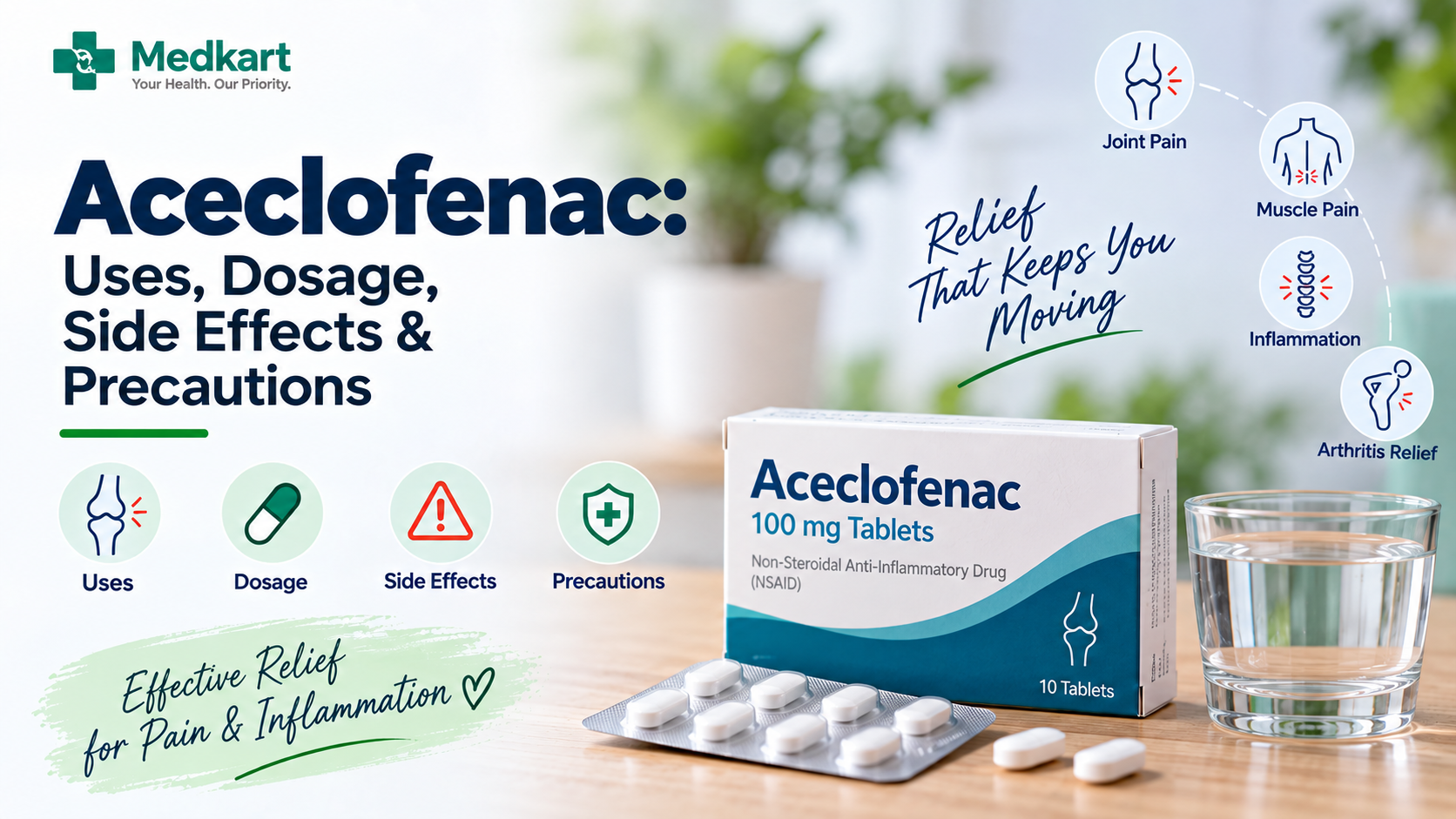
Aceclofenac is a prescription anti-inflammatory painkiller, sold in India under dozens of brand names and usually taken twice a day. It is one of the most familiar tablets in an Indian medicine cabinet.
One fact about it is not familiar, and it runs through this article. Aceclofenac has little pharmacological activity of its own, and European regulators treat it as diclofenac because that is largely what the body turns it into.
What Is Aceclofenac?
Aceclofenac is a non-steroidal anti-inflammatory drug, the class the NHS[1] describes as medicines that treat pain and reduce inflammation or fever. It is prescription-only.
Its licensed uses are specific. The UK product information[2] lists relief of pain and inflammation in osteoarthritis, rheumatoid arthritis and ankylosing spondylitis.
In India it is also approved in combinations. The CDSCO record of approved fixed dose combinations[3] includes aceclofenac with paracetamol, cleared in July 2004 for acute painful conditions in adults only.
Is Aceclofenac a Painkiller, and How Does It Work?
It is, and the way it works explains most of its safety profile. The UK medicines regulator[4] states that aceclofenac has little pharmacological activity itself, and that its main mode of action is through its metabolites, which include diclofenac.
That matters because diclofenac is the NSAID regulators watch most closely. The same regulator records that the risk of arterial thrombotic events with diclofenac is greater than with other non-selective NSAIDs and similar to the COX-2 inhibitors.
The consequence arrived in January 2015. Aceclofenac was given the same cardiovascular contraindications as diclofenac, which is the single most useful thing to know before taking it.
NSAIDs are not interchangeable on this point. The regulator’s wider advice on the class[5] states that naproxen and low-dose ibuprofen still have the most favourable cardiovascular safety profiles among the non-selective NSAIDs.
What Is the Dosage for Adults, and Is It Taken Before or After Food?
The UK product information gives a licensed adult dose of 200 mg daily, taken as two separate 100 mg doses, one in the morning and one in the evening. That is what the licence permits rather than what any individual should take.
On food the wording is clear. The tablets should be swallowed whole with plenty of water, and taken with or after food.
The patient leaflet[6] also covers a missed dose. It advises taking the next dose at the usual time, and states that a double dose should not be taken to make up for a forgotten one.
The prescriber decides the rest. Dose, duration and whether an NSAID is suitable at all depend on the person, and the CDSCO combination approvals above are for adults only.
Which Brands of Aceclofenac Are Sold in India?
The molecule is the same across them, and the price is not. These are brands listed on Medkart at the 100 mg strength.
| Brand | Marketer or manufacturer |
| Aceclo | Aristo Pharmaceuticals Private Limited |
| Hifenac | Intas Pharmaceuticals Limited |
| Movon | Ipca Laboratories Limited |
| Dolokind | Mankind Pharma Limited |
| Acemiz | Lupin Limited |
| Acenac | Medley Pharmaceuticals Limited |
Several more brands appear on the same aceclofenac listing. Availability, pack size and price differ between them and can change.
Is a Generic Aceclofenac the Same as a Branded One?
Every product in the table above contains the same active ingredient at the same strength. What differs is the name on the pack, the manufacturer and the price.
The safety information does not change with the brand. The contraindications and warnings below come from the regulator and apply to aceclofenac itself, whichever product carries it.
Also Read: What are generic medicines?
What Are the Side Effects of Aceclofenac?
The digestive tract is where most of them appear. The UK product information records gastrointestinal effects as the most common, including nausea, vomiting, diarrhoea, indigestion and abdominal pain.
The serious ones sit in the same place. It warns of gastrointestinal bleeding, ulceration and perforation, which it states can be fatal. The patient leaflet asks anyone passing black tarry stools or blood to stop and seek medical advice at once.
The NHS lists the class effects more briefly. Indigestion, stomach ache, nausea, diarrhoea, dizziness, rash and headaches are the common ones, with stomach ulcers, kidney problems and allergic reactions among the serious.
Heart and circulation are the other concern. The patient leaflet states that NSAIDs may carry a small increased risk of heart attack, and advises against exceeding the recommended dose or duration.
Who Should Not Take Aceclofenac?
The contraindication list grew in 2015, and the cardiovascular entries are the newer ones.
| Situation | What the sources say |
| Established ischaemic heart disease | The regulator added this as a contraindication for aceclofenac in January 2015. |
| Peripheral arterial disease | Named in the same 2015 contraindication list. |
| Cerebrovascular disease | Named in the same 2015 contraindication list. |
| Congestive heart failure, NYHA class II to IV | Named in the same 2015 contraindication list. |
| Active or previous stomach ulcer or gastrointestinal bleeding | The UK product information contraindicates aceclofenac in these situations. |
| Asthma or hives triggered by aspirin or another NSAID | The product information contraindicates it after such a reaction. |
| Severe liver or kidney impairment | Contraindicated in the product information. |
| Pregnancy, particularly the third trimester | Contraindicated in the third trimester, and avoided otherwise unless clearly necessary. |
That list is not a substitute for a consultation. Only the prescriber knows the rest of a person’s history and medicines.
What Precautions Apply While Taking It?
The dose principle is the same for every NSAID. Both the regulator and the product information direct that the lowest effective dose is used for the shortest time necessary to control symptoms.
Risk factors are weighed before starting rather than after. The regulator names high blood pressure, raised blood lipids, diabetes and smoking among the cardiovascular risk factors a prescriber considers.
Older people need more caution. The product information records an increased frequency of adverse reactions in the elderly, particularly gastrointestinal bleeding and perforation, which it notes may be fatal.
Other medicines matter too. The NHS advises that people taking blood thinners, steroids, antidepressants or blood pressure medicines should not take NSAIDs without advice. It adds that drinking a lot of alcohol raises the risk of stomach problems.
Where Can You Buy Aceclofenac on Medkart?
Aceclofenac is a prescription medicine, so a valid prescription is needed. Medkart sells medicines online and highlights quality credentials for its generic range.
The brands in the table above sit on one listing page, which is where their pack sizes and current prices can be seen side by side. A pharmacist can confirm whether a different listed product carries the same active ingredient at the same strength.
Nothing here says any of these treats the condition a reader has, which is a judgement for the prescriber. Medkart lists these products and does not test or approve them, and availability and price can change.
Medkart’s medicine comparison tools can be used to compare listed options on:
- Active ingredient
- Strength
- Dosage form
- Manufacturer
- Pack size
- Current price
It is also possible to search by name, browse the full medicine list, or find the nearest Medkart store.
Key Takeaways
- Aceclofenac is a prescription NSAID licensed for osteoarthritis, rheumatoid arthritis and ankylosing spondylitis.
- It has little activity of its own and works through metabolites that include diclofenac.
- In January 2015 it was given the same cardiovascular contraindications as diclofenac.
- Those contraindications cover ischaemic heart disease, peripheral arterial disease, cerebrovascular disease and heart failure.
- The licensed adult dose in the UK product information is 200 mg daily, as two 100 mg doses.
- The tablets are swallowed whole with plenty of water, with or after food.
- Gastrointestinal effects are the most common, and bleeding or perforation is the serious risk.
- The lowest effective dose for the shortest time is the principle both the regulator and the product information state.
FAQs
Q. Can aceclofenac be taken on an empty stomach?
The product information does not describe it that way. Food is named in the instruction, and the reason is the same stomach lining that the serious side effects involve. Anyone told otherwise by their prescriber should follow that instruction and ask why it differs.
Q. How is it different from diclofenac?
Less than the two names suggest. The regulator states that aceclofenac works mainly through metabolites that include diclofenac, and it carries the same cardiovascular contraindications for that reason. Treating it as a gentler option is the misunderstanding this article exists to correct.
Q. Can it be taken with paracetamol?
That combination is separately approved in India rather than something to assemble at home. The CDSCO record carries it as its own licensed product with its own wording, alongside approved combinations with drotaverine, tizanidine and thiocolchicoside. Whether a combination or a single ingredient suits a person is for the prescriber to decide.
Q. How long can aceclofenac be taken for?
No fixed period appears in the retrieved sources, and that is deliberate. Both the regulator and the product information frame it as the shortest duration necessary to control symptoms, which makes the answer specific to the person rather than to the medicine.
Q. Is aceclofenac safe in pregnancy?
The product information contraindicates it in the third trimester, and advises avoiding it at other times unless clearly necessary. It names miscarriage, cardiac malformation and effects on the baby’s kidney function among the concerns. Anyone pregnant or planning a pregnancy should raise this before taking any NSAID.
Q. Can children take aceclofenac?
The Indian combination approvals are worded for adults only, and the UK product information describes an adult dose without a paediatric one. Nothing retrieved for this article supports giving it to a child, and a child in pain needs advice specific to their age and weight.
References
- https://www.nhs.uk/conditions/nsaids/
- https://www.medicines.org.uk/emc/product/6578/smpc
- https://cdsco.gov.in/opencms/resources/UploadCDSCOWeb/2018/UploadApprovalMarketingFDC/01.07.2021%20Approved%20FDC%20list%20till%2031st%20Dec%202019.pdf
- https://www.gov.uk/drug-safety-update/aceclofenac-preservex-updated-cardiovascular-advice-in-line-with-diclofenac-and-cox-2-inhibitors
- https://www.gov.uk/drug-safety-update/non-steroidal-anti-inflammatory-drugs-nsaids-cardiovascular-risks
- https://www.medicines.org.uk/emc/product/6578/pil
Medical disclaimer: Aceclofenac is a prescription-only medicine and this article is general information rather than advice about any individual. It cannot say whether aceclofenac suits a particular person, at what dose or for how long, because that depends on a medical history the page cannot see. No one should start, stop, change or substitute this medicine, or switch between brands or combinations, without advice from the prescriber or a qualified pharmacist.
Leave a Reply