Blog

  • Sagging Breasts: Causes, Treatment Options, Exercises and Prevention

    Sagging Breasts: Causes, Treatment Options, Exercises and Prevention

    Breast shape changes over a lifetime, and the change surgeons call ptosis is the one most people mean by sagging. It is a normal structural change rather than a disease.

    Two findings from the same research group shape this article. Breastfeeding was not a risk factor for sagging, and neither was a lack of regular upper body exercise. Between them they undo most of what circulates on this subject.

    What Does Breast Sagging Mean?

    Sagging is the everyday word for ptosis, which describes the position of the breast and the nipple relative to the fold beneath the breast. Plastic surgeons grade it from standardised photographs using a published classification[1].

    That grading is done in a clinic rather than at home. It exists to plan an operation, and it is not a scale for anyone to measure themselves against in a mirror.

    The change itself is common after pregnancy. In a review of 132 women attending for breast surgery, 85% of those who had been pregnant at least once reported a change in breast shape afterwards.

    What Causes Breasts to Sag? 

    The clearest evidence comes from two studies of women attending plastic surgery clinics. The table sets out what they found, and it describes measured associations rather than a checklist for self-assessment.

    Factor What the Sources Say
    Age The 2010 review of 132 women found age a significant independent risk factor for ptosis.
    Number of pregnancies The same review found the number of pregnancies significant, and a 2008 study[2] reported that risk rises with each one.
    Body mass index Higher body mass index was a significant risk factor in both studies.
    Large weight loss A history of losing more than 50 pounds was significant in the 2010 review.
    Bra cup size A larger cup size before pregnancy was significant in both studies.
    Smoking A history of smoking was a significant independent risk factor in both studies.
    Breastfeeding Neither study found breastfeeding to be an independent risk factor.

    Four of those seven are fixed or largely fixed. Smoking and body weight are the two that a person can act on, which is why the prevention section below is shorter than most people expect.

    Does Pregnancy Change Breast Shape? 

    Pregnancy is the event most strongly associated with the change, and the direction is not uniform. In the 2010 review, 35% of women reported that their breasts had become smaller after pregnancy and 30% reported that they had become larger.

    The 2008 study puts the pattern plainly. It concludes that the risk of ptosis increases with each pregnancy, so the count matters more than any single pregnancy does.

    Also Read: Diet for breastfeeding mothers

    Does Breastfeeding Cause Sagging? 

    This is the claim the research was designed to test, and it did not hold. The 2008 study in the Aesthetic Surgery Journal reviewed 93 women who had been pregnant and were seeking breast surgery, 54 of whom had breastfed.

    Breastfeeding was not an independent risk factor for ptosis. Age, body mass index, number of pregnancies, bra size before pregnancy and smoking were, and breastfeeding was not.

    The authors say what follows from that. They write that expectant mothers should be reassured that breastfeeding does not appear to have an adverse effect upon breast appearance.

    The belief has a cost, which is why it matters. The same paper records that breastfeeding is avoided by many women because of concerns about breast appearance. The World Health Organization[3] recommends exclusive breastfeeding for the first six months, and links it to a reduced risk of ovarian and breast cancer in the mother.

    Do Exercises Help with Sagging Breasts?

    The one study that tested this found nothing. In the 2010 review, lack of participation in regular upper body exercise was examined alongside the other factors and was not a significant risk factor for ptosis.

    That is a single finding in one clinic population, so it is not the last word. What can be said is that the claim about chest exercises has no support in the retrieved evidence, and one direct test against it.

    Exercise remains worth doing for other reasons, but not as a way to change breast position.

    What Treatment Options Exist? 

    Surgery is the only treatment described in the retrieved sources. An NHS trust leaflet[4] describes mastopexy as the removal of excess skin from sagging breasts, with the nipple area repositioned higher on the reshaped breast.

    Breast reduction is the related operation. The same leaflet describes it as removing breast tissue and skin to form a smaller breast, again with the nipple moved higher.

    The scars are permanent and predictable in location. The leaflet describes them around the nipple areola, down the middle of the breast and along the crease underneath it, and notes that they usually fade over time.

    The risks are set out alongside. They include loss or reduction of nipple sensation, numbness, wound breakdown, fat necrosis and bleeding that occasionally needs a return to theatre. The leaflet also states that breastfeeding is not usually possible afterwards, because milk ducts are disrupted or lost.

    How Can Sagging Be Prevented? 

    Only two of the risk factors are modifiable, and both appear in the studies above. Smoking is the first, identified as a significant independent risk factor in both.

    Weight is the second, and it works in two directions. A higher body mass index was significant in both studies, and a history of losing more than 50 pounds was significant in the 2010 review. Large swings appear to matter as much as the level.

    Nothing else in the retrieved evidence prevents it, and no source opened here supports a cream, a supplement, a massage or an exercise for the purpose.

    When Should You See a Doctor? 

    See a GP about any change in the size or shape of one or both breasts, rather than assuming it is only sagging. The NHS[5] lists that change alongside the others below, and notes that most such symptoms have causes other than cancer.

    Situation What To Do
    A change in the size or shape of one or both breasts See a GP. The NHS lists this among the changes to get checked.
    A lump or swelling in the breast, chest or armpit See a GP. The NHS names all three sites.
    Dimpling of the skin, or skin that looks like orange peel See a GP. The NHS lists this as a skin change to report.
    A change in the shape of a nipple, or one turning inwards See a GP. The NHS names inversion and a rash on the nipple.
    Nipple discharge when not pregnant or breastfeeding See a GP, particularly if there is blood in it.
    Considering surgery Ask the questions the NHS[6] sets out, and expect a cooling-off period after the consultation.
    Feeling pressured into a procedure Walk away. The NHS states plainly that you can, if you are not completely comfortable.

    What This Article Cannot Tell You 

    It cannot say why any individual’s breasts have changed shape. The factors above were measured across groups of women attending surgical clinics, and a group finding does not explain one person.

    It cannot tell anyone whether to have surgery. That decision involves scarring, sensation, the effect on future breastfeeding and cost, and it belongs in a consultation rather than in an article.

    It cannot promise that anything prevents the change. Two risk factors are modifiable on this evidence, and neither is described in the sources as a guarantee.

    It also cannot describe the Indian picture. Both studies were conducted in clinic populations in the United States, and no Indian data on this were retrieved.

    Where Can You Buy Quit-Smoking and Everyday Health Products on Medkart? 

    Medkart lists no product shown to change breast shape, and nothing in this article suggests otherwise. What it does list covers one of the two modifiable risk factors above.

    Medkart sells medicines online and lists nicotine replacement products containing nicotine, in a second listed strength as well, including Nicotex from Cipla. Which form suits a person is a question for a pharmacist.

    Its personal care and nutritional supplements ranges cover everyday needs, and ayurvedic products are listed separately. Availability and price can change.

    Nothing here says any of these treats the condition, and Medkart lists these products rather than testing or approving them. Medkart’s medicine comparison tools can be used to compare listed options on:

    • Active ingredient
    • Strength
    • Dosage form
    • Manufacturer
    • Pack size
    • Current price

    It is also possible to search by name, browse the full medicine list, or find the nearest Medkart store.

    Key takeaways 

    • Sagging is the everyday word for ptosis, a change in breast and nipple position that surgeons grade from photographs.
    • In a review of 132 women, 85% of those who had been pregnant reported a change in breast shape afterwards.
    • Age, number of pregnancies, body mass index, large weight loss, cup size and smoking were significant risk factors.
    • Breastfeeding was not an independent risk factor in either study.
    • Lack of regular upper body exercise was not a significant risk factor either.
    • Smoking and body weight are the two factors a person can act on.
    • Mastopexy removes excess skin and repositions the nipple, leaving permanent scars in three places.
    • Breastfeeding is not usually possible after that surgery, because milk ducts are disrupted or lost.

    FAQs 

    Q. Does wearing a bra prevent sagging? 

    No source retrieved for this article tested it. The two studies opened here examined age, pregnancies, weight, cup size, smoking, breastfeeding and upper body exercise, and bra wearing was not among the factors they measured. The question is open rather than answered either way.

    Q. Can sagging be reversed without surgery? 

    Nothing retrieved describes a non-surgical method that changes breast position. The only treatments the sources set out are operations, and the closest thing to prevention is the two modifiable risk factors. Products promising a lift have nothing behind them in the material opened here.

    Q. Do creams or oils firm the breasts? 

    No study opened for this article assessed any topical product for this. Claims of that kind are common and none of them traces to the retrieved evidence. A pharmacist can check what is actually in a product before anyone spends money on it.

    Q. Is sagging after weight loss different? 

    The 2010 review treated large weight loss as its own risk factor, significant at more than 50 pounds lost. That suggests the amount of change matters, not only the weight a person settles at. Anyone planning substantial weight loss can raise the question with the clinician supervising it.

    Q. Does the change get worse with each child? 

    That is what the 2008 study concluded. Each additional pregnancy added to the risk in its analysis, which is why the count appeared as a risk factor while breastfeeding did not. The study cannot say how much change any individual will see.

    Q. Is surgery available on the NHS or covered in India? 

    The retrieved NHS material treats these as cosmetic procedures, with the trust leaflet describing the operation and the NHS advice page setting out how to check a practitioner. No Indian coverage rules were retrieved for this article, so cost and eligibility here need checking locally.

    References 

    • https://pubmed.ncbi.nlm.nih.gov/20354434/
    • https://pubmed.ncbi.nlm.nih.gov/19083576/
    • https://www.who.int/news-room/fact-sheets/detail/infant-and-young-child-feeding
    • https://www.worcsacute.nhs.uk/leaflets/mastopexy-or-breast-reduction/
    • https://www.nhs.uk/conditions/breast-cancer/symptoms/
    • https://www.nhs.uk/tests-and-treatments/cosmetic-procedures/advice/before-you-have-a-cosmetic-procedure/

    Medical disclaimer: This article gives general information about breast shape and is not a diagnosis. It cannot tell any individual why their breasts have changed or whether a change needs investigating, because that needs a doctor and an examination. Any change in the size or shape of a breast should be checked rather than assumed to be sagging, surgery carries permanent consequences that belong in a consultation, and no medicine or supplement should be started, stopped or changed without advice from the prescriber or a qualified pharmacist.
  • Doxycycline: Uses, Dosage, Side Effects, Precautions and How It Works

    Doxycycline: Uses, Dosage, Side Effects, Precautions and How It Works

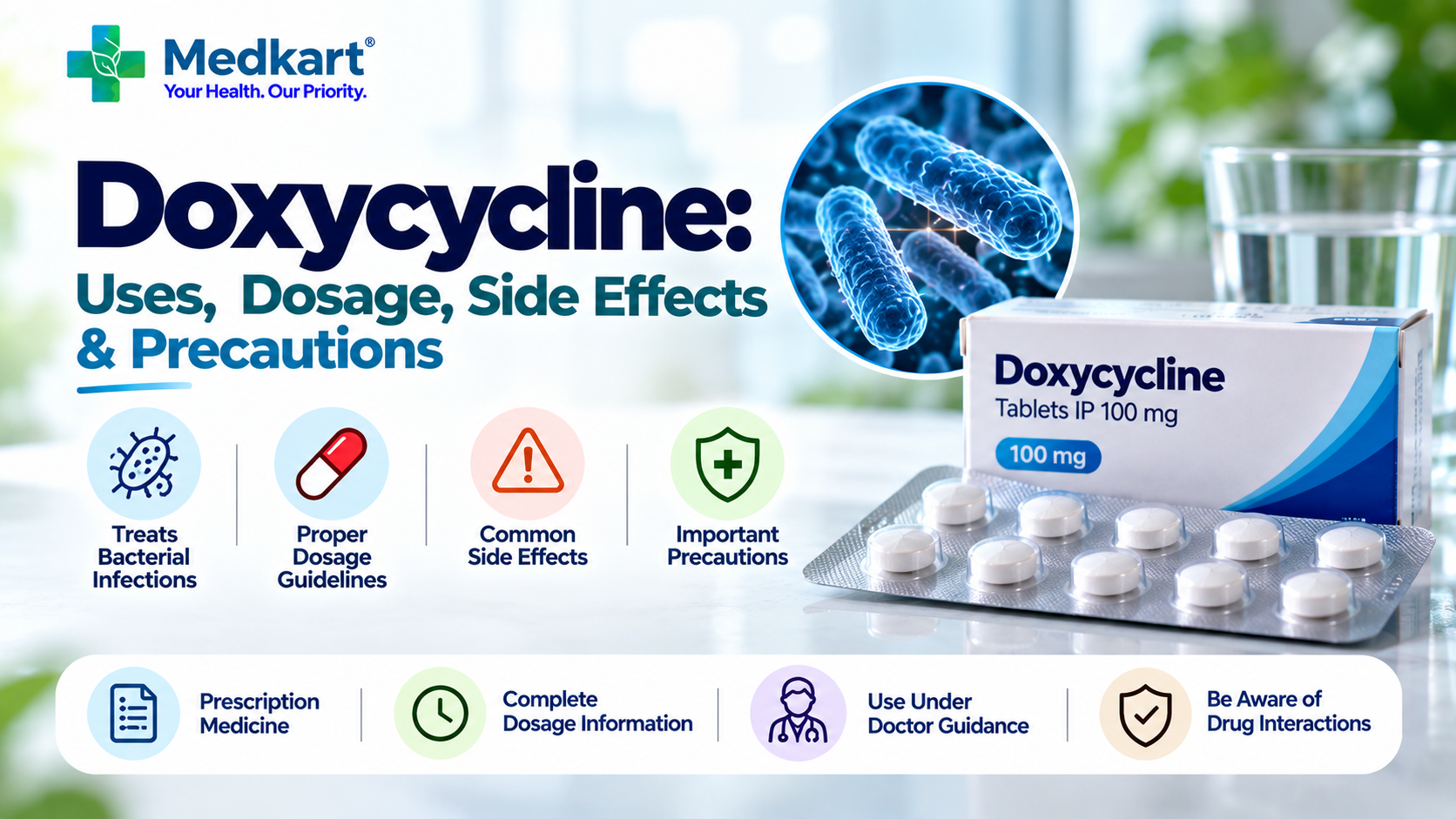
    Doxycycline is a prescription antibiotic used for a wide spread of infections, from chest and urinary infections to acne and malaria prevention. It is one of the most widely prescribed tablets in India.

    Two things about it are worth knowing before the rest. It can injure the food pipe if it is swallowed carelessly, and the official sources disagree about the age below which children should not take it.

    What Is Doxycycline, and How Does It Work?

    Doxycycline is an antibiotic in the tetracycline class. MedlinePlus[1] states that it works by stopping bacteria from growing and spreading, which is a different action from killing them outright.

    That class membership is the answer to the classification question. The UK product information[2] refers to drugs in the tetracycline class, including doxycycline, when it sets out the warnings they share.

    It does nothing against viruses. An antibiotic is prescribed for a bacterial infection, and the NHS[3] describes doxycycline as a medicine used to treat or prevent certain infections rather than illness in general.

    What Is Doxycycline Used For? 

    The licensed list is long. The UK product information names respiratory tract infections, urinary tract infections, sexually transmitted infections, skin infections and rickettsial infections, along with plague, leptospirosis and malaria prevention.

    The NHS adds the everyday ones. It names chest infections, gum infections, acne and rosacea, and preventing malaria in travellers.

    India licenses it in combinations too. The CDSCO record of approved fixed dose combinations[4] includes a doxycycline capsule with lactobacillus spores, cleared in 2007 for adults prone to abdominal bacterial infection and antibiotic-associated diarrhoea.

    What Is the Dosage for Adults?

    The UK product information gives a usual adult regimen of 200 mg on the first day, followed by a maintenance dose of 100 mg daily. For severe infections it describes 200 mg daily continued throughout.

    Acne is dosed differently and for longer. The same document describes 50 mg daily with food or fluid for six to twelve weeks.

    None of that is a self-prescription. Which regimen applies depends on the infection, and the prescriber sets both the dose and the length of the course.

    How Should Doxycycline Be Taken? 

    This is the part most often got wrong, and the reason matters. The product information directs that capsules are swallowed with plenty of water, sitting or standing, and well before going to bed.

    The warning behind that instruction is specific. It records oesophagitis and oesophageal ulceration in people taking tetracyclines, most of them having taken the medicine immediately before lying down or with too little fluid.

    On food the patient leaflet[5] is the clearest of the sources. It states that for infections the capsules can be taken with or without food, and that for acne they are taken with food or a drink. Food or milk is recommended if they upset the stomach.

    Timing against other medicines matters more than most people realise. The same leaflet names antacids, iron preparations, oral zinc and bismuth as reducing how well doxycycline works. It states they should not be taken at the same time of day as it.

    The course is finished either way. The NHS asks people to keep taking the medicine until it is finished, even once they feel better.

    Which Brands of Doxycycline Are Sold in India? 

    The molecule is the same across them, and the price is not. These are products listed on Medkart at the 100 mg strength.

    Brand Marketer or manufacturer
    Doxyclin Inga Laboratories Private Limited
    Doxypal DR Jagsonpal Pharmaceuticals Limited
    Nudoxy Nulife Pharmaceuticals
    Doxip Vatican Life Sciences Private Limited
    Doxynam Namcare Biotech LLP
    Doxydan Danish Health Care

    More appear on the same doxycycline listing, including injections and one product the listing marks as discontinued. Availability, pack size and price differ and can change.

    Is a Generic Doxycycline the Same as a Branded One? 

    Every product in the table contains the same active ingredient at the same strength. The name on the pack, the manufacturer and the price are what differ.

    The safety information does not change with the brand. The warnings below come from the regulator and from the health services, and they apply to doxycycline itself.

    Also Read: What are generic medicines?

    What Are the Side Effects of Doxycycline? 

    The common ones are digestive and mild. The NHS names headaches, feeling or being sick and a rash, while MedlinePlus adds diarrhoea, loss of appetite and dry mouth.

    Sunlight is the effect people are least prepared for. The product information records photosensitivity shown as an exaggerated sunburn reaction, and advises stopping at the first sign of skin redness.

    Serious reactions are uncommon but named. The NHS lists allergic reactions, inflammation of the bowel and changes in blood cells. MedlinePlus names vision problems, difficulty breathing and bloody stools among the effects needing urgent attention.

    Who Should Not Take Doxycycline, and What Precautions Apply? 

    The age limit is where the sources part company, so the table sets out what each one says.

    Situation What The Sources Say
    Children under 8 years The product information contraindicates use below 8 years because of the risk of teeth discolouration.
    Children aged 8 to 12 The product information permits it only when other medicines are unavailable or unsuitable.
    Children under 12 The NHS states that doxycycline is not usually given below 12, for the same reason.
    Pregnancy The product information contraindicates doxycycline in pregnancy, and MedlinePlus notes permanent staining of the baby’s teeth.
    Breastfeeding The product information contraindicates it in nursing mothers.
    Allergy to tetracyclines Contraindicated where there is hypersensitivity to doxycycline or other tetracyclines.
    Liver or kidney problems, or lupus The NHS names these among the reasons doxycycline may not be suitable.
    Going out in strong sun Both sources warn about sun sensitivity, and the product information advises stopping at the first skin sign.

    That disagreement on age is not a reason to guess. It is a reason to let the prescriber decide, particularly in India, where children are treated with doxycycline for infections that the product information lists among its indications.

    Why Does Finishing the Course Matter? 

    Because a shortened course helps resistance along. The World Health Organization[6] describes antimicrobial resistance as bacteria, viruses, fungi and parasites no longer responding to the medicines meant for them. It names misuse and overuse as what drives it.

    The scale is not small. The WHO records bacterial resistance as connected to more than 4.7 million deaths worldwide in 2021.

    The product information puts the same point in a single line. It states that consideration should be given to official guidance on the appropriate use of antibacterial agents, which is why an antibiotic is a prescription rather than a purchase.

    Where Can You Buy Doxycycline on Medkart? 

    Doxycycline is a prescription medicine, so a valid prescription is needed. Medkart sells medicines online and highlights quality credentials for its generic range.

    The brands in the table sit on one listing page, where pack sizes and current prices can be seen side by side. A pharmacist can confirm whether a different listed product carries the same active ingredient at the same strength.

    Nothing here says any of these treats the condition a reader has, which is a judgement for the prescriber. Medkart lists these products and does not test or approve them. Medkart’s medicine comparison tools can be used to compare listed options on:

    • Active ingredient
    • Strength
    • Dosage form
    • Manufacturer
    • Pack size
    • Current price

    It is also possible to search by name, browse the full medicine list, or find the nearest Medkart store.

    Key takeaways 

    • Doxycycline is a prescription antibiotic in the tetracycline class.
    • MedlinePlus describes it as working by stopping bacteria growing and spreading, and it does nothing against viruses.
    • Its licensed uses run from chest, urinary and skin infections to rickettsial infections, acne and malaria prevention.
    • The product information gives 200 mg on the first day, then 100 mg daily, with 200 mg daily for severe infections.
    • Capsules are swallowed with plenty of water, sitting or standing, and well before lying down.
    • Oesophagitis and oesophageal ulceration have been reported, mostly after taking it at bedtime or with too little fluid.
    • The product information sets the age limit at 8 years while the NHS states 12, so the prescriber decides.
    • Sun sensitivity is a named effect, and the product information advises stopping at the first sign of skin redness.

    FAQs 

    Q. Can doxycycline be taken with milk? 

    It is allowed, and for one particular reason. Both the patient leaflet and MedlinePlus present dairy as an option for a stomach that has been upset by the capsule rather than as a routine. What neither permits is taking an antacid or an iron tablet alongside it, because those reduce how well the antibiotic is absorbed.

    Q. What happens if a dose is missed? 

    Both patient-facing sources give the same approach. The dose is taken as soon as it is remembered, unless the next one is nearly due, in which case the missed one is skipped. Neither supports taking two doses together to catch up.

    Q. Is doxycycline used for acne? 

    It is, and the regimen is not the one used for an infection. The acne course described in the product information runs for weeks rather than days, at a lower daily amount. That is why it should never be copied from a leftover infection pack. The NHS lists acne and rosacea among its uses.

    Q. Can doxycycline be taken in pregnancy? 

    The product information contraindicates it in pregnancy and in nursing mothers. MedlinePlus explains part of the reason, noting permanent staining of the baby’s teeth and effects on bone growth. Anyone pregnant, planning a pregnancy or breastfeeding should say so before any antibiotic is prescribed.

    Q. Why does it cause sunburn so easily? 

    The effect is documented rather than exaggerated. The product information records photosensitivity as an exaggerated sunburn reaction in people taking tetracyclines, and advises discontinuing treatment at the first sign of skin redness. That is worth planning around in an Indian summer.

    Q. Can the course be stopped once the symptoms go? 

    The NHS asks for the opposite, that the medicine is finished even after feeling better. Stopping early is part of the misuse the WHO names as a driver of resistance. Any decision to stop early belongs with the prescriber rather than with the person feeling improved.

    References 

    Medical disclaimer: Doxycycline is a prescription-only antibiotic and this article is general information rather than advice about any individual. It cannot say whether doxycycline suits a particular person, at what dose or for how long, because that depends on the infection and on a medical history the page cannot see. No one should start, stop, shorten or substitute an antibiotic, or use one left over from an earlier course, without advice from the prescriber or a qualified pharmacist.

  • Mouth Larvae (Oral Myiasis): Causes, Symptoms and Treatment

    Mouth Larvae (Oral Myiasis): Causes, Symptoms and Treatment

    Mouth larvae is the everyday phrase for oral myiasis, an infestation of mouth tissue by fly larvae. It is rare, and India accounts for the largest reported share of cases.

    Two things frame the rest of this article. It follows a wound or a mouth that cannot be kept clean, rather than anything a person has eaten. And the sources are counts of individual cases rather than a treatment guideline.

    What is oral myiasis, and what do the sources call it? 

    The United States Centers for Disease Control[1] defines myiasis as infection with the larval stage of various flies. A second page from the same agency[2] calls it a parasitic infection of fly larvae in human tissue.

    Oral myiasis is that infestation when it occurs in the mouth. A review of published cases[3] describes it as fly larvae deposited in tissue, and calls involvement of the mouth uncommon.

    None of the retrieved sources uses the phrase mouth larvae. The agency pages use myiasis and the dental literature uses oral myiasis, so those are the terms used here.

    What are the symptoms of oral myiasis? 

    The signs below are what the sources associate with the condition. They are not a test anyone can apply to themselves, and several overlap with ordinary dental problems.

    Feature What the sources say
    Larvae that can be seen or felt The agency[4] names feeling or seeing maggots move in a wound or sore, or in the ears, nose, eyes or mouth.
    A wound that gets worse quickly It describes painful wounds or sores that worsen within a few days.
    A foul smell The same page describes larvae eating live tissue and causing a worsening, often painful and foul-smelling wound.
    A lump or swelling The agency[2] records that a lump develops in the tissue as the larva grows.
    Where in the mouth Across 157 published cases[3] the gum was affected in 29%, the palate in 25% and the lip in 21%.
    In children A review of paediatric cases[5] found the gum of the upper front region and the palate most often involved.

    A systematic review of the Old World screwworm fly[6] describes the disease as aggressive and destructive in its hosts.

    Also Read: Mouth ulcer causes and treatment

    What causes oral myiasis, and who is at higher risk? 

    Flies of several species cause it. The agency[1] names the human bot fly, the New World screwworm, the Old World screwworm and the tumbu fly, with other genera involved occasionally.

    Infestation begins with eggs. The agency[2] describes flies dropping eggs on wounds or body openings, eggs carried in by biting mosquitoes or ticks, and eggs laid on damp clothing.

    Not every species invades healthy tissue. Two genera named on that page lay eggs only in existing festering wounds, while screwworm larvae feed on flesh that is alive.

    The risk sits with the wound rather than the mouth. An open wound is named as the risk factor[4], including breaks as small as a scratch, an insect bite or a recent operation.

    Who this happens to is consistent across the reviews. The analysis of 157 cases[3] found it predominantly affects people with neurological or locomotor disability, of low socioeconomic status and with poor oral hygiene. Chemical dependence, earlier injuries and an inability to seal the lips appear on the same list. The screwworm review[6] adds old age and underlying disease, and nine reported cases occurred alongside advanced oral cancer[7].

    How common is oral myiasis in India? 

    Rarely, and more often here than almost anywhere else. The analysis of English-language reports from 1990 to 2020[3] covered 157 people, of whom 41% were in India and 29.5% in Brazil.

    The same analysis found men made up 67.5% of cases, at an average age of 41.9 years. A separate review of children[5] found 68 cases across 32 studies, aged between two and sixteen.

    Under-reporting is likely. The screwworm review[6] summarised 291 human cases since 1909, and noted the fly is recorded in 44 countries while cases come from only 16.

    Those are counts of published reports rather than rates. No Indian surveillance figure for oral myiasis was retrieved, so the share above describes the literature and not the population.

    How is oral myiasis diagnosed? 

    The criterion is the larva itself. The agency[1] states that the diagnosis is made by finding fly larvae in tissue. The species is then identified by comparing spiracles, mouthparts and cuticular spines.

    Identifying the fly matters, because species differ in whether they invade living tissue.

    No blood test appears in any source opened here. The agency[2] advises seeing a healthcare provider for a proper diagnosis.

    How is oral myiasis treated? 

    Removal comes first. The agency[2] describes treatment as surgical removal of the larvae, followed by daily cleaning of the wound while it heals.

    Reported practice has varied. The analysis of 157 cases[3] records manual removal and surgical debridement, substances applied to suffocate the larvae, antibiotic treatment and ivermectin. Which of those applies, and in what amount, is decided by a prescriber.

    There is no agreed protocol, and the reviewers say so. They call for one to be established, so that studies can be compared and health services offer the same approach.

    No national clinical guideline for oral myiasis could be retrieved. What exists is case reports and reviews of them, a thinner evidence base than most conditions of this seriousness carry.

    How can oral myiasis be prevented? 

    Covering wounds is the measure both agency pages name. They advise keeping open wounds clean and covered whatever their size or location[4], along with loose long-sleeved clothing, insect repellent and permethrin-treated clothing[2].

    The same page[4] also names sleeping indoors with windows closed or screened.

    Oral hygiene is the part specific to the mouth. The review of children[5] concludes that the condition can be prevented by reducing fly numbers, maintaining good hygiene and educating the people at risk.

    Access is the harder half. The World Health Organization[8] states that most low and middle income countries lack sufficient services for oral health conditions, and that out-of-pocket costs are a major barrier.

    When should you see a doctor? 

    If you see or feel something moving in your mouth or in a wound, treat it as urgent rather than waiting to see whether it settles.

    Situation What to do
    You see or feel larvae in the mouth, a wound or a sore Contact your healthcare provider immediately, which is the agency’s wording[4].
    A mouth sore or wound is worsening over a few days Get it looked at. Wounds that worsen within a few days are named among the signs[4].
    A wound in the mouth smells foul Get it looked at. A worsening, painful and foul-smelling wound is described on the same page.
    A lump in the mouth is growing Get it examined. The agency[2] records a lump developing in tissue as the larva grows.
    You care for someone who cannot describe symptoms Check the mouth. The groups most affected include people with neurological or locomotor disability[3].
    An open wound anywhere is uncovered Cover it. Untreated or open wounds are named as the risk factor[2].
    Larvae were removed and the wound is not healing Go back. Daily wound cleaning after removal is part of the described recovery[2].

    What this article cannot tell you

    It cannot say whether anyone reading it has oral myiasis. That answer needs a clinician who can see the mouth, and a larva that can be examined and identified.

    It cannot say what treatment suits an individual. No standard protocol exists, and removal is a clinical procedure rather than something done at home.

    It cannot offer a timeline or an outcome. The reviews count cases and describe what was done, not how long recovery took for any one person.

    It also cannot give an Indian rate. The 41% figure is a share of reported cases, and no population figure was retrieved.

    Where can you buy prescribed medicines on Medkart? 

    Medkart lists no product that removes larvae, and nothing in this article suggests one exists. That part of the treatment happens in a clinic or a hospital.

    Medkart sells medicines online, and a prescription medicine needs a valid prescription. Its personal care, elderly care and diabetes care ranges cover everyday needs, and nutritional supplements and health care devices are listed separately.

    Nothing here says any of these treats the condition, and Medkart lists these products rather than testing or approving them. Notes on generic medicines, why generics cost less and bioequivalence testing sit on the same blog. Medkart’s medicine comparison tools can be used to compare listed options on:

    • Active ingredient
    • Strength
    • Dosage form
    • Manufacturer
    • Pack size
    • Current price

    It is also possible to search by name, browse the full medicine list, or find the nearest Medkart store.

    Key takeaways 

    • Oral myiasis is infestation of mouth tissue by fly larvae, and none of the retrieved sources uses the phrase mouth larvae.
    • Across 157 published cases, 41% were in India and 29.5% in Brazil, with men making up 67.5%.
    • The gum was the site involved most often, followed by the palate and the lip.
    • An open wound is the named risk factor, including a scratch, an insect bite or a recent operation.
    • Poor oral hygiene, neurological or locomotor disability and old age recur across the reviews.
    • Diagnosis is made by finding the larvae in tissue and identifying the species under a microscope.
    • Treatment is surgical removal of the larvae, followed by daily cleaning of the wound.
    • No standard treatment protocol exists, and the reviewers of the literature call for one.

    FAQs 

    Q. Can larvae get into a healthy mouth? 

    The sources point away from that. What they name repeatedly is an existing wound or sore, together with difficulty keeping the mouth clean. Species differ too, and some lay eggs only in decaying tissue.

    Q. Is this caused by eating contaminated food? 

    Nothing retrieved describes it that way. The routes named are eggs laid on wounds and body openings, eggs carried in by biting insects, and eggs picked up from damp clothing. The problem is where the fly lays.

    Q. Can the larvae be removed at home? 

    No source opened here supports doing that. Removal and the cleaning that follows are described as clinical work, and the tissue underneath has usually been damaged.

    Q. Does ivermectin cure it? 

    It appears in the published record as one option among several, not as a settled answer. The review that catalogued treatments lists it beside manual removal, debridement, suffocating substances and antibiotics. No amount or schedule appears in this article, because that is a prescriber’s decision.

    Q. Why are so many cases reported from India? 

    The honest answer is that nobody has measured it properly. The figure describes the share of published case reports, and reporting depends on who writes cases up. Warm climates, fly numbers and gaps in dental care are named as background in the reviews.

    Q. Are children affected differently? 

    The paediatric review found 68 cases in children aged two to sixteen, with the upper front gum and the palate most involved. The risk factors named are the familiar ones, particularly difficulty keeping the mouth clean. A child who cannot explain a symptom depends on somebody else noticing.

    Q. Is oral myiasis contagious? 

    Nothing in the retrieved sources describes person-to-person spread. The fly lays the eggs, so the exposure is environmental rather than passed between people. An untended wound shared by circumstance explains a cluster better than contagion does.

    References 

    Medical disclaimer: This article gives general information about oral myiasis and is not a diagnosis. It cannot tell any individual whether they have it, how severe it is, or which treatment suits them, because those decisions need a doctor and the right examination. Anyone who sees or feels larvae in the mouth or in a wound should get medical help straight away rather than self-treat, and no medicine should be started, stopped or changed without advice from the prescriber or a qualified pharmacist.
  • Pregabalin: Uses, Dosage, Side Effects, Precautions and How It Works

    Pregabalin: Uses, Dosage, Side Effects, Precautions and How It Works

    Pregabalin is a prescription medicine for nerve pain, epilepsy and anxiety, and in India it is most often dispensed in combination with methylcobalamin for diabetic nerve pain. It is also a medicine regulators watch closely.

    Two facts frame the rest of this article. It can cause dependence at ordinary prescribed doses, and it is not a tablet that can simply be stopped when a person feels better.

    What is pregabalin, and how does it work? 

    Pregabalin is the generic name of the molecule, and Lyrica is the original brand name for it. Every other name on a pharmacy shelf is a different company’s brand for the same ingredient.

    MedlinePlus[1] places it in a class of medicines called anticonvulsants. It describes the way it works as decreasing the number of pain signals sent out by damaged nerves.

    That explains the spread of its uses. A medicine acting on nerve signalling can be used for seizures and for pain arising from nerve damage, which are otherwise unrelated problems.

    What is pregabalin used for? 

    The UK product information[2] lists three licensed uses in adults. They are peripheral and central neuropathic pain, add-on treatment for partial seizures, and generalised anxiety disorder.

    MedlinePlus names the pain conditions more specifically. It lists diabetic nerve pain, pain after shingles, pain from spinal cord injury and fibromyalgia among the reasons it is prescribed.

    India licenses combinations the UK does not. The CDSCO record of approved fixed dose combinations[3] includes pregabalin with methylcobalamin for peripheral neuropathy, cleared in 2007. A five-ingredient capsule adding alpha lipoic acid, pyridoxine and folic acid is approved for painful diabetic neuropathy in adults only.

    What is the dosage for adults? 

    The product information gives a range rather than a single dose. It describes 150 mg to 600 mg a day, taken in either two or three divided doses.

    Treatment is built up rather than started at the top. It describes beginning at 150 mg daily, with increases after a week or so depending on how a person responds and tolerates it.

    The upward steps are the prescriber’s to make. Nothing in this article is a schedule to follow, because the right dose depends on the condition, on kidney function and on what else a person takes.

    Why must pregabalin not be stopped suddenly? 

    Because stopping abruptly can cause withdrawal. The product information records insomnia, anxiety and convulsions among the effects reported when it is stopped without tapering.

    The taper has a stated minimum. It advises reducing gradually over at least one week for 150 to 300 mg a day, and at least three weeks for 600 mg a day.

    MedlinePlus puts the same point in plainer words. It states that pregabalin should not be stopped without talking to a doctor, even where side effects are the reason for wanting to stop.

    Why is pregabalin a controlled drug? -H2

    Because of dependence and diversion. In April 2019 the UK regulator[4] reclassified pregabalin and gabapentin as Class C controlled substances under the Misuse of Drugs Act. It placed them in Schedule 3 of the Misuse of Drugs Regulations at the same time.

    The reason given was concern about abuse. The regulator cited misuse, illegal diversion and dependence, and advised prescribers to assess patients for a history of drug abuse before prescribing.

    The product information is blunter still. It states that pregabalin can cause drug dependence, and that this may occur at therapeutic doses rather than only at high ones.

    That is why dose escalation matters as a signal. The regulator asks prescribers to watch for drug-seeking behaviour, rising doses and developing tolerance during treatment.

    Which brands of pregabalin are sold in India? 

    The molecule is the same across them, and the price is not. These are products listed on Medkart.

    Brand Marketer or manufacturer
    Lyrica 75 Pfizer Pharmaceutical India Private Limited
    Pregabid 75 Intas Pharmaceuticals Limited
    Neugaba 75 Sun Pharmaceutical Industries Limited
    Maxgalin 150 Sun Pharmaceutical Industries Limited
    Pregalin 150 Torrent Pharmaceuticals Limited
    Pregaba 75 Torrent Pharmaceuticals Limited

    Two of those listings are marked in store only rather than orderable online, which is worth checking before travelling. More appear on the 75 mg listing and the 150 mg listing.

    Is a generic pregabalin the same as a branded one? 

    Every product in the table contains the same active ingredient at the same strength. The name on the pack, the manufacturer and the price are what differ.

    Switching between them is still a prescriber’s decision. The dose is titrated to the person, so a change of product is worth confirming rather than assuming.

    Also Read: What are generic medicines?

    What are the side effects of pregabalin? 

    The common ones affect alertness and balance. The NHS[5] names headaches, feeling sleepy, tired or dizzy, difficulty sleeping, mood changes, swollen hands and feet, blurred vision and weight gain.

    One warning sits above the rest. MedlinePlus records that about one in 500 people taking it developed suicidal thoughts, sometimes within a week of starting. The NHS treats thoughts of self harm as a reason to seek emergency help.

    Breathing is the other serious concern. The regulator reported in February 2021[6] that pregabalin has been associated with infrequent reports of severe respiratory depression, including in some cases without opioids involved.

    Severe dizziness, fainting, or seeing or hearing things that are not there all need same-day advice on the NHS wording. A swollen mouth or throat, or struggling to breathe, needs emergency help.

    Who should be careful with pregabalin? 

    The higher-risk groups are named rather than implied.

    Situation What the sources say
    Taking opioids or other sedating medicines The regulator links this combination with respiratory failure, coma and deaths.
    High doses alongside opioids It records that above 300 mg a day with opioids is particularly associated with opioid-related death.
    Reduced kidney function Named among the higher-risk groups, with dose adjusted to kidney function.
    Breathing or neurological conditions Both are named among the groups at higher risk of respiratory depression.
    Age over 65 Named in the same list, and the product information notes falls from dizziness in older people.
    A history of drug misuse The regulator advises assessing this before prescribing, because dependence can occur at usual doses.
    Driving or operating machinery Dizziness and sleepiness are very common effects, so alertness is affected until a person knows how they react.

    Anyone noticing mood changes, or thoughts of self harm, is advised to seek help rather than wait for the next appointment.

    Where can you buy pregabalin on Medkart? 

    Pregabalin is a prescription medicine, so a valid prescription is needed. Medkart sells medicines online and highlights quality credentials for its generic range.

    The brands above sit on the composition listings, where pack sizes and current prices can be seen side by side. A pharmacist can confirm whether a different listed product carries the same active ingredient at the same strength.

    Nothing here says any of these treats the condition a reader has, which is a judgement for the prescriber. Medkart lists these products and does not test or approve them. Medkart’s medicine comparison tools can be used to compare listed options on:

    • Active ingredient
    • Strength
    • Dosage form
    • Manufacturer
    • Pack size
    • Current price

    It is also possible to search by name, browse the full medicine list, or find the nearest Medkart store.

    Key takeaways 

    • Pregabalin is the generic name of the molecule and Lyrica is the original brand name for it.
    • MedlinePlus places it among the anticonvulsants and describes it as reducing pain signals from damaged nerves.
    • Its licensed adult uses are neuropathic pain, add-on treatment for partial seizures and generalised anxiety disorder.
    • The product information gives 150 mg to 600 mg a day in two or three divided doses, built up gradually.
    • It is tapered over at least one week, or at least three weeks from the highest dose.
    • The UK reclassified it as a Class C controlled drug in April 2019 over misuse and dependence.
    • The product information states dependence can occur at therapeutic doses, not only at high ones.
    • Severe respiratory depression has been reported, with the risk highest alongside opioids.

    FAQs 

    Q. Is pregabalin a painkiller?

    Not in the way paracetamol is. It is classed among the anticonvulsants and acts on nerve signalling rather than on inflammation or on pain receptors generally. That is why it is prescribed for pain arising from nerve damage rather than for a headache or a sprain.

    Q. Can pregabalin be taken only when the pain is bad? 

    The retrieved sources do not describe it that way. It is prescribed as a regular daily dose divided across the day and built up over weeks, which is a different pattern from a tablet taken as needed. Anyone tempted to use it occasionally should raise that with the prescriber.

    Q. How long does it take to work? 

    No single figure appears in the sources opened here, and the titration steps suggest why. The dose is raised over weeks according to response, so the answer depends on where a person settles rather than on the first tablet. The prescriber reviews progress at each step.

    Q. Can it be taken with sleeping tablets or alcohol? 

    That combination is where the serious warnings concentrate. The regulator links pregabalin with opioids or other central nervous system depressants to respiratory failure, coma and deaths. Anything sedating, including alcohol, is worth declaring before the prescription rather than after.

    Q. Does pregabalin cause weight gain? 

    The NHS lists weight gain among the side effects occurring in more than one in 100 people. It also lists swollen hands, arms, legs and feet separately, which can look similar. Neither is a reason to stop the medicine without advice, because stopping abruptly carries its own risk.

    Q. What happens if a dose is missed? 

    The sources do not set out a catch-up schedule, and doubling up is not supported anywhere in them. What they are consistent about is the opposite end: stopping altogether needs a taper agreed with the prescriber. A pharmacist can advise on a single missed dose.

    References 

    Medical disclaimer: Pregabalin is a prescription-only medicine and this article is general information rather than advice about any individual. It cannot say whether pregabalin suits a particular person, at what dose or for how long, because that depends on the condition, on kidney function and on a medical history the page cannot see. No one should start, stop, reduce or substitute this medicine without advice from the prescriber or a qualified pharmacist, and stopping suddenly carries a risk of withdrawal effects including seizures.

  • Aceclofenac: Uses, Dosage, Side Effects and Precautions

    Aceclofenac: Uses, Dosage, Side Effects and Precautions

    Aceclofenac is a prescription anti-inflammatory painkiller, sold in India under dozens of brand names and usually taken twice a day. It is one of the most familiar tablets in an Indian medicine cabinet.

    One fact about it is not familiar, and it runs through this article. Aceclofenac has little pharmacological activity of its own, and European regulators treat it as diclofenac because that is largely what the body turns it into.

    What Is Aceclofenac? 

    Aceclofenac is a non-steroidal anti-inflammatory drug, the class the NHS[1] describes as medicines that treat pain and reduce inflammation or fever. It is prescription-only.

    Its licensed uses are specific. The UK product information[2] lists relief of pain and inflammation in osteoarthritis, rheumatoid arthritis and ankylosing spondylitis.

    In India it is also approved in combinations. The CDSCO record of approved fixed dose combinations[3] includes aceclofenac with paracetamol, cleared in July 2004 for acute painful conditions in adults only.

    Is Aceclofenac a Painkiller, and How Does It Work? 

    It is, and the way it works explains most of its safety profile. The UK medicines regulator[4] states that aceclofenac has little pharmacological activity itself, and that its main mode of action is through its metabolites, which include diclofenac.

    That matters because diclofenac is the NSAID regulators watch most closely. The same regulator records that the risk of arterial thrombotic events with diclofenac is greater than with other non-selective NSAIDs and similar to the COX-2 inhibitors.

    The consequence arrived in January 2015. Aceclofenac was given the same cardiovascular contraindications as diclofenac, which is the single most useful thing to know before taking it.

    NSAIDs are not interchangeable on this point. The regulator’s wider advice on the class[5] states that naproxen and low-dose ibuprofen still have the most favourable cardiovascular safety profiles among the non-selective NSAIDs.

    What Is the Dosage for Adults, and Is It Taken Before or After Food?

    The UK product information gives a licensed adult dose of 200 mg daily, taken as two separate 100 mg doses, one in the morning and one in the evening. That is what the licence permits rather than what any individual should take.

    On food the wording is clear. The tablets should be swallowed whole with plenty of water, and taken with or after food.

    The patient leaflet[6] also covers a missed dose. It advises taking the next dose at the usual time, and states that a double dose should not be taken to make up for a forgotten one.

    The prescriber decides the rest. Dose, duration and whether an NSAID is suitable at all depend on the person, and the CDSCO combination approvals above are for adults only.

    Which Brands of Aceclofenac Are Sold in India? 

    The molecule is the same across them, and the price is not. These are brands listed on Medkart at the 100 mg strength.

    Brand Marketer or manufacturer
    Aceclo Aristo Pharmaceuticals Private Limited
    Hifenac Intas Pharmaceuticals Limited
    Movon Ipca Laboratories Limited
    Dolokind Mankind Pharma Limited
    Acemiz Lupin Limited
    Acenac Medley Pharmaceuticals Limited

    Several more brands appear on the same aceclofenac listing. Availability, pack size and price differ between them and can change.

    Is a Generic Aceclofenac the Same as a Branded One?

    Every product in the table above contains the same active ingredient at the same strength. What differs is the name on the pack, the manufacturer and the price.

    The safety information does not change with the brand. The contraindications and warnings below come from the regulator and apply to aceclofenac itself, whichever product carries it.

    Also Read: What are generic medicines?

    What Are the Side Effects of Aceclofenac? 

    The digestive tract is where most of them appear. The UK product information records gastrointestinal effects as the most common, including nausea, vomiting, diarrhoea, indigestion and abdominal pain.

    The serious ones sit in the same place. It warns of gastrointestinal bleeding, ulceration and perforation, which it states can be fatal. The patient leaflet asks anyone passing black tarry stools or blood to stop and seek medical advice at once.

    The NHS lists the class effects more briefly. Indigestion, stomach ache, nausea, diarrhoea, dizziness, rash and headaches are the common ones, with stomach ulcers, kidney problems and allergic reactions among the serious.

    Heart and circulation are the other concern. The patient leaflet states that NSAIDs may carry a small increased risk of heart attack, and advises against exceeding the recommended dose or duration.

    Who Should Not Take Aceclofenac? 

    The contraindication list grew in 2015, and the cardiovascular entries are the newer ones.

    Situation What the sources say
    Established ischaemic heart disease The regulator added this as a contraindication for aceclofenac in January 2015.
    Peripheral arterial disease Named in the same 2015 contraindication list.
    Cerebrovascular disease Named in the same 2015 contraindication list.
    Congestive heart failure, NYHA class II to IV Named in the same 2015 contraindication list.
    Active or previous stomach ulcer or gastrointestinal bleeding The UK product information contraindicates aceclofenac in these situations.
    Asthma or hives triggered by aspirin or another NSAID The product information contraindicates it after such a reaction.
    Severe liver or kidney impairment Contraindicated in the product information.
    Pregnancy, particularly the third trimester Contraindicated in the third trimester, and avoided otherwise unless clearly necessary.

    That list is not a substitute for a consultation. Only the prescriber knows the rest of a person’s history and medicines.

    What Precautions Apply While Taking It? 

    The dose principle is the same for every NSAID. Both the regulator and the product information direct that the lowest effective dose is used for the shortest time necessary to control symptoms.

    Risk factors are weighed before starting rather than after. The regulator names high blood pressure, raised blood lipids, diabetes and smoking among the cardiovascular risk factors a prescriber considers.

    Older people need more caution. The product information records an increased frequency of adverse reactions in the elderly, particularly gastrointestinal bleeding and perforation, which it notes may be fatal.

    Other medicines matter too. The NHS advises that people taking blood thinners, steroids, antidepressants or blood pressure medicines should not take NSAIDs without advice. It adds that drinking a lot of alcohol raises the risk of stomach problems.

    Where Can You Buy Aceclofenac on Medkart? 

    Aceclofenac is a prescription medicine, so a valid prescription is needed. Medkart sells medicines online and highlights quality credentials for its generic range.

    The brands in the table above sit on one listing page, which is where their pack sizes and current prices can be seen side by side. A pharmacist can confirm whether a different listed product carries the same active ingredient at the same strength.

    Nothing here says any of these treats the condition a reader has, which is a judgement for the prescriber. Medkart lists these products and does not test or approve them, and availability and price can change.

    Medkart’s medicine comparison tools can be used to compare listed options on:

    • Active ingredient
    • Strength
    • Dosage form
    • Manufacturer
    • Pack size
    • Current price

    It is also possible to search by name, browse the full medicine list, or find the nearest Medkart store.

    Key Takeaways 

    • Aceclofenac is a prescription NSAID licensed for osteoarthritis, rheumatoid arthritis and ankylosing spondylitis.
    • It has little activity of its own and works through metabolites that include diclofenac.
    • In January 2015 it was given the same cardiovascular contraindications as diclofenac.
    • Those contraindications cover ischaemic heart disease, peripheral arterial disease, cerebrovascular disease and heart failure.
    • The licensed adult dose in the UK product information is 200 mg daily, as two 100 mg doses.
    • The tablets are swallowed whole with plenty of water, with or after food.
    • Gastrointestinal effects are the most common, and bleeding or perforation is the serious risk.
    • The lowest effective dose for the shortest time is the principle both the regulator and the product information state.

    FAQs 

    Q. Can aceclofenac be taken on an empty stomach? 

    The product information does not describe it that way. Food is named in the instruction, and the reason is the same stomach lining that the serious side effects involve. Anyone told otherwise by their prescriber should follow that instruction and ask why it differs.

    Q. How is it different from diclofenac? 

    Less than the two names suggest. The regulator states that aceclofenac works mainly through metabolites that include diclofenac, and it carries the same cardiovascular contraindications for that reason. Treating it as a gentler option is the misunderstanding this article exists to correct.

    Q. Can it be taken with paracetamol? 

    That combination is separately approved in India rather than something to assemble at home. The CDSCO record carries it as its own licensed product with its own wording, alongside approved combinations with drotaverine, tizanidine and thiocolchicoside. Whether a combination or a single ingredient suits a person is for the prescriber to decide.

    Q. How long can aceclofenac be taken for? 

    No fixed period appears in the retrieved sources, and that is deliberate. Both the regulator and the product information frame it as the shortest duration necessary to control symptoms, which makes the answer specific to the person rather than to the medicine.

    Q. Is aceclofenac safe in pregnancy? 

    The product information contraindicates it in the third trimester, and advises avoiding it at other times unless clearly necessary. It names miscarriage, cardiac malformation and effects on the baby’s kidney function among the concerns. Anyone pregnant or planning a pregnancy should raise this before taking any NSAID.

    Q. Can children take aceclofenac? 

    The Indian combination approvals are worded for adults only, and the UK product information describes an adult dose without a paediatric one. Nothing retrieved for this article supports giving it to a child, and a child in pain needs advice specific to their age and weight.

    References 

    Medical disclaimer: Aceclofenac is a prescription-only medicine and this article is general information rather than advice about any individual. It cannot say whether aceclofenac suits a particular person, at what dose or for how long, because that depends on a medical history the page cannot see. No one should start, stop, change or substitute this medicine, or switch between brands or combinations, without advice from the prescriber or a qualified pharmacist.

  • Avocado: Nutrition, Health Benefits, Uses and Side Effects

    Avocado: Nutrition, Health Benefits, Uses and Side Effects

    Avocado is a fleshy fruit with a single large seed, eaten as a savoury food rather than a sweet one. It is unusual among fruits for being high in fat and very low in sugar.

    Once an import, it is now grown commercially in southern India. This article sets out what a hundred grams contains, what the trial evidence supports, how much has actually been studied, and who has reason to be careful with it.

    What is avocado, and where does it grow in India? 

    Avocado is the fruit of Persea americana. It is grown in India in the southern states, and the Indian Council of Agricultural Research has released varieties bred for those conditions.

    A 2025 article in Indian Horticulture[1] describes two of them. Arka Supreme carries 18% to 20% fat with a pulp content of 60% to 70%. Arka Coorg Ravi carries 12% to 14% fat, with a pulp recovery above 80%.

    Both are described as suitable for commercial cultivation in Karnataka, Kerala and Tamil Nadu. Grafted plants begin to bear within three years, while seedlings take five to six.

    What is the nutritional value of avocado? 

    Avocado is mostly water and fat, with very little sugar. These figures are from the United States Department of Agriculture database[2] for raw avocado of all commercial varieties.

    Nutrient What 100 g of raw avocado provides
    Energy Raw avocado provides 160 kcal per 100 g.
    Total fat Total fat is 14.7 g per 100 g.
    Monounsaturated fat Monounsaturated fat accounts for 9.8 g of that total.
    Saturated fat Saturated fat is 2.13 g per 100 g.
    Fibre Total dietary fibre is 6.7 g per 100 g.
    Carbohydrate Carbohydrate by difference is 8.53 g per 100 g.
    Sugars Total sugars are 0.66 g per 100 g.
    Protein Protein is 2 g per 100 g.
    Potassium Potassium is 485 mg per 100 g.
    Vitamin E Vitamin E is 2.07 mg per 100 g.
    Vitamin K Vitamin K is 21 micrograms per 100 g.
    Folate Total folate is 81 micrograms per 100 g.

    The fat is the point of interest. The NHS[3] describes monounsaturated fats as helping protect the heart by maintaining HDL cholesterol while reducing LDL cholesterol. It also notes that a gram of fat of any kind supplies 9 kcal, against 4 kcal for carbohydrate or protein.

    What are the health benefits of avocado? 

    Two effects are supported by pooled trial data, and both are modest. A 2025 meta-analysis in Food Science and Nutrition[4] combined 10 randomised controlled trials covering 2,354 participants.

    It found LDL cholesterol lower by 3.75 mg/dl and systolic blood pressure lower by 1.15 mmHg. It rated the certainty of the LDL finding as very high and the blood pressure finding as high.

    The same analysis found no significant change in total cholesterol, HDL, triglycerides or body weight. Its authors received no specific funding and declared no conflicts of interest.

    That last point matters more than it usually would. A 2025 scoping review in Frontiers in Nutrition[5] mapped 45 studies of avocado and health, and reports that 58% of the articles disclosed funding from commodity boards.

    Also Read: Omega-3 Rich Foods: Top 10 Sources for Better Health

    Is avocado good for skin? 

    The evidence here is one small study, and that is worth saying before anything else. The scoping review searched for human research across skin health among other outcomes.

    It identified a single human intervention study on skin, a pilot trial reporting increased skin elasticity and firmness in women. A pilot study is designed to test whether a larger trial is feasible, not to establish an effect.

    The review describes nearly every topic outside cardiometabolic outcomes as a gap in the research. Skin is one of those gaps, so claims about avocado and skin rest on very little.

    What are the uses of avocado? 

    The pulp is the part used. Indian Horticulture reports pulp recovery above 80% for Arka Coorg Ravi, which is what makes a variety worth growing commercially.

    In research the fruit has been used in several forms. The meta-analysis describes its trials as testing avocado products rather than one preparation, at daily amounts between 25 g and 300 g.

    Beyond the fruit itself, avocado appears as an oil and in prepared foods. No retrieved source sets out culinary uses in detail, so this article does not list recipes.

    How do you eat avocado, and how much has been studied? 

    The flesh is scooped from the skin once the fruit has softened, and the seed is discarded. The trials give the clearest guide to quantity.

    Amounts in the pooled trials ran from 25 g to 300 g a day, over periods of 4 to 24 weeks. A hundred grams is roughly half a medium fruit, so that range spans a few slices to two whole avocados.

    Those are the amounts researchers gave participants. They are not a recommendation, and no retrieved source sets a daily amount for general use.

    What are the side effects of avocado? 

    The energy density is the everyday one. At 160 kcal per 100 g, avocado carries several times the energy of most fruit, which matters for anyone counting intake rather than for anyone else.

    Allergy is the clinically important one. A 2026 review in Advances in Dermatology and Allergology[6] describes latex-fruit syndrome, in which people allergic to natural rubber latex react to certain plant foods. It names avocado among those foods.

    It puts the proportion of people with latex allergy affected at 30% to 50%, with some estimates higher. Reactions described range from oral allergy syndrome and hives through to anaphylaxis.

    Who should be careful with avocado? 

    The cautions are narrow and specific rather than general.

    Situation What to do
    Known latex allergy Raise it with a doctor before eating avocado. The dermatology review names avocado among the foods involved in latex-fruit syndrome.
    A past reaction to banana, kiwi or chestnut Mention it too. The same review groups those fruits with avocado as cross-reacting foods.
    Swelling or itching in the mouth after eating it Stop and seek advice. Oral allergy syndrome is among the reactions the review describes.
    Taking a medicine for cholesterol Keep taking it. The pooled LDL reduction from avocado was 3.75 mg/dl, which is not comparable to a prescribed treatment.
    Counting calories closely Weigh the portion. The NHS notes that fat supplies more than twice the energy per gram of carbohydrate or protein.

    Where can you buy heart-health products on Medkart? 

    Avocado is a grocery item rather than a pharmacy one. Medkart sells the nutritional supplements that overlap with it, alongside its wider range of medicines.

    Listed products containing omega-3 fatty acid include Geomax 3G from Leeford and Mega 3 from Dr Reddy’s, and Seven Seas cod liver oil is listed separately. Vitamin E products are also listed. Availability, pack size and price differ between products and can change.

    Nothing here says a food or a supplement replaces a prescribed medicine such as atorvastatin, which is a decision for the prescriber. Medkart’s medicine comparison tools can be used to compare listed options on:

    • Active ingredient
    • Strength
    • Dosage form
    • Manufacturer
    • Pack size
    • Current price

    Anyone already on treatment should discuss dietary changes with a doctor or pharmacist.

    Key takeaways 

    • Avocado is the fruit of Persea americana, now grown commercially in Karnataka, Kerala and Tamil Nadu.
    • Raw avocado provides 160 kcal per 100 g, with 14.7 g of fat and only 0.66 g of sugar.
    • Most of that fat is monounsaturated, which the NHS links to lower LDL cholesterol.
    • Pooled trials found LDL lower by 3.75 mg/dl and systolic blood pressure lower by 1.15 mmHg.
    • The same trials found no significant change in total cholesterol, HDL, triglycerides or weight.
    • Only one small human study on avocado and skin was identified in a 2025 scoping review.
    • More than half the avocado studies mapped by that review disclosed commodity board funding.
    • People with latex allergy may react to avocado, and should raise it with a doctor.

    FAQs 

    Q. How do you tell when an avocado is ripe? 

    By the skin rather than the calendar. Indian Horticulture describes ripening as the skin becoming smoother and losing its glossy appearance, and notes that purple-skinned varieties turn from green to light purple. It records that mature fruit ripens within six to ten days of harvest.

    Q. Is avocado fattening? 

    It is energy dense, which is not the same thing. A hundred grams carries 160 kcal, well above most fruit, because fat supplies 9 kcal per gram. The pooled trials found no significant change in body weight or BMI, though those trials ran for months rather than years.

    Q. Can avocado replace a cholesterol medicine? 

    No. The reduction measured in the pooled analysis was 3.75 mg/dl of LDL, which is a dietary effect rather than a therapeutic one. Anyone whose cholesterol is being treated should keep taking what has been prescribed, and raise diet with the doctor managing it.

    Q. Do Indian-grown avocados differ from imported ones? 

    In fat content they can. The Indian varieties described by Indian Horticulture run from 12% to 14% fat for Arka Coorg Ravi up to 18% to 20% for Arka Supreme. The USDA records 14.7 g per 100 g for commercial varieties generally, so variety matters more than origin.

    Q. Can someone with a latex allergy eat avocado? 

    That is a question for a doctor rather than an article. The dermatology review reports that up to 40% to 50% of people with latex allergy may be affected by cross-reactivity with food allergens. It lists reactions as severe as anaphylaxis, so the risk is individual and needs assessing.

    Q. Are the avocado seed and skin edible? 

    No retrieved source for this article describes either as food. The sources opened here deal with the pulp, which is the part measured for nutrients and used in trials. Ground seed preparations circulate online, and nothing retrieved here supports eating them.

    References 

    Medical disclaimer: This article gives general information only. It does not replace advice from a doctor or pharmacist. No medicine or supplement should be started, stopped or changed without advice from the prescriber or a qualified pharmacist.
  • Blood Clots During Periods: Causes, What’s Normal & When to See a Doctor

    Blood Clots During Periods: Causes, What’s Normal & When to See a Doctor

    Clots in menstrual blood are common, and most of them are not a sign of anything wrong. They appear as dark red or almost black jelly-like lumps, usually on the heaviest days of a period.

    What matters is size, volume and change. Official sources do not treat clots as a problem in themselves, but they do set markers for when bleeding needs assessment. This article sets out those markers, the causes and the symptoms that mean a doctor should be seen.

    What Are Period Blood Clots, and What Do They Look Like? 

    They are thickened collections of menstrual blood and tissue from the womb lining. The lumps are described in the retrieved sources by size rather than by appearance, and they are generally darker than the surrounding flow.

    The sources retrieved for this article do not explain the mechanism by which clots form. None of the pages opened here describes why blood clots on some days and not others.

    Is It Normal to Have Blood Clots During Your Period? 

    Small clots are described as normal. The Office on Women’s Health[1] states that it is normal to pass clots the size of quarters or smaller, and that clots larger than that are a reason to see a doctor.

    The NHS[2] uses a different yardstick for the same idea. It lists passing blood clots larger than about 2.5 cm, the size of a 10p coin, among the signs of heavy periods.

    Clot size is one marker among several. The table below sets out what the sources associate with heavy menstrual bleeding, and it is not a test anyone can apply to themselves.

    Feature What the sources say
    Clot size The Office on Women’s Health treats clots larger than a quarter as a reason to seek advice, and the NHS uses about 2.5 cm.
    How often protection is changed Both sources describe bleeding through a pad or tampon every one to two hours as a marker of heavy bleeding.
    Length of the period The NHS lists periods lasting more than 7 days, and the Office on Women’s Health lists periods longer than 8 days.
    Bleeding overnight MedlinePlus[3] lists needing to change protection during the night among the signs of heavy menstrual bleeding.
    Effect on daily life The NHS advises seeing a GP where heavy periods are affecting a person’s life, which makes impact a marker in its own right.
    Tiredness and breathlessness The Office on Women’s Health lists dizziness, light-headedness, weakness and tiredness as possible symptoms of anaemia.

    What Causes Blood Clots During Periods? 

    Clots follow heavy flow, so the causes are the causes of heavy menstrual bleeding. The NHS groups them into conditions affecting the womb or ovaries, bleeding disorders, and certain medicines.

    Named conditions include fibroids, endometriosis, adenomyosis, polycystic ovary syndrome and pelvic inflammatory disease. MedlinePlus adds polyps, thickening of the womb lining and hormone imbalance where the ovaries do not release an egg.

    The Office on Women’s Health also names an underactive thyroid, obesity and pregnancy complications. Both the NHS and MedlinePlus name medicines including anticoagulants, and the NHS notes that womb cancer is a rare cause.

    What Does Period Blood Colour Mean? 

    No source retrieved for this article assigns meanings to the colour of menstrual blood. The NHS, MedlinePlus and the Office on Women’s Health pages opened here describe volume, duration and clot size, and none of them interprets shade.

    That gap is worth stating plainly, because colour charts circulate widely. Nothing retrieved here supports reading a diagnosis from whether blood looks bright red, dark brown or almost black.

    What the sources treat as meaningful is volume, duration and change.

    What About Tissue-Like Clots During a Period? 

    Menstrual clots contain womb lining, so some texture is expected. A different possibility applies where pregnancy is known or possible.

    The NHS[4] describes the symptoms of miscarriage as including pink, grey or white lumps coming out of the vagina, which may look or feel stringy. Bleeding and cramping in the lower abdomen are listed alongside them. That description is distinct from an ordinary menstrual clot.

    Anyone who might be pregnant and passes tissue of that kind should contact a doctor without waiting, on NHS advice.

    Also Read: What to Eat and Avoid During Periods

    How Common Is Heavy Bleeding and Anaemia in India? 

    Heavy periods are common. The Office on Women’s Health reports that heavy menstrual bleeding affects about one in five women each year, on United States figures.

    The Indian picture is clearest through anaemia, which is what sustained blood loss causes. The Ministry of Health and Family Welfare’s Anaemia Mukt Bharat operational guidelines[5] report that anaemia affects 53% of women of reproductive age. That figure covers women aged 15 to 49, on National Family Health Survey-4 data.

    A 2024 analysis in BMC Public Health[6] puts the figure higher in the following survey round. It reports national prevalence among women of reproductive age rising from 53.2% in NFHS-4 to 57% in NFHS-5, covering 2019 to 2021.

    Those figures describe anaemia from all causes, not heavy periods alone. No retrieved Indian source gives a prevalence figure for heavy menstrual bleeding itself.

    How Is Heavy Menstrual Bleeding Assessed and Treated? 

    Assessment starts with blood tests. The NHS states that a series of blood tests may be done to check for underlying conditions such as iron deficiency anaemia. MedlinePlus adds pelvic examination, clotting studies, hormone and pregnancy tests, ultrasound and hysteroscopy.

    Treatment is chosen by a clinician rather than picked from a list. The NHS names an intrauterine system, the combined contraceptive pill, tranexamic acid and anti-inflammatory painkillers among the options a GP may offer.

    MedlinePlus names tranexamic acid as a prescription medicine for heavy menstrual bleeding. Where medicines are not enough, the NHS names endometrial ablation, fibroid removal and hysterectomy as specialist procedures.

    This article gives no amounts for any of those medicines. Which one suits a person is decided by the prescriber, after the cause has been established.

    When Should You See a Doctor? 

    See a doctor if your periods are heavy enough to affect your life, or if anything below applies to you. Do not wait for several cycles to pass before raising it.

    Situation What to do
    You pass clots larger than a 10p coin or a quarter Book an appointment. Both the NHS and the Office on Women’s Health treat clots above that size as a reason to seek advice.
    You soak a pad or tampon every one to two hours Raise it with a doctor. Both sources list this among the markers of heavy bleeding.
    You bleed between periods or after sex See a GP, which the NHS lists as a specific reason to seek help.
    You have severe pain during your periods The NHS names this among the reasons to make an appointment.
    You feel dizzy, weak or unusually tired Ask for a blood test. The Office on Women’s Health lists these as possible symptoms of anaemia.
    You might be pregnant and pass stringy pink or grey tissue Contact a doctor or maternity service the same day, on NHS miscarriage guidance.

    What This Article Cannot Tell You 

    It cannot say whether any individual’s clots are normal. Size thresholds are markers that help a clinician decide whether to investigate, not a verdict that can be reached from a page.

    It cannot identify a cause. Fibroids, adenomyosis, polyps, thyroid disease and bleeding disorders can produce similar bleeding. The tests listed above exist precisely because the cause is not obvious from symptoms.

    It cannot say which treatment suits anyone, or how much of it is appropriate. That decision needs a diagnosis, a blood count and a prescriber.

    It also cannot say why menstrual blood clots form, because no source retrieved for this article explains the mechanism.

    Where Can You Buy Prescribed Medicines on Medkart?

    Medicines for heavy menstrual bleeding are prescription medicines, so a valid prescription is needed first. Medkart sells medicines online from several manufacturers and highlights quality credentials for its generic medicine range.

    Where a doctor prescribes one, Medkart lists products containing tranexamic acid, including Pause XT from Emcure. It also lists mefenamic acid products such as Meftal, and iron preparations such as Ferrotem XT and Haemaday Plus. Availability, pack size and price differ between products and can change.

    Nothing here says any of these treats the condition, which is a judgement for the prescriber. Medkart’s medicine comparison tools can be used to compare listed options on:

    • Active ingredient
    • Strength
    • Dosage form
    • Manufacturer
    • Pack size
    • Current price

    Any change to a prescribed medicine should be discussed with a doctor or pharmacist first.

    Key Takeaways 

    • Clots in menstrual blood are common and small ones are described as normal.
    • The Office on Women’s Health treats clots larger than a quarter as a reason to seek advice.
    • The NHS uses clots larger than about 2.5 cm as one sign of heavy periods.
    • Clot size is one marker, alongside pad changes, period length and effect on daily life.
    • Causes named include fibroids, adenomyosis, polyps, thyroid disease, bleeding disorders and some medicines.
    • No retrieved source assigns any meaning to the colour of menstrual blood.
    • Anaemia affects more than half of Indian women of reproductive age on national survey data.
    • Stringy pink or grey tissue during a possible pregnancy needs same-day medical contact.

    FAQs 

    Q. Can a medicine or a contraceptive be the reason for clots? 

    It can be part of the picture. The NHS names certain medicines, including anticoagulants and chemotherapy, among the causes of heavy periods. MedlinePlus lists hormonal birth control among the causes of abnormal uterine bleeding. Neither source suggests stopping a prescribed medicine, and that decision belongs to the prescriber.

    Q. Does passing clots always mean the bleeding is heavy? 

    No. The retrieved sources treat small clots as an ordinary part of a period, and reserve concern for larger ones. Heavy bleeding is judged on several things together, including how often protection is changed and how many days the bleeding lasts. A single clot on the heaviest day is a different matter from clots across a week.

    Q. Can a bleeding disorder be behind heavy periods with clots? 

    Yes, and it is a recognised cause rather than a rare curiosity. The NHS names Von Willebrand disease among the conditions that cause heavy periods, and the Office on Women’s Health names inherited bleeding disorders including haemophilia. Clotting studies are among the tests MedlinePlus lists for abnormal uterine bleeding.

    Q. Can heavy periods with clots be a sign of cancer? 

    It is possible but uncommon. The NHS lists womb cancer among the causes of heavy periods and describes it as rare. The same page lists bleeding between periods and bleeding after sex as reasons to see a GP, which is why those symptoms are asked about rather than ignored.

    Q. Why does heavy bleeding leave someone feeling tired? 

    Because of what repeated blood loss does to iron. The Office on Women’s Health describes anaemia as a condition in which blood cannot carry enough oxygen because of a lack of iron, and lists dizziness, light-headedness, weakness and tiredness among its symptoms. The NHS checks for iron deficiency anaemia with blood tests.

    Q. What tests might follow if heavy bleeding is reported? 

    Several, depending on what the history suggests. MedlinePlus lists a pelvic examination, a complete blood count, clotting studies, hormone tests, a pregnancy test and ultrasound. It also describes hysteroscopy, performed in a provider’s office to look into the uterus through the vagina.

    References

    • https://womenshealth.gov/menstrual-cycle/period-problems
    • https://www.nhs.uk/conditions/heavy-periods/
    • https://medlineplus.gov/ency/article/000903.htm
    • https://www.nhs.uk/conditions/miscarriage/
    • https://nhm.gov.in/images/pdf/Nutrition/AMB-guidelines/Anemia-Mukt-Bharat-Operational-Guidelines-FINAL.pdf
    • https://pmc.ncbi.nlm.nih.gov/articles/PMC10860231/

    Medical disclaimer: This article gives general information about heavy menstrual bleeding and is not a diagnosis. It cannot tell any individual whether their bleeding is normal, what is causing it, or which treatment suits them, because those decisions need a doctor and the right tests. Anyone with the symptoms described here should see a doctor rather than self-treat, and no medicine or supplement should be started, stopped or changed without advice from the prescriber or a qualified pharmacist.
  • Cashew Nuts (Kaju): Nutrition, Benefits, Uses and Side Effects

    Cashew Nuts (Kaju): Nutrition, Benefits, Uses and Side Effects

    Kaju is the Indian name for the cashew, the kidney-shaped seed of Anacardium occidentale. It is eaten plain, salted, ground into gravies and pressed for oil.

    Two things in the research are worth knowing before the rest. Cashews are the one tree nut that has not shown the cholesterol benefit the others show, and cashew is now the leading cause of tree nut anaphylaxis in children. Both are covered below with the figures behind them.

    What Are Cashew Nuts, and Where Do They Come From? 

    Cashews are the seed of a tropical tree, sold shelled because the shell contains an irritant resin. India is among the major growers and processors.

    The Indian Council of Agricultural Research[1] describes cashew as the second most important edible tree nut crop after almonds. It reports cultivation in more than 30 countries with a production of over 3.80 million tonnes. It puts the global market at nearly six billion US dollars.

    India-specific production figures could not be retrieved for this article, because the Directorate of Cashew Research site did not resolve when it was opened.

    What Is the Nutritional Value of Cashew Nuts?

    Cashews are fat and protein with a useful mineral load. The United States Department of Agriculture database[2] records these figures for raw cashew nuts.

    Nutrient What 100 g of raw cashew nuts provides
    Energy Raw cashews provide 553 kcal per 100 g.
    Total fat Total fat is 43.8 g per 100 g.
    Monounsaturated fat Monounsaturated fat accounts for 23.8 g of that total.
    Saturated fat Saturated fat is 7.78 g per 100 g.
    Protein Protein is 18.2 g per 100 g.
    Carbohydrate Carbohydrate by difference is 30.2 g per 100 g.
    Fibre Total dietary fibre is 3.3 g per 100 g.
    Magnesium Magnesium is 292 mg per 100 g.
    Copper Copper is 2.20 mg per 100 g.
    Iron Iron is 6.68 mg per 100 g.
    Zinc Zinc is 5.78 mg per 100 g.
    Sodium Sodium in unsalted raw cashews is 12 mg per 100 g.

    A hundred grams is a large bowl rather than a handful. The figures scale down accordingly, and the salted roasted version differs, which the FAQs cover.

    How Much Protein Is in Cashew Nuts? 

    More than most plant foods, at 18.2 g per 100 g of raw cashews. That is high for a snack food, though it comes alongside 553 kcal.

    The dry roasted salted version carries slightly less, at 15.3 g per 100 g[3]. Cashews sit below almonds and peanuts among common nuts on protein, and the fat is the larger part of what they deliver.

    What Are the Health Benefits of Cashew Nuts? 

    The defensible benefits are the fat quality and the minerals. More than half the fat is monounsaturated, at 23.8 g of the 43.8 g total, and the saturated fraction is comparatively small.

    The mineral figures are the more striking part. Raw cashews carry 292 mg of magnesium, 2.20 mg of copper, 6.68 mg of iron and 5.78 mg of zinc per 100 g.

    Beyond composition, the retrieved clinical evidence is almost entirely about blood lipids, and it does not say what most people expect. That is the next section.

    Are Cashew Nuts Good for Cholesterol?

    This is where cashews part company with other nuts. A 2023 review in Nutrients[4] surveyed 19 systematic reviews of nut consumption and found consistent reductions in total cholesterol, LDL cholesterol and triglycerides across nuts as a group.

    Cashews were the exception. The same review identified two meta-analyses that looked at cashews specifically, covering doses of 28 g to 108 g daily over four to twelve weeks. It reports that both found no change in lipid markers.

    A 2024 trial supports that reading. The Brazilian Nuts Study in Frontiers in Nutrition[5] randomised 68 adults with overweight or obesity into three arms for eight weeks. One had an energy-restricted diet alone, one added 30 g of cashews daily, and one added 30 ml of cashew nut oil.

    The whole nut did not shift LDL significantly, with a fall of 5.8 mg/dl that did not reach significance. The oil arm did, with a fall of 11.5 mg/dl. The reviewers of the wider literature suggest the food matrix may explain it.

    How Are Cashew Nuts Used? 

    In Indian cooking they are used whole, roasted or ground. Ground cashew thickens and enriches gravies, which is a culinary use rather than a nutritional one.

    The research used them more narrowly, feeding whole nuts in measured daily amounts that are set out in the FAQs below.

    Cashew nut oil is a separate product with a separate result, as the cholesterol section shows. The two should not be treated as interchangeable.

    What Are the Side Effects of Cashew Nuts? 

    Allergy is the serious one, and it is growing. A 2025 analysis of the European Anaphylaxis Registry[6] examined 1,083 confirmed cases of tree nut anaphylaxis reported between 2007 and April 2024.

    Cashew was the leading cause in children. It accounted for 334 of the 845 paediatric cases, about 40%, and 97% of all cashew cases in the registry occurred in children rather than adults.

    The amounts involved were small. The analysis records that 36% of children reacted to less than a teaspoon and 76% to less than a tablespoon, with six reactions following inhalation or skin contact alone.

    Two lesser effects follow from the composition. Salted roasted cashews carry 640 mg of sodium per 100 g against 12 mg in raw. At 553 kcal per 100 g, the energy density is also high for a food eaten by the handful.

    Who Should Be Careful with Cashew Nuts? 

    The cautions are specific rather than general.

    Situation What to do
    Known cashew or tree nut allergy Avoid them and follow the allergy plan agreed with a doctor. The registry records reactions to amounts under a teaspoon.
    A child with a diagnosed nut allergy Take specialist advice. Cashew accounted for about 40% of paediatric tree nut anaphylaxis in the registry.
    Known pistachio allergy Raise cashews with the allergy team. The registry describes cashew and pistachio as highly similar with high cross-reactivity.
    Watching salt intake Choose unsalted. Dry roasted salted cashews carry 640 mg of sodium per 100 g.
    Managing cholesterol Do not rely on cashews for it. The retrieved meta-analyses found no change in lipid markers from cashews.

    No retrieved source reports serious harm from cashews in people who are not allergic to them.

    Where Can You Buy Supplements and Medicines on Medkart? 

    Cashews are a grocery item rather than a pharmacy one. Medkart sells medicines and the nutritional supplements that cover some of the same minerals, including iron products such as Daily Iron.

    Two categories are relevant to what this article describes. Medkart lists antihistamines containing cetirizine, and lipid medicines containing atorvastatin. Availability, pack size and price differ between products and can change.

    Nothing here says any of these treats a condition, and an antihistamine is not a treatment for anaphylaxis, which needs emergency care. Medkart’s medicine comparison tools can be used to compare listed options on:

    • Active ingredient
    • Strength
    • Dosage form
    • Manufacturer
    • Pack size
    • Current price

    It is also possible to browse the full medicine list or find the nearest Medkart store.

    Key Takeaways 

    • Kaju is the cashew, the seed of Anacardium occidentale, sold shelled because the shell holds an irritant resin.
    • Raw cashews provide 553 kcal and 18.2 g of protein per 100 g.
    • More than half the fat is monounsaturated, at 23.8 g of the 43.8 g total.
    • They are dense in magnesium, copper, iron and zinc.
    • Two meta-analyses of cashews specifically found no change in blood lipid markers.
    • In a 2024 trial, cashew nut oil lowered LDL but whole cashews did not do so significantly.
    • Cashew caused about 40% of paediatric tree nut anaphylaxis in a European registry of 1,083 cases.
    • Most children in that registry reacted to less than a tablespoon.

    FAQs 

    Q. Are roasted cashews different from raw ones? 

    On salt, considerably. The USDA records 640 mg of sodium per 100 g in dry roasted salted cashews against 12 mg in raw, which is the largest difference between the two. Energy rises slightly to 574 kcal and protein falls slightly to 15.3 g per 100 g.

    Q. How many cashews count as a portion? 

    No retrieved source sets a portion for general use. What the research used is clearer: the 2024 trial fed 30 g a day, and the meta-analyses covered 28 g to 108 g daily. Those are research amounts rather than a recommendation.

    Q. Why do cashews not lower cholesterol when other nuts do? 

    The reviewers offer a composition explanation rather than a proven mechanism. The Nutrients review suggests the absence of an effect may come from the differing food matrix. It notes that cashews carry lower levels of tocopherols, phytosterols and dietary fibre than other tree nuts, and that few cashew studies exist.

    Q. Can someone allergic to cashews eat pistachios? 

    That is a question for an allergy specialist. The registry analysis describes cashew and pistachio as having highly similar features with high cross-reactivity, and compared 345 cashew cases with 77 pistachio cases. Nothing retrieved here supports assuming one is safe because the other has not caused a reaction.

    Q. Do children grow out of cashew allergy? 

    Usually not, on this evidence. The registry authors state that natural tolerance rarely develops in cashew allergy, which is part of why they describe it as an escalating public health concern. Any decision about reintroduction belongs with an allergy specialist.

    Q. Do cashews cause weight gain? 

    No trial retrieved for this article tested that directly. The 2024 study fed 30 g a day inside an energy-restricted diet, so it does not answer the question either. What is established is the energy density, at 553 kcal per 100 g.

    References 

    Medical disclaimer: This article gives general information only. It does not replace advice from a doctor, pharmacist or dietitian. Anyone with a known nut allergy, or caring for a child with one, should follow the plan agreed with their allergy team, and no medicine or supplement should be started, stopped or changed without advice from the prescriber or a qualified pharmacist.
  • Alum (Fitkari): Uses, Side Effects, Benefits & Safety

    Alum (Fitkari): Uses, Side Effects, Benefits & Safety

    Fitkari is the Indian name for alum, the hard translucent crystal sold in general stores and used for everything from shaving nicks to clearing muddy water. It is a chemical rather than a herb.

    Two things shape what follows. The regulators have studied aluminium in cosmetics closely and set numbers, and almost nobody has studied the household practices that fitkari is actually used for. Both are set out below.

    What is alum, and what is fitkari? 

    Alum is a salt. PubChem[1] records potassium alum as the potassium double sulphate of aluminium, with the formula AlKO8S2 and a molecular weight of 258.21.

    The names multiply around it. The same record lists potash alum, potassium aluminium sulphate and aluminium potassium sulphate among its synonyms, and all describe the crystal sold as fitkari.

    What the crystal actually does

    PubChem describes potassium alum as an astringent and a styptic, and separately as a mordant used to fix dye. An astringent draws tissue together, which is the property behind most of its household uses.

    What is alum used for? 

    The uses run well beyond the bathroom shelf. PubChem groups them, and the table sets out what it names.

    Use What the sources say
    Skin and shaving PubChem lists cosmetic use as a deodorant and as an aftershave treatment, and names the styptic pencil among its forms.
    Water purification PubChem names water purification among its common uses, and the WHO[2] records aluminium salts as widely used coagulants in water treatment.
    Food PubChem names baking powder, and India permits related uses under its own rules, covered further down.
    Industry PubChem lists leather tanning and fireproof textiles among the uses of the same compound.
    Oral care PubChem records oral health care among the reported uses of potassium alum.
    Antiperspirant PubChem classes potassium alum under deodorant and antiperspirant use.

    How is alum used on the skin? 

    Two forms are described in the retrieved sources. The styptic pencil is one, used on the small cuts left by shaving, and the crystal deodorant is the other.

    What the sources do not give is a method. No source retrieved for this article states how long the crystal is held against skin, how often it is used, or what it is dissolved in.

    That gap is worth naming rather than filling. Household instructions for fitkari circulate widely, but the figures in them come from no measured source, and inventing them under a doctor’s byline is not something this article will do.

    Also Read: Preventing skin infections

    Does alum stop sweating?

    Aluminium salts are the working part of most antiperspirants, and PubChem places potassium alum in that class. Sweat gland blockage is the mechanism described for aluminium compounds in the cosmetics literature.

    The NHS[3] treats stronger antiperspirants as the first step for heavy sweating, and says a pharmacist can advise on those along with sweat shields and foot powders. It does not name alum specifically.

    Where that fails it moves on. The NHS advises seeing a GP if excessive sweating has lasted at least six months, happens at least once a week, or interferes with daily life. Sweating that wakes a person at night sits on the same list.

    Is alum used to purify water? 

    Yes, and at national scale rather than only in a bucket. The WHO records that aluminium salts are widely used in water treatment to reduce organic matter, colour, turbidity and microorganisms.

    The residue is what gets regulated. The WHO states that no health-based guideline value was derived for aluminium in drinking water, and that a practicable level was set instead from what good treatment can achieve.

    Those figures are specific. It gives 0.1 mg per litre or less as achievable in large, well-run treatment plants. For small facilities it puts the reasonable expectation at 0.2 mg per litre.

    Is alum permitted in food in India? 

    It is, in defined roles. The FSSAI food additives compendium[4] lists aluminium potassium sulphate under INS 522 as an acidity regulator and stabiliser.

    It appears once more as a processing aid. The same compendium lists alum, described as aluminium sulphate or potassium aluminium sulphate, as a coagulant for alcoholic beverages.

    Being permitted in a named role is not the same as being safe in any amount. The compendium sets out the categories and limits, and use outside them is not covered by that permission.

    How much alum is considered safe in a cosmetic? 

    The European Scientific Committee on Consumer Safety[5] has put numbers on this for aluminium as an element. It considers the use of aluminium compounds safe up to 6.25% in non-spray deodorants or antiperspirants.

    Its other limits follow the same logic. They are 10.60% in spray deodorants or antiperspirants, 2.65% in toothpaste and 0.77% in lipstick.

    Those ceilings describe formulated products rather than a raw crystal. A block of fitkari is close to pure aluminium potassium sulphate, so the percentage that a manufacturer is held to does not describe what is being rubbed on skin.

    The committee also compared cosmetics with everything else. It considers that daily use of cosmetic products does not add significantly to the body’s aluminium burden from other sources, and notes that diet is the major source.

    What are the side effects of alum? 

    Skin irritation is the effect the sources document. The SCCS records local dermal effects from aluminium compounds applied to animal skin over five days, including epidermal damage and thickening of the skin.

    It is careful about who this applies to. It states that aluminium compounds are widely used in antiperspirants without acute harmful effects to the skin, while adding that some people may be unusually sensitive to them.

    Higher concentrations have caused problems in people. The committee records skin irritation in human subjects given a high-dose aluminium chloride formulation for heavy sweating of the underarms or palms.

    Swallowing is a different matter entirely. MedlinePlus[6] lists aluminium salts among the poisonous ingredients in deodorants, and names abdominal pain, burning throat pain, vomiting and diarrhoea among the symptoms of swallowing them.

    Who should be careful with alum? 

    The cautions follow from the chemistry rather than from tradition.

    Situation What to do
    Anyone thinking of swallowing it Do not. MedlinePlus treats aluminium salts in deodorant as a poisoning, and advises contacting a poison centre immediately.
    Broken, bleeding or inflamed skin Get advice first. The irritation the SCCS records was seen on skin exposed repeatedly to aluminium compounds.
    Heavy sweating that keeps returning See a GP rather than continuing alone. The NHS sets out when excessive sweating needs assessment.
    Skin that stings or reddens after use Stop and ask a pharmacist. The SCCS notes that some people are unusually sensitive to topical aluminium.
    Use in or around the eyes or mouth No retrieved source supports it, and the oral figures above describe formulated toothpaste rather than a crystal.
    Children Keep it out of reach. MedlinePlus records the ingestion symptoms above without setting a safe amount for anyone.

    No retrieved source describes alum as a treatment for any diagnosed condition.

    Where can you buy skin and personal care products on Medkart?

    Alum is a general store item rather than a pharmacy one, and Medkart does not list it. Medkart sells medicines online alongside a range of everyday health products.

    Its personal care range covers some of the same ground. Listed items include Dettol Original Soap, the Cetaphil Gentle Skin Cleanser, Moist Sure Lotion for dry skin, and Nycil Classic Powder from Zydus.

    Traditional preparations sit in their own category. Medkart lists ayurvedic products and nutritional supplements separately, and availability, pack size and price differ between products and can change.

    Nothing here says any of these treats the condition described, and Medkart lists these products rather than testing or approving them. Medkart’s medicine comparison tools can be used to compare listed options on:

    • Active ingredient
    • Strength
    • Dosage form
    • Manufacturer
    • Pack size
    • Current price

    It is also possible to search by name, browse the full medicine list, or find the nearest Medkart store.

    Key takeaways 

    • Fitkari is potassium alum, the potassium double sulphate of aluminium, recorded by PubChem as an astringent and styptic.
    • Its documented uses run from shaving and deodorant to water treatment, tanning and baking powder.
    • No retrieved source states how long the crystal is held on skin, how often, or in what dilution.
    • The WHO names aluminium salts as widely used water coagulants and sets practicable residues of 0.1 to 0.2 mg per litre.
    • The FSSAI lists aluminium potassium sulphate as INS 522, an acidity regulator and stabiliser.
    • The SCCS considers aluminium safe up to 6.25% in non-spray antiperspirants and 2.65% in toothpaste.
    • Skin irritation is the documented side effect, and some people are unusually sensitive to topical aluminium.
    • MedlinePlus treats swallowing aluminium salts from deodorant as a poisoning.

    FAQs

    Q. Is fitkari the same as the crystal deodorant sold in shops? 

    The compound is the same one. PubChem records cosmetic deodorant use for potassium alum, which is what a marketed crystal stick contains. What differs is the regulation around it, because a product sold as a cosmetic has to meet a stated aluminium limit and a raw crystal carries no such label.

    Q. Can alum be used on a shaving cut? 

    That is among its documented forms. PubChem lists the styptic pencil among the products made from this compound, and names the astringent action behind it. Nothing retrieved describes how long it should be held there, and a cut that keeps bleeding is a reason to ask a pharmacist rather than to press harder.

    Q. Does alum whiten or tighten skin? 

    No source opened for this article supports either claim. PubChem describes astringent action, which is a temporary drawing together of tissue rather than a change in skin colour or structure. Claims of a lasting cosmetic change have nothing retrievable behind them here.

    Q. Is aluminium in antiperspirants linked to disease? 

    The committee that set the cosmetic limits addressed this directly. It concluded that everyday cosmetic use does not add meaningfully to the aluminium already in the body, most of which comes from food. The WHO document on drinking water reaches a similarly cautious position on the wider question, describing the evidence as not permitting a causal conclusion.

    Q. Can fitkari be added to drinking water at home? 

    Water utilities do use these salts, but under measurement. The WHO describes the process as optimised coagulation in treatment plants, with the residue checked against a stated target. A household has no way to measure that, which is the difference between the two situations.

    Q. Is alum safe during pregnancy? 

    Nothing retrieved for this article addresses pregnancy specifically. The cosmetic limits were set for the general population, and the drinking water document does not single out pregnancy either. Anyone pregnant who is thinking of using it on skin should ask the clinician managing the pregnancy.

    References 

    Medical disclaimer: This article gives general information only. It does not replace advice from a doctor or pharmacist. Alum is not described here as a treatment for any condition, anything swallowed by accident needs urgent medical advice rather than home management, and no medicine or supplement should be started, stopped or changed without advice from the prescriber or a qualified pharmacist.
  • Folic Acid: Uses, Benefits, Food Sources and Side Effects

    Folic Acid: Uses, Benefits, Food Sources and Side Effects

    Folic acid is the manufactured form of a B vitamin the body cannot store for long. It is one of the few supplements with a hard timing rule attached, because its most important job is finished before most people know they are pregnant.

    Two points shape the rest of this article. The amount that prevents a serious birth defect is small and specific, and the amount that starts causing a different problem is only a little higher.

    What is folic acid, and how is it different from folate? 

    Folate is the form found in food and folic acid is the manufactured form used in supplements and fortified staples. MedlinePlus[1] lists folate, folacin and vitamin B9 among the names for the same vitamin.

    The distinction matters on a label rather than on a plate. A tablet and a fortified packet of atta both carry folic acid, while spinach and lentils carry folate.

    Neither is stored for long. The NHS[2] records that the body does not keep folate in reserve, so it is needed regularly rather than occasionally.

    What does folic acid do in the body? 

    Two jobs are named consistently. MedlinePlus states that it helps the body make healthy new cells, and the NHS records that folate helps form healthy red blood cells.

    The second job is the one behind the pregnancy advice. The NHS states that folate reduces the risk of birth defects called neural tube defects, such as spina bifida, in unborn babies.

    Shortage shows up in the blood. The WHO[3] names folate deficiency among the causes of anaemia, alongside deficiencies of iron, vitamin A, vitamin B12 and riboflavin.

    Why is folic acid important in pregnancy? 

    Because the window closes early. The NHS advises 400 micrograms daily for anyone pregnant or trying to conceive, taken until the twelfth week of pregnancy.

    Starting before conception is the point. The NHS medicines page[4] states that supplements are ideally begun three months before conception. That is why the advice covers anyone who might become pregnant, not only those who already are.

    Some pregnancies need considerably more. The NHS records that women at increased risk are advised 5 mg daily, a strength that is a prescription decision rather than a shelf choice.

    What is the recommended daily intake for adults? 

    For adults generally the NHS gives 200 micrograms a day. That figure is for folate from food and applies outside pregnancy.

    Supplements sit under a separate ceiling. The NHS states that doses higher than 1 mg can mask the symptoms of vitamin B12 deficiency. It puts 1 mg or less daily in the range unlikely to cause harm.

    The gap between those numbers is smaller than it looks. The everyday requirement is 200 micrograms, the pregnancy supplement is 400 micrograms, and the point of concern begins at 1,000 micrograms.

    When and for how long is it taken? 

    For pregnancy the duration is defined rather than open-ended. The NHS describes the supplement running through the first 12 weeks, having ideally started three months before conception.

    Outside pregnancy the length depends on the reason. The NHS medicines page lists folate deficiency anaemia, dialysis and reducing the side effects of methotrexate among the reasons it is prescribed. Each carries its own course length.

    Taking it is straightforward. The tablets are swallowed whole with a glass of water, and a missed dose is taken when remembered rather than doubled up at the next one.

    Also Read: Diet for breastfeeding mothers

    What foods are high in folate? 

    Green vegetables and pulses carry most of it. The table gives figures from the United States Department of Agriculture database.

    Food Folate per 100 g
    Raw spinach The USDA records 194 micrograms of total folate per 100 g[5].
    Cooked lentils Boiled lentils provide 181 micrograms per 100 g[6].
    Cooked chickpeas Boiled chickpeas, or bengal gram, provide 172 micrograms per 100 g[7].
    Other leafy greens The NHS names cabbage, kale, spring greens and spinach among its folate sources.
    Other pulses It also names peas, chickpeas and kidney beans.
    Brassicas Broccoli and Brussels sprouts appear on the same NHS list.

    Cooking and portion size both matter. Those figures are per 100 g, and the NHS list is qualitative rather than numerical, so the two describe the same foods in different ways.

    Is folic acid added to food in India? 

    It is, and the amounts are set by regulation. The FSSAI fortification regulations[8] require fortified atta and fortified maida to contain added iron, folic acid and vitamin B12.

    The folic acid level is specified. For fortified atta and maida the regulations set 75 to 125 micrograms per kilogram. Iron and vitamin B12 are set in the same table at their own levels.

    Rice carries the same folic acid range. The regulations set 75 to 125 micrograms of folic acid per kilogram of fortified rice, with iron at a higher level to account for lower bioavailability.

    What are the side effects of folic acid? 

    Most are digestive and mild. The NHS medicines page names bloating, wind, feeling sick and loss of appetite among the common effects.

    Serious reactions are rare. It names anaphylaxis, with a swollen face, throat or tongue, an itchy rash and difficulty breathing, as the reaction needing emergency help.

    The most consequential effect is not a symptom at all. Doses above 1 mg can hide the signs of vitamin B12 deficiency, which is why the ceiling exists and why B12 status matters before high-dose folic acid is started.

    Who should be careful with folic acid? 

    The cautions are specific, and several concern other medicines.

    Situation What the sources say
    Vitamin B12 deficiency or pernicious anaemia The NHS lists both among the reasons folic acid may not be suitable.
    Cancer, unless advised otherwise Named by the NHS among the situations needing medical advice first.
    A coronary stent Also named by the NHS among those situations.
    Epilepsy medicines The NHS advises checking with a doctor or pharmacist before combining them.
    Methotrexate Folic acid is prescribed alongside it to reduce side effects, which is a decision made by the prescriber.
    Sulfasalazine, lithium or chloramphenicol The NHS names these among the medicines to check before starting folic acid.
    Children under 12 The NHS states multivitamins containing folic acid are not recommended for this age group.

    Anyone on long-term medicine should take that list to a pharmacist rather than assume a vitamin is neutral.

    Where can you buy folic acid on Medkart? 

    Medkart sells medicines and nutritional supplements online, and lists several folic acid products.

    Listed options include Folvite from Wyeth, Fol 5 from Zydus Lifesciences, Foliheal 5 from Healing Pharma and Folcure from USV. Fa 5 from Anthus Pharmaceuticals and Folvite Active from Pfizer are listed as well.

    Strengths differ between them, and the higher strengths are the ones a prescriber selects. Nothing here says any of these treats the condition a reader has, and Medkart lists these products rather than testing or approving them. Availability and price can change.

    Medkart’s medicine comparison tools can be used to compare listed options on:

    • Active ingredient
    • Strength
    • Dosage form
    • Manufacturer
    • Pack size
    • Current price

    It is also possible to search by name, browse the full medicine list, or find the nearest Medkart store.

    Key takeaways 

    • Folate is the form in food and folic acid the manufactured form in supplements and fortified staples.
    • The NHS gives 200 micrograms a day as the adult requirement, and the body keeps no long-term reserve.
    • Anyone pregnant or trying to conceive is advised 400 micrograms daily until the twelfth week.
    • Supplements are ideally started three months before conception, because the protective window is early.
    • Women at higher risk are advised 5 mg daily, which is a prescription decision.
    • Doses above 1 mg can mask the symptoms of vitamin B12 deficiency.
    • Raw spinach carries 194 micrograms of folate per 100 g, cooked lentils 181 and cooked chickpeas 172.
    • Indian regulations set 75 to 125 micrograms of folic acid per kilogram of fortified atta, maida and rice.

    FAQs 

    Q. Is folic acid the same as iron and folic acid tablets? 

    They are not interchangeable. An iron and folic acid tablet carries both, and the combination is used where anaemia is the concern rather than pregnancy alone. The WHO treats iron shortage and folate shortage as separate causes of anaemia, so which one a person needs depends on why their blood count is low.

    Q. Can folic acid be taken without being pregnant? 

    Yes, and several reasons for it have nothing to do with pregnancy. The prescribed uses set out above cover anaemia, dialysis and support alongside methotrexate. The everyday requirement is met from food for most people, so a supplement outside those situations is worth discussing first.

    Q. Does cooking destroy folate in vegetables? 

    The figures in the table above already separate raw from cooked foods, which is a hint that preparation changes the number. No source retrieved for this article quantifies the loss for Indian cooking methods specifically, so the honest position is that the USDA values describe the foods as they were measured.

    Q. Is fortified atta enough on its own? 

    Not for pregnancy, on these numbers. The Indian fortification level is set per kilogram of flour, which delivers a small daily top-up rather than a pregnancy supplement. Fortification and supplementation are doing different jobs.

    Q. What happens if too much folic acid is taken? 

    The concern is concealment rather than poisoning. Above 1 mg daily, folic acid can hide the blood changes that reveal vitamin B12 deficiency, allowing nerve damage to progress unnoticed. That is why the NHS sets its ceiling at 1 mg for supplements taken without medical advice.

    Q. Can it be taken alongside other vitamins? 

    Usually, with two cautions. The age limit noted in the table above applies to children, and anyone already prescribed a folic acid tablet risks doubling up by adding a multivitamin on top. A pharmacist can check the total across everything being taken.

    References 

    Medical disclaimer: This article gives general information only. It does not replace advice from a doctor, pharmacist or dietitian. Anyone who is pregnant, planning a pregnancy, being treated for anaemia, or taking methotrexate or an epilepsy medicine should get individual advice before starting folic acid, and no medicine or supplement should be started, stopped or changed without advice from the prescriber or a qualified pharmacist.