
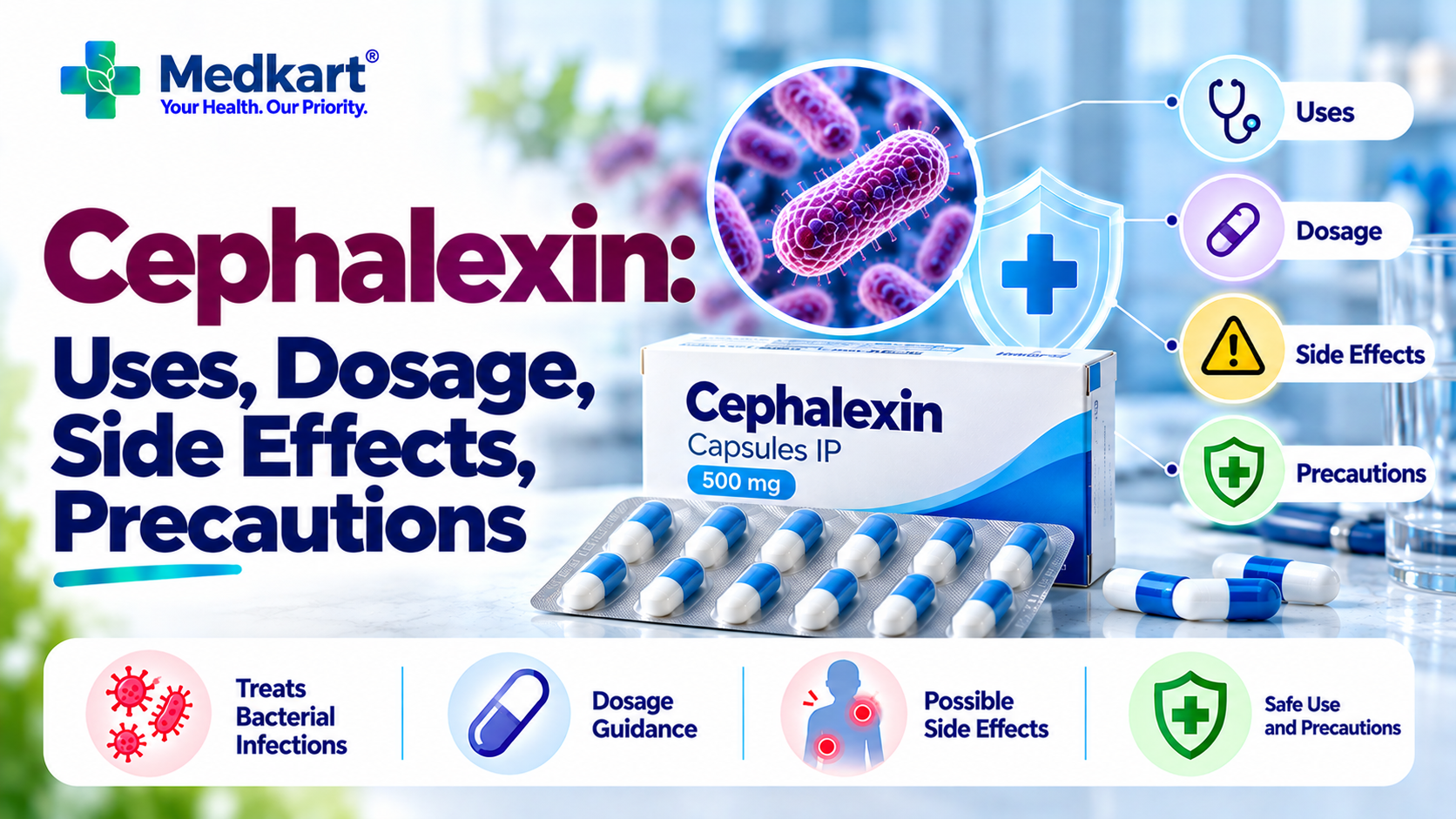
Cephalexin is the generic name of a prescription antibiotic sold under several brand names. It is used for selected bacterial infections, including some infections of the skin, chest and urinary tract.
It comes as capsules, tablets and a liquid, and many companies make it. The active ingredient is the same, but strength, form, pack size and price are not.
What Is Cephalexin?
Cephalexin is an antibiotic from the cephalosporin group. MedlinePlus[1] explains that it treats infections caused by bacteria by killing the bacteria.
UK sources, including the NHS, spell the name cefalexin and describe it as a prescription-only medicine. An Indian regulatory source confirming its schedule could not be opened for this article.
Cephalexin Mechanism of Action and Classification
The cephalexin drug class is the cephalosporins. DailyMed[2] describes the cephalexin mechanism of action as bactericidal, working by blocking the building of the bacterial cell wall.
The UK summary of product characteristics[3] for Milpharm’s cefalexin 250 mg capsules gives a narrower cephalexin classification, grouping it with the first-generation cephalosporins under the ATC code J01DB01.
What Are the Main Cephalexin Uses?
Cephalexin is used for bacterial infections. The NHS[4] lists pneumonia and other chest infections, skin infections and urinary tract infections.
The DailyMed label gives a longer list of cephalexin antibiotic uses, covering respiratory tract, middle ear, skin, bone and genitourinary tract infections caused by susceptible bacteria. That is a United States label and does not describe the approved indications of any Indian product.
MedlinePlus notes that it is sometimes given before dental procedures to people with certain heart conditions who are allergic to penicillin.
Among the cephalexin antibiotic uses, skin infections appear on both the NHS and DailyMed lists. DailyMed limits its skin indication to susceptible Gram-positive bacteria and states that methicillin-resistant staphylococci and most enterococci are resistant to cephalexin.
Whether cephalexin for skin infection suits a particular case is the prescriber’s decision.
Why Antibiotic Resistance Matters
DailyMed states that cephalexin should only be used for infections proven or strongly suspected to be caused by bacteria, as a way to slow the development of drug-resistant bacteria. MedlinePlus warns that it does not work for colds, flu or other viral infections.
NHS common questions about cefalexin[5] say that stopping the medicine early makes it more likely that the infection returns and the bacteria become resistant.
Popular Brands and Strengths of Cephalexin
Several cephalexin brands are sold in India. The company names below are those shown on the Medkart listing for each pack.
| Brand Name | Active Ingredient | Available Strengths / Forms* | Manufacturer / Company |
| Phexin | Cephalexin | 250 mg and 500 mg capsules | GSK Pharmaceuticals Limited |
| Sporidex | Cephalexin | 250 mg and 500 mg capsules | Sun Pharmaceutical Industries Ltd |
| Ceff | Cephalexin | 500 mg capsules | Lupin Limited |
| Oriphex | Cephalexin | 500 mg capsules | Zydus Lifesciences Limited |
| Cephaxin | Cephalexin | 250 mg and 500 mg capsules | Biochem Pharmaceutical Industries |
| Cepen | Cephalexin | 500 mg capsules | Talent India Pvt Ltd |
Examples of listed strengths and forms, not a complete catalogue. Product ranges can change.
MedlinePlus lists cephalexin as capsules, tablets and a liquid suspension, and the DailyMed label covers 250 mg and 500 mg capsules. Medkart’s listings for cephalexin 250 mg and cephalexin 500 mg show capsules and tablets from several manufacturers.
A strength such as cephalexin 500 mg describes the amount of active ingredient in that product. It is product information, not a dosing instruction.
Generic Cephalexin Vs Brand-Name Cephalexin
The US FDA[6] states that a generic medicine matches the brand-name medicine on active ingredient, strength, dosage form and route of administration, and is bioequivalent to it.
The FDA adds that approved generics provide the same clinical benefit and risks as their brand-name counterparts. That is the U.S. FDA standard, and an India-specific regulatory source is needed before making the same claim about an Indian product.
Products can still differ in manufacturer, inactive ingredients, appearance and price. The same active ingredient and strength alone do not prove that two products are interchangeable. Any cephalexin alternative, whether another brand or another antibiotic, should be confirmed by a doctor or pharmacist.
How Is Cephalexin Dosage Decided?
There is no one cephalexin dosage that applies to every prescription. The infection, the person’s age and weight, and kidney function all come into it.
NHS guidance on how and when to take cefalexin[7] says adults usually take 500 mg two or three times a day for most infections, with different doses for severe infections and for children.
The DailyMed label gives 250 mg every 6 hours or 500 mg every 12 hours for patients aged 15 and over, usually for 7 to 14 days. It gives a weight-based daily range for children over 1 year and lower doses in severe kidney impairment.
The NHS says some infections need at least 10 days of treatment and advises finishing the full course even after feeling better.
What Are the Common Cephalexin Side Effects?
Feeling sick, diarrhoea and stomach pain are the common cephalexin side effects in NHS guidance on cefalexin side effects[8], which says they happen in around 1 in 10 people.
MedlinePlus lists other effects, including vomiting, heartburn, itching, tiredness, dizziness, headache and joint pain. DailyMed identifies diarrhoea as the most frequent adverse reaction.
The NHS describes serious side effects as rare, affecting fewer than 1 in 1,000 people. It advises urgent medical help for:
- Severe diarrhoea, or diarrhoea with blood or mucus
- Pale stools with dark urine, or yellowing of the skin or the whites of the eyes
- Unexplained bruising
- Swelling of the lips, mouth, throat or tongue, or difficulty breathing
DailyMed warns that diarrhoea linked to C. difficile can occur with antibiotics, including months after treatment ends.
Which Medicines and Supplements Can Interact?
NHS guidance on who can and cannot take cefalexin[9] says most adults and children can take it.
| Situation | What to do |
| Allergy to a cephalosporin | DailyMed lists known hypersensitivity to cephalexin or other cephalosporins as a contraindication. The NHS says any previous allergic reaction to cefalexin or another medicine should be mentioned to a doctor. |
| Kidney problems | The NHS lists kidney problems among the conditions to raise first. DailyMed lists seizures as a risk in kidney impairment and advises reducing the dose. |
| A past reaction to antibiotics | The NHS asks about any severe rash, skin peeling, blistering or mouth sores after an antibiotic, and about severe or bloody diarrhoea with a previous antibiotic. |
| Bowel or liver disease | MedlinePlus says a doctor should be told about any gastrointestinal, kidney or liver disease. |
| Pregnancy or breastfeeding | NHS guidance on cefalexin in pregnancy and breastfeeding[10] says it can be taken at any stage of pregnancy and while breastfeeding. It advises contacting a health professional if a breastfed baby has feeding problems, vomiting, diarrhoea, thrush or a rash. |
Which Medicines and Supplements Can Interact?
Several can. NHS guidance on taking cefalexin with other medicines[11] names probenecid, metformin, diuretics such as furosemide, and other antibiotics as medicines to mention to a doctor first.
DailyMed states that this antibiotic raises metformin levels in the blood, and that probenecid slows the kidneys’ removal of cephalexin. The NHS says zinc can lower the amount of cefalexin in the body and advises at least 3 hours between a zinc supplement and a dose.
MedlinePlus says cephalexin may make hormonal contraceptives less effective. The NHS common questions page says protection from the pill may be reduced if the medicine causes severe diarrhoea for more than 24 hours.
Anyone using hormonal contraception should ask a doctor or pharmacist which advice applies to them. DailyMed also notes that cephalexin can give a false-positive result on some urine glucose tests.
Buy or Compare Cephalexin on Medkart
Medkart sells cephalexin capsules online in several brands and strengths from different manufacturers. Medkart marks these packs as prescription items, and its comparison page highlights WHO-GMP certified products.
The medicines index lists what is in stock. The details a reader can compare on Medkart’s medicine comparison tool include:
- Active ingredient
- Strength
- Dosage form
- Manufacturer
- Pack size
- Current price
Any suggested alternative should be discussed with a doctor or pharmacist before changing a prescribed medicine.
Key takeaways
- Cephalexin, spelt cefalexin in UK sources, is a prescription antibiotic.
- The cephalexin drug class is the cephalosporins, and UK labelling places it among the first-generation cephalosporins.
- The main cephalexin uses are bacterial infections of the chest, skin, urinary tract, middle ear and bone.
- The US label limits cephalexin for skin infection to susceptible Gram-positive bacteria.
- A strength such as cephalexin 500 mg is product information, not an instruction about how much to take.
- Feeling sick, diarrhoea and stomach pain are the common side effects.
- Probenecid, metformin, diuretics, other antibiotics and zinc should be checked with a doctor or pharmacist first.
- Generic and branded cephalexin share the same active ingredient, but two products are not automatically interchangeable.
FAQs
Q. What is cephalexin called in UK guidance?
Cefalexin. NHS pages and UK product labels use that spelling, while US sources such as MedlinePlus and DailyMed write cephalexin. Indian packs carry their own brand names, so the composition line on the pack is the clearest way to identify the medicine.
Q. Does cephalexin classification matter for someone with a penicillin allergy?
Yes. As a cephalosporin, it can cross-react with penicillins, and DailyMed warns this occurs in up to 10% of people who have a history of penicillin allergy. That is why any penicillin allergy should be raised with the doctor before the medicine is prescribed, so the prescriber can weigh that history.
Q. How soon should cephalexin for skin infection start to work?
Within a few days in most cases. The NHS says the timing depends on the type of infection being treated. It advises telling a doctor if there is no improvement after 2 to 3 days of treatment, or if symptoms get worse at any point during the course.
Q. What happens if a dose of cephalexin is missed?
It depends on how close the next dose is. MedlinePlus says the missed dose is taken once remembered, unless the next one is nearly due, in which case it is skipped. The NHS adds that at least 4 hours should separate doses and that a double dose should never be taken to catch up.
Q. Can cephalexin capsules be opened or chewed?
No. The NHS says cefalexin capsules and tablets are swallowed whole with water and are not chewed or broken. For the liquid, it says the syringe or spoon supplied should be used, because a kitchen teaspoon does not measure the right amount.
Q. Is it safe to drink alcohol while taking cephalexin?
Yes, according to the NHS. Its common questions page says alcohol can be drunk during a course of cefalexin, and that the medicine does not affect the ability to drive or ride a bike. Questions about a particular person’s situation are best taken to the prescriber or a pharmacist.
Q. Is a cephalexin alternative needed for someone allergic to it?
Yes. DailyMed lists known hypersensitivity to cephalexin, or to any other cephalosporin, as a contraindication. Because that covers the whole cephalosporin group, the prescriber chooses a different antibiotic after reviewing the allergy history. This is one reason the NHS asks about earlier reactions to medicines before cefalexin is started.
References
- https://medlineplus.gov/druginfo/meds/a682733.html
- https://dailymed.nlm.nih.gov/dailymed/fda/fdaDrugXsl.cfm?setid=6440351e-065f-59da-e053-2a91aa0aa4c5&type=display
- https://www.medicines.org.uk/emc/product/555/smpc/print
- https://www.nhs.uk/medicines/cefalexin/about-cefalexin/
- https://www.nhs.uk/medicines/cefalexin/common-questions-about-cefalexin/
- https://www.fda.gov/drugs/generic-drugs/generic-drug-facts
- https://www.nhs.uk/medicines/cefalexin/how-and-when-to-take-cefalexin/
- https://www.nhs.uk/medicines/cefalexin/side-effects-of-cefalexin/
- https://www.nhs.uk/medicines/cefalexin/who-can-and-cannot-take-cefalexin/
- https://www.nhs.uk/medicines/cefalexin/pregnancy-breastfeeding-and-fertility-while-taking-cefalexin/
- https://www.nhs.uk/medicines/cefalexin/taking-cefalexin-with-other-medicines-and-herbal-supplements/
Medical disclaimer: This article provides general information and does not replace advice from a doctor or pharmacist. Cephalexin is a prescription antibiotic, and Medkart lists cephalexin packs as prescription items. Brands with the same composition should only be substituted under the guidance of a healthcare professional or pharmacist because product details and approved indications can differ.
Leave a Reply