
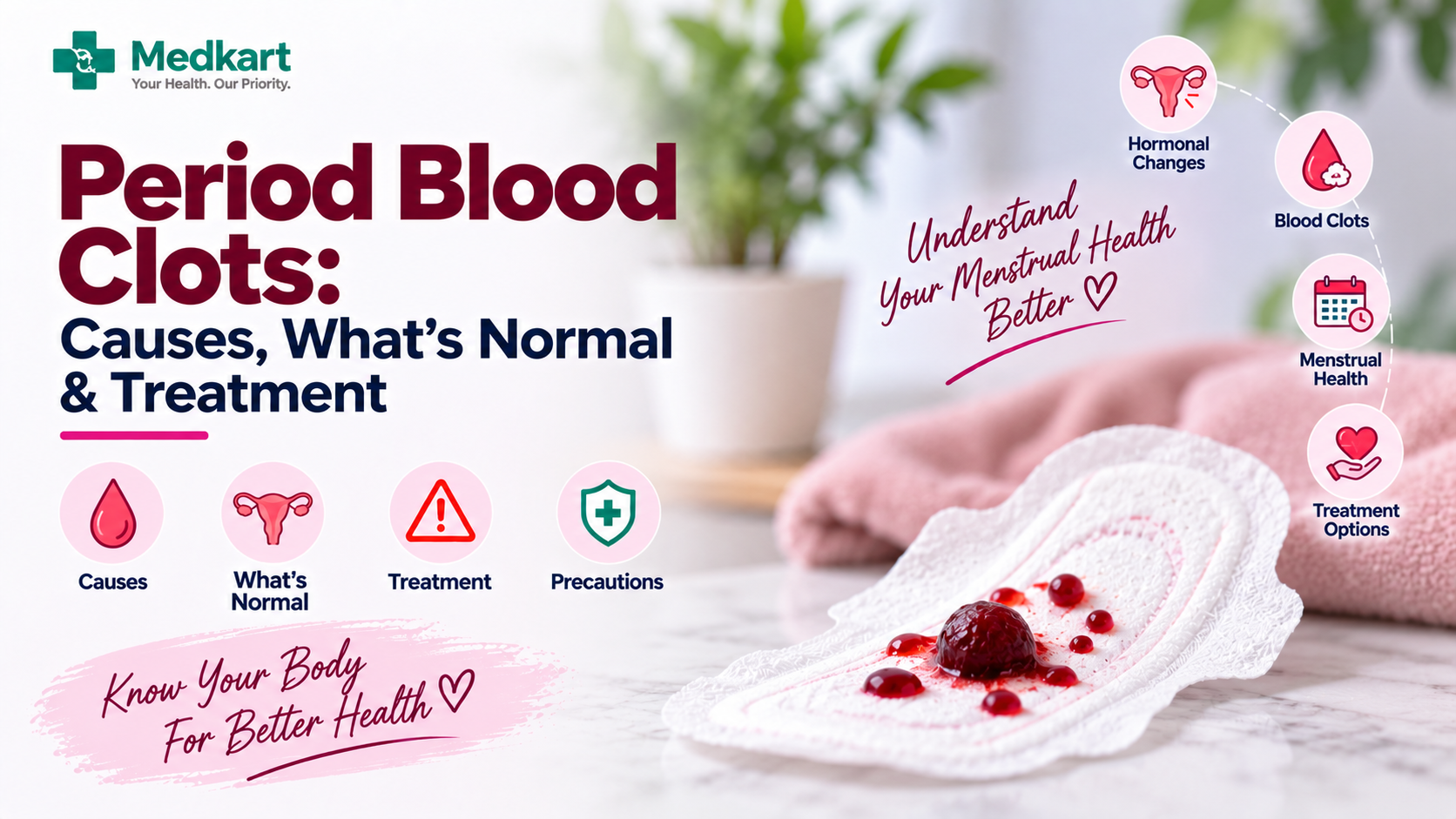
Clots in menstrual blood are common, and most of them are not a sign of anything wrong. They appear as dark red or almost black jelly-like lumps, usually on the heaviest days of a period.
What matters is size, volume and change. Official sources do not treat clots as a problem in themselves, but they do set markers for when bleeding needs assessment. This article sets out those markers, the causes and the symptoms that mean a doctor should be seen.
What Are Period Blood Clots, and What Do They Look Like?
They are thickened collections of menstrual blood and tissue from the womb lining. The lumps are described in the retrieved sources by size rather than by appearance, and they are generally darker than the surrounding flow.
The sources retrieved for this article do not explain the mechanism by which clots form. None of the pages opened here describes why blood clots on some days and not others.
Is It Normal to Have Blood Clots During Your Period?
Small clots are described as normal. The Office on Women’s Health[1] states that it is normal to pass clots the size of quarters or smaller, and that clots larger than that are a reason to see a doctor.
The NHS[2] uses a different yardstick for the same idea. It lists passing blood clots larger than about 2.5 cm, the size of a 10p coin, among the signs of heavy periods.
Clot size is one marker among several. The table below sets out what the sources associate with heavy menstrual bleeding, and it is not a test anyone can apply to themselves.
| Feature | What the sources say |
| Clot size | The Office on Women’s Health treats clots larger than a quarter as a reason to seek advice, and the NHS uses about 2.5 cm. |
| How often protection is changed | Both sources describe bleeding through a pad or tampon every one to two hours as a marker of heavy bleeding. |
| Length of the period | The NHS lists periods lasting more than 7 days, and the Office on Women’s Health lists periods longer than 8 days. |
| Bleeding overnight | MedlinePlus[3] lists needing to change protection during the night among the signs of heavy menstrual bleeding. |
| Effect on daily life | The NHS advises seeing a GP where heavy periods are affecting a person’s life, which makes impact a marker in its own right. |
| Tiredness and breathlessness | The Office on Women’s Health lists dizziness, light-headedness, weakness and tiredness as possible symptoms of anaemia. |
What Causes Blood Clots During Periods?
Clots follow heavy flow, so the causes are the causes of heavy menstrual bleeding. The NHS groups them into conditions affecting the womb or ovaries, bleeding disorders, and certain medicines.
Named conditions include fibroids, endometriosis, adenomyosis, polycystic ovary syndrome and pelvic inflammatory disease. MedlinePlus adds polyps, thickening of the womb lining and hormone imbalance where the ovaries do not release an egg.
The Office on Women’s Health also names an underactive thyroid, obesity and pregnancy complications. Both the NHS and MedlinePlus name medicines including anticoagulants, and the NHS notes that womb cancer is a rare cause.
What Does Period Blood Colour Mean?
No source retrieved for this article assigns meanings to the colour of menstrual blood. The NHS, MedlinePlus and the Office on Women’s Health pages opened here describe volume, duration and clot size, and none of them interprets shade.
That gap is worth stating plainly, because colour charts circulate widely. Nothing retrieved here supports reading a diagnosis from whether blood looks bright red, dark brown or almost black.
What the sources treat as meaningful is volume, duration and change.
What About Tissue-Like Clots During a Period?
Menstrual clots contain womb lining, so some texture is expected. A different possibility applies where pregnancy is known or possible.
The NHS[4] describes the symptoms of miscarriage as including pink, grey or white lumps coming out of the vagina, which may look or feel stringy. Bleeding and cramping in the lower abdomen are listed alongside them. That description is distinct from an ordinary menstrual clot.
Anyone who might be pregnant and passes tissue of that kind should contact a doctor without waiting, on NHS advice.
Also Read: What to Eat and Avoid During Periods
How Common Is Heavy Bleeding and Anaemia in India?
Heavy periods are common. The Office on Women’s Health reports that heavy menstrual bleeding affects about one in five women each year, on United States figures.
The Indian picture is clearest through anaemia, which is what sustained blood loss causes. The Ministry of Health and Family Welfare’s Anaemia Mukt Bharat operational guidelines[5] report that anaemia affects 53% of women of reproductive age. That figure covers women aged 15 to 49, on National Family Health Survey-4 data.
A 2024 analysis in BMC Public Health[6] puts the figure higher in the following survey round. It reports national prevalence among women of reproductive age rising from 53.2% in NFHS-4 to 57% in NFHS-5, covering 2019 to 2021.
Those figures describe anaemia from all causes, not heavy periods alone. No retrieved Indian source gives a prevalence figure for heavy menstrual bleeding itself.
How Is Heavy Menstrual Bleeding Assessed and Treated?
Assessment starts with blood tests. The NHS states that a series of blood tests may be done to check for underlying conditions such as iron deficiency anaemia. MedlinePlus adds pelvic examination, clotting studies, hormone and pregnancy tests, ultrasound and hysteroscopy.
Treatment is chosen by a clinician rather than picked from a list. The NHS names an intrauterine system, the combined contraceptive pill, tranexamic acid and anti-inflammatory painkillers among the options a GP may offer.
MedlinePlus names tranexamic acid as a prescription medicine for heavy menstrual bleeding. Where medicines are not enough, the NHS names endometrial ablation, fibroid removal and hysterectomy as specialist procedures.
This article gives no amounts for any of those medicines. Which one suits a person is decided by the prescriber, after the cause has been established.
When Should You See a Doctor?
See a doctor if your periods are heavy enough to affect your life, or if anything below applies to you. Do not wait for several cycles to pass before raising it.
| Situation | What to do |
| You pass clots larger than a 10p coin or a quarter | Book an appointment. Both the NHS and the Office on Women’s Health treat clots above that size as a reason to seek advice. |
| You soak a pad or tampon every one to two hours | Raise it with a doctor. Both sources list this among the markers of heavy bleeding. |
| You bleed between periods or after sex | See a GP, which the NHS lists as a specific reason to seek help. |
| You have severe pain during your periods | The NHS names this among the reasons to make an appointment. |
| You feel dizzy, weak or unusually tired | Ask for a blood test. The Office on Women’s Health lists these as possible symptoms of anaemia. |
| You might be pregnant and pass stringy pink or grey tissue | Contact a doctor or maternity service the same day, on NHS miscarriage guidance. |
What This Article Cannot Tell You
It cannot say whether any individual’s clots are normal. Size thresholds are markers that help a clinician decide whether to investigate, not a verdict that can be reached from a page.
It cannot identify a cause. Fibroids, adenomyosis, polyps, thyroid disease and bleeding disorders can produce similar bleeding. The tests listed above exist precisely because the cause is not obvious from symptoms.
It cannot say which treatment suits anyone, or how much of it is appropriate. That decision needs a diagnosis, a blood count and a prescriber.
It also cannot say why menstrual blood clots form, because no source retrieved for this article explains the mechanism.
Where Can You Buy Prescribed Medicines on Medkart?
Medicines for heavy menstrual bleeding are prescription medicines, so a valid prescription is needed first. Medkart sells medicines online from several manufacturers and highlights quality credentials for its generic medicine range.
Where a doctor prescribes one, Medkart lists products containing tranexamic acid, including Pause XT from Emcure. It also lists mefenamic acid products such as Meftal, and iron preparations such as Ferrotem XT and Haemaday Plus. Availability, pack size and price differ between products and can change.
Nothing here says any of these treats the condition, which is a judgement for the prescriber. Medkart’s medicine comparison tools can be used to compare listed options on:
- Active ingredient
- Strength
- Dosage form
- Manufacturer
- Pack size
- Current price
Any change to a prescribed medicine should be discussed with a doctor or pharmacist first.
Key Takeaways
- Clots in menstrual blood are common and small ones are described as normal.
- The Office on Women’s Health treats clots larger than a quarter as a reason to seek advice.
- The NHS uses clots larger than about 2.5 cm as one sign of heavy periods.
- Clot size is one marker, alongside pad changes, period length and effect on daily life.
- Causes named include fibroids, adenomyosis, polyps, thyroid disease, bleeding disorders and some medicines.
- No retrieved source assigns any meaning to the colour of menstrual blood.
- Anaemia affects more than half of Indian women of reproductive age on national survey data.
- Stringy pink or grey tissue during a possible pregnancy needs same-day medical contact.
FAQs
Q. Can a medicine or a contraceptive be the reason for clots?
It can be part of the picture. The NHS names certain medicines, including anticoagulants and chemotherapy, among the causes of heavy periods. MedlinePlus lists hormonal birth control among the causes of abnormal uterine bleeding. Neither source suggests stopping a prescribed medicine, and that decision belongs to the prescriber.
Q. Does passing clots always mean the bleeding is heavy?
No. The retrieved sources treat small clots as an ordinary part of a period, and reserve concern for larger ones. Heavy bleeding is judged on several things together, including how often protection is changed and how many days the bleeding lasts. A single clot on the heaviest day is a different matter from clots across a week.
Q. Can a bleeding disorder be behind heavy periods with clots?
Yes, and it is a recognised cause rather than a rare curiosity. The NHS names Von Willebrand disease among the conditions that cause heavy periods, and the Office on Women’s Health names inherited bleeding disorders including haemophilia. Clotting studies are among the tests MedlinePlus lists for abnormal uterine bleeding.
Q. Can heavy periods with clots be a sign of cancer?
It is possible but uncommon. The NHS lists womb cancer among the causes of heavy periods and describes it as rare. The same page lists bleeding between periods and bleeding after sex as reasons to see a GP, which is why those symptoms are asked about rather than ignored.
Q. Why does heavy bleeding leave someone feeling tired?
Because of what repeated blood loss does to iron. The Office on Women’s Health describes anaemia as a condition in which blood cannot carry enough oxygen because of a lack of iron, and lists dizziness, light-headedness, weakness and tiredness among its symptoms. The NHS checks for iron deficiency anaemia with blood tests.
Q. What tests might follow if heavy bleeding is reported?
Several, depending on what the history suggests. MedlinePlus lists a pelvic examination, a complete blood count, clotting studies, hormone tests, a pregnancy test and ultrasound. It also describes hysteroscopy, performed in a provider’s office to look into the uterus through the vagina.
References
- https://womenshealth.gov/menstrual-cycle/period-problems
- https://www.nhs.uk/conditions/heavy-periods/
- https://medlineplus.gov/ency/article/000903.htm
- https://www.nhs.uk/conditions/miscarriage/
- https://nhm.gov.in/images/pdf/Nutrition/AMB-guidelines/Anemia-Mukt-Bharat-Operational-Guidelines-FINAL.pdf
- https://pmc.ncbi.nlm.nih.gov/articles/PMC10860231/
Medical disclaimer: This article gives general information about heavy menstrual bleeding and is not a diagnosis. It cannot tell any individual whether their bleeding is normal, what is causing it, or which treatment suits them, because those decisions need a doctor and the right tests. Anyone with the symptoms described here should see a doctor rather than self-treat, and no medicine or supplement should be started, stopped or changed without advice from the prescriber or a qualified pharmacist.
Leave a Reply