

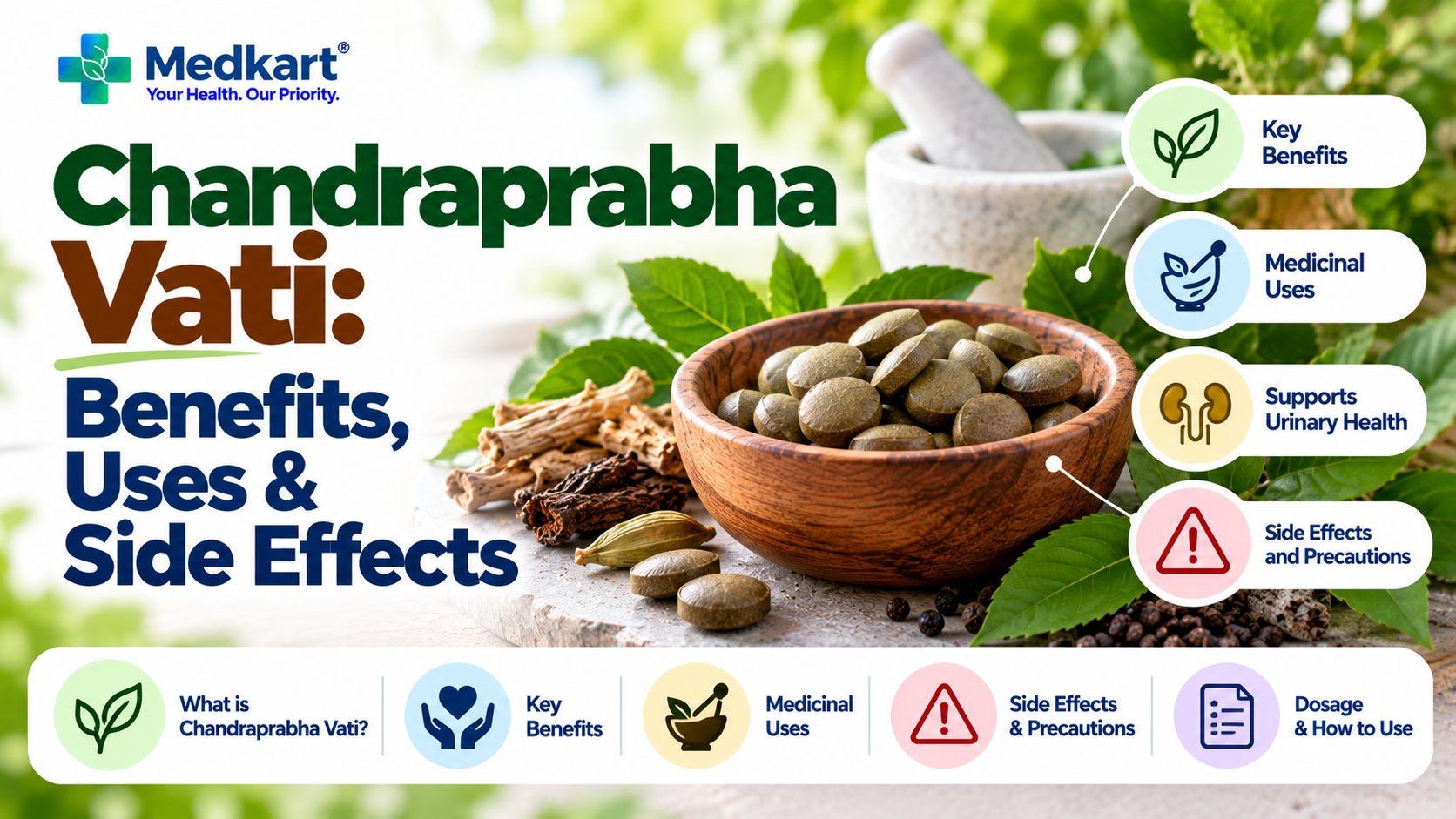
Chandraprabha vati is a classical Ayurvedic tablet made from a long list of herbs, resins, minerals and salts. Most chandraprabha vati uses described in published research relate to blood sugar and the urinary tract.
It is sold as tablets by Indian Ayurvedic manufacturers, including Zandu. The research on it is limited, and most of it comes from laboratory and animal work.
What Is Chandraprabha Vati?
Chandraprabha vati is a herbo-mineral formulation with 37 components. A 2024 analysis in the Journal of Ayurveda and Integrative Medicine[1] traces it to the Sharangadhara Samhita, where it appears in the chapter on Prameha.
The same paper states that its composition follows the Ayurvedic Formulary of India, Part 1. It describes the formulation as first presented as a remedy for diabetes.
What Are the Chandraprabha Vati Ingredients?
Most of the 37 ingredients are herbs and plant parts, each listed at 3 g in the reference batch. Haridra, Guduchi and Haritaki are among them.
A few ingredients are present in much larger amounts:
- Silajatu: 96 g, which the paper’s own tables describe as containing fulvic acids, humic acids and selenium
- Guggulu: 96 g, a resin exudate from Commiphora wightii
- Sita: 48 g
- Lauha bhasma: 24 g, a mineral preparation
- Vamshalochana: 12 g, listed as a silicaceous concretion
- Salts and alkalis: Yava kshara, Sarji kshara, Saindhava, Sauvarchala and Vida lavana, at 3 g each
These quantities describe a batch that makes many tablets. They are not amounts taken in one dose.
What Are the Chandraprabha Vati Uses and Benefits?
The traditional chandraprabha vati uses centre on Prameha and urinary complaints. A 2016 rat study in the same journal[2] relates Prameha to obesity, metabolic syndrome and diabetes. It notes that the product label lists further uses, including constipation, jaundice and skin disease.
The chandraprabha vati benefits studied so far are much narrower than that list.
| Use | What the evidence says |
| Type 2 diabetes, as an add-on | A 2025 open-label trial in the Asian Journal of Pharmaceutical and Clinical Research[3] enrolled 60 newly diagnosed patients for six months. One group took glimepiride alone and the other took glimepiride with chandraprabha vati 250 mg daily. The combined group had greater falls in fasting sugar, post-meal sugar and HbA1c at 12 and 24 weeks. |
| Blood sugar in animals | The 2016 study gave rats 50 to 200 mg per kg for seven days. It improved glucose tolerance and lowered sugar in alloxan-diabetic rats, with the highest dose comparable to metformin. |
| Urinary tract infection | A 2013 study in mice[4] infected with E. coli found that the extract reduced inflammatory markers in the kidneys over 20 days. This was animal work, not a trial in people. |
| Pelvic floor weakness | A 2023 case report[5] described one woman with stress urinary incontinence treated with the tablet alongside medicated oils and milk. The authors credit the whole regimen rather than the tablet alone. |
| Metabolic syndrome | The 2024 analysis was a computer-based screen of 16 of the herbs against disease genes. Its authors ask for preclinical and clinical studies. |
US federal guidance on Ayurvedic medicine[6] notes that most trials of Ayurvedic approaches are small or poorly designed. The 2025 trial was small and open-label.
What Is the Recommended Chandraprabha Vati Dosage?
There is no one dose that applies to everyone. Across the chandraprabha vati uses studied, the amounts differ.
The 2025 trial used 250 mg a day alongside glimepiride. The 2023 case report gave one tablet in the morning and one at night, without stating the tablet strength.
The 2016 rat study derived its doses from a human equivalent dose. It does not state a dose for patients.
A strength printed on a pack describes how much of the formulation each tablet contains. It is product information, not a dosing instruction. The chandraprabha vati dosage that suits a person is for a doctor or qualified Ayurvedic practitioner to decide.
When Should You Take Chandraprabha Vati?
Published research does not set one time of day for it. It also does not settle whether taking chandraprabha vati before or after food makes a difference.
The 2023 case report gave one tablet in the morning and one at night, after food during the later phase of treatment. On how to take chandraprabha vati, the 2016 study notes that the label suggests water or milk among its vehicles.
The instruction on the label of the product being used, or from the prescriber, takes priority.
How Long Can You Take Chandraprabha Vati?
The human reports cover periods of weeks to months. The 2025 trial ran for six months, with blood sugar measured at 12 and 24 weeks.
The case report used a 30-day course, then a 7-day course, then a further month. Longer use is a question for the doctor monitoring treatment.
What Chandraprabha Vati Side Effects Are Reported?
The published human reports describe few side effects in detail. The 2023 case report records none.
The 2025 trial authors write that plant compounds may cause adverse reactions in people with lower tolerance. They call for careful monitoring.
The wider concern with Ayurvedic products is metal content. The US guidance warns that some Ayurvedic preparations may contain lead, mercury or arsenic in toxic amounts.
A 2008 JAMA study[7] found lead, mercury or arsenic in 20.7% of 193 Ayurvedic medicines bought online. Every product containing metals exceeded at least one daily intake standard. Chandraprabha vati is not among the products named in that study, so its findings say nothing about any single brand of it.
Also Read: Things to consider before buying medicines in India
Who Should Be Careful with Chandraprabha Vati?
Several groups should talk to a doctor or pharmacist before trying it for any of the chandraprabha vati uses described above.
| Situation | What to do |
| Pregnancy or breastfeeding | The US guidance advises consulting a health care provider first, because some Ayurvedic products may be harmful. |
| Children | The same guidance applies to a child’s health care provider. None of the human studies above gives a dose for children. |
| Taking diabetes medicines | In the 2025 trial, blood sugar fell further when the tablet was added to glimepiride. Its use, and how sugar is monitored, should be agreed with the doctor. |
| An existing health condition | The US guidance advises talking with a conventional health care provider before using Ayurvedic products. |
| Products bought online | The JAMA study found metals in both US-made and Indian-made products sold online. The pack should name the manufacturer, and a pharmacist can advise before use. |
What Is Known About Chandraprabha Vati and Other Medicines?
Very little, and what is known concerns one diabetes medicine. In the 2025 trial, the tablet was taken with glimepiride, and blood sugar fell further than with glimepiride alone.
The US guidance advises telling every health care provider about any complementary approach being used. If you take regular medicines, show the pack to your pharmacist before starting it.
Where Can You Buy Chandraprabha Vati Online?
Medkart lists chandraprabha vati in its Ayurvedic range. Zandu Chandraprabha Vati tablets are listed in a 40-tablet pack made by Emami Limited (Zandu).
The Ayurvedic products category lists other classical tablets, such as Shanshamani Vati. Related ranges include kidney care, diabetes care and nutritional supplements.
Medkart’s medicine comparison tool places products side by side. The medicines index and the full medicine list show what is stocked, and points worth comparing include:
- Manufacturer
- Tablet strength
- Ingredient list on the label
- Pack size
- Current price
Medkart stores can be found with the store locator, and orders can be placed through the Medkart app. Availability, pack size and price differ between products.
Questions about how to take chandraprabha vati alongside other medicines are best taken to a pharmacist.
Key takeaways
- Chandraprabha vati is a classical Ayurvedic tablet with 37 herbal and mineral ingredients.
- The largest chandraprabha vati ingredients by weight include silajatu, guggulu, sita and lauha bhasma.
- The main traditional chandraprabha vati uses relate to Prameha and urinary complaints.
- Evidence in people comes down to one small open-label trial and a single case report.
- Studies use different amounts, so chandraprabha vati dosage is for a doctor or qualified Ayurvedic practitioner to decide.
- Published research leaves the timing of chandraprabha vati before or after food unsettled.
- Metal content is the main safety concern, and few chandraprabha vati side effects are described in detail.
- People on diabetes medicines, and anyone pregnant or breastfeeding, should speak to a doctor before starting it.
FAQs: Common Questions About Chandraprabha Vati
Q. Are chandraprabha vati benefits proven in people?
Not firmly. The only randomised human trial enrolled 60 people, was not blinded, and gave the tablet on top of glimepiride. Animal work and computer modelling sit behind most other chandraprabha vati uses in research, and the authors of both say more work is needed.
Q. How to take chandraprabha vati before or after food?
Published research does not favour one over the other. The product label is the first guide, and the 2016 study notes that labels name a vehicle such as water or milk. Where a prescriber has set a timing, that instruction comes first.
Q. Can chandraprabha vati replace diabetes medicine?
No. In the 2025 trial every patient stayed on glimepiride, so the design says nothing about using the tablet in its place. No diabetes medicine should be stopped or reduced for an Ayurvedic product without the prescriber’s agreement.
Q. Does chandraprabha vati contain minerals such as iron?
Yes. The 2013 mouse study analysed the formulation and reported zinc and iron among its constituents, along with terpenoids and flavonoids. The ingredient list also includes prepared minerals such as lauha bhasma and makshika dhatu bhasma, so a pharmacist should see the label if a mineral supplement is already being taken.
Q. Where does the name chandraprabha come from?
The formulation shares its name with one of its own ingredients. The 2024 ingredient table lists Chandraprabha, also given as Karpura, as a sublimed extract at 3 g in the reference batch. By weight it is one of the smaller components, well below the resins and minerals that dominate the batch.
Q. What is chandraprabha vati, an Ayurvedic or a Siddha medicine?
It appears in both traditions in the published literature. The 2013 mouse study calls it an Indian polyherbal Siddha drug used for arthritis and urinary ailments. The 2024 paper links it to the Sharangadhara Samhita and to the Ayurvedic Formulary of India.
Q. How quickly does chandraprabha vati work?
The published studies do not give a reliable timescale. The diabetes trial measured blood sugar after three and six months, not in the first days. The case report patient felt better from about the second day, but she was also receiving oils and medicated milk alongside the tablet.
Q. Does a safety test in rats mean chandraprabha vati is safe for people?
No. The 2016 study found no deaths or toxic reactions in rats given 2,000 mg per kg and watched for 14 days. That short animal limit test does not measure long-term use in people or the metal content of any particular product.
References
- https://pmc.ncbi.nlm.nih.gov/articles/PMC11177199/
- https://pmc.ncbi.nlm.nih.gov/articles/PMC5052381/
- https://journals.innovareacademics.in/index.php/ajpcr/article/view/54162
- https://pubmed.ncbi.nlm.nih.gov/24072152/
- https://pmc.ncbi.nlm.nih.gov/articles/PMC10424129/
- https://www.nccih.nih.gov/health/ayurvedic-medicine-in-depth
- https://pmc.ncbi.nlm.nih.gov/articles/PMC2755247/
Medical disclaimer: This article gives general information only. It does not replace advice from a doctor or pharmacist. No medicine or supplement should be started, stopped or changed without advice from the prescriber or a qualified pharmacist.

Leave a Reply