

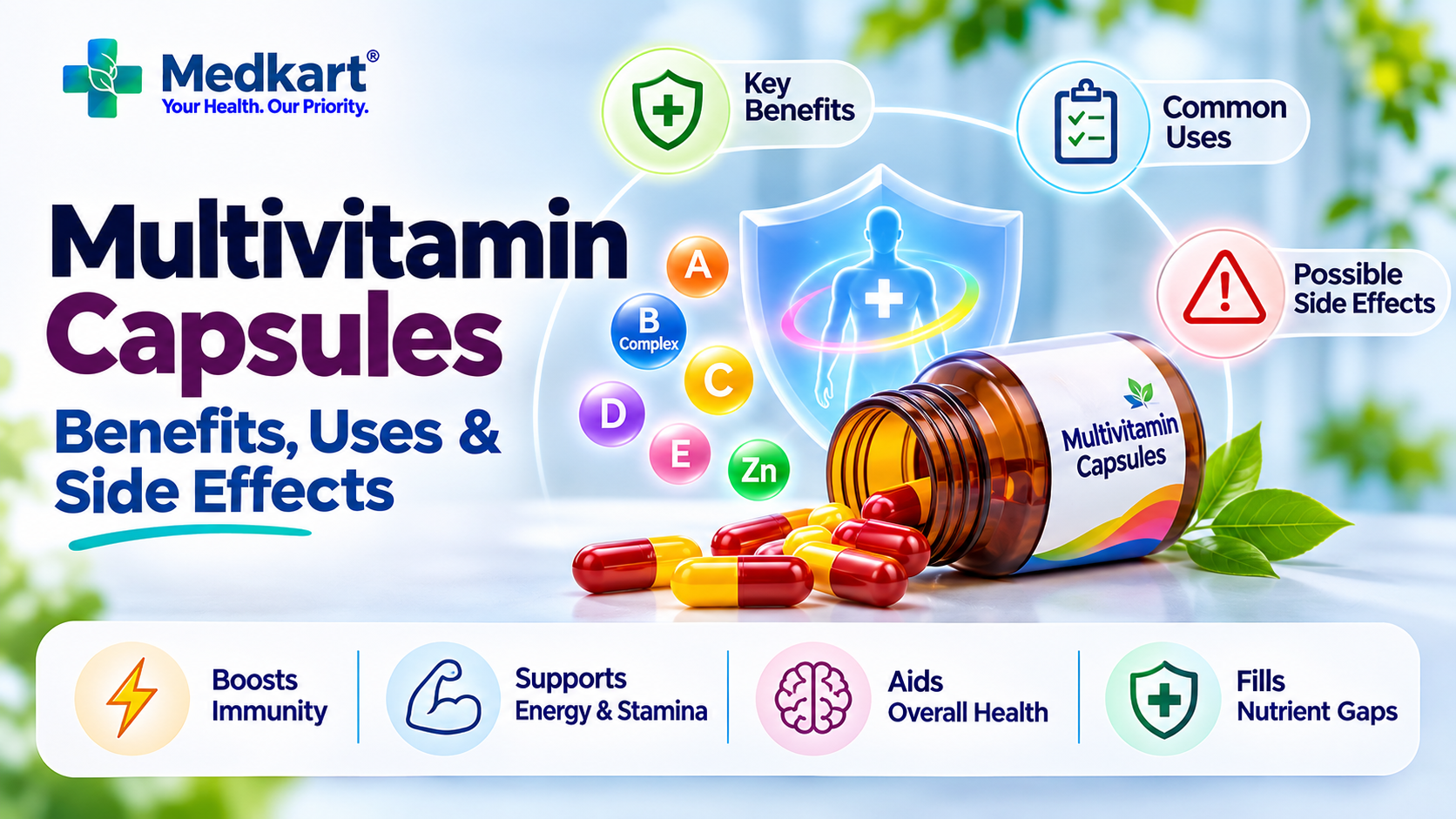
Multivitamin capsules combine several vitamins, and often minerals, in a single product. This article sets out the multivitamin capsules benefits that official sources recognise, and the claims they do not support.
Multivitamins are sold without a prescription as capsules, tablets, syrups and other forms. Their contents differ widely between brands, so the amount, the timing and the risks depend on the product.
What are multivitamin capsules benefits and uses?
Multivitamin capsules benefits are clearest where food does not supply enough of a nutrient. MedlinePlus[1] explains that supplements are an option when diet falls short, and that they can help during pregnancy and with certain medical problems.
It still points to a varied diet of fruits, vegetables, legumes, lentils and whole grains as the main source of vitamins. The multivitamin capsules uses that published sources have examined are set out below.
| Use | What the evidence says |
| Gaps in the Indian diet | A 2023 study of school children in ten Indian cities[2] found vitamin B12 deficiency in 33.4% and folate deficiency in 22.2% of those aged 6 to 16. Most of the children had an inadequate intake of both nutrients. |
| Heart disease and cancer | The US Preventive Services Task Force[3] found the evidence insufficient to judge the balance of benefits and harms of multivitamins for preventing cardiovascular disease or cancer in non-pregnant adults. |
| Memory in older adults | A 2023 trial in older adults[4] gave 3,562 people a daily multivitamin or a placebo. The multivitamin group scored better on immediate recall, though the authors describe the effect as small and other cognitive measures did not differ. |
| Before and during pregnancy | NHS[5] pregnancy guidance recommends 400 micrograms of folic acid a day from before conception until 12 weeks of pregnancy. |
The Indian study measured deficiency and diet. It did not test whether a multivitamin corrects either.
The task force statement does not apply to children, to pregnancy, or to people with a known nutritional deficiency.
What are the usual multivitamin capsules ingredients?
The usual multivitamin capsules ingredients are vitamins, often combined with minerals, but the mix varies by product. MedlinePlus lists 13 vitamins the body needs: A, C, D, E, K, and eight B vitamins.
Vitamins A, D, E and K are fat-soluble and are stored in the liver, fatty tissue and muscles. Vitamin C and the B vitamins are water-soluble, and any excess leaves in the urine. The exception is B12, which the liver can store for many years.
Contents can change while the brand name stays the same. Singapore’s Health Sciences Authority[6] reports that a new formulation of Centrum Silver added 25 mcg of vitamin K1, which the earlier version lacked.
MedlinePlus guidance on ciprofloxacin[7] refers to multivitamins containing calcium, magnesium, zinc or iron.
What is the recommended multivitamin capsules dosage?
No single multivitamin capsules dosage applies to every product or every person. MedlinePlus advises against taking more than 100% of the RDA unless a provider is supervising.
It warns that fat-soluble vitamins from supplements can build up and cause harm. It defines the RDA as the average daily intake that meets the needs of about 97 to 98% of healthy people.
A strength printed on a pack, such as the micrograms of a vitamin per capsule, describes the product. It is product information, not a dosing instruction.
UK guidance gives upper figures for some nutrients that multivitamins can contain:
- Vitamin A: NHS guidance on vitamin A[8] says daily intake from food and supplements combined should not exceed 1.5 mg (1,500 µg), particularly for women past menopause and older men
- Iron: NHS guidance on iron[9] states that 17 mg or less a day from supplements is unlikely to cause harm. More should be taken only on a GP’s advice
- Vitamin D: NHS guidance on vitamin D[10] says adults should not exceed 100 micrograms (4,000 IU) a day, and children aged 1 to 10 should not exceed 50 micrograms (2,000 IU)
These are UK figures, not Indian limits for any particular product.
When should you take multivitamin capsules?
Published guidance does not set one time of day for multivitamins. What it does address, on when to take multivitamin capsules, is food and other medicines.
MedlinePlus explains that the body absorbs the fat-soluble vitamins A, D, E and K more easily with dietary fat.
Some medicines need to be taken hours apart from the minerals in a multivitamin. For someone on regular treatment, no single best time to take multivitamin capsules applies, and a pharmacist can set the spacing.
How long can you take multivitamin capsules?
Published guidance does not give a maximum course length for a standard multivitamin. UK guidance instead frames its cautions around long-term intake.
NHS guidance says that more than an average of 1.5 mg of vitamin A a day over many years may affect the bones. It also warns that too much vitamin D over a long period can cause calcium to build up, known as hypercalcaemia. This can weaken bones and damage the kidneys and heart.
In pregnancy, NHS guidance gives folic acid for the first 12 weeks and notes that continuing beyond that will not harm the baby.
On the related question of how long do multivitamins take to work, the memory trial measured its main result at one year.
Also Read: Multivitamin Tablets in India: Top 9 Choices for Daily Wellness
What are the common multivitamin capsules side effects?
Common multivitamin capsules side effects are mostly digestive, and the most serious problems come from taking too much. In the memory trial, the multivitamin group reported less stomach pain, diarrhoea, rash and bruising than the placebo group, but more gastrointestinal bleeding.
NHS guidance links iron doses over 20 mg a day with constipation, nausea, vomiting and stomach pain.
MedlinePlus guidance on multivitamin overdose[11] states that iron and calcium carry the most serious risk in large amounts. It lists these effects for specific nutrients:
- Iron: vomiting, diarrhoea that may be bloody or dark, and weakness
- Calcium: nausea, vomiting, confusion and itching
- Vitamin A: nausea, vomiting, dizziness and blurred vision
- Niacin: skin flushing lasting two to eight hours
- Vitamin D: raised blood calcium
MedlinePlus adds that B vitamins usually do not cause symptoms.
Who should be careful with multivitamin capsules?
Multivitamin capsules benefits do not apply equally, because several groups face specific risks from common ingredients.
| Situation | What to do |
| Pregnancy or planning one | NHS pregnancy guidance warns against supplements containing vitamin A, sometimes called retinol, because too much can harm the baby’s development. The label should be checked, and a doctor or midwife can advise on a suitable product. |
| Smoking or past asbestos exposure | The task force reports an increased risk of lung cancer with beta carotene supplements in people who smoke or had workplace asbestos exposure. Products listing beta carotene should be discussed with a doctor. |
| Children in the house | NHS guidance warns that very high doses of iron can be fatal, particularly for children. Iron-containing capsules should be kept out of their reach. |
| Older adults | NHS guidance identifies older men and women past menopause as the groups to watch for long-term vitamin A excess. It advises that anyone eating liver weekly avoid vitamin A supplements, including fish liver oil. |
| Using more than one supplement | MedlinePlus warns that fat-soluble vitamins from supplements can build up in the body. A separate vitamin D, iron or calcium product adds to what the multivitamin already supplies. |
Can multivitamin capsules interact with medicines?
Yes. Minerals and vitamin K in multivitamins can affect how some medicines work.
MedlinePlus advises that multivitamins containing calcium, magnesium, zinc or iron be taken at least six hours before or two hours after ciprofloxacin, an antibiotic.
Its levothyroxine guidance[12] gives a four-hour gap either side for calcium and iron supplements. It also asks patients to tell their doctor and pharmacist about any vitamins they take.
Warfarin is the other main case. The Health Sciences Authority reports that small amounts of vitamin K1, around 10 to 25 mcg, are generally considered safe with warfarin. It adds that people with low vitamin K status may be more sensitive, and advises telling the clinician before starting, stopping or switching a supplement.
If you take regular medicines, ask a pharmacist what spacing applies to them.
Where can you buy multivitamin capsules online?
Medkart lists multivitamin capsules and tablets from several manufacturers. The multivitamin composition page groups these products, and the nutritional supplements category covers the wider range.
Capsule listings include Maxirich Capsule from Cipla and Lycodoc Plus Capsule from Morepen. Antoxyl Forte Capsule and Alamin M Forte Capsule are also listed.
Tablet listings include Supradyn Daily, Vitanourish Opti Man and Vitanourish Opti Woman. Products for older adults appear in the elderly care category.
Medkart’s medicine comparison tool places products side by side, and the medicines index and Medkart home page show what is stocked. Medkart also explains generic medicines for readers comparing options.
Points worth comparing between products include:
- Vitamins and minerals listed
- Amount of each nutrient per capsule
- Dosage form
- Manufacturer
- Pack size
- Current price
Availability, pack size and price differ between products. A doctor or pharmacist can weigh multivitamin capsules benefits against any regular medicines before a product is started.
Key takeaways
- Multivitamin capsules combine several vitamins, and often minerals, and their contents vary between brands.
- The clearest multivitamin capsules benefits apply where diet does not supply enough of a nutrient.
- Folic acid before and in early pregnancy is among the multivitamin capsules uses that NHS guidance supports.
- The US Preventive Services Task Force found the evidence insufficient to judge multivitamins for preventing heart disease or cancer.
- Multivitamin capsules ingredients and strengths are product information, and MedlinePlus advises staying within 100% of the RDA unless a provider supervises.
- Common multivitamin capsules side effects are digestive, and iron and calcium carry the most serious overdose risk.
- Minerals and vitamin K in multivitamins can interact with ciprofloxacin, levothyroxine and warfarin.
- Anyone on regular medicines, pregnant, or who smokes should check a multivitamin with a doctor or pharmacist first.
FAQs: Common Questions About Multivitamin Capsules
Q. How long do multivitamins take to work?
It depends on the effect being measured. In the 2023 memory trial, better recall showed at the first yearly test and held when all three years were averaged. Years two and three taken alone showed no significant gap, and the multivitamin capsules benefits there were limited to one memory measure.
Q. How do you decide when to take multivitamin capsules with thyroid medicine?
The thyroid tablet sets the timetable. MedlinePlus says levothyroxine is taken once a day on an empty stomach, 30 minutes to one hour before breakfast. A multivitamin with calcium or iron is kept about four hours away from it, so a pharmacist is the right person to plan the day.
Q. Is it safe to add a separate vitamin D or iron supplement to a multivitamin?
It depends on the combined amounts. The NHS figures for iron and vitamin D are daily totals, and the vitamin A figure counts food and supplements together. A second product therefore adds to the amount already being taken, and a pharmacist can add up both labels.
Q. What happens if a child swallows multivitamin capsules?
It needs urgent medical attention, especially if the capsules contain iron. The NHS describes children as the group most at risk from very large iron doses, which can kill. MedlinePlus advises against making the person vomit unless a health professional says to. It notes that people with iron overdoses usually recover when treated quickly.
Q. Can someone on warfarin switch multivitamin brands?
No, not without telling the doctor who manages the warfarin. The Health Sciences Authority describes an 80-year-old whose INR fell below target after a switch to a product with added vitamin K1. Her warfarin had to be adjusted. It also reports bleeding in a patient who stopped a vitamin K1 multivitamin without telling her doctor.
Q. How do multivitamin capsules differ from tablets?
The label, not the form, shows what a product supplies. MedlinePlus lists liquid, gummy, powder and pill forms, with the same advice for each: read the dose and look for added sugars or other additives. Products listed as multivitamins on Medkart range from vitamin and mineral blends to products built around lycopene or omega fatty acids.
References
- https://medlineplus.gov/ency/article/002399.htm
- https://pmc.ncbi.nlm.nih.gov/articles/PMC10565204
- https://www.uspreventiveservicestaskforce.org/uspstf/recommendation/vitamin-supplementation-to-prevent-cvd-and-cancer-preventive-medication
- https://pmc.ncbi.nlm.nih.gov/articles/PMC10375458/
- https://www.nhs.uk/pregnancy/keeping-well/pregnancy-vitamins-and-supplements/
- https://www.hsa.gov.sg/announcements/potential-interaction-between-warfarin-and-health-supplements-containing-vitamin-k/
- https://medlineplus.gov/druginfo/meds/a688016.html
- https://www.nhs.uk/conditions/vitamins-and-minerals/vitamin-a/
- https://www.nhs.uk/conditions/vitamins-and-minerals/iron/
- https://www.nhs.uk/conditions/vitamins-and-minerals/vitamin-d/
- https://medlineplus.gov/ency/article/002596.htm
- https://medlineplus.gov/druginfo/meds/a682461.html
Medical disclaimer: This article gives general information only. It does not replace advice from a doctor or pharmacist. No medicine or supplement should be started, stopped or changed without advice from the prescriber or a qualified pharmacist.




Leave a Reply