
Chamomile tea is an infusion made by pouring boiling water over the dried flower heads of the chamomile plant. In India the plant is a permitted nutraceutical ingredient, and in Europe the flower is a registered traditional herbal medicine.
The plant behind almost all of it is Matricaria recutita, also written Matricaria chamomilla and known as German chamomile. Most human trials on chamomile tested a concentrated extract in a capsule rather than the drink.
What is chamomile tea?
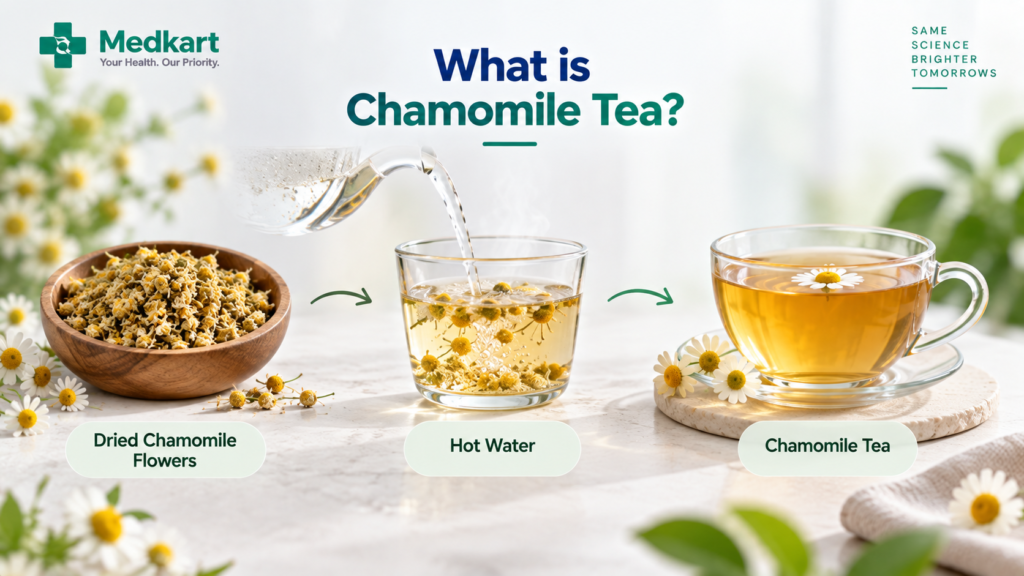
Chamomile tea is an infusion of dried chamomile flower heads in hot water. The European Medicines Agency[1] defines the herbal substance as Matricaria recutita L., flos, meaning the flower and no other part of the plant.
What people use it for is broader than what it is registered for. The National Center for Complementary and Integrative Health[2] lists the common cold, indigestion, anxiety and insomnia among the things chamomile is promoted for.
What are the benefits and uses of chamomile tea?

The EMA recognises chamomile flower for a small set of minor complaints, and only as a traditional herbal medicine.
Only one of the five registered uses involves drinking the infusion. The others are a mouth rinse, a skin wash, a local irrigation and a steam inhalation.
| Use | What the evidence says |
| Minor digestive complaints | The EMA registers the flower, taken by mouth as an infusion, for minor gastro-intestinal complaints such as bloating and minor spasms. The registration rests on long-standing use, not on trial results. |
| Anxiety | A trial in the Journal of Clinical Psychopharmacology[3] randomised 57 outpatients with mild to moderate generalised anxiety disorder to a standardised extract or placebo for eight weeks. Anxiety scores fell further on chamomile, at p equal to 0.047. The trial used capsules, not tea. |
| Mouth and throat | The EMA registers an infusion of 1 to 5 g in 100 ml of water for minor ulcers and inflammation of the mouth and throat, used for rinsing and gargling rather than swallowed. |
| Skin and sunburn | It also registers the flower for minor skin inflammation including sunburn, superficial wounds and small boils, applied as a wash or an impregnated dressing. |
| Common cold | For cold symptoms the monograph gives 3 to 10 g in 100 ml of hot water as a steam inhalation, which is not a drinking use. |
Does chamomile tea help with weight loss?
No. Weight is not among the uses the EMA registers. A 2021 review of chamomile in obesity and metabolic syndrome[4] states that no clinical trials of chamomile in the management of obesity were available to its authors.
The review describes laboratory and animal work on carbohydrate digestion and energy metabolism instead. Its authors treat chamomile as a promising candidate, while noting that any effect is likely to be moderate because plant polyphenols are poorly absorbed when swallowed.
How do you make chamomile tea?

As an infusion. The EMA’s patient leaflet template for herbal teas[5] sets out the method in standard terms.
Boiling water is poured over the flowers, and the tea is left to steep for a set period, usually 5 to 15 minutes where nothing else is specified. The vessel is kept covered with a lid and stirred at intervals. The liquid is then strained through a tea strainer.
The same document notes that infusion suits leaves, flowers and delicate plant parts, while roots and barks are simmered or soaked instead.
What is the recommended dosage of chamomile tea?
There is no one amount that applies to everyone. For the flower brewed as a tea, the monograph gives adolescents, adults and the elderly a single dose of 1.5 to 4 g in 150 ml of boiling water. It puts the frequency at 3 to 4 times a day.
Smaller single doses are set out for children, taken 2 to 4 times a day:
- 6 months to 2 years: 0.5 to 1.0 g
- 2 to 6 years: 1.0 to 1.5 g
- 6 to 12 years: 1.5 to 3.0 g
A weight printed on a pack of tea bags describes how much flower each bag holds. It is product information, not an instruction about how much to drink.
India regulates the ingredient rather than the brew. The Food Safety and Standards Authority of India[6] lists Matricaria chamomilla as a permitted nutraceutical ingredient in Schedule VI, Part B. The entry covers an aerial parts extract, sets no daily range, and describes a manufactured product rather than flowers brewed at home.
When should you drink chamomile tea?
No source retrieved for this article gives a best time of day. The monograph sets a frequency of 3 to 4 times daily and says nothing about morning or evening.
Does chamomile tea help with sleep?
Sleep is why people ask, and the sources disagree.
The NCCIH reports that a 2019 review found only one insomnia study, and that it showed no benefit. A pilot trial in BMC Complementary and Alternative Medicine[7] gave 34 adults with chronic primary insomnia 270 mg of chamomile extract twice daily for 28 days. Total sleep time and sleep efficiency did not differ significantly from placebo, though time to fall asleep shortened by about 16 minutes.
A trial in the Journal of Education and Health Promotion[8] found the opposite. Seventy-seven nursing home residents aged over 60 took 400 mg capsules twice daily, after lunch and after dinner, for four weeks. Sleep quality scores improved against the control group, and the authors name the absence of blinding and of a placebo group among the study’s limits.
All three used capsules of extract, so their schedules are not schedules for a cup of tea.
Also Read: Ashwagandha for Men: Benefits for Energy, Strength & Hormones
How long can you drink chamomile tea?
The EMA sets a checkpoint rather than a maximum. If symptoms last more than one week, the monograph says a doctor or a qualified health care practitioner should be consulted. The same applies if symptoms get worse.
No source retrieved for this article sets a limit on chamomile drunk as an ordinary beverage.
What side effects can chamomile tea cause?
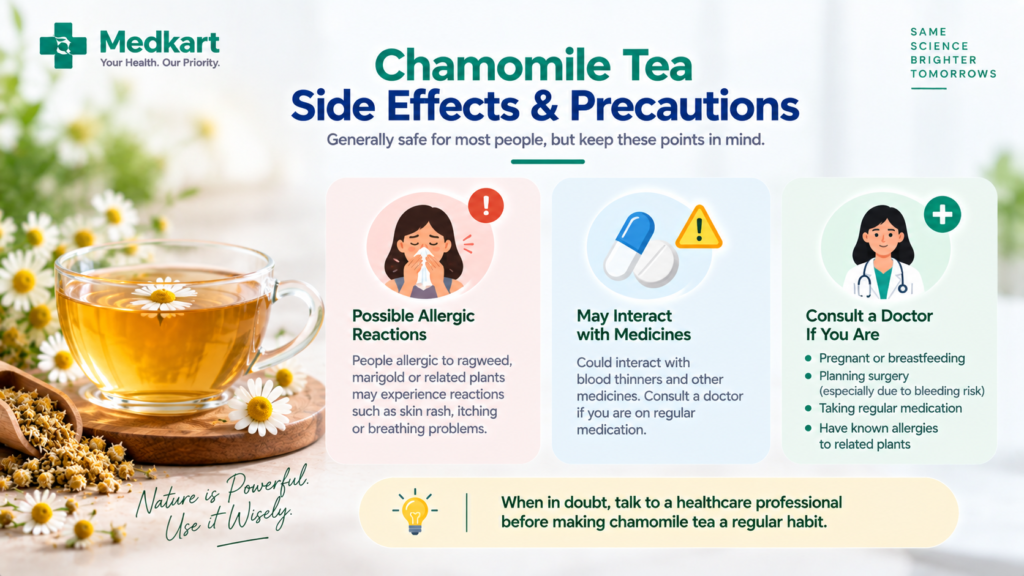
Allergic reactions are the effect the sources single out. The EMA records hypersensitivity reactions, including severe ones, and puts their frequency at not known.
Among the severe reactions it names breathlessness, Quincke’s disease, vascular collapse and anaphylactic shock. These were reported after mucosal contact with liquid chamomile preparations.
The NCCIH describes chamomile as likely safe by mouth in the amounts commonly found in teas and other foods. It lists nausea, dizziness and allergic reactions as uncommon effects. The EMA adds that no case of overdose has been reported.
Who should be careful with chamomile tea?
The clearest case is an allergy to plants in the daisy family. Four other situations call for care.
| Situation | What to do |
| An allergy to daisies, marigolds or ragweed | The EMA contraindicates chamomile in anyone with hypersensitivity to it or to other plants of the Asteraceae family. The NCCIH notes that reactions are more likely in people allergic to ragweed, chrysanthemums, marigolds or daisies. |
| Pregnancy and breastfeeding | The sources disagree. The EMA states that safety during pregnancy and lactation has been established for the comminuted flower used as a tea, but not for the extracts, whose use it does not recommend. The NCCIH says little is known about either. |
| Babies under six months | The EMA has not established oral use of the herbal tea below six months of age, on general grounds of nutrition and fluid intake. |
| Regular prescribed medicines | Interactions have been reported for concentrated preparations. A pharmacist should be told what is being taken before chamomile becomes a daily habit. |
| Hormonal contraception | The NCCIH notes that chamomile may have oestrogen-like effects, and that these might reduce the effectiveness of birth control pills. |
| Breathlessness, swelling or faintness after drinking it | The EMA lists these among reported severe reactions. They call for stopping the tea and getting medical help the same day. |
Can chamomile tea interact with medicines?
Possibly, and what has been reported involves concentrated preparations rather than a cup. The EMA reports interactions based on effects on CYP450 in patients after kidney transplantation who took high doses for about two months. For skin, mouth, inhalation and bath use it reports none.
The NCCIH reports interactions between chamomile and warfarin, a blood thinner, and with some medicines that the liver breaks down.
Neither source describes an interaction study on chamomile tea at ordinary drinking strength.
Where can you buy chamomile tea online?
Medkart is a pharmacy, so chamomile appears there mostly as an ingredient inside a formulated product.
Periods Care tea bags from Taparia Tea Company name chamomile among their herbs. On the skin side, Dermsilk cream from Cure N Cure Pharmaceutical and Urtiplex lotion from Charak Pharmaceuticals both list chamomile extract. So does Gentle Baby Shampoo from Himalaya Wellness.
The Ayurvedic products category and the Ayurvedic composition listing show the wider herbal range. Availability, pack size and price differ between products and can change.
Medkart states that the medicines it sells are sourced from WHO-GMP certified manufacturers. Medkart’s medicine comparison tool places products side by side, while the medicines index and the search page show what is in stock. Points worth comparing on a herbal pack include:
- Botanical name of the plant
- Whether the pack is pure chamomile or a blend
- Weight of flower per bag
- Manufacturer
- Pack size
Chamomile products are sold without a prescription, so a doctor or pharmacist should be told before one joins a set of regular medicines.
Key takeaways
- Chamomile tea is an infusion of the dried flowers of Matricaria recutita, known as German chamomile.
- The EMA registers it as a traditional herbal medicine, which means the use rests on long-standing use rather than trials.
- Only one of its five registered uses is a drink, for minor digestive complaints such as bloating and spasms.
- The monograph gives adults a single dose of 1.5 to 4 g in 150 ml of boiling water, 3 to 4 times a day.
- An infusion is steeped for 5 to 15 minutes under a lid, then strained.
- No source retrieved for this article gives a best time of day to drink it.
- The sleep and anxiety trials used capsules of concentrated extract, not the tea.
- Allergy is the main reported risk, and it is more likely in people who react to daisies, marigolds or ragweed.
FAQs: Common Questions About Chamomile Tea
Q. Is the chamomile in a tea bag the same as the chamomile in a capsule?
No, and the difference matters more than it looks. A tea bag holds the dried flower, while a capsule holds an extract concentrated many times over. The EMA treats them as separate preparations with separate amounts, and reaches different conclusions about them in pregnancy.
Q. Why does the water need to be boiling?
For hygiene as much as for flavour. The EMA’s leaflet template notes that boiling water lowers the microbial load carried by dried plant material, which is not sterile. Water that has gone off the boil does less to that load.
Q. Can brewed chamomile tea be kept and drunk later?
For a short while, and cold. The same EMA template says a herbal infusion should be drunk soon after it is made, and otherwise kept covered in the fridge for no more than 24 hours. A pot left standing at room temperature all day falls outside that advice.
Q. Is German chamomile the same as Roman chamomile?
They are different plants sold under a shared name. The EMA monograph and the FSSAI listing both name Matricaria recutita, and the NCCIH says chamomile refers primarily to German chamomile. No source retrieved for this article covers Roman chamomile, so nothing here should be assumed to apply to it.
Q. Can chamomile tea replace a prescribed medicine for anxiety or sleep?
No. The anxiety trial tested a standardised extract in people with mild to moderate symptoms, and its authors said the findings do not extend to severe cases. The registered use for the drink covers minor digestive complaints and nothing more. Any change to prescribed treatment is a decision for the prescriber.
Q. Do loose flowers and tea bags need different handling?
Slightly. The EMA notes that herbal teas come both loose and in sachets, and gives each a different final step. Loose flowers are stirred and strained, with the residue pressed to yield more liquid. A sachet is gently squeezed instead.
References
- https://www.ema.europa.eu/en/documents/herbal-monograph/final-european-union-herbal-monograph-matricaria-recutita-l-flos-first-version_en.pdf
- https://www.nccih.nih.gov/health/chamomile
- https://pmc.ncbi.nlm.nih.gov/articles/PMC3600416/
- https://pmc.ncbi.nlm.nih.gov/articles/PMC8481792/
- https://www.ema.europa.eu/en/documents/regulatory-procedural-guideline/patient-leaflet-template-concerning-advice-preparation-herbal-teas-traditional-herbal-medicinal-products-end-users_en.pdf
- https://fssai.gov.in/upload/uploadfiles/files/Compendium_Nutra_29_09_2021.pdf
- https://pmc.ncbi.nlm.nih.gov/articles/PMC3198755/
- https://pmc.ncbi.nlm.nih.gov/articles/PMC5470311/
Medical disclaimer: This article gives general information only. It does not replace advice from a doctor or pharmacist. No medicine or supplement should be started, stopped or changed without advice from the prescriber or a qualified pharmacist.
Leave a Reply