

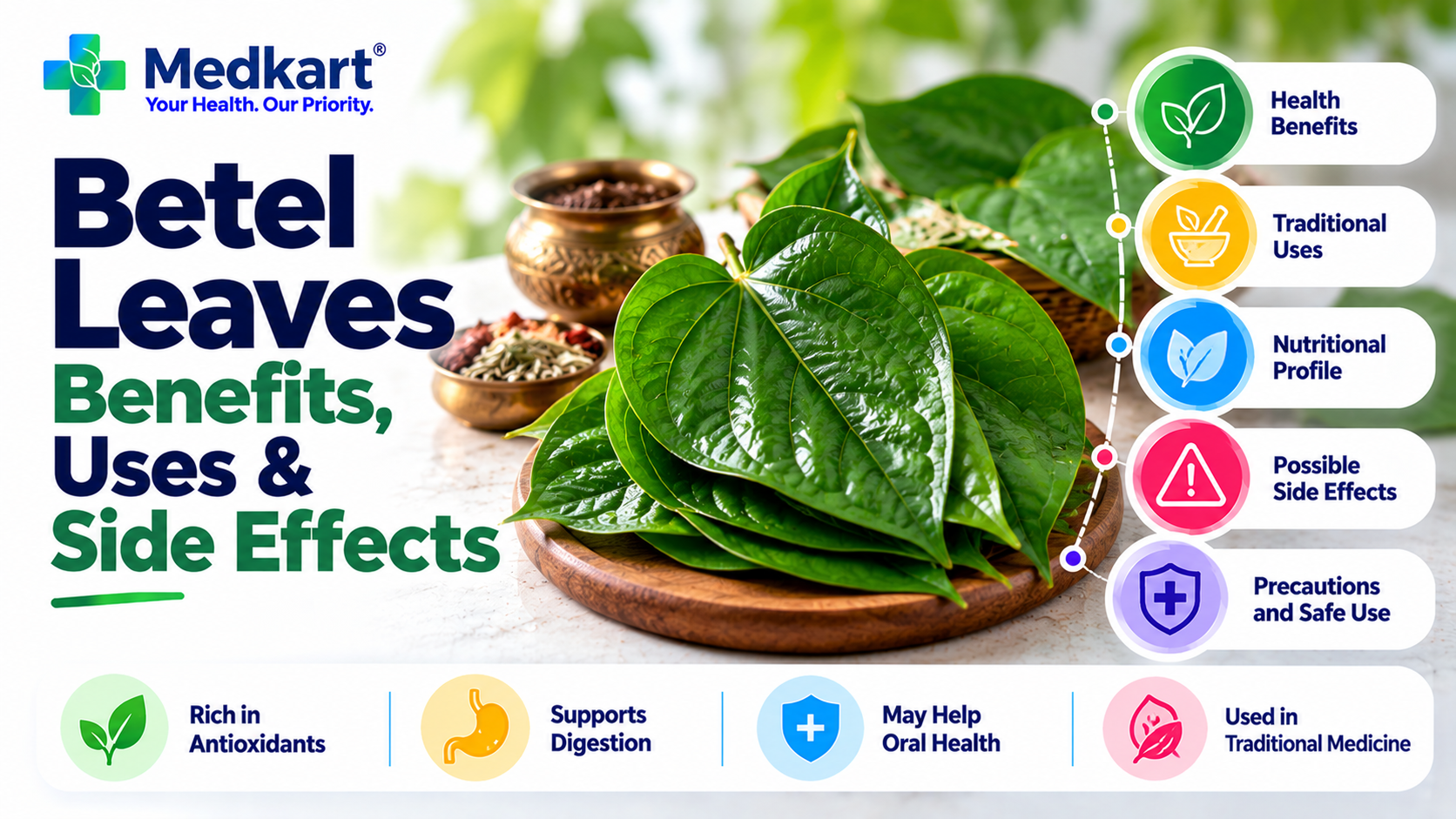
Betel leaves come from Piper betle, a vine grown mainly in South and Southeast Asia, and are known in Hindi, Bengali and Urdu as paan. Most claims about betel leaves benefits rest on traditional use and laboratory work rather than on studies in people.
The leaf is chewed, used in folk medicine, and wrapped around areca nut, lime and sometimes tobacco to make betel quid. The safety picture changes with what goes inside the leaf.
What Is Betel Leaf?
Betel leaf is the leaf of the betel vine, a plant of the family Piperaceae. A 2022 review in the Journal of Cellular and Molecular Medicine[1] gives the betel leaf scientific name as Piper betle L.
For anyone asking what is betel leaf in everyday terms, the review describes glossy, heart-shaped leaves that are chewed or taken as betel quid. It records Indian names including tambool in Sanskrit, vetrilai in Tamil and tamalapaku in Telugu.
The review names hydroxychavicol as the leaf’s most important active compound.
What Is the Nutritional Value of Betel Leaves?
Betel leaf is mostly water, with modest amounts of fibre, calcium and iron. The most complete figures retrieved for this article come from Malaysia rather than India.
The Malaysian Food Composition Database[2] gives these values per 100 g of edible leaf:
- Energy and water: 40 kcal, with 83.5 g of water
- Protein, fat and carbohydrate: 3.1 g, 0.4 g and 6.1 g
- Fibre: 4.7 g
- Minerals: 190 mg of calcium, 5.7 mg of iron and 684 mg of potassium
- Vitamins: 29.4 mg of vitamin C and 6,878 µg of carotenes
The entry dates from 1997 and describes Malaysian samples. No Indian Food Composition Tables entry for betel leaf could be retrieved for this article, so these figures may not match leaves grown in India.
Which Betel Leaves Benefits Have Been Tested?
Very few, and mostly not in people. The 2022 review records betel leaves medicinal uses in Indian and Chinese folk practice as a carminative, a stimulant and an astringent, and against worms, conjunctivitis, rheumatism and wounds.
Its list of traditional betel leaves uses also covers cold, bronchial asthma, cough and stomach pain. The betel leaves benefits it reports come almost entirely from cell and animal experiments.
| Use | What the evidence says |
| Germs and bad breath | The 2022 review reports antibacterial and antifungal activity, and an anti-halitosis effect measured as lower volatile sulphur compounds. These are experimental findings, not trials of chewing the leaf. |
| Blood sugar | The review reports that a leaf suspension lowered blood glucose from 205 to 151.3 mg/dl in diabetic rats and reduced glycosylated haemoglobin. |
| Stomach ulcers | An ethanol extract cut the ulcer index by 93.4% in the experimental work the review summarises, and improved the mucin content of stomach tissue. |
| Weight | A 2012 randomised trial in Lipids in Health and Disease[3] tested a capsule combining betel leaf extract with Dolichos biflorus seed extract. Weight fell by 4.28 kg against 1.79 kg on placebo over eight weeks. |
| Use in people overall | The review calls broad clinical studies a major gap and asks for well-designed trials with enough patients. |
No study retrieved for this article tested the benefits of eating betel leaves as a food.
What Does the Evidence Say About Betel Leaves for Cough?
Very little that applies to people. Cough, cold and bronchial asthma appear among the traditional uses in the 2022 review, but it describes no human trial for any of them.
The nearest finding comes from animals. The review reports a prominent anti-asthmatic effect from an extract given at 100 to 200 mg per kg, a laboratory dose rather than a human one.
There is also an Indian warning. A 2020 Indian case series[4] describes ten children aged four to nine who developed leukomelanosis, a skin pigment disorder, on the chest or forehead.
The changes followed traditional home use of the leaves for a cough or cold. This series is the only Indian source retrieved on betel leaves for cough, and it reports harm rather than benefit.
A persistent cough, in a child or an adult, should be assessed by a doctor.
What Is the Recommended Dosage of Betel Leaf?
No recommended dosage of fresh betel leaf appears in any source retrieved for this article. That applies to chewing, eating and drinking it as an infusion.
The only human figure comes from the 2012 trial. Its 50 adults, with a body mass index of 30 to 40, took 300 mg of the combination capsule three times a day.
That figure describes one standardised product in one study. It is product information, not a dose of betel leaf for anyone else.
Animal studies in the review used doses in milligrams per kilogram of body weight. These are experimental figures, not guidance for people.
When Should You Take Betel Leaves, and for How Long?
No source retrieved for this article gives a time of day or a safe duration.
The 2012 trial ran for eight weeks, and the animal studies in the 2022 review for up to 60 days. In the Taiwanese survey described below, skin bleaching appeared within one to four weeks of facial use.
Anyone planning regular medicinal use for more than a few weeks should agree it with a doctor first.
What Are the Betel Leaf Side Effects?
The most clearly documented betel leaf side effects involve the skin. A 1999 survey in the Journal of the American Academy of Dermatology[5] described 15 people in Taiwan who had used steamed betel leaves as facial dressings.
They first had redness and stinging, then bleaching of the skin. Eight later developed darker patches and confetti-like pale spots after sun exposure.
The authors suggest that phenol, catechol and benzene derivatives in the leaves may block melanin production or damage pigment cells.
In the 2012 trial, minor complaints such as stomach irritation, abdominal pain and a burning sensation were spread evenly between the capsule and placebo groups.
How Is Plain Betel Leaf Different from Paan with Areca Nut?
Plain leaf is one ingredient, and a paan quid adds several more. The International Agency for Research on Cancer[6] describes betel quid as areca nut, catechu, slaked lime and flavourings wrapped in betel leaf, frequently with tobacco added.
IARC classes three of these as carcinogenic to humans:
- Betel quid with tobacco, which causes cancers of the mouth, pharynx and oesophagus
- Betel quid without tobacco, which causes oral cancer
- Areca nut, which also causes oral submucous fibrosis, a precancerous condition
For the leaf alone, IARC reports animal evidence suggesting a lack of carcinogenicity, with betel leaf extracts producing no tumours. That finding does not extend to a paan containing areca nut or tobacco.
Who Should Be Careful with Betel Leaves?
Some groups face more risk from betel leaves medicinal uses than others.
| Situation | What to do |
| Children with a cough or cold | The Indian case series links home use of the leaves to pigment changes on children’s skin. A child with a lasting cough should see a doctor, and any new skin patch should be shown to one. |
| Pregnancy or trying to conceive | The 2022 review reports antifertility, anti-implantation and abortifacient activity in animal studies. Medicinal use of the leaf should be discussed with a doctor first. |
| Leaves on the face | The Taiwanese survey links steamed leaves on the face to stinging, bleaching and patchy pigmentation. Skin that stings or reddens should be washed and the change shown to a doctor. |
| Regular paan chewing | IARC classes betel quid, with or without tobacco, and areca nut itself as causes of cancer. A doctor or dentist can discuss the risk and support for stopping. |
| Regular medicines | The 2022 review lists interactions with other drugs among the questions still needing research, and no interaction study was retrieved for this article. A pharmacist should be told about any betel leaf extract taken with prescribed medicines. |
If you take regular medicines, tell your doctor or pharmacist about any betel leaf product you use.
Where Can You Buy Related Products on Medkart?
Fresh betel leaves are sold as a food, and no betel leaf product was found in Medkart’s catalogue when this article was prepared. Medkart does list products in related categories.
The Ayurvedic products category and the Ayurvedic composition listing show the herbal range. Cough and cold products, personal care items and nutritional supplements each have their own category.
Oral hygiene products such as Vantej Aqua mouthwash are listed, and a pharmacist can say whether a medicated mouthwash suits a particular person.
Medkart’s medicine comparison tool places products side by side on points such as:
- Active ingredient
- Strength
- Dosage form
- Manufacturer
- Pack size
- Current price
The medicines index shows the full range, and the store locator finds a nearby pharmacy. The generic medicine page highlights WHO-GMP certification for the range Medkart sells. Availability and pack sizes change.
A doctor or pharmacist should be asked before any herbal product is added to regular medicines.
Key takeaways
- Betel leaf is the leaf of Piper betle, a vine of the family Piperaceae, known in Hindi as paan.
- Traditional betel leaves uses include cough, cold, digestive complaints and wounds.
- Most reported betel leaves benefits come from laboratory and animal studies, not from trials in people.
- No retrieved source gives a recommended dosage, a safe duration or a time of day for betel leaf.
- Malaysian data give 4.7 g of fibre and 190 mg of calcium per 100 g of leaf, and no Indian table entry was retrieved.
- The most clearly documented betel leaf side effects are skin pigment changes after leaves were used on the face or chest.
- IARC classes betel quid, with or without tobacco, and areca nut as causes of cancer.
- Children, pregnancy and regular medicines are reasons to check with a doctor or pharmacist first.
FAQs: Common Questions About Betel Leaves
Q. What is the betel leaf scientific name?
It is Piper betle L. The 2022 review also lists Piper betel Blanco as a synonym, so both spellings turn up in research papers. A search under either name finds studies on the same plant, which is useful when reading product labels or older literature.
Q. Is betel leaf the same as betel nut?
No. The leaf comes from the Piper betle vine, while the so-called betel nut is areca nut, a separate ingredient folded inside the leaf in a paan. The difference matters because IARC classes areca nut on its own as a human carcinogen, and its animal evidence on the plain leaf does not show the same effect.
Q. Do the benefits of eating betel leaves apply to paan?
Not necessarily. Betel quid, as the 2022 review describes it, is leaf brushed with burnt lime and filled with pieces of areca nut, often with cardamom or cloves and sometimes tobacco. Whatever the plain leaf does, that mixture adds ingredients that IARC links to cancer.
Q. How do betel leaves uses vary between varieties?
The sources do not say. The 2022 review counts more than 100 varieties worldwide, about 40 of them in India and 30 in West Bengal and Bangladesh. No study retrieved here compares betel leaves benefits between them, so no single type can be called better than another.
Q. What are the main active compounds in betel leaf?
Hydroxychavicol is the one the 2022 review rates highest. It also names eugenol, chavicol and safrole, along with phenols, terpenes, flavonoids and tannins, and puts the oil content of fresh leaves at 4.2%. The amount of each compound in a single leaf was not given in the sources retrieved.
Q. Do animal studies show betel leaves medicinal uses are safe?
It depends on the extract and the species. The 2022 review reports no toxicity from an alcoholic extract at 100 to 300 mg per kg in mice and rats, and no deaths from a methanol extract at 5,000 mg per kg in mice. In guinea pigs, doses above 300 mg per kg killed half the animals, so animal data alone cannot show the leaf is harmless.
Q. Is a betel leaf extract the same as the fresh leaf?
No. The extract in the 2012 trial was made with 60% alcohol and standardised to 6% polyphenols, then blended with a second plant extract in a 2:3 ratio. A fresh leaf has none of that standardisation, so the trial says nothing direct about betel leaves benefits from chewing or eating the leaf.
References
- https://pmc.ncbi.nlm.nih.gov/articles/PMC9170825/
- https://myfcd.moh.gov.my/index.php/1997-food-compositon-database/148-betel-leaf-(sireh)-;-piper-betel.html
- https://pmc.ncbi.nlm.nih.gov/articles/PMC3551693/
- https://www.ebi.ac.uk/europepmc/webservices/rest/search?query=EXT_ID:32621618%20AND%20SRC:MED&resultType=core&format=json
- https://www.ebi.ac.uk/europepmc/webservices/rest/search?query=EXT_ID:10188678%20AND%20SRC:MED&resultType=core&format=json
- https://inchem.org/documents/iarc/vol85/85-01-betel-areca.html
Medical disclaimer: This article gives general information only. It does not replace advice from a doctor or pharmacist. No medicine or supplement should be started, stopped or changed without advice from the prescriber or a qualified pharmacist.

Leave a Reply