
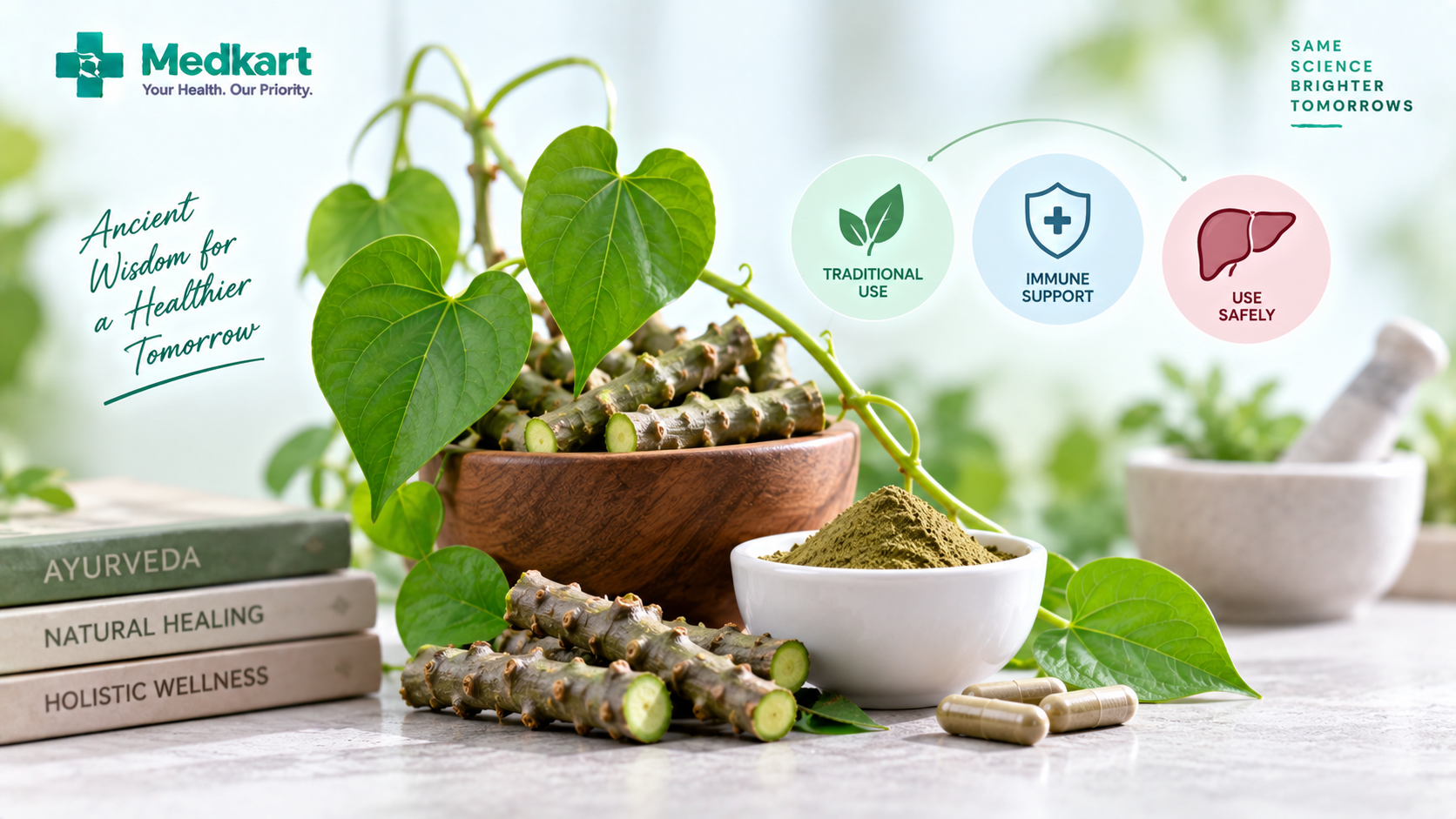
Giloy is the common name for Tinospora cordifolia, a climbing shrub used in Ayurveda under the name Guduchi.
Its use rose sharply during the COVID-19 pandemic. So did a set of published reports linking it to liver injury.
What is giloy?
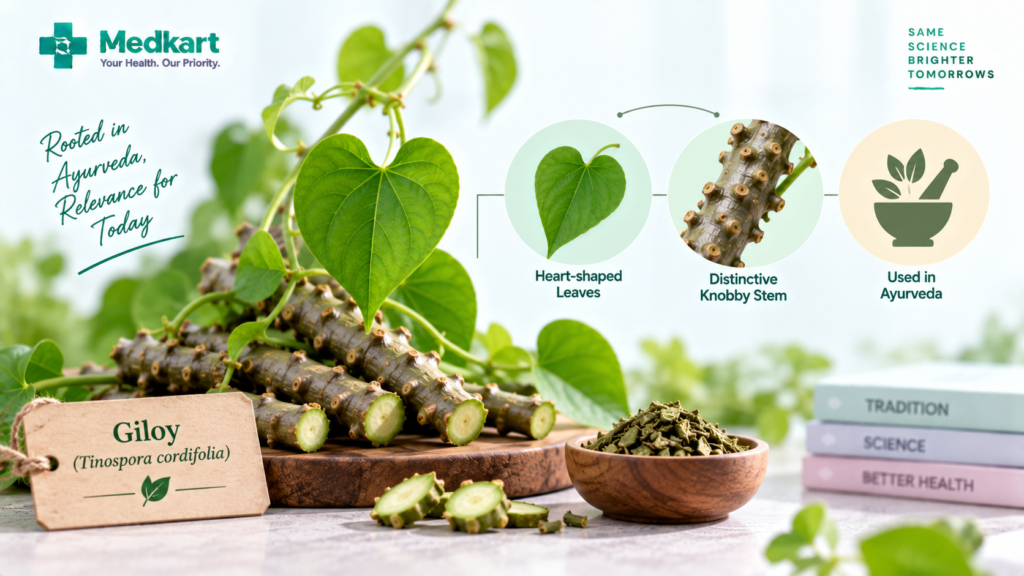
Giloy is Tinospora cordifolia, a plant of the Menispermaceae family. A 2023 review in the Chinese Journal of Integrative Medicine[1] describes it as a herbaceous vine, or climbing deciduous shrub.
LiverTox[2], the United States National Institutes of Health database on drug-induced liver injury, records that extracts of the leaves, roots and bark are used.
LiverTox names more than 60 compounds in Tinospora species, including lactones, steroids, flavonoids, lignans, alkaloids and the characteristic clerodane-type furanoditerpenoids. It identifies the clerodane diterpenoids as the probable cause of the liver injury set out below.
What is the nutritional value of giloy?
Giloy is taken as a herb rather than eaten as a food, so nutrient figures describe the dried plant rather than a dose.
A 2024 review of giloy leaves[3] gives about 5.2 g of protein and about 52 g of fibre per 100 g of dehydrated leaves. It lists calcium and iron among the minerals present. A 2023 review of the stem in food[4] reports protein and dietary fibre, with vitamin C, calcium and iron in small concentrations.
Both sets of figures are per 100 g, and a typical daily dose is a small fraction of that weight. No Indian food composition entry for giloy could be retrieved for this article.
What are the benefits and uses of giloy?
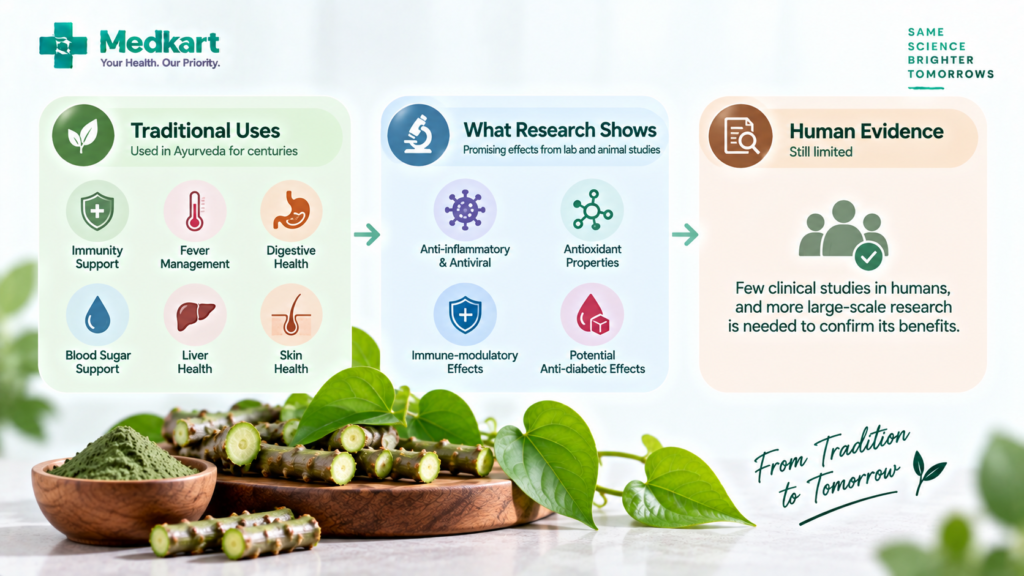
Giloy has a long list of traditional uses and a much shorter list of tested ones. The 2023 review lists fevers, jaundice, diabetes, dysentery, urinary infections and skin diseases among its traditional applications.
The same review names anti-diabetic, immune-modulatory, antiviral, antioxidant and hepatoprotective effects among the pharmacological properties studied. The stem, the leaf and the root are all used.
LiverTox records a similar list. It names diabetes, rheumatism, jaundice, malaria, asthma, depression, pain and urinary tract infections, with recent use aimed at COVID-19.
What does the clinical evidence show?
Less than the traditional list suggests. The 2023 review states that large-scale clinical studies are still needed.
| Use | What the evidence says |
| Immune effects in HIV | A randomised, double-blind, placebo-controlled trial[5] gave 300 mg three times daily for six months to 68 people. Sixty per cent on the extract reported fewer symptoms against 20 per cent on placebo, but CD4 count did not improve in either group. |
| The wider pharmacology | The 2023 review reports anti-diabetic, antiviral and immune-modulatory activity from laboratory and animal work, and calls for large-scale clinical studies to establish efficacy in people. |
| Giloy leaves | The 2024 review of giloy leaves reports that leaf extracts stimulate immune cells including natural killer cells, B cells and T cells. It states that these findings come from laboratory and animal work, and reports no human trials of leaf-based products. |
| Everyday immunity | No source retrieved for this article establishes that giloy prevents or shortens an ordinary infection in a healthy adult. |
The trial authors add two caveats of their own. Six months may not have been long enough to judge, and not all the objective measures backed up what patients reported.
How do you use giloy, and how much?
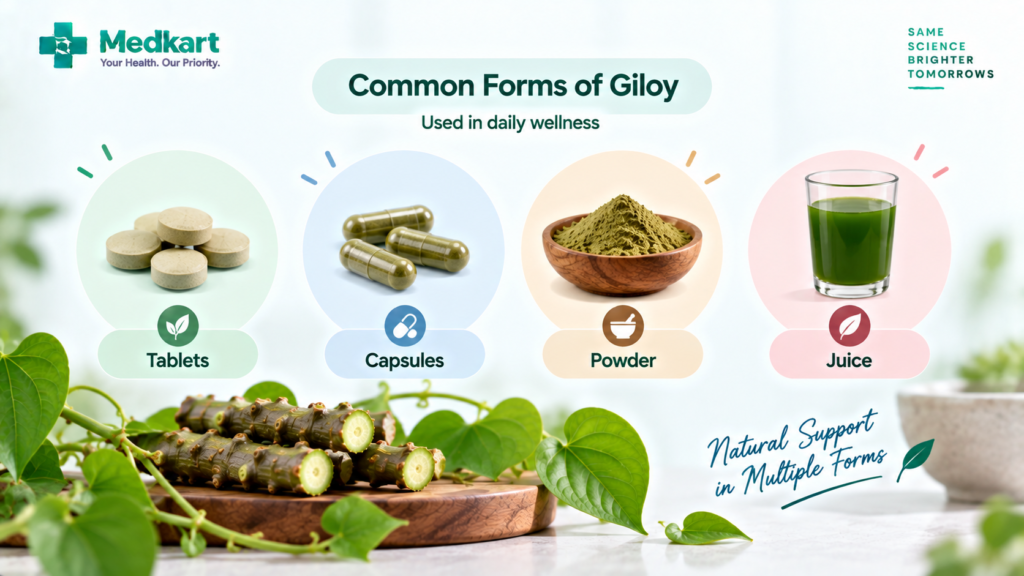
Giloy is used as tablets, capsules, powders and juices, and no one dose applies to everyone. LiverTox records a typical dose of 400 to 1,000 mg daily across the forms sold over the counter, which include solutions, powders, capsules and tablets.
The HIV trial used 900 mg a day, under supervision and with monitoring.
A strength printed on a pack describes the amount of extract in that product. It is product information, not an instruction about how much to take. What suits a particular person is a question for a doctor or a qualified Ayurvedic practitioner.
When should you take giloy, and for how long?
No source retrieved for this article gives a time of day. The Ministry of AYUSH publishes a technical dossier on Guduchi, and neither that document nor the Ministry’s press statements could be opened while researching this article.
On duration there is more to go on. The HIV trial ran for six months under medical supervision. LiverTox reports that liver injury appeared between a few weeks and six months after starting.
Long unsupervised use is the pattern the reports describe most often. Anyone planning to take giloy for more than a few weeks should agree that with a doctor first.
Also Read: What Is Shatavari? A Complete Guide to Its Uses and Health Benefits
What side effects can giloy cause?
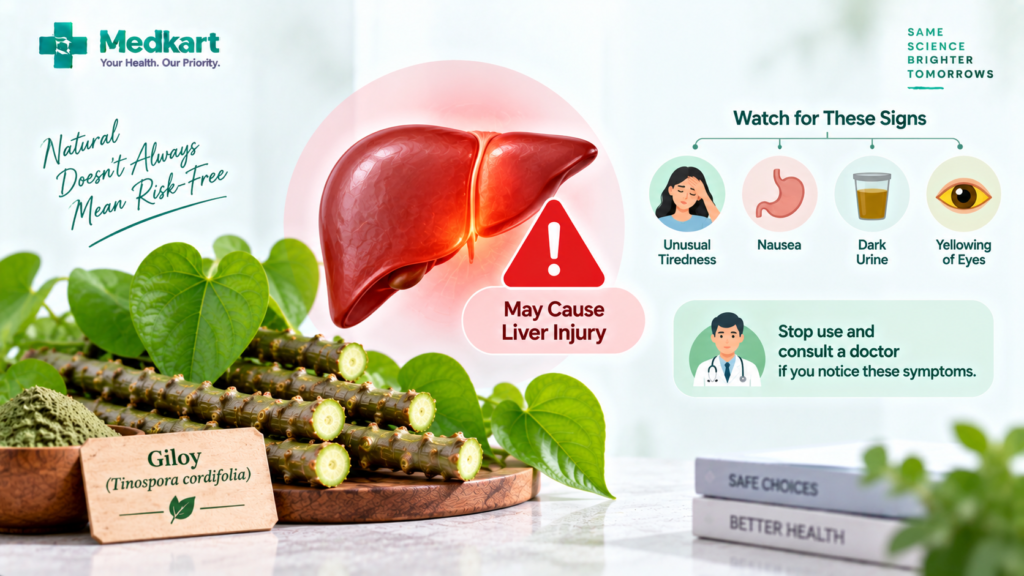
The side effect that matters most is liver injury. LiverTox describes the pattern as hepatocellular, with ALT and AST between 10 and 50 times the upper limit of normal.
It records more than 50 reported cases since 2017, most of them during the COVID-19 period. Autoantibodies were frequent, sometimes with features of autoimmune hepatitis on liver biopsy.
Severity ranges widely. LiverTox describes cases from minimally symptomatic enzyme rises, through mild hepatitis that settled on stopping, to severe hepatitis, acute liver failure and deaths.
What do the liver injury reports say?
An Indian case series described six people who developed hepatotoxicity after self-medicating with giloy. The Ayurveda community responded that the patients had probably taken Tinospora crispa, a look-alike species known to harm the liver. The authors then confirmed by DNA analysis[6] that the plant taken was Tinospora cordifolia. They concluded it had caused an autoimmune-like hepatitis, or unmasked a latent autoimmune liver disease.
A rebuttal in the same journal[7] argued the other way. It cites animal work finding the aqueous extract non-toxic up to 2,000 mg per kg by mouth. It also cites a trial in healthy volunteers taking 500 mg for 21 days, with normal results. It adds that diabetes and hypothyroidism, and the medicines used for them, are confounders, and that baseline liver function was not reported.
A 2023 case report in Cureus[8] sits with the first group. A woman taking a supplement containing 900 mg of Tinospora cordifolia extract developed symptoms after four to five weeks, with ALT at 1,336. Stopping it, with a short course of prednisone, returned her liver tests to baseline within three months.
LiverTox has since given Tinospora its highest likelihood score, listing it as a well established cause of clinically apparent liver injury. Where sources disagree this way, the useful response is not to pick a side but to know the warning signs.
Who should be careful with giloy?
| Situation | What to do |
| Existing liver disease | LiverTox reports that cases appear more frequent and more severe in people with pre-existing liver disease, often as acute-on-chronic injury that worsens the underlying condition. Giloy should not be started without a doctor’s agreement. |
| An autoimmune condition | The Cureus patient had Hashimoto’s thyroiditis, and the authors suggest autoimmune disease deserves further investigation as a risk factor. |
| Long unsupervised courses | LiverTox puts time to onset between a few weeks and six months. The published cases describe self-medication rather than prescribed courses. |
| Raw stem bought loose | Tinospora crispa resembles Tinospora cordifolia and is known to harm the liver. Loose stem carries an identification risk that a labelled product does not. |
| New symptoms while taking it | Fresh tiredness, nausea, loss of appetite, dark urine or yellowing of the eyes is a reason to stop giloy and see a doctor that week. |
Can giloy interact with other medicines?
No formal interaction studies were retrieved for this article.
The nearest thing the sources offer is indirect. People taking medicines for diabetes and hypothyroidism were among those in the liver injury cases, which the rebuttal treats as a confounder rather than an interaction.
That is a reason to tell a prescriber what you are taking rather than to assume the two are unrelated.
Where can you buy giloy online?
Medkart lists giloy products in its Ayurvedic range. Guduchi capsules from Himalaya Wellness carry Tinospora cordifolia extract, and Shanshamani Vati from Zandu is built on the same herb.
Giloy also appears inside combination formulations. Kofol Immunity tablets and Ojus syrup both list Guduchi among their herbs, and Immumor syrup lists Giloy alongside tulsi and ashwagandha.
The Ayurvedic products category and the Ayurvedic composition listing show what is stocked, and Medkart’s medicine comparison tool places products side by side. Medkart states that the medicines it sells are sourced from WHO-GMP certified manufacturers.
Giloy products appear in the medicines index and are sold without a prescription, so a doctor or pharmacist should be told before one is added to regular medicines.
Key takeaways
- Giloy is Tinospora cordifolia, known in Ayurveda as Guduchi.
- Its traditional uses are wide, and the evidence tested in people is much narrower.
- A 2023 review states that large-scale clinical studies are still needed to prove efficacy.
- LiverTox records a typical dose of 400 to 1,000 mg daily for products sold over the counter.
- No source retrieved for this article gives a best time of day to take it.
- LiverTox lists Tinospora as a well established cause of clinically apparent liver injury.
- A published case series and a published rebuttal disagree about how strong that link is.
- Fresh tiredness, nausea, dark urine or yellow eyes while taking giloy calls for stopping and seeing a doctor.
FAQs: Common Questions About Giloy
Q. Is giloy the same thing as Guduchi?
Yes. LiverTox records giloy as the Hindi name and Guduchi as the Sanskrit name for the same plant. Guduchi is the form used on most Indian product labels, and seeing both on one pack does not mean two ingredients.
Q. Is giloy juice as effective as giloy tablets?
No retrieved source compares the forms against each other. LiverTox gives a single dose range of 400 to 1,000 mg daily across solutions, powders, capsules and tablets together, rather than a separate figure for each form. The choice between a juice and a tablet is therefore not one the published evidence settles.
Q. How soon after starting giloy could liver trouble appear?
Not immediately, which is part of why it gets missed. The Cureus patient developed symptoms after four to five weeks. Someone who has taken it for a fortnight without trouble has not cleared the window.
Q. Does stopping giloy reverse the liver injury?
Usually, though not always. LiverTox describes the injury as typically self-limited, with chronic damage not clearly described. The same source also records severe hepatitis, acute liver failure and deaths, so this is not a reason to wait and see.
Q. Is a labelled tablet safer than raw giloy stem?
On identification, yes. A labelled product from a known manufacturer names the species it contains, and a bundle of stem bought loose does not. Since a look-alike species is known to harm the liver, knowing which plant is in the pack is the practical difference.
Q. Can giloy be taken to prevent colds and flu?
No source retrieved for this article supports that. The published human trial was in HIV-positive patients and measured symptoms and blood counts. Immune-modulatory activity in a laboratory is a different claim from preventing an illness in a person.
Q. Should someone already taking giloy stop?
That is a decision for their doctor, not for an article. What the sources support is knowing the warning signs, avoiding long unsupervised courses, and being more cautious where there is existing liver disease or an autoimmune condition. Anyone with symptoms should stop and seek advice rather than finish the pack.
References
- https://pmc.ncbi.nlm.nih.gov/articles/PMC10073789/
- https://www.ncbi.nlm.nih.gov/books/NBK608429/
- https://pmc.ncbi.nlm.nih.gov/articles/PMC11699423/
- https://pmc.ncbi.nlm.nih.gov/articles/PMC10609069/
- https://pmc.ncbi.nlm.nih.gov/articles/PMC2792597/
- https://pmc.ncbi.nlm.nih.gov/articles/PMC10025683/
- https://pmc.ncbi.nlm.nih.gov/articles/PMC8766691/
- https://pmc.ncbi.nlm.nih.gov/articles/PMC10238282/
Medical disclaimer: This article gives general information only. It does not replace advice from a doctor or pharmacist. No medicine or supplement should be started, stopped or changed without advice from the prescriber or a qualified pharmacist.
Leave a Reply