

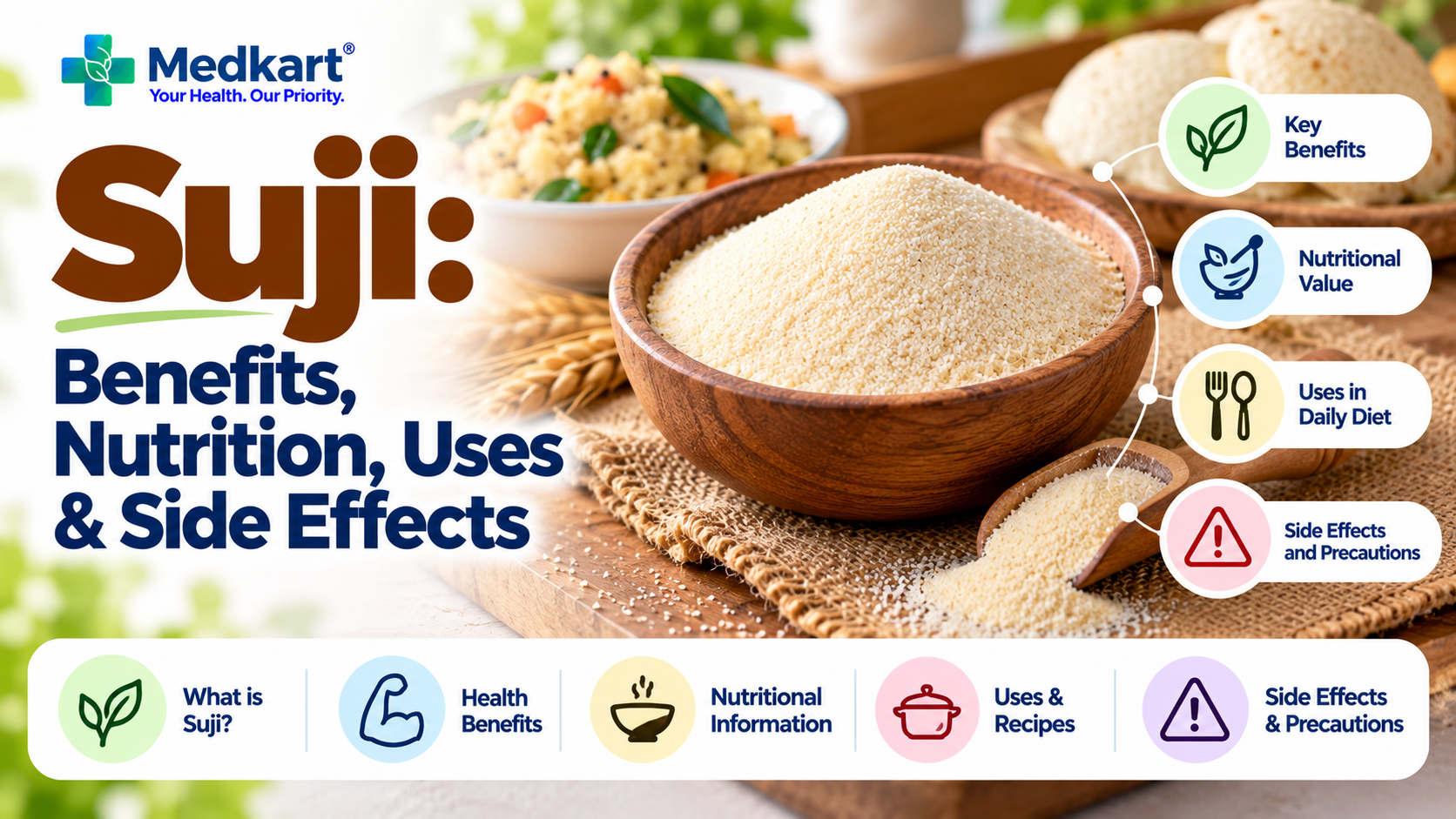
Suji is a granular wheat product, known in English as semolina and in many Indian kitchens as rava. Most suji benefits come down to what it supplies as a cereal food: energy, carbohydrate and some protein.
It is sold dry and used in pasta and in Indian dishes such as upma. Plain and enriched semolina differ in their nutrients, so the figures below always name the product they describe.
What Is Suji, and What Does Semolina Mean?
The short answer to what is suji is semolina, a granular product milled from wheat. The Bureau of Indian Standards[1] titles its specification IS 1010 as suji or rava (semolina). Its record shows the 1968 edition as withdrawn and superseded by IS 1010:2023.
The answer to what is semolina differs between standards. The semolina meaning in US food law is specific. The Code of Federal Regulations[2] defines it as the food made by grinding and bolting cleaned durum wheat.
That standard also sets how far it is refined. Bran, or bran and germ, is removed until ash is no more than 0.92 per cent on a moisture-free basis, and moisture may not exceed 15 per cent.
The US definition describes durum semolina. It does not establish which wheat a particular Indian pack of suji was milled from.
What Is the Suji Nutritional Value?
Suji nutritional value is mostly carbohydrate, with smaller amounts of protein, fibre and fat. USDA FoodData Central[3] gives the following for dry unenriched semolina.
| Nutrient | What the USDA lists |
| Energy | Unenriched semolina provides 360 kcal per 100 g in its dry form. |
| Carbohydrate | Carbohydrate makes up 72.8 g per 100 g, including 3.9 g of dietary fibre. |
| Protein and fat | Protein is listed at 12.7 g and total fat at 1.05 g per 100 g. |
| Minerals | The entry gives 1.23 mg of iron, 47 mg of magnesium, 136 mg of phosphorus and 186 mg of potassium per 100 g. |
| B vitamins | It lists 0.28 mg of thiamin, 3.31 mg of niacin and 72 µg of folate per 100 g, with no vitamin B12. |
Enriched semolina[4] has a separate USDA entry with the same energy, protein and carbohydrate. It carries 4.36 mg of iron, 0.811 mg of thiamin and 183 µg of folate per 100 g.
These figures underlie most suji benefits described below. Both entries are US database records, not Indian composition figures for suji sold in India.
How Much Suji Is in a Cup, and What Are the Suji Calories?
One cup of dry semolina weighs 167 g in FoodData Central, which comes to roughly 601 kcal. The same arithmetic puts its protein at about 21 g.
No single serving size applies to everyone. These suji calories describe the dry ingredient before cooking, not a finished dish.
How much suji suits a particular diet is a question for a doctor or dietitian, particularly where diabetes or weight is being managed.
What Suji Benefits Do the Sources Support?
The suji benefits the sources support are nutritional rather than medicinal. It supplies energy, carbohydrate, protein and some B vitamins, and no treatment use for it has been established.
Its main documented use is as a cereal ingredient. The US standard for macaroni products[5] names semolina first among the bases for pasta dough, alongside durum flour, farina and flour.
In Indian cooking it is used for upma. A 2022 study in the Indian Journal of Medical Research[6] refers to wheat semolina upma when comparing blood sugar responses to traditional Indian foods.
Enrichment changes the picture. The USDA entries show enriched semolina with about three and a half times the iron and about two and a half times the folate of the unenriched form.
Also Read: Best High Protein Foods for Muscle Growth
Is Semolina Good for Diabetes?
No. Published evidence does not show semolina improving blood sugar control, so this is not among the suji benefits the sources support.
The 2022 Indian study cites an earlier measured glycaemic index of 67 for normal wheat semolina upma. It did not test that dish itself.
Its own test used broken wheat upma, made from whole wheat grits rather than semolina. In healthy adults aged 20 to 45 who were overweight or obese, that dish measured 51.7, which the authors class as low glycaemic index.
Those are different foods, and the lower figure does not describe suji.
A 2013 meta-analysis of 16 cohort studies[7] in the European Journal of Epidemiology found that whole grain intake was associated with lower type 2 diabetes risk. Refined grain intake was not, and the authors support replacing refined grains with whole grains.
People with diabetes should ask their doctor or dietitian how suji fits their meal plan.
When Can Suji Be Eaten?
Published guidance does not set a time of day for eating suji.
The 2013 meta-analysis suggests that at least two daily servings of whole grains may reduce type 2 diabetes risk. That figure concerns whole grains, so it is not a target for suji.
How Long Can Suji Be Part of the Diet?
No published guidance limits how long suji can be eaten as part of an ordinary diet.
People with coeliac disease are the exception. The NHS[8] describes them as no longer able to eat foods containing wheat, so for them suji is excluded rather than limited.
What Are the Suji Side Effects?
The documented suji side effects come from the wheat it is made from. Two conditions account for them: coeliac disease and wheat allergy.
The NHS lists semolina and durum among the wheat foods that people with coeliac disease cannot eat. Treatment, it explains, is a diet that excludes foods containing gluten.
Wheat is among the most common food allergies in NHS[9] guidance. The symptoms it lists include an itchy or raised rash, swelling of the lips, face and eyes, tummy pain, feeling sick and diarrhoea.
The Australasian Society of Clinical Immunology and Allergy[10] includes semolina and durum among the wheat foods that people with wheat allergy are advised to avoid.
Signs That Need Emergency Help
The NHS treats some reactions as an emergency, including:
- Sudden swelling of the lips, mouth, throat or tongue
- Breathing very fast or struggling to breathe
- A tight throat or difficulty swallowing
- Skin, tongue or lips turning blue, grey or pale
It advises calling an ambulance straight away when these appear, even if an adrenaline auto-injector has already been used.
Who Should Be Careful with Suji?
Four groups need more care with suji than most people.
| Situation | What to do |
| Coeliac disease | The NHS lists semolina among the foods excluded in coeliac disease and refers newly diagnosed people to a dietitian. Suji should be left out of the diet. |
| Wheat allergy | The same allergy society states that about 20 per cent of people with wheat allergy may also react to other cereals containing gluten. It advises asking an allergy specialist which foods to avoid. |
| Diabetes | Anyone asking is semolina good for diabetes should note the cited glycaemic index of 67 for semolina upma. Portions should be agreed with a doctor or dietitian. |
| Weight management | Dry suji provides 360 kcal per 100 g. No suji recipe for weight loss has been shown in published evidence to reduce weight, so portions are better planned with a dietitian. |
Where Can You Find Nutrition Products on Medkart?
Medkart lists nutrition and diabetes care products in its online range. These include protein powders such as Prototal Whey Protein and Kabi Pro protein powder, with more in the nutritional supplements category.
Nutrition powders such as Protinex Diabetes Care and Prozuca supplement for diabetes sit alongside the diabetes care range. For blood sugar monitoring, Medkart lists glucometer test strips among its health care devices, and blood tests are listed on its lab test page.
Medkart’s medicine comparison tool places products side by side on points such as:
- Product type
- Manufacturer
- Pack size
- Flavour
- Current price
Availability, pack size and price differ between products. The wider range is in the order medicine index, and Medkart highlights quality credentials for its generic medicine range.
Anyone with diabetes, coeliac disease or a wheat allergy should discuss a supplement with a doctor or pharmacist before adding it.
Key takeaways
- Suji is semolina, a granular wheat product that Indian standards also call rava.
- In US food law, semolina is milled from durum wheat with the bran removed to a set limit.
- Suji nutritional value is mostly carbohydrate, with 360 kcal and 12.7 g of protein per 100 g of dry unenriched semolina.
- The suji benefits supported by the sources are nutritional, and no medicinal use has been established.
- Published evidence does not show semolina improving blood sugar control.
- Suji side effects come from wheat, mainly in coeliac disease and wheat allergy.
- The NHS lists semolina among the foods people with coeliac disease cannot eat.
- Swelling of the mouth or throat, or difficulty breathing, after eating wheat needs emergency help.
FAQs: Common Questions About Suji
Q. What is semolina in law, and does the semolina meaning change between countries?
It depends on the country’s standard. US federal rules give a narrow answer: milled durum wheat, with farina and durum flour listed as separate pasta ingredients. In India the BIS specification groups suji, rava and semolina under one title, so the term there covers all three names.
Q. How does suji protein compare with its carbohydrate?
Carbohydrate outweighs it by more than five to one. The USDA entry gives 12.7 g of protein against 72.8 g of carbohydrate in 100 g of dry unenriched semolina. Within that suji protein, lysine is listed at 0.243 g per 100 g and glutamic acid at 4.57 g.
Q. Is there a suji recipe for weight loss?
No. No suji dish has been shown in research to cause weight loss, and suji benefits for weight have not been established. What the USDA does give is energy content, at 360 kcal per 100 g of the dry product, which a dietitian can build into a meal plan.
Q. Is enriched semolina better than plain suji?
It depends on the measure. The USDA lists 111 µg of added folic acid per 100 g in enriched semolina, against none in the unenriched entry, and niacin rises from 3.31 mg to 5.99 mg. Energy, protein and carbohydrate are listed at identical values in both entries.
Q. Can a reaction to suji appear days after eating it?
Yes. The NHS notes that food allergy symptoms may begin straight after eating a food or only days later. A delayed rash or stomach upset after a wheat-based meal is therefore worth raising with a doctor rather than dismissing.
Q. Does a gluten-free label mean a product has no gluten at all?
No. The NHS explains that, by law, food labelled gluten-free may contain up to 20 parts per million of gluten. That figure describes UK labelling law. Suji itself is a wheat product and appears on the NHS list of foods that contain gluten.
References
- http://www.services.bis.gov.in/php/BIS_2.0/bisconnect/knowyourstandards/Indian_standards/isdetails/ODM4
- https://www.law.cornell.edu/cfr/text/21/137.320
- https://api.nal.usda.gov/fdc/v1/food/168933?api_key=DEMO_KEY
- https://api.nal.usda.gov/fdc/v1/food/169715?api_key=DEMO_KEY&format=abridged
- https://www.law.cornell.edu/cfr/text/21/139.110
- https://pmc.ncbi.nlm.nih.gov/articles/PMC9552392/
- https://www.ebi.ac.uk/europepmc/webservices/rest/search?query=EXT_ID:24158434%20AND%20SRC:MED&resultType=core&format=json
- https://www.nhs.uk/conditions/coeliac-disease/treatment/
- https://www.nhs.uk/conditions/food-allergy/
- https://www.allergy.org.au/patients/food-allergy/ascia-dietary-avoidance-for-food-allergy/wheat
Medical disclaimer: This article gives general information only. It does not replace advice from a doctor or pharmacist. No medicine or supplement should be started, stopped or changed without advice from the prescriber or a qualified pharmacist.


Leave a Reply