
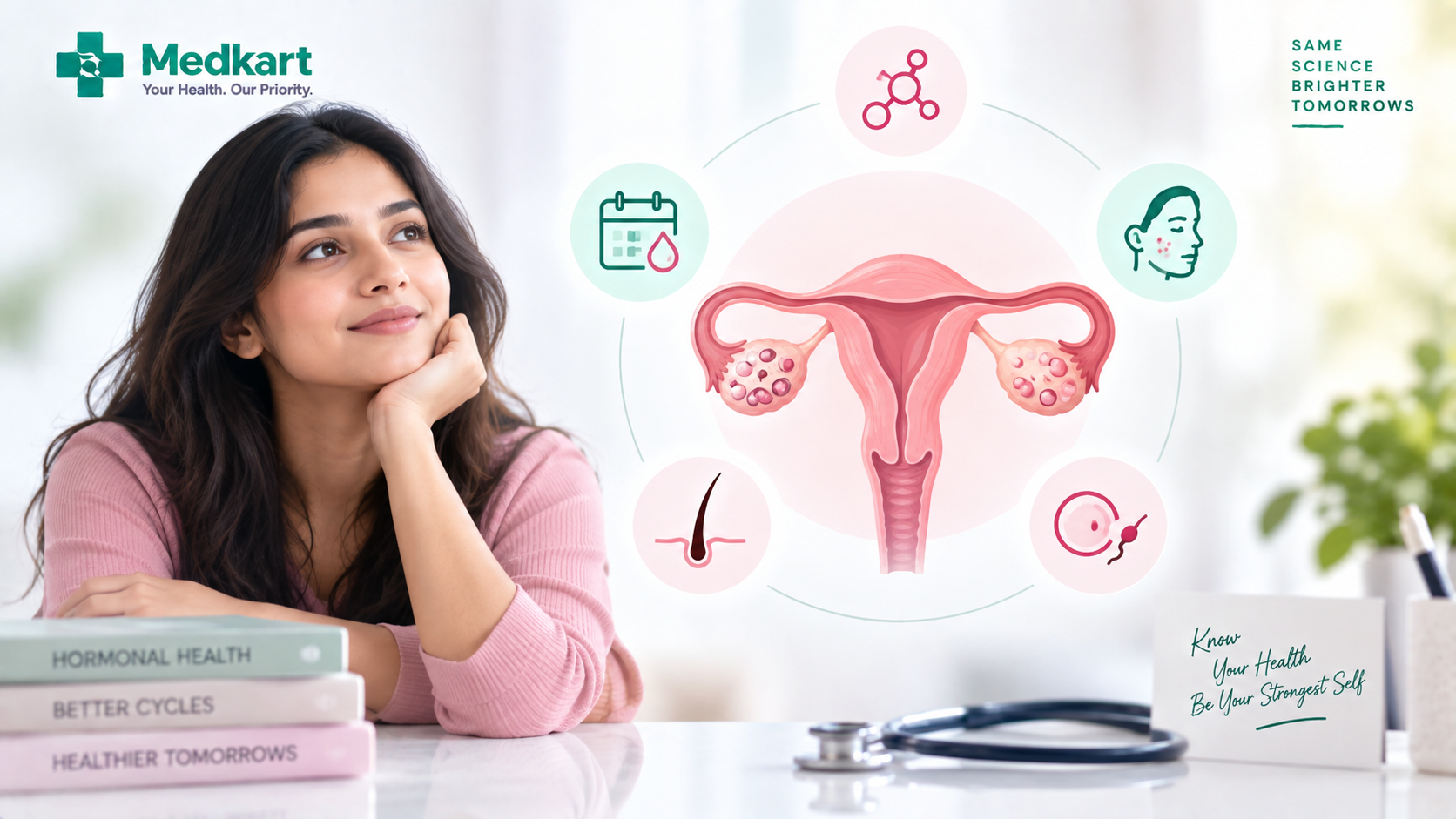
PCOD is the name Indian readers search for when periods turn irregular, unwanted hair appears, or pregnancy is not happening. It names a hormone condition rather than a test result.
The name needs sorting out first, because it has changed.
What does PCOD stand for, and what is it called now?
Nothing the sources use. None of them uses PCOD, and the condition’s clinical name has recently changed. The NHS[1] now calls it polyendocrine metabolic ovarian syndrome, or PMOS, and states that PMOS used to be called polycystic ovary syndrome, or PCOS.
Not every source has moved. The World Health Organization[2] fact sheet still uses polycystic ovary syndrome. MedlinePlus[3] gives the alternative names as PCOS and Stein-Leventhal syndrome.
No source retrieved for this article treats PCOD as a clinical term, so this article uses the names the sources use.
MedlinePlus describes a set of symptoms caused by a hormone imbalance, and the NHS states there is no cure but treatments can help.
What are the symptoms of PCOD?
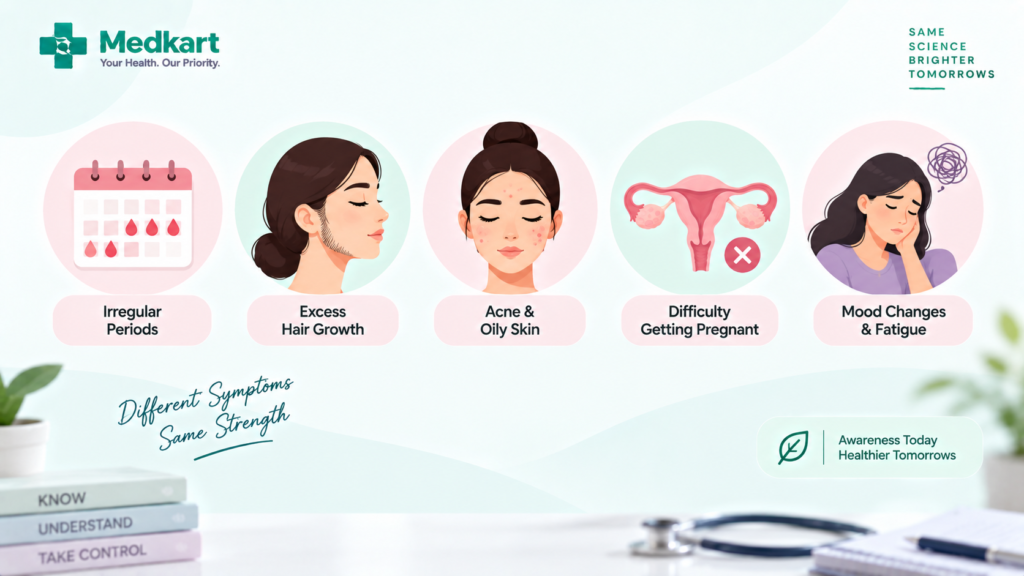
They cluster around periods, hair, skin and fertility, and vary widely.
| Feature | What the sources say |
| Periods | The NHS lists irregular periods or long gaps between them. The WHO adds that periods may be absent altogether, and that some people have heavy, long or painful ones. |
| Hair | The NHS lists excess hair growth, called hirsutism, and also hair loss. The WHO describes female-pattern baldness or thinning alongside excess facial or body hair. |
| Skin | Oily skin and acne appear on both lists. The NHS also names thick, dark patches of skin, called acanthosis nigricans. |
| Fertility | Both name difficulty getting pregnant. |
| Mood and energy | The NHS lists mental health problems including depression and anxiety, and feeling very tired. |
These are features the sources associate with the condition, not a test anyone can apply to themselves.
What causes PCOD?
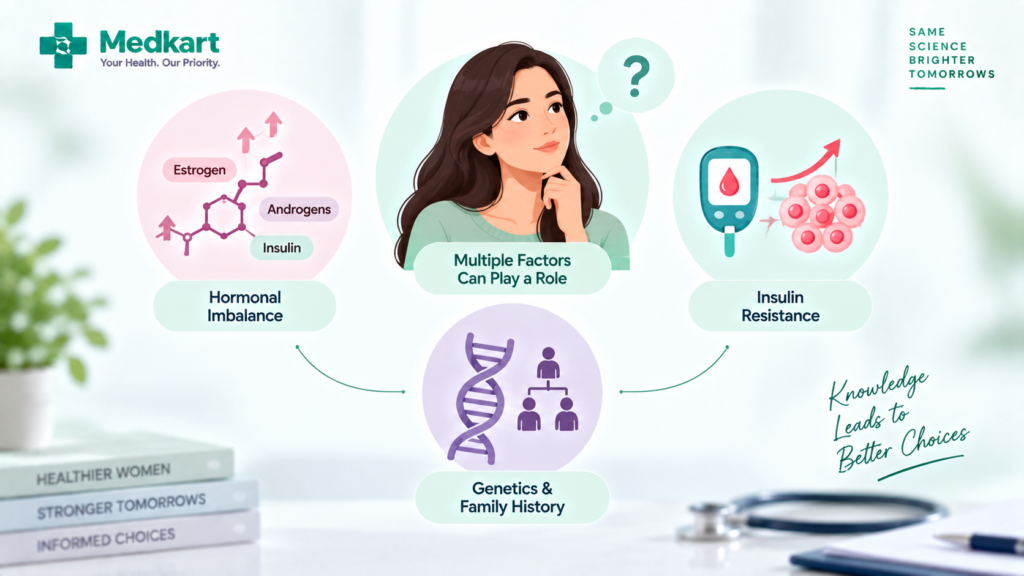
Nobody knows. Both the NHS and the WHO state plainly that the cause is unknown.
What they describe instead are things that travel with it. The NHS says it may involve hormones such as insulin and testosterone not working properly, and notes a link with family history. MedlinePlus names genetics, raised androgen levels and insulin resistance, and the WHO adds that a family history of type 2 diabetes also raises risk.
How is PCOD diagnosed?
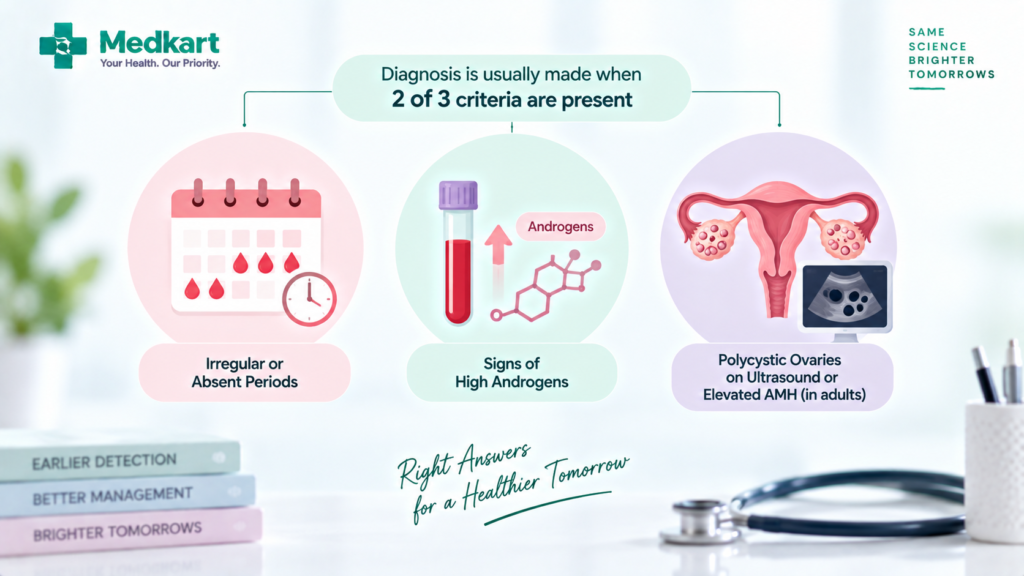
By meeting two of three criteria, after tests a doctor arranges. The WHO gives the three as signs of high androgens, irregular or absent periods, and polycystic ovaries on ultrasound.
The 2023 international guideline[4] keeps that structure and adds one option: in adults, a blood test for anti-Müllerian hormone may replace the ultrasound. It says that test should not be used alone, and that both it and the scan should not be done, to limit over-diagnosis.
The guideline advises against the scan in adolescents.
The NHS describes the practical route: blood tests for hormone levels and insulin resistance, and an ultrasound scan of the ovaries for patients over 18.
How common is PCOD in India?
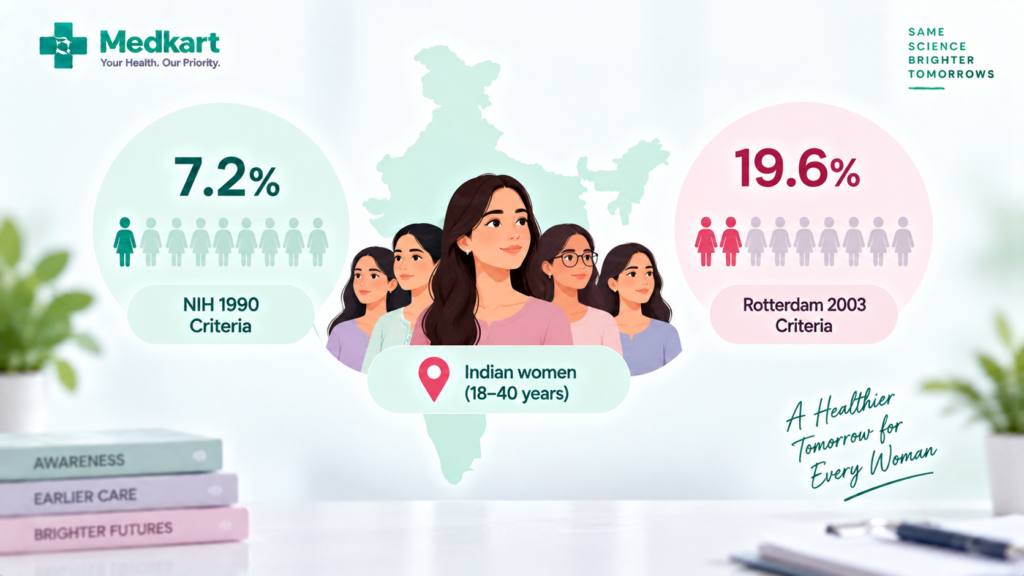
Common, and Indian estimates differ sharply depending on the criteria applied. An Indian Council of Medical Research task force study[5] assessed 8,993 women aged 18 to 40 across eight states, published in JAMA Network Open in 2024.
It found a weighted national prevalence of 7.2 per cent by the older NIH 1990 criteria, and 19.6 per cent by the Rotterdam 2003 criteria. Among the women who met the criteria, 91.9 per cent had dyslipidaemia.
A 2022 systematic review in Cureus[6] pooled eleven Indian studies and gave lower figures: 11.33 per cent by Rotterdam and 5.8 per cent by NIH criteria. The WHO estimates 10 to 13 per cent of reproductive-aged women worldwide are affected.
Also Read: Maximum Delay in Periods if not Pregnant: How Long is Normal?
How is PCOD treated?

There is no cure, and treatment targets whichever features are causing trouble. The WHO states that treatments can improve quality of life, assist with fertility, and reduce endometrial cancer risk.
For irregular cycles and excess hair growth, the guideline names combined oral contraceptive pills as first-line drug treatment in adults. The NHS also lists the progestogen-only pill and the intrauterine system.
Metformin has a narrower place: the guideline says it should be considered in adults with a body mass index of 25 kg/m² or above. It adds that metformin and active lifestyle intervention have similar efficacy.
Where the difficulty is getting pregnant, the guideline names letrozole as the first-line drug for ovulation induction. The NHS lists clomifene and laparoscopic ovarian drilling.
Every one of these is a prescription decision.
How is PCOD managed with diet and exercise?

With both, and the guideline is unusually clear that the benefit does not depend on losing weight.
It recommends lifestyle intervention for everyone with the condition, whether exercise alone or diet and exercise with behavioural strategies.
On amount, the guideline points to general population targets: 150 to 300 minutes a week of moderate activity, or 75 to 150 of vigorous, plus muscle-strengthening twice weekly.
The two sources differ on intensity. The guideline finds no evidence that one type or intensity beats another, while the NHS advises avoiding high-intensity exercise because it can make symptoms worse.
The guideline also records that many women with the condition meet weight stigma in healthcare, and says the harm that does should be recognised.
Is there a recommended diet for PCOD, and foods to avoid?
No single diet, and no list of foods to avoid. The guideline finds no evidence that one diet composition beats another for metabolic, hormonal, reproductive or psychological outcomes.
It recommends any composition consistent with healthy-eating guidelines, tailored to the person’s own food preferences. The NHS advice is a balanced diet, with weight loss suggested where someone is overweight.
When should you see a doctor?
See a doctor if you think you might have the condition, or if symptoms are affecting your everyday life, work and relationships. That is the NHS threshold, and it does not require every feature above.
| Situation | What to do |
| Periods that are irregular, very infrequent or have stopped | Raise it at an appointment rather than waiting. The 2023 guideline records that premenopausal women with the condition have a markedly higher risk of endometrial hyperplasia and endometrial cancer. |
| Difficulty getting pregnant | Both the NHS and the WHO list this among the reasons to seek help, and the fertility treatments named above all need a prescriber. |
| Excess hair growth, hair loss or acne affecting daily life | The NHS names these among the symptoms to see a GP about where they affect everyday life. |
| Low mood or anxiety | The NHS lists mental health problems among the features of the condition, and the same threshold applies. |
| A family history of type 2 diabetes | Mention it. The guideline records raised risk of impaired glucose tolerance and type 2 diabetes regardless of body mass index. |
Do not wait until the list is complete. The WHO estimates around 70 per cent of affected women worldwide are undiagnosed.
What this article cannot tell you
Whether you have it. The diagnosis needs two of three criteria, and two of those three need a blood test or a scan.
It also cannot say which treatment suits any individual, because everything named above is addressed to clinicians. The choice depends on age, test results, whether pregnancy is wanted, and other conditions.
The 2023 guideline was published before the renaming, so it uses PCOS throughout, as does the WHO fact sheet.
Where can you buy prescribed medicines on Medkart?
Every medicine named above is prescription-only, so this is about filling a prescription rather than choosing a treatment.
Medkart lists products whose labels name PCOS, and each is marked as needing a prescription. Four are built on inositol: Mychiro tablets from USV, Myocyst M from Akums, which pairs it with sustained-release metformin, Met PCO Care from Akumentis, and Ovagrace sachets from Mankind.
Metformin is listed on its own too, as Glycomet tablets from USV. Nothing here says any of these treats the condition. Availability, pack size and price differ between products and can change.
Medkart states that the medicines it sells are sourced from WHO-GMP certified manufacturers. Medkart’s medicine comparison tool sets products side by side once something has been prescribed, and the medicines index and search page show current stock. Points worth comparing on a prescription:
- Active ingredient
- Strength
- Dosage form
- Manufacturer
- Pack size
Nothing listed here should be started, stopped or changed without the prescriber’s advice.
Key takeaways
- The NHS now calls the condition polyendocrine metabolic ovarian syndrome, and says it used to be called polycystic ovary syndrome.
- The WHO fact sheet and the 2023 international guideline still use the name PCOS.
- No source retrieved for this article uses PCOD as a clinical term.
- Diagnosis needs two of three criteria, and a doctor arranges the tests that settle them.
- An Indian task force study found a national prevalence of 7.2 per cent by NIH criteria and 19.6 per cent by Rotterdam criteria.
- There is no cure, and treatment targets whichever features are causing trouble.
- The guideline names lifestyle change for everyone with the condition, and says the benefit does not depend on weight loss.
- Irregular periods, difficulty conceiving, or symptoms affecting daily life are all reasons to see a doctor.
FAQs: Common Questions About PCOD
Q. Do you need cysts on your ovaries to have it?
No, and that is part of what the new name is getting at. The scan finding is one of three criteria, and only two are needed, so the diagnosis can be made without it.
Q. Is yoga recommended for PCOD?
Not by any source retrieved for this article. The 2023 guideline does not mention yoga, meditation or other mind-body practices, and neither the NHS nor the WHO fact sheet names them. That is silence rather than a finding against yoga, so this article cannot say what it does for the condition.
Q. Can teenagers be diagnosed with it?
With more caution than adults. The 2023 guideline states there are no definitive criteria for polycystic ovary morphology on ultrasound in adolescents. Where features are present but the full criteria are not met, it advises reassessment at or before eight years after the first period.
Q. Does it always cause weight gain?
No. Weight gain and difficulty losing weight sit on the NHS symptom list, but they are not universal. In the Indian task force study, 43.2 per cent of the women who met the criteria had obesity, so most did not. The guideline records raised diabetes risk regardless of body mass index.
Q. What other health checks might a doctor suggest?
Metabolic and cardiovascular ones. The guideline considers women with the condition at increased cardiovascular risk, and notes more obstructive sleep apnoea independent of body mass index. The NHS adds high blood pressure and non-alcoholic fatty liver disease.
Q. Why do Indian prevalence figures differ so much?
Because the criteria count different things. The NIH 1990 definition is narrower than the Rotterdam 2003 definition, so the same population yields a smaller number. Hence one study reporting both 7.2 and 19.6 per cent for the same women.
Q. Does it affect only the ovaries?
No, which is the reason behind the new name. MedlinePlus describes hormone imbalance affecting the ovaries and many other body systems. The NHS names hair growth, periods, fertility and mood among the things it touches.
References
- https://www.nhs.uk/conditions/polycystic-ovary-syndrome-pcos/
- https://www.who.int/news-room/fact-sheets/detail/polycystic-ovary-syndrome
- https://medlineplus.gov/polycysticovarysyndrome.html
- https://pmc.ncbi.nlm.nih.gov/articles/PMC10505534/
- https://pmc.ncbi.nlm.nih.gov/articles/PMC11581580/
- https://pmc.ncbi.nlm.nih.gov/articles/PMC9826643/
Medical disclaimer: This article gives general information about polycystic ovary syndrome, now also called polyendocrine metabolic ovarian syndrome, and is not a diagnosis. It cannot tell any individual whether they have the condition, how severe it is, or which treatment suits them, because those decisions need a doctor and the right tests. Anyone with the symptoms described here should see a doctor rather than self-treat, and no medicine or supplement should be started, stopped or changed without advice from the prescriber or a qualified pharmacist.
Leave a Reply