

Most home remedies for glowing skin are things already sitting in your kitchen. The trouble is that the advice around them is usually vague: apply turmeric, wash it off later, wait for results.
This article gives you the actual steps: how much, what to mix it with, how long to leave it on, and how it comes off. It also says which popular remedies to leave alone.
What this article covers
- Aloe vera
- Turmeric
- Besan
- Multani mitti
- Coconut oil
- Honey
- Tea tree oil
- Green tea
- Oats
- Curd
- Shea butter
- Sunflower seed oil
- Olive oil
- Argan oil
- Jojoba oil
- Almond oil
- Sesame oil
- Rose water
- Papaya
- Sandalwood
These natural remedies for glowing skin are grouped by how they are used. The first ten are pastes, packs and rinses, the next eight are oils and waters, and the last two are seasonal.
Why does skin look dull?
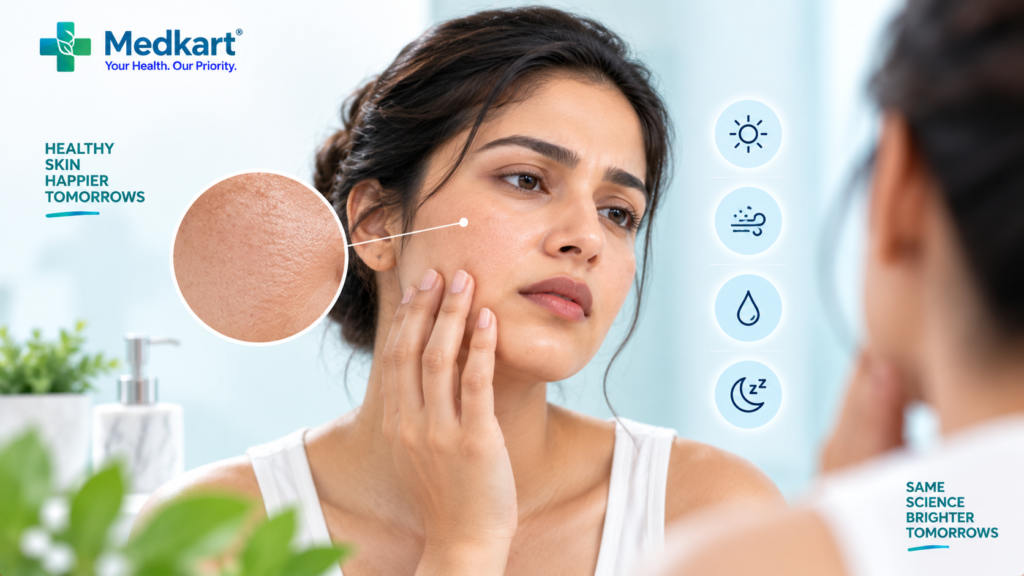
Dull skin is usually a surface problem. Dead cells sit on top, the barrier dries out, and light scatters instead of reflecting evenly.
So most of what follows either lifts the surface gently or puts water and oil back into it. Nothing here changes your skin type, and nothing works overnight.
Before you start
Try anything new on a small patch of inner forearm first and leave it for a day. If the skin reacts, do not put it on your face.
Wash off anything that stings, burns or turns the skin red. That is not the remedy working, and leaving it on for longer will not help.
Check the list for anything you already react to. Almond oil is a nut product and curd is dairy, so skip those rather than testing them if you have an allergy.
If you have sensitive skin or frequently experience irritation, see our guide to skin care for sensitive skin before trying new homemade remedies.
How to get glowing skin naturally
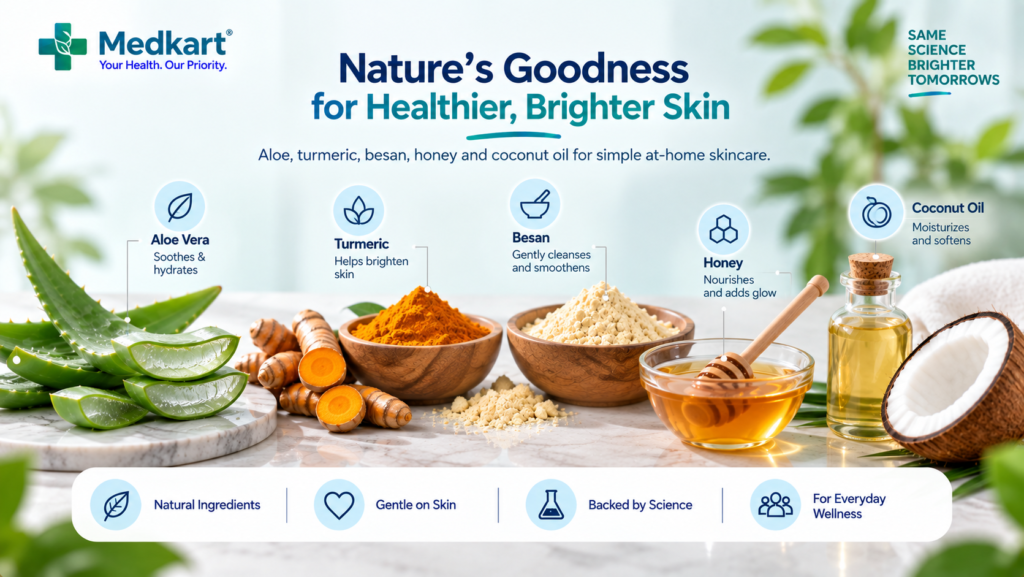
1. Aloe vera
Aloe vera gel is the clear jelly inside the thick leaf. It goes on cool and dries to a slight tightness.
How to use it
- Split a fresh leaf lengthways and scoop out about a teaspoon of the clear gel.
- Smooth it over clean skin in a thin layer.
- Leave it 15 to 20 minutes, until it feels tacky rather than wet.
- Rinse with cool water and pat dry.
Benefits
- Cools skin that feels hot after a day in the sun
- Absorbs quickly and leaves no greasy film
- Costs almost nothing if you keep a plant on the windowsill
Good to know: The yellow sap just under the leaf skin can irritate. Stand the cut leaf upright for ten minutes and let it drain before you scoop the gel.
2. Turmeric
Turmeric is the ground rhizome you already cook with. On skin it is used in very small amounts.
How to use it
- Stir a small pinch of turmeric into a tablespoon of curd, milk or honey.
- Mix to a loose paste, thin enough to spread without dragging.
- Spread it thinly and leave for 10 to 15 minutes.
- Rinse with lukewarm water, working gently in circles.
Benefits
- Takes the flat look off tired skin
- One of the cheapest things on this list
- Mixes into whatever base suits your skin that day
Good to know: Turmeric stains skin and fabric yellow. Use a pinch rather than a spoonful, keep an old towel for it, and rinse with lukewarm water rather than hot.
3. Besan
Besan is gram flour, ground from chana dal, and the base of the most common face pack in an Indian kitchen. It has a fine, slightly gritty texture that works as a mild cleanser.
How to use it
- Put two tablespoons of besan in a small bowl.
- Add water, milk or curd a little at a time until you have a spreadable paste.
- Spread it over the face and leave for 10 to 15 minutes.
- Rinse before it dries hard, working in small circles as you go.
Benefits
- Lifts surface dullness without a scrub
- Absorbs oil on a humid day
- Keeps in the kitchen indefinitely
Good to know: Do not let a besan face pack dry to a crust. It drags on the skin coming off, which is the opposite of gentle. Rinse while it is still slightly tacky.
4. Multani mitti
Multani mitti is fuller’s earth, a fine clay sold in blocks or powder. It is the classic hot-weather pack.
How to use it
- Mix one tablespoon of multani mitti with rose water or plain water.
- Stir to a smooth paste with no lumps.
- Apply an even layer and leave for about 10 minutes.
- Rinse with cool water before it dries completely.
Benefits
- Draws oil off skin that feels heavy by midday
- Cools the face in summer
- Sold everywhere and lasts for months
Good to know: Clay is drying by design. If your skin already feels tight, use it on the T-zone only, or skip it and use curd instead.
5. Coconut oil
Virgin coconut oil is pressed from fresh kernel. It is solid in winter and liquid in summer, which is normal.
How to use it
- Warm three or four drops between your palms until they melt.
- Massage into skin that is still damp from washing.
- Leave it on overnight, or rinse after 20 minutes if you prefer.
Benefits
- Softens dry patches on arms, legs and heels
- Doubles as a hair oil, so one bottle covers both
- Very cheap for the amount you actually use
Good to know: Coconut oil is heavy and sits on the surface for a while. If your face feels clogged the next morning, keep it for the body and use a lighter oil above the neck.
6. Honey
Raw honey is thick and slightly grainy. The runny squeezy sort sold for cooking is not the same thing.
How to use it
- Warm half a teaspoon of raw honey between your fingers.
- Spread a thin layer over clean, slightly damp skin.
- Leave for 15 to 20 minutes.
- Rinse with warm water, which lifts it off far more easily than cold.
Benefits
- Leaves skin feeling soft rather than tight
- One ingredient, nothing to mix
- Rinses off completely with no residue
Good to know: Honey is sticky enough to catch hair. Tie it back first, and put a towel round your shoulders unless you enjoy mopping.
7. Tea tree oil
Tea tree oil is distilled from the leaves of an Australian shrub. It is strong, and it is never used neat.
How to use it
- Put one teaspoon of a carrier oil, such as coconut or jojoba, in a small dish.
- Add one or two drops of tea tree oil and stir.
- Dab the mix onto the spot with a clean fingertip.
- Leave it on. Do not spread it across the face.
Benefits
- Targets one small area rather than the whole face
- A 10 ml bottle lasts months at two drops a time
- Mixes into any plain oil you already own
Good to know: Neat tea tree oil can cause a reaction even in people who tolerate it diluted. Never put it near your eyes.
If you’re looking for a formulated option for acne-prone skin, see Medkart’s guide to face wash for pimples and dark spots
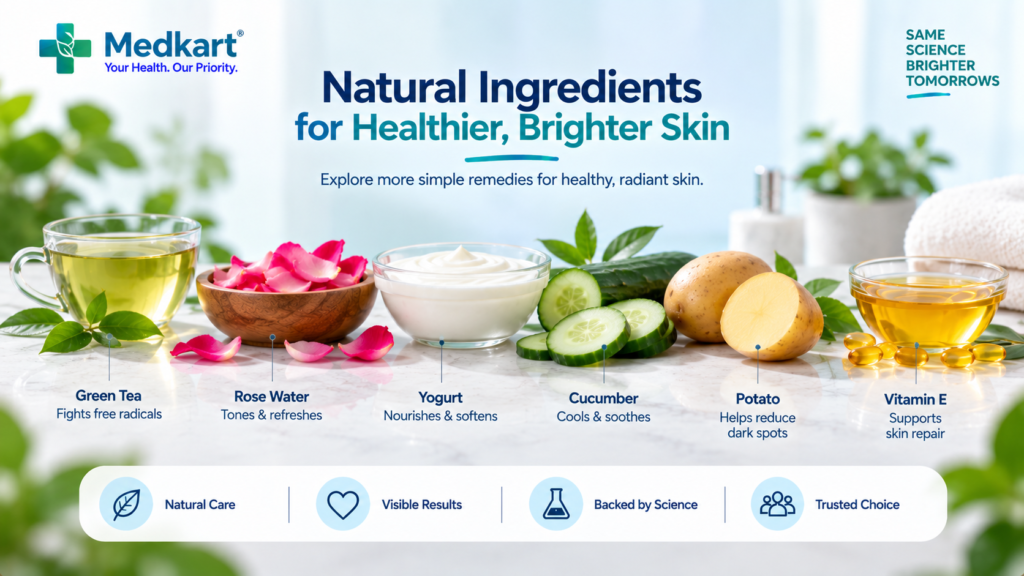
8. Green tea
Green tea works on skin as a cooled rinse. You are using the brewed tea, not the dry leaf.
How to use it
- Brew one cup of green tea and let it cool completely to room temperature.
- Splash it over the face, or soak a cotton pad and sweep it across.
- Leave it to dry on the skin. There is nothing to rinse.
- Keep any leftovers in the fridge and use within two days.
Benefits
- Costs nothing extra if you already drink it
- Leaves no film, so it goes under anything else
- Feels good on a hot afternoon
Good to know: Let it cool properly. Warm tea on the face does nothing useful and will leave the skin flushed for an hour.
9. Oats
Oats are used ground, not whole. The grind is what separates a soothing pack from a scratchy one.
How to use it
- Grind one tablespoon of plain oats to a fine powder.
- Mix with enough water, milk or curd to make a soft paste.
- Spread it on and leave for about 10 minutes.
- Rinse with lukewarm water, without scrubbing.
Benefits
- Feels gentle on skin that is easily irritated
- Doubles as a cleanser on days you skip face wash
- Already in most kitchens
Good to know: Grind the oats properly. Coarse oats act as an abrasive on facial skin, which is not what you want. If it feels gritty between your fingers, grind it again.
10. Curd
Plain curd, set at home or bought, with nothing added. Not flavoured, not sweetened.
How to use it
- Take one tablespoon of plain curd, at room temperature rather than fridge-cold.
- Spread a thin layer over the face and neck.
- Leave for 10 to 15 minutes.
- Rinse with cool water.
Benefits
- Cooling on skin that feels hot or wind-burnt
- Already in the fridge, so nothing to buy
- Mixes with turmeric, besan or oats as a base
Good to know: Curd is dairy. If you react to dairy on your skin, skip this one rather than patch-testing it, and use aloe gel as a base instead.
Also Read: Skin Care: 5 Tips for Healthy Skin
You can also explore these homemade face masks for different skin types.
11. Shea butter
Shea butter is a solid fat from the nut of the shea tree. It is firm in the tub and melts on contact.
How to use it
- Scrape out a pea-sized amount.
- Warm it between your fingers until it turns to oil.
- Press it into dry areas such as elbows, knees and heels.
- Use it at night, since it takes a while to sink in.
Benefits
- Very rich, so a small tub lasts a long time
- Works on the roughest patches where lighter oils fail
- No smell to speak of once it is on
Good to know: Shea is too heavy for most faces and will feel like a layer rather than a moisturiser. Keep it below the neck unless your skin is very dry.
12. Sunflower seed oil
Plain sunflower oil, ideally cold-pressed. The same bottle you cook with will do.
How to use it
- Wash your face and leave the skin damp.
- Warm three or four drops between your palms.
- Press them into the skin rather than rubbing.
- Leave it to absorb for a few minutes before anything else goes on.
Benefits
- Light enough for most skin, including oily
- Absorbs faster than coconut or olive oil
- Cheap and sold in every shop
Good to know: Cold-pressed oil is worth the small extra cost here. Heavily refined oil has been heated and treated, and it feels flatter on the skin.
13. Olive oil
Olive oil is the one on this list with a genuine mark against it, so it comes with a caveat.
How to use it
- Warm a teaspoon between your palms.
- Use it as a body massage oil, on arms, legs and shoulders.
- Leave for 15 minutes, then bathe as usual.
Benefits
- Already in the kitchen
- Works well as a pre-bath body oil
- Rinses off with ordinary soap
Good to know: A review of plant oils[1] found that olive oil increased water loss through the skin and reported a detrimental effect on the skin barrier. Keep it off the face, and off skin that is already dry. Sunflower or coconut oil is the better choice there.
14. Argan oil
Argan oil is pressed from the kernels of a Moroccan tree. It is light for a rich-looking oil.
How to use it
- Put two or three drops on your fingertips.
- Press them into the face at night, after cleansing.
- Use a little more on dry patches elsewhere.
Benefits
- Sinks in fast for an oil of its weight
- Almost no scent, so it layers under anything
- A 30 ml bottle lasts several months at three drops a night
Good to know: Argan is expensive, and much of what is sold cheaply is blended with other oils. Check the label says one hundred per cent argan if you are paying for the real thing.
15. Jojoba oil
Jojoba is technically a liquid wax rather than an oil, pressed from the seeds of a desert shrub.
How to use it
- Warm two or three drops in your palm.
- Press into clean skin, alone or mixed into a heavier oil to thin it.
- Use morning or night. It is light enough for either.
Benefits
- Feels closest to skin’s own oil of anything here
- Thins out heavier oils that feel like too much on their own
- Keeps far longer than most oils without turning
Good to know: Because it is a wax, jojoba does not go rancid the way a nut or seed oil does. An open bottle is still fine a year later, which is not true of almond or sunflower oil.
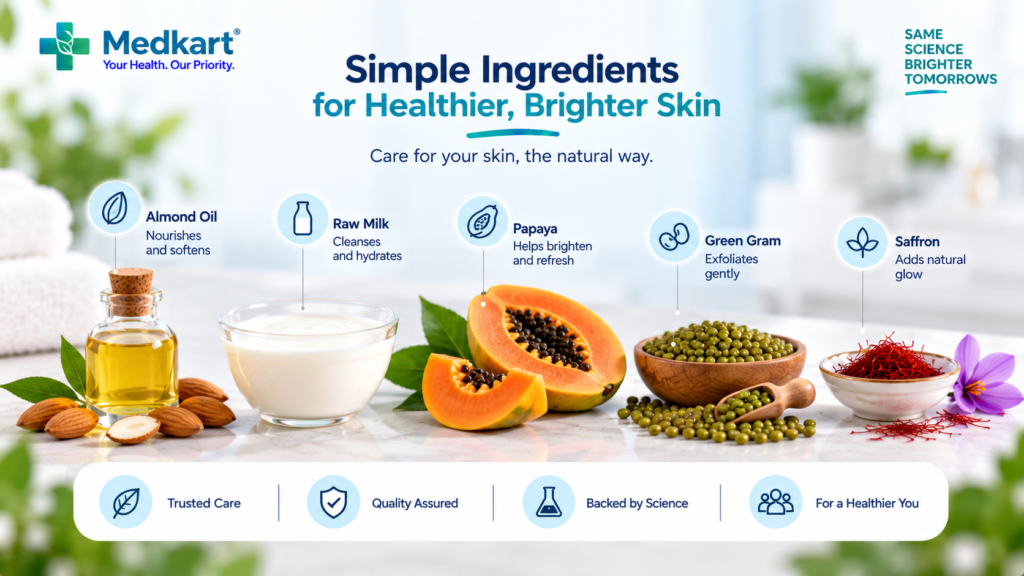
16. Almond oil
Sweet almond oil is the classic Indian massage oil, sold in every chemist.
How to use it
- Warm a teaspoon between your palms.
- Massage into the body in slow circles, working upwards.
- Leave for 15 minutes, then bathe.
Benefits
- Mild, familiar scent that most people like
- Widely sold and easy to replace
- Good slip for a proper massage
Good to know: Almond oil is a nut product. If you have a nut allergy, do not use it and do not patch-test it. Sesame or sunflower oil does the same job without the risk.
17. Sesame oil
Sesame oil is the traditional oil for abhyanga, the oil massage done before bathing.
How to use it
- Warm two tablespoons of sesame oil until it is comfortably warm, not hot.
- Massage into the whole body, starting at the feet and working up.
- Leave it on for 15 to 20 minutes.
- Bathe as usual. Warm water lifts it off better than cold.
Benefits
- Warming in winter, which lighter oils are not
- Cheap and available everywhere in India
- The traditional choice for a full-body massage
Good to know: Use plain sesame oil, not the dark toasted kind sold for cooking. Toasted oil has a strong smell that lingers on skin and clothes.
18. Rose water
Rose water is the water left after distilling rose petals. Real distillate has a faint, clean smell.
How to use it
- Splash or spritz it onto the face after cleansing.
- Or soak a cotton pad and sweep it over the skin.
- Leave it to dry. There is nothing to rinse off.
- Keep the bottle in the fridge in summer for a cold splash.
Benefits
- Freshens skin in seconds with no rinsing
- Travels well and works over the day
- Doubles as the liquid for mixing multani mitti or besan
Good to know: Much of what is sold as rose water is water with added fragrance. Check the ingredients for rose distillate or rose hydrosol rather than perfume or parfum.
19. Papaya
Ripe papaya is used mashed. The fruit needs to be properly ripe, soft to the thumb.
How to use it
- Mash two or three cubes of ripe papaya to a smooth pulp.
- Spread it over the face in an even layer.
- Leave for 15 to 20 minutes.
- Rinse with cool water.
Benefits
- Cheap and everywhere when it is in season
- Smells pleasant, which not everything here does
- Rinses off cleanly with no residue
Good to know: Use ripe fruit only. The white sap in unripe papaya is irritating on skin, so if the cubes feel firm and the sap runs milky, eat it instead.
20. Sandalwood
Sandalwood is used as a powder, ground to a paste with water. It is the traditional cooling pack.
How to use it
- Mix one teaspoon of sandalwood powder with rose water or plain water.
- Stir to a smooth, spreadable paste.
- Apply an even layer and leave until it is nearly dry, about 15 minutes.
- Rinse with cool water.
Benefits
- Cooling on hot days, more so than clay
- The scent is the main reason most people use it
- Traditional for weddings and festivals, so easy to find
Good to know: Real sandalwood powder is expensive and much of what is sold cheaply is sawdust with fragrance added. If it costs very little and smells strongly, it is probably not sandalwood.
Which remedies can you leave on overnight?

The oils and butters are the ones that stay on. Coconut oil, shea butter, argan and jojoba are all used at night and left until morning, which is why they sit at the drier end of this list.
Packs and pastes are not left on. Turmeric stains a pillowcase, besan and multani mitti dry to a crust that drags coming off, and curd and papaya will not keep once they are on your face.
Leaving something on for longer does not speed it up. An overnight habit is about convenience, and about giving a heavier oil time to sink in, rather than a stronger result.
What should you skip and why?
Some popular remedies are worth avoiding, and two of them are on nearly every list you will find.
Lemon juice. Citrus on skin followed by sunlight can cause phytophotodermatitis[2], a painful reaction that blisters and leaves dark streaks where the juice ran. Those marks can last months. It is the most common bad advice in this category.
Apple cider vinegar. In the study that tested it[3], one forearm was soaked daily in vinegar diluted to 0.5% acetic acid, against plain water on the other. It changed nothing measurable over two weeks. It also irritated most of the people in the trial.
Baking soda and toothpaste. Both sit far from skin’s own pH, and neither belongs on a face.
Sugar and salt scrubs. The grains are sharp and leave tiny tears in facial skin. Use ground oats instead.
Skin-lightening creams. The World Health Organization[4] reports these can cause rashes, discolouration and scarring. It cites a 2018 study in which around 10% of creams tested exceeded the Minamata Convention mercury limit, many by a hundred times.
What to expect and how long it takes
Nothing here works in a week. These are maintenance habits rather than repairs, and a month or two of regular use is a fairer test.
A review of complementary treatments for skin[5] found not enough evidence to recommend ingredients of this kind for diagnosed conditions. The honest case for most of them is that they are pleasant, cheap and low-risk, not that they are proven.
What counts as it not working? Skin more irritated after two weeks, a pack that stings every time, or a spot that is getting bigger. Any of those means stop.
For simple everyday habits that support healthy skin, see our healthy skin care tips guide.
When home remedies are not enough
ALT – Home Remedies When Avoid
Home and Ayurvedic preparations are used over long stretches, and they suit upkeep rather than repair.
Skin that is painful, spreading, bleeding or simply not settling needs a doctor rather than the next item on a list. So does anything changing shape, colour or size.
If you want something more consistent than a kitchen mix, a shop-bought product is a fair alternative. It is made to the same recipe every time and carries its own label, which a hand-mixed paste does not.
For persistent or recurring skin concerns, explore our skin care and treatments resources or speak with a healthcare professional.
Where can you buy face wash, moisturiser and sunscreen on Medkart?
Medkart lists face washes, moisturisers and sunscreens alongside its medicine range. The personal care products category covers cleansers, moisturising lotions and topical skin preparations.
Products listed on Medkart include:
1.Face Washes:
For oily, acne-prone or dull-looking skin
- Ahaglow Advanced Face Wash – For users looking for a face wash with exfoliating ingredients and everyday cleansing.
- ACWASH Face Wash – For users looking for a cleanser formulated for acne-prone/oily skin.
- Aqua Facewash Suay – For everyday face cleansing.
For dry or sensitive skin
- Cetaphil Gentle Skin Cleanser – A gentle cleansing option for users with dry or sensitive skin.
2. Moisturisers
For dry to very dry skin
- Cetaphil Moisturising Cream – A rich moisturiser designed for dry to very dry skin and currently available in 100 g and 250 g variants on Medkart.
For lightweight daily moisturisation
- Cetaphil Moisturising Lotion – A lighter lotion-format moisturiser for everyday use. The 100 ml version is currently available on Medkart.
For moisturisation + sun protection
- Hydrasun Moisturising SPF 30 Cream – For users looking for a moisturising cream that also provides sun protection.
3.Sunscreens
For lightweight gel-based sun protection
- Cetaphil Sun SPF 50 Plus Gel – For users looking for SPF 50 gel-based sun protection. It is currently available on Medkart.
- Suncote Gel – For users who prefer a gel sunscreen.
- Ekran Aqua Gel – For users who prefer a lightweight gel texture.
- Suntris SPF 40 PA+++ Sunscreen Gel – For users specifically looking for an SPF 40 gel sunscreen.
For lotion-format sun protection
- Sunscreen Suay Lotion – For users who prefer a lotion-format sunscreen.
Medkart states that the medicines it sells are sourced from WHO-GMP certified manufacturers. Its comparison tool places products side by side, and the medicines index lists what is in stock.
If you already use a prescribed skin treatment, ask a pharmacist before adding to it.
Key takeaways
- Patch-test anything new on your inner forearm and leave it a day before it goes near your face.
- Most packs come off best while still slightly tacky, not dried to a crust.
- Oils go on damp skin, not dry, so they have something to hold.
- Tea tree oil is always diluted in a carrier oil, never used neat.
- Olive oil belongs on the body rather than the face, and off skin that is already dry.
- Lemon juice before sun exposure can cause a painful reaction that leaves marks for months.
- Nothing here works in a week, and a month or two is a fairer test.
- Skin that is painful, spreading or not settling needs a doctor, not another remedy.
FAQs: Common Questions About Home Remedies for Glowing Skin
Q. Is turmeric or besan better for glowing skin?
They are used for different reasons. Besan is the mild cleanser of the two, which is why it suits oily or humid days, and turmeric goes in by the pinch for colour rather than texture. Plenty of people use both in one paste with curd or milk as the base.
Q. How often can I use a face pack?
Two or three times a week is plenty. Clay and besan are drying enough that daily use leaves skin tight, while curd, aloe and rose water are mild enough for more often. If your skin feels tighter after a week, cut back.
Q. Can I mix two remedies together?
Yes, and most are designed for it. Turmeric, besan and oats all want a liquid base, and curd, honey, rose water or aloe gel each work as one. Keep it to two or three ingredients, because a pack with six is harder to blame when something reacts.
Q. How long do homemade packs keep?
Mix them fresh each time. Nothing here has a preservative, so a paste left out grows bacteria within a day. Cut aloe keeps about a week in the fridge and cooled green tea about two days.
Q. My skin stings when I use turmeric. Is that normal?
No. Stinging means rinse it off, not that something is working. Turmeric is usually fine, but the base may not suit you, or the pinch may have been closer to a spoonful. If a fresh mix stings again, leave it out.
Q. Do I still need sunscreen if I use these?
Yes. Nothing here protects skin from sunlight, and lemon juice makes sun exposure worse. Sun protection is a separate habit, and the most useful one for how skin looks over years.
Q. Are shop-bought versions better than homemade?
They are more consistent. A cream is made to the same recipe every time and lists what is in it, which a hand-mixed paste does not. That is a fair reason to prefer one, not a claim that it works better.
References
- https://pmc.ncbi.nlm.nih.gov/articles/PMC5796020/
- https://pmc.ncbi.nlm.nih.gov/articles/PMC5965419/
- https://pmc.ncbi.nlm.nih.gov/articles/PMC8172074/
- https://www.who.int/news/item/14-02-2023-countries-unite-to-remove-mercury-from-hazardous-skin-lightening-products
- https://pmc.ncbi.nlm.nih.gov/articles/PMC8362305/
Medical disclaimer: This article describes remedies and practices in common household use. It is written for general interest and does not replace advice from a doctor or pharmacist. Anything painful, spreading or not settling should be seen by a doctor rather than treated at home, and no medicine or supplement should be started, stopped or changed without advice from the prescriber or a qualified pharmacist.
Leave a Reply