

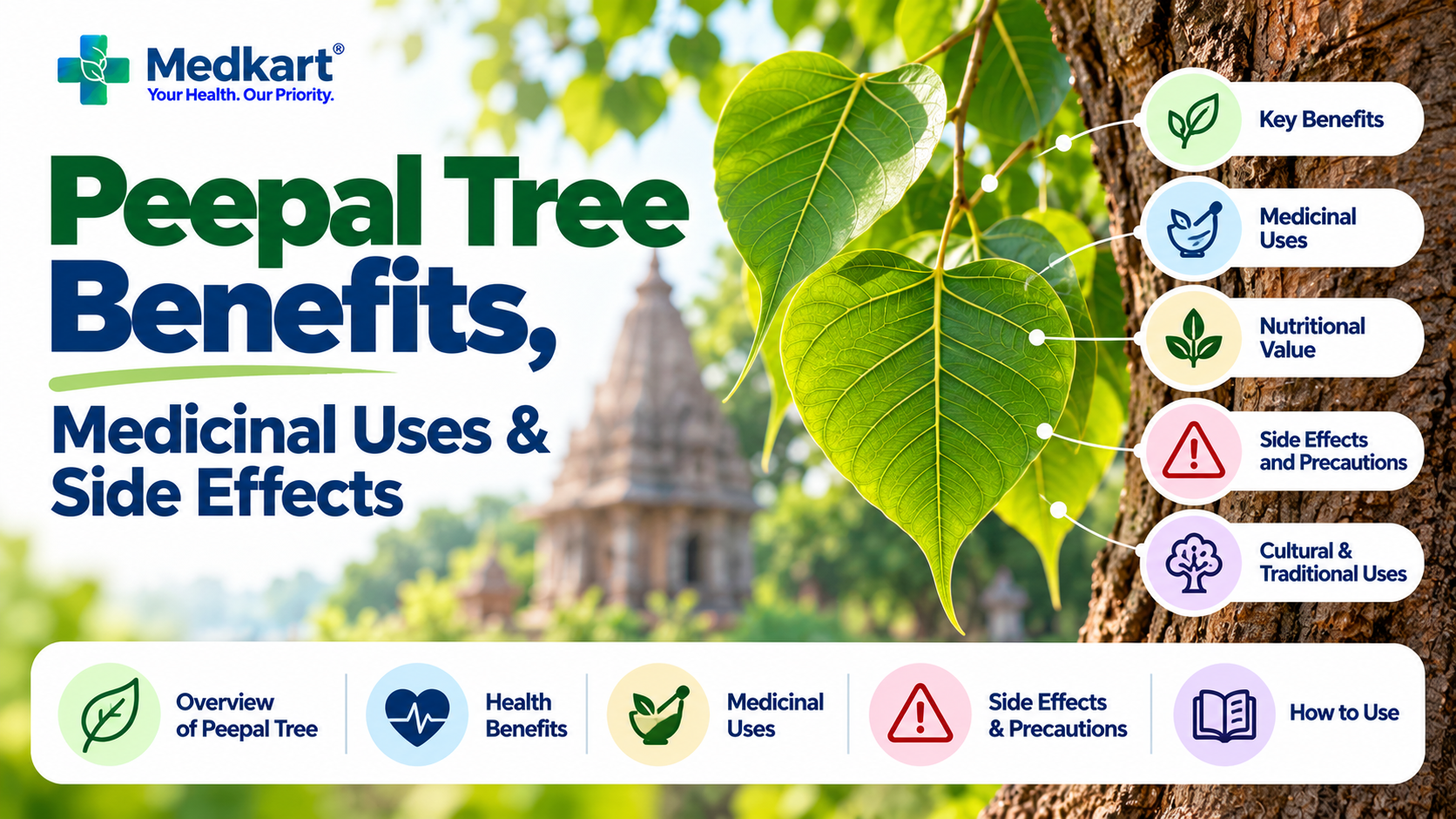
The peepal tree is a large fig tree known by many names across India. Its bark, leaves, fruit and latex all have a place in traditional medicine.
Most of the research on it has been done in laboratories and animals. That gap between traditional use and tested use shapes what can be said about its doses, benefits and safety.
What Is a Peepal Tree?
A peepal tree is Ficus religiosa, a semi-evergreen tree of the mulberry family, Moraceae. A 2024 review in the Journal of Traditional Chinese Medicine[1] lists peepal, pipul, bodhi tree and sacred fig among its common names.
The peepal tree scientific name used in the Ayurvedic Pharmacopoeia of India[2] is Ficus religiosa Linn. The pharmacopoeia, published by the Government of India, titles its monograph Asvattha and gives Pipal tree as the English name and Pipal or Pipala in Hindi.
Peepal tree leaves are heart shaped, roughly 10 to 17 cm long, on stalks of 6 to 10 cm. The small figs grow in pairs and turn from green to purple.
A 2024 review of the Ficus genus in the American Journal of Translational Research[3] describes it as an ornamental and ceremonial plant whose fruit is eaten.
What Are the Main Peepal Tree Medicinal Uses?
In Ayurveda, they centre mainly on the bark. The pharmacopoeia monograph covers the bark and lists Vatarakta, Raktapitta, Vrana, Yonidosa and Prameha as its therapeutic uses.
It classifies the bark as Kasaya in taste, Guru and Ruksa in quality and Sita in potency. A 2010 clinical paper in the journal AYU[4] renders these properties as an astringent taste, heavy and dry qualities, and a cooling potency.
Nyagrodhadi Kvatha Curna and Nyagrodhadi Curna are the formulations the pharmacopoeia names for the bark.
Wider peepal tree uses appear in the 2024 review. It lists the bark for diarrhoea, gonorrhoea and ulcers, the leaves for skin diseases, the fruit for asthma and as a laxative, and the latex as a tonic. Its broader list includes wounds, constipation, jaundice, fever, diabetes and heart disorders.
What Does the Evidence Show for Peepal Tree Leaf Benefits?
Most of the evidence comes from animals and laboratories, not people. A 2010 review in Pharmacognosy Reviews[5] describes antibacterial, wound-healing, hypoglycaemic and anticonvulsant effects, nearly all from that kind of work.
| Use | What the evidence says |
| Blood sugar | The 2010 review reports that bark extract lowered blood glucose in rat models. The 2024 review describes leaf extract given to diabetic rats at 250 mg per kg for 21 days. |
| Wounds | Ointments made with 5% and 10% leaf extract improved wound healing in rats, according to the 2010 review. |
| Infections | The 2010 review reports broad antibacterial activity from a chloroform leaf extract in the laboratory, while water-based extracts were generally weak. |
| Erectile dysfunction | The AYU trial compared a peepal preparation with a placebo in men with erectile dysfunction. Among those without diabetes, 61.11% on peepal were mildly improved, while everyone on placebo stayed unchanged. |
| General health | Clinical evidence that peepal tree leaves improve health in healthy adults has not been established. The 2024 review states that placebo trials are still needed. |
The AYU trial was small. Its authors note the limited sample size, especially in the diabetic group, and patients in both arms also received psychological counselling.
What Is the Nutritional Value of Peepal Tree Leaves?
Peepal leaves contain protein, fibre and minerals including calcium and iron, according to livestock feed analyses. Feedipedia[6], an animal feed database, records that fresh leaves are about 23.8% dry matter.
On a dry matter basis it gives about 11.0% crude protein, 15.9% crude fibre, 2.7% fat and 13.1% ash. Calcium is listed at 16.1 g per kg and iron at 623 mg per kg of dry matter.
Several of these values rest on a single sample, and the datasheet is marked as pending revision. They describe the leaf as fodder, not the amount of a nutrient a person would get from a dose.
For the fruit, the 2024 Ficus review gives nutrient information for the genus as a whole rather than for Ficus religiosa.
Also Read: Betel Leaves Benefits, Nutrition, Uses and Side Effects
What Is the Recommended Dosage of Peepal?
There is no single recommended dosage of peepal. For the bark, the Ayurvedic Pharmacopoeia gives 20 to 30 g of the drug for making a decoction.
The AYU trial used a preparation called Ashvattha Kshirpaka. It was made from 10 g of powdered root bark, stem bark, fruit and tender leaf buds, given twice a day under supervision.
The pharmacopoeia monograph covers the bark only. The 2024 review reports doses for leaf extracts in animals alone, measured in mg per kg of body weight.
A strength printed on a pack describes how much peepal extract the product contains. It is product information, not a dosing instruction, and what suits a particular person is a question for a doctor or a qualified Ayurvedic practitioner.
When Should You Take Peepal, and for How Long?
Published guidance does not set a time of day for taking peepal. The only schedule tested in people was the twice-daily one used in the AYU trial.
Neither the pharmacopoeia nor the reviews set a maximum length of use. The 2024 review states that toxicological research is still needed.
Anyone planning a longer course of a peepal preparation should agree it with a doctor first.
What Are the Side Effects of Peepal Leaves?
Few side effects of peepal leaves have been documented in people, and few human studies exist to record them.
In the AYU trial, one man reported itching all over his body after taking the preparation. It stopped when the herb was withdrawn and returned when it was restarted. No other patient reported an adverse effect.
Animal data are limited too. The 2024 review reports that a methanolic extract was safe in an acute toxicity test in mice, with no neurotoxicity seen.
The same review states that no side effects have been reported, but it describes no human safety study behind that statement. None of these sources describes a long-term human safety study of peepal leaves.
Who Should Be Careful with Peepal?
People on diabetes medicines, anyone who reacts to a dose and anyone planning long use need the most care.
| Situation | What to do |
| Taking diabetes medicines | Peepal extracts lowered blood glucose in diabetic rats. In the AYU trial, diabetic patients stayed on their usual antidiabetic medicines, so peepal should not be added without the prescriber knowing. |
| Pregnancy or breastfeeding | The reviews give no safety data for pregnancy or breastfeeding. A doctor should be asked before any peepal preparation is used. |
| Itching or a rash after a dose | The itching in the AYU trial came back each time the herb was restarted. Peepal should be stopped and a doctor consulted. |
| Long or repeated courses | The 2024 review calls for further toxicological research. A doctor should agree any course beyond a short period. |
People who buy regular treatment from the diabetes care range should mention any herbal product to their pharmacist. If you take regular medicines, ask a pharmacist whether a peepal preparation is suitable alongside them.
Where Can You Buy Ayurvedic and Herbal Products on Medkart?
Medkart lists Ayurvedic and herbal products in its Ayurvedic products category. Product ranges change, so the availability of any peepal preparation should be checked at the time of ordering.
Other leaf-based herbal extracts are listed by composition, such as Carica papaya leaf extract 550 mg. A papaya leaf extract with Tinospora cordifolia combination is also listed.
The nutritional supplements and personal care categories carry related products. Medkart’s medicine comparison tool places products side by side on:
- Active ingredient
- Strength
- Dosage form
- Manufacturer
- Pack size
- Current price
The medicines index and the molecule browser help locate a product by name or ingredient. Medkart highlights WHO-GMP certified medicines on its about page, and the store locator lists its pharmacies.
A doctor or pharmacist should be told before any herbal product is added to regular medicines.
Key takeaways
- The peepal tree scientific name is Ficus religiosa, and Ayurveda knows it as Asvattha.
- Traditional peepal tree uses cover the bark, leaves, fruit and latex.
- The Ayurvedic Pharmacopoeia of India sets its standard for the bark rather than the leaves.
- Most reported peepal tree leaf benefits come from animal and laboratory studies.
- The pharmacopoeia gives 20 to 30 g of bark for a decoction, which is not a personal dose.
- Leaf nutrient figures come from livestock feed analysis, not human food tables.
- One trial patient developed itching that returned each time the herb was restarted.
- People taking diabetes medicines should tell their prescriber before adding peepal.
FAQs: Common Questions About the Peepal Tree
Q. Why do labels use the peepal tree scientific name instead of peepal?
Because formal names are more precise than common ones. Ficus religiosa is the botanical name, and Asvattha, also spelt Ashvattha, is the Ayurvedic one. A pack carrying either name refers to the same tree, so anyone comparing products should look for both.
Q. What is a peepal tree called in other Indian languages?
It has a different name in almost every region. The Ayurvedic Pharmacopoeia records Arasamaram in Tamil, Ravichettu in Telugu, Arayal in Malayalam, Pimpal in Marathi, Piplo in Gujarati and Ashud in Bengali. Regional names on a label can therefore point to the same plant.
Q. Can peepal tree leaves be eaten as food?
It depends on the part of the tree. The 2024 Ficus review mentions people eating the fruit, while the leaf analyses on record were made for animal fodder rather than human meals. Anyone wanting to eat the leaves regularly should ask a doctor first.
Q. Does animal research on peepal show that it works in people?
Not on its own. Doses in those studies are stated in mg per kg for rats and mice, and the 2024 review still calls for placebo trials in humans. Until such trials are published, peepal tree leaf benefits reported in animals remain unconfirmed in people.
Q. Can peepal replace a diabetes medicine?
No. In the AYU trial, the men with diabetes kept taking their prescribed antidiabetic drugs alongside the herb, and their blood glucose did not change significantly in either group. Any change to a diabetes prescription is a decision for the doctor managing it.
Q. Is latex among the traditional peepal tree uses?
Yes. Latex is one of the less familiar peepal tree medicinal uses, listed as a tonic in the 2024 review, which also reports that latex fractions acted against five bacteria and Candida albicans in the laboratory. No human study of the latex is described.
Q. What should happen if itching starts after taking peepal?
The preparation should be stopped and a doctor seen. Itching is among the few side effects of peepal leaves and bark preparations recorded in people. In the single trial case, it settled once peepal was withdrawn and came back on restarting, and the trial authors flagged it for pharmacovigilance.
References
- https://pmc.ncbi.nlm.nih.gov/articles/PMC11462526
- https://archive.org/stream/AyurvedicPharmacopoeiaOfIndiaAllVolume/Ayurvedic%20Pharmacopoeia%20of%20India%20All%20Volume_djvu.txt
- https://pmc.ncbi.nlm.nih.gov/articles/PMC11645579
- https://pmc.ncbi.nlm.nih.gov/articles/PMC3221058
- https://pmc.ncbi.nlm.nih.gov/articles/PMC3249921/
- https://feedipedia.org/node/12547
Medical disclaimer: This article gives general information only. It does not replace advice from a doctor or pharmacist. No medicine or supplement should be started, stopped or changed without advice from the prescriber or a qualified pharmacist.

Leave a Reply