
Category: Generic Medicine

  • Hair Oil Guide: 15 Types, Benefits and How to Choose

    Hair Oil Guide: 15 Types, Benefits and How to Choose

    Oiling hair is one of the few grooming habits almost every Indian household already has. What most of us never got told is which oil does what, or why the order of the steps matters.

    This guide covers fifteen oils, with the steps for each, what it is actually good for, and the one thing about it worth knowing before you start.

    What this article covers 

    • Coconut oil
    • Sesame oil
    • Mustard oil
    • Almond oil
    • Castor oil
    • Olive oil
    • Argan oil
    • Jojoba oil
    • Sunflower oil
    • Bhringraj oil
    • Amla oil
    • Brahmi oil
    • Onion oil
    • Rosemary oil
    • Tea tree oil

    The first nine are plain oils you can buy as a single ingredient. The next four are herbal oils, made by infusing a herb into a base. The last two are essential oils, which are used differently and never neat.

    Why does oiling help hair? 

    oil helps grow hair

    Hair is dead protein once it leaves the follicle, so nothing you put on it repairs it. What oil does is sit on and inside the shaft, reduce friction, and cut the damage that washing and combing cause.

    One oil does measurably more than the others. A 2021 review in the Indian Journal of Plastic Surgery[1] reports that coconut oil was the only oil that reduced protein loss. That held for both damaged and undamaged hair, used before and after washing. Mineral oil and sunflower oil did not.

    The reason is chemistry. The same review credits lauric acid, which has a high affinity for hair protein and a low enough molecular weight to penetrate to the cortex. Bulkier oils stay on the surface.

    What does hair oil do for hair growth? 

    It protects the hair you already have rather than speeding up new growth. Growth happens at the follicle, below the skin, and an oil sitting on the shaft does not reach it.

    What oiling changes is how much of that growth you keep. Cutting breakage means more length stays on your head instead of collecting in the comb.

    So a hair growth routine is really a protective one. Oil before you wash, handle wet hair gently, comb from the ends upwards, and change one thing at a time so you know what made the difference.

    Which hair oil should you choose? 

    Hair Oil Selection

    Match the oil to your hair rather than to the label on the bottle.

    If your hair is What tends to suit it
    Fine or quick to go oily Lighter oils that absorb rather than sit: jojoba, argan, sunflower. A few drops on the mid-lengths and ends, not the scalp.
    Thick, coarse or dry Heavier oils hold up better: coconut, sesame, or castor thinned into a lighter oil.
    Curly or frizz-prone Any of the plain oils, applied to damp hair on the mid-lengths and ends, to seal water in before it escapes.
    Itchy or flaking at the scalp Keep oil light and occasional. Heavy oil on an already irritated scalp usually makes it worse, and a scalp that stays sore needs a doctor.
    Colour-treated or heat-styled Coconut oil before washing, since that is where the protein-loss benefit was measured.
    Prone to matting or tangling Do not leave neat virgin oil on for hours. The same review names plica polonica, a hair matting condition, as a risk of applying virgin oil directly.

    Before you start 

    Check Before Use New Oil

    Try any new oil on a small patch of inner forearm first and leave it for a day. If the skin reacts, do not put it on your scalp.

    Wash off anything that stings, burns or reddens the scalp. That is not the oil working.

    Two cautions apply throughout. Almond oil is a nut product, so skip it entirely if you have a nut allergy rather than patch-testing it. And the two essential oils at the end of the list are never used neat. A 2025 review in Skin Appendage Disorders[2] records allergic contact dermatitis and scalp irritation among reactions reported to topical herbal preparations.

    The Oils – 15 Types 
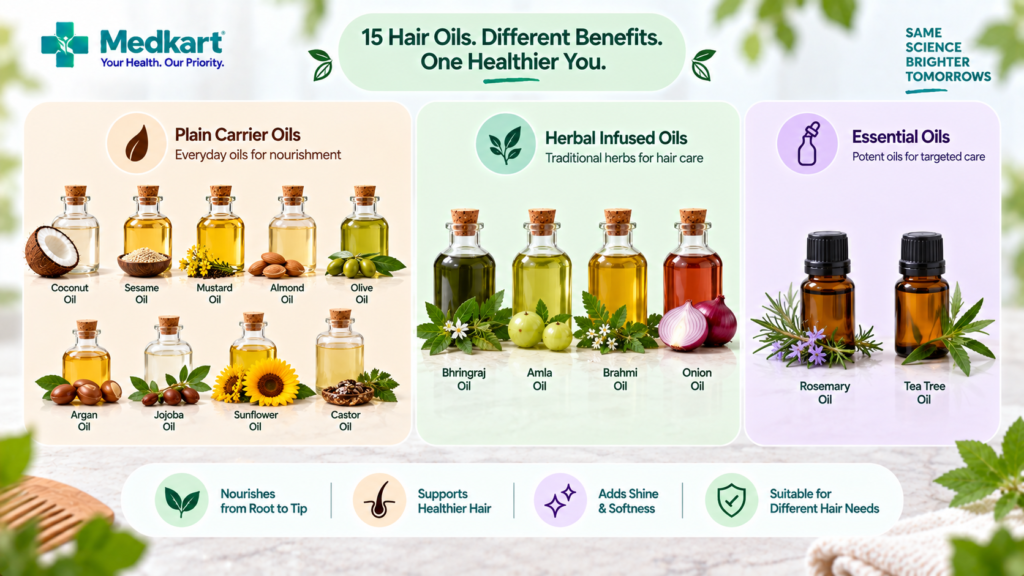
    All Types of Hair Oil

    1. Coconut oil 

    Coconut oil is pressed from kernel and turns solid below about 24 degrees. It is the oil most Indian kitchens already have.

    How to use it

    1. Warm two to three tablespoons between your palms until it runs clear.
    2. Part your hair and work it into the scalp for two or three minutes.
    3. Draw whatever is left down through the mid-lengths and ends.
    4. Leave it 30 minutes to an hour, then wash out with shampoo.

    Benefits

    • The one common oil measured to cut protein loss from washing
    • Costs very little and is sold in every shop
    • Doubles as a body and cuticle oil

    Good to know: Use it before you wash, not only after. The protein-loss finding covers both, and pre-wash is the half most people skip.

    2. Sesame oil 

    Sesame oil, or til oil, is pressed from sesame seeds. It is the traditional oil for a warm head massage in most of India.

    How to use it

    1. Warm two tablespoons until comfortably warm, never hot.
    2. Massage into the scalp in slow circles for five minutes.
    3. Work the rest through to the ends and leave for an hour, or overnight if your hair is very dry.
    4. Wash out with shampoo. It takes two rounds.

    Benefits

    • Heavier and more warming than coconut oil in winter
    • Cheap and available everywhere in India
    • Good slip for a proper massage

    Good to know: Buy plain sesame oil, not the dark toasted kind used for cooking. Toasted oil has a strong smell that clings to hair for days.

    3. Mustard oil 

    Mustard oil, or sarson ka tel, is pressed from mustard seeds and has a sharp, unmistakable smell.

    How to use it

    1. Warm one to two tablespoons.
    2. Work it into the scalp and hair, using less than you would coconut oil.
    3. Leave for 30 to 45 minutes.
    4. Wash out thoroughly. The smell needs shampoo, not just water.

    Benefits

    • Very inexpensive and widely stocked
    • Thicker than most oils, so a little covers a lot
    • Warms the scalp noticeably in cold weather

    Good to know: The smell is the main reason people give up on it. Mixing it half and half with coconut oil keeps most of the feel and loses some of the pungency.

    4. Almond oil 

    Sweet almond oil is pressed from almonds and is light, mild and almost odourless.

    How to use it

    1. Warm a tablespoon between your palms.
    2. Massage into the scalp, or use a few drops on the ends alone if your hair is fine.
    3. Leave for 30 minutes to an hour.
    4. Wash out as usual.

    Benefits

    • Light enough for fine hair that heavier oils weigh down
    • Mild smell that does not compete with anything
    • Sold in every chemist in India

    Good to know: This is a nut product. If you have a nut allergy, do not use it and do not patch-test it. Jojoba or sunflower oil does the same job without the risk.

    5. Castor oil 

    Castor oil is pressed from castor seeds and is far thicker than any other oil here. It pours like syrup.

    How to use it

    1. Mix one part castor oil into three or four parts coconut, sesame or almond oil.
    2. Warm the blend and work it into the scalp and ends.
    3. Leave for 30 minutes to an hour.
    4. Wash out with shampoo, twice if needed.

    Benefits

    • Acts as a moisturiser and coats the shaft heavily
    • A small bottle lasts a very long time once diluted
    • Adds noticeable weight and shine to fine, flyaway hair

    Good to know: Never use it neat. Undiluted castor oil is difficult to wash out and is the oil most often behind a matted, tangled mess the next morning.

    6. Olive oil 

    Olive oil is the same bottle you cook with, pressed from olives. It is medium weight and slightly green.

    How to use it

    1. Warm two tablespoons.
    2. Apply mostly to the mid-lengths and ends, going light at the roots.
    3. Leave for 30 minutes.
    4. Wash out with shampoo.

    Benefits

    • Already in the kitchen, so nothing to buy
    • Heavier than sunflower, lighter than castor
    • Rinses out more easily than most thick oils

    Good to know: Olive oil sits on the surface rather than penetrating, so it conditions the outside of the hair without doing what coconut oil does inside it.

    Also Read: Mahabringraj Oil: The Natural Solution for Healthy Hair Growth

    7. Argan oil 

    Argan oil is pressed from the kernels of a Moroccan tree. It is light, quick to absorb and sold in small bottles.

    How to use it

    1. Put two or three drops on your fingertips.
    2. Rub your palms together and smooth it over damp mid-lengths and ends.
    3. Leave it in. There is nothing to wash out.

    Benefits

    • Absorbs fast enough to use on hair you are about to leave the house with
    • Almost no smell
    • A 30 ml bottle lasts months at three drops a time

    Good to know: The 2021 review notes argan oil contains antioxidants but lacks scientific evidence for its conditioning claims. It is pleasant and convenient; the marketing runs ahead of the data.

    8. Jojoba oil 

    Jojoba is technically a liquid wax, pressed from the seeds of a desert shrub. It feels closer to the scalp’s own oil than anything else here.

    How to use it

    1. Warm three or four drops in your palm.
    2. Work into the scalp if it feels tight, or through the ends if they feel rough.
    3. Leave it in, or wash out after an hour if you prefer.

    Benefits

    • Light enough for oily hair and fine hair
    • Keeps far longer than seed oils without turning
    • Thins out heavier oils that feel like too much alone

    Good to know: Because it is a wax rather than an oil, an open bottle is still fine a year later. Almond and sunflower oil are not.

    9. Sunflower oil 

    Plain sunflower oil, pressed from the seeds. It is one of the lightest cooking oils and very cheap.

    How to use it

    1. Warm a tablespoon.
    2. Apply to the scalp and hair, or use it as the base you dilute castor oil into.
    3. Leave for 30 minutes.
    4. Wash out with shampoo.

    Benefits

    • Extremely cheap and in most kitchens
    • Light and easy to wash out
    • Useful as a carrier for heavier oils and essential oils

    Good to know: The 2021 review found sunflower oil did not reduce protein loss, and put that down to its bulky molecular structure. It conditions the surface but does not get inside the shaft.

    10. Bhringraj oil 

    Bhringraj oil is made by infusing the herb Eclipta alba into a base oil, usually coconut or sesame. It is dark green and smells strongly herbal.

    How to use it

    1. Warm two tablespoons.
    2. Section your hair and apply along the scalp, then through the lengths.
    3. Massage for five minutes and leave for at least an hour.
    4. Wash out with shampoo.

    Benefits

    • The classic Ayurvedic hair oil, easy to find in any Indian shop
    • Comes ready-blended, so nothing to mix
    • Strong herbal smell that some people genuinely like

    Good to know: What you are buying is mostly the base oil. Check whether the base is coconut or a mineral oil, because that changes how it behaves more than the herb does.

    11. Amla oil 

    Amla oil is Indian gooseberry infused into a base oil. It is one of the oldest hair preparations in India and usually comes dark and thick.

    How to use it

    1. Warm one to two tablespoons.
    2. Work it into the scalp and along the hair.
    3. Leave for an hour, or overnight with a towel on the pillow.
    4. Wash out with shampoo.

    Benefits

    • Widely sold and inexpensive
    • Heavier feel that suits coarse hair
    • Traditional choice for a weekly oiling routine

    Good to know: Many commercial amla oils are mineral oil with amla extract and colour added. Mineral oil does not penetrate hair, so read the base before you judge the oil.

    12. Brahmi oil 

    Brahmi oil infuses Bacopa monnieri into a base oil. It is usually lighter than bhringraj and less strongly scented.

    How to use it

    1. Warm a tablespoon or two.
    2. Apply to the scalp with fingertips and massage for a few minutes.
    3. Leave for 45 minutes to an hour.
    4. Wash out as usual.

    Benefits

    • Lighter than most Ayurvedic oils, so easier on fine hair
    • Milder smell than bhringraj or mustard
    • Often sold blended with bhringraj and amla in one bottle

    Good to know: Brahmi is sometimes confused with gotu kola, a different plant sold under similar names. Check for Bacopa monnieri on the label if it matters to you.

    13. Onion oil 

    Onion oil is red onion extract carried in a base oil. It became popular in India in the last few years and is now sold everywhere.

    How to use it

    1. Apply one to two tablespoons to the scalp with an applicator bottle or fingertips.
    2. Massage for three to five minutes.
    3. Leave for 30 minutes to an hour, no longer.
    4. Wash out with shampoo. It usually takes two rounds.

    Benefits

    • Comes ready-made, so no chopping or straining
    • Light enough for most hair types
    • Widely stocked and often blended with amla or bhringraj

    Good to know: The smell is the honest drawback. The 2025 review lists unpleasant odour as the main reported problem with onion preparations, and the reason people stop using them.

    14. Rosemary oil 

    Rosemary oil is an essential oil, steam-distilled from the herb. It is highly concentrated and is never applied neat.

    How to use it

    1. Add three to five drops to one tablespoon of coconut, jojoba or sunflower oil.
    2. Stir, then work the blend into the scalp only.
    3. Leave for 30 minutes.
    4. Wash out with shampoo.

    Benefits

    • A few drops go a long way, so one bottle lasts
    • Sharp, clean smell that most people prefer to herbal oils
    • Mixes into any plain oil you already own

    Good to know: Neat essential oil on the scalp can cause a reaction even in people who tolerate it diluted. Dilute it every time, and keep it away from your eyes.

    15. Tea tree oil 

    Tea tree oil is an essential oil distilled from the leaves of an Australian shrub. Like rosemary, it is used in drops rather than spoonfuls.

    How to use it

    1. Add two to three drops to one tablespoon of a carrier oil.
    2. Apply to the scalp, not through the lengths.
    3. Leave for 20 to 30 minutes.
    4. Wash out with shampoo.

    Benefits

    • Very small quantities needed, so a bottle lasts months
    • Distinct medicinal smell that fades after washing
    • Blends into any of the plain oils above

    Good to know: Tea tree oil is not put on the scalp neat under any circumstances. If the scalp is already broken, sore or weeping, leave it alone entirely and see a doctor.

    What to expect, and how long it takes 

    Hair Grooming With Oil

    Oiling is grooming, not repair. It reduces the damage washing and combing do, and it makes hair easier to handle. It does not rebuild a damaged shaft, because hair is not living tissue.

    Give any routine six to eight weeks before you judge it, and judge it on how the hair feels and behaves rather than on length. A week tells you nothing.

    What would count as it not working? A scalp that itches or flakes more than before, hair that mats or tangles worse, or spots that stay sore. Any of those means stop, not persist.

    When is oiling not enough? 

    Consult With Doctor for Hair care

    Oils work slowly where they work at all, and they suit upkeep rather than repair.

    Hair that is falling out suddenly, coming out in patches, or thinning fast is a reason to see a doctor rather than to try the next oil. So is a scalp that is painful, weeping, bleeding or not settling. The 2025 review is explicit that people should discuss herbal preparations with a healthcare professional rather than assume they are a substitute.

    If you want something more consistent than a kitchen blend, a formulated hair oil is a fair alternative. It is made to the same recipe every time and carries its own label, which a mix poured by hand does not.

    Where can you buy hair oil on Medkart? 

    Medkart lists hair oils alongside its medicine range. The personal care category covers hair oils, cleansers and other topical preparations.

    Hair oils listed on Medkart include:

    Medkart states that the medicines it sells are sourced from WHO-GMP certified manufacturers. Its comparison tool places products side by side, and the medicines index lists what is in stock.

    If you already use a prescribed scalp treatment, ask a pharmacist before adding an oil on top of it.

    Key takeaways 

    • Hair is dead protein, so oil reduces damage rather than repairing it.
    • Coconut oil is the one common oil measured to cut protein loss from washing.
    • Lighter oils suit fine or oily hair, heavier oils suit thick or dry hair.
    • Castor oil is always diluted into a lighter oil, never used neat.
    • Almond oil is a nut product and is skipped entirely by anyone with a nut allergy.
    • Rosemary and tea tree are essential oils and are used in drops, always diluted.
    • Many commercial herbal oils are mineral oil with extract added, so read the base.
    • Sudden, patchy or fast hair loss needs a doctor rather than another oil.

    FAQs: Common Questions About Hair Oiling 

    Q. How often should you oil your hair? 

    Once or twice a week suits most people. Fine or quickly oily hair often does better with once a week on the ends only, while coarse or dry hair can take twice. If your scalp feels heavy, itchy or spotty after a few weeks, you are oiling too often or using too much.

    Q. Should oil go on wet hair or dry hair? 

    Both work, for different reasons. On damp hair, oil helps seal water in, which is why curly hair usually does better that way. On dry hair before a wash, it coats the shaft and takes some of the damage that shampoo would otherwise do.

    Q. Is leaving oil in overnight better? 

    Not necessarily, and for some hair it is worse. An hour is enough for most oils to do what they are going to do. Long overnight sessions with a thick or neat oil are also where matting and tangling most often start.

    Q. Can you mix two oils together? 

    Yes, and it is often the best way to use the difficult ones. Castor oil is far easier diluted, and essential oils have to be. Keep a blend to two or three oils so you know what to drop if your scalp reacts.

    Q. How do you get oil out of hair properly? 

    Shampoo dry hair before wetting it, which sounds wrong and works far better. Work the shampoo into the oiled hair first, then add water and lather. Heavier oils usually need a second round.

    Q. Can oiling make hair look thicker? 

    Only in how it looks, not in how much hair there is. A light oil through the mid-lengths smooths the surface and catches the light, which makes fine hair read as denser in the mirror. It does not change the number of follicles, and too heavy an oil does the opposite and leaves hair looking flat.

    Q. Does a hair care routine need more than oiling? 

    Yes, and the rest of it matters as much. Washing, drying and combing all decide how much hair survives the week, and no oil undoes rough handling on soaking wet hair. A wide-toothed comb and blotting with a towel rather than rubbing are the cheapest parts of the routine.

    References 

    Medical disclaimer: This article describes hair oils and oiling practices in common household use. It is written for general interest and does not replace advice from a doctor or pharmacist. A scalp that is painful, spreading or not settling, or hair loss that is sudden or patchy, should be seen by a doctor rather than treated at home, and no medicine should be started, stopped or changed without advice from the prescriber or a qualified pharmacist.

  • Dark Lips: Causes, Treatment, Remedies and When to See a Doctor

    Dark Lips: Causes, Treatment, Remedies and When to See a Doctor

    Lip colour comes from blood flow through thin skin and from melanin, the pigment made by cells called melanocytes. When lips darken, one of those two things has usually changed.

    Two findings shape this article. The strongest measured cause of lip darkening is tobacco, and the most recent international guideline on pigmentation disorders does not cover the lip at all.

    What Causes Dark Lips? 

    MedlinePlus[1] describes skin with too much melanin as hyperpigmented, and lists the general causes. The table sets out the ones that reach the lips, and it describes what the sources report rather than offering a way to self-diagnose.

    Feature What The Sources Say
    Smoking and tobacco A case-control study of 213 men[2] found current smoking strongly associated with lip pigmentation.
    Sun exposure MedlinePlus names sun exposure among the causes of increased melanin, and the NHS[3] names sunlight among the risks to the lips.
    Medicines MedlinePlus names minocycline, some cancer chemotherapies and birth control pills among the drug causes.
    Inflammation that has healed MedlinePlus records darkening that follows skin inflammation, described as post-inflammatory hyperpigmentation.
    Hormone conditions MedlinePlus names Addison disease among the hormone system causes of darker skin.
    Inherited syndromes MedlinePlus Genetics[4] records dark spots on and around the lips as a feature of Peutz-Jeghers syndrome.

    Why Smoking Shows on the Lips 

    The 2007 study in Oral Diseases assessed photographs of 213 men and found that 73% of those with lip pigmentation were current smokers, against 33% of those without.

    The odds ratio for current smoking against lip pigmentation was 5.6. Daily consumption, duration of smoking and lifetime exposure all correlated with how heavy the pigmentation was.

    Can Dark Lips Be a Sign of Something Serious? 

    Usually not, and occasionally yes. The conditions below are uncommon, and they are the reason a persistent change is worth showing to a doctor rather than treating at home.

    Addison’s disease is one. The NHS[5] lists areas of skin darker than the surrounding skin among its symptoms, alongside extreme tiredness, weight loss, salt cravings and dizziness on standing.

    Peutz-Jeghers syndrome is another. MedlinePlus Genetics describes small dark spots on the lips, around and inside the mouth and near the eyes and nostrils. They appear in childhood, often fade with age, and belong to a condition carrying a high lifetime cancer risk.

    Cancer of the lip itself is the third. The NHS[6] names a lump on the lip, a red or white patch inside the mouth, and a mouth ulcer lasting more than three weeks among mouth cancer symptoms.

    Also Read: Preventing skin infections

    What Treatment Do the Guidelines Describe? 

    Here the honest answer is a gap. A global consensus on the management of melanin hyperpigmentation disorders[7] was published in the Journal of the European Academy of Dermatology and Venereology in 2025. Ten experts across four continents developed it using a Delphi method.

    It covers melasma, post-inflammatory hyperpigmentation, periorbital hyperpigmentation, freckles, photodamage and pigmentation of the skin folds. It does not address the lips or mucosal pigmentation.

    What it does establish applies more widely. The consensus calls photoprotection key across every pigmentation disorder it covers, and describes broad-spectrum cover against ultraviolet and visible light. For the visible part it names tinted sunscreens containing iron oxide or titanium dioxide.

    It also treats the strongest topical agents as restricted rather than routine. Hydroquinone appears in its recommendations with limits on how long it is used, which is a decision for a dermatologist rather than a shelf.

    Do Home Remedies for Dark Lips Work? 

    No source retrieved for this article tested any of them. The guideline above does not reach the lips, and no trial of a household preparation on lip pigmentation was found.

    The recipes that circulate are not evidence. They appear on commercial pages that publish no measurements, and repeating their quantities under a doctor’s byline would mean inventing a treatment.

    That is a statement about the search rather than a verdict on any ingredient. What can be said is that the one intervention with measured support behind it is stopping tobacco, and that it costs nothing.

    Are Skin Lightening Products Safe? 

    Some are actively dangerous, and the reason is worth reading twice. The World Health Organization[8] records mercury as a common ingredient in skin lightening creams and soaps, working by inhibiting the formation of melanin.

    Its listed harms include the thing the buyer was trying to fix. The WHO names kidney damage, skin rashes, skin discolouration and scarring, reduced resistance to bacterial and fungal infections, anxiety, depression, psychosis and peripheral neuropathy.

    Regulation exists and is widely outrun. The Minamata Convention sets a mercury limit for skin lightening products, and the WHO records that many exceed it to increase the whitening effect. Such products remain easy to obtain even where they are banned.

    Mercury-free is not the same as safe. The WHO notes that products without mercury may contain other hazardous substances such as hydroquinone, and that buyers are often unaware of the risks.

    The WHO also names the demand side plainly. It records that beauty standards promoted by media, advertising and marketing reinforce a bias that lighter skin is more desirable than darker skin.

    How Can Further Darkening Be Prevented? 

    Three things have sources behind them. The first is tobacco, given the size of the association measured in the Oral Diseases study.

    The second is sun. The consensus treats photoprotection as the foundation of managing pigmentation elsewhere on the body, and the NHS names sunlight and sunbeds among the exposures that affect the lips.

    The third is avoidance. Nothing in the WHO note supports buying an unregulated lightening product, and its harm list includes further discolouration and scarring.

    When Should You See a Doctor? 

    Book an appointment if the darkening is new, if it is spreading, or if one spot looks different from the rest. You do not need to work out the cause first.

    Situation What To Do
    A mouth ulcer lasting more than three weeks See a doctor or a dentist. The NHS names this among mouth cancer symptoms.
    A lump on the lip, or a red or white patch in the mouth See a doctor or a dentist. The NHS lists all three together.
    One spot that is changing shape, size or colour See a doctor. MedlinePlus names a changing lesion as a reason to seek care.
    Darkening with tiredness, weight loss or dizziness on standing See a GP. The NHS lists these together among Addison’s disease symptoms.
    Dark spots on the lips present since childhood Raise it with a doctor. MedlinePlus Genetics describes this pattern in Peutz-Jeghers syndrome.
    Darkening that started after a new medicine Speak to the prescriber rather than stopping it. MedlinePlus names several drug causes.
    Any reaction after using a lightening cream Stop and seek advice. The WHO records rashes, discolouration and scarring among mercury effects.

    What This Article Cannot Tell You 

    It cannot say why any individual’s lips are dark. The same appearance follows from tobacco, sun, medicines, healed inflammation, an inherited syndrome and a hormone condition, and only examination separates them.

    It cannot offer a method for lightening them. The guideline that governs pigmentation elsewhere does not extend to the lip, and no tested household preparation was retrieved.

    It cannot say whether a given spot is harmless. That is what a doctor or dentist looks at.

    It also cannot tell anyone what their lips should look like. Lip colour varies between people, and the WHO’s note on beauty standards is part of this subject rather than separate from it.

    Where Can You Buy Lip Care and Quit-Smoking Products on Medkart? 

    The measure with the most evidence behind it here is stopping tobacco. Medkart sells medicines online and lists nicotine replacement products, including those containing nicotine in two listed strengths, such as Nicotex from Cipla. Which one suits a person is a question for a pharmacist.

    Sun and moisture products sit in the personal care range. Listed items include the Cetaphil Sun SPF 50 Plus gel and Vaseline Deep Moisture Lotion, and nutritional supplements are listed separately.

    Nothing here says any of these treats the condition, and no product on any pharmacy shelf has been shown in a retrieved source to lighten lips. Medkart lists these products and does not test or approve them. Availability and price can change.

    Medkart’s medicine comparison tools can be used to compare listed options on:

    • Active ingredient
    • Strength
    • Dosage form
    • Manufacturer
    • Pack size
    • Current price

    It is also possible to search by name, browse the full medicine list, or find the nearest Medkart store.

    Key takeaways 

    • Lip colour comes from blood flow and from melanin, and darkening usually means one of those has changed.
    • In a study of 213 men, 73% of those with lip pigmentation were current smokers against 33% of those without.
    • The odds ratio for current smoking against lip pigmentation was 5.6, and it rose with how much and how long people smoked.
    • Named causes also include sun, some medicines, healed inflammation, Addison’s disease and Peutz-Jeghers syndrome.
    • The 2025 global consensus on pigmentation disorders does not cover the lips or mucosal pigmentation.
    • No trial of a home remedy for dark lips was retrieved for this article.
    • The WHO records mercury in lightening creams, whose harms include skin discolouration and scarring.
    • Mercury-free lightening products may still contain other hazardous substances such as hydroquinone.

    FAQs 

    Q. Do dark lips go away after quitting smoking? 

    The literature on smoking-related pigmentation describes it as fading rather than vanishing on a timetable. The case-control study opened here measured the association rather than following people who stopped, so it cannot give a schedule. What it does show is that the pigmentation tracked with how much and how long people had smoked.

    Q. Can lip balm make lips pink again? 

    No retrieved source tested that. Balms address dryness and cracking, which are different problems from pigment sitting in the skin. The consensus on pigmentation disorders does not reach the lips at all, so there is no guideline position on any lip product either way.

    Q. Is dark pigmentation on the lips normal? 

    Lip colour varies widely between people and within families. The sources opened here describe patterns that warrant a look, such as a single changing spot or spots present since childhood, rather than defining a correct shade.

    Q. Does drinking more water lighten the lips? 

    Nothing retrieved for this article addresses it. Dehydration affects how dry lips feel and look, but no source opened here links fluid intake to melanin in the lip. The question has not been answered rather than answered in the negative.

    Q. Why are the lips darker in the middle or in one patch? 

    A single well-defined dark spot on the lip has its own name in dermatology and its own list of possible causes, including ones that need ruling out. That is a reason for an examination rather than a home remedy, because appearance alone does not separate a harmless spot from one that matters.

    Q. Are herbal or ayurvedic lightening creams safer than others? 

    Being herbal is not a safety claim the sources support. The WHO warns about hazardous ingredients in this product category generally, and records that buyers are frequently unaware of what they are applying. A pharmacist can check an ingredient list before anything goes on the skin.

    References 

    Medical disclaimer: This article gives general information about lip pigmentation and is not a diagnosis. It cannot tell any individual why their lips have darkened or whether a spot is harmless, because those questions need a doctor or dentist and an examination. Nothing here is a method for lightening lips, unregulated skin lightening products carry documented harms, and no medicine or supplement should be started, stopped or changed without advice from the prescriber or a qualified pharmacist.

  • Sapota (Chikoo): Health Benefits, Nutrition and Side Effects

    Sapota (Chikoo): Health Benefits, Nutrition and Side Effects

    Chikoo is the Indian name for sapota, the brown grainy-skinned fruit of Manilkara zapota. It is sweet enough to be eaten as a dessert and dense enough in fibre to behave differently from most sweet fruits.

    Two things in the research are worth knowing first. The figures for its sugar and fibre content disagree between sources. The single measured study of its effect on blood glucose also carries a spread far wider than the tidy numbers circulating online.

    What Is Sapota, and Where Does Chikoo Grow in India? 

    Sapota is a tropical evergreen fruit crop grown across the warmer half of the country. The National Horticulture Board[1] records it as mainly cultivated in India for its fruit, in a warm and humid climate at around 70% relative humidity.

    Six states carry most of it. The board names Gujarat, Maharashtra, Karnataka, Tamil Nadu, Andhra Pradesh and Kerala, and the varieties include Kalipatti, Cricket ball and Calcutta round.

    The fruit is slow. The board records that a tree starts bearing from the third year after planting, with economic yields from the fifth. The fruit itself takes four months from flowering to maturity.

    What Is the Nutritional Value of Chikoo? 

    Sapota is a fibre-heavy carbohydrate fruit with very little protein or fat. The United States Department of Agriculture[2] records these figures for raw sapodilla.

    Nutrient What 100 g of raw sapodilla provides
    Energy Raw sapodilla provides 83 kcal per 100 g.
    Carbohydrate Carbohydrate by difference is 19.96 g per 100 g.
    Fibre Total dietary fibre is 5.3 g per 100 g.
    Protein Protein is 0.44 g per 100 g.
    Fat Total fat is 1.1 g per 100 g.
    Water Water makes up 78 g of every 100 g.
    Vitamin C Vitamin C is 14.7 mg per 100 g.
    Potassium Potassium is 193 mg per 100 g.
    Calcium Calcium is 21 mg per 100 g.
    Iron Iron is 0.8 mg per 100 g.

    The USDA entry carries no figure for total sugars. A 2026 review in Foods[3] gives 11% to 15% sugars for the fruit, so the sweetness is documented in the literature rather than in the food database.

    How Many Calories Are in Chikoo? 

    Around 83 kcal per 100 g, which is moderate for a fruit and comes almost entirely from carbohydrate. A single sapota weighs well under 100 g in most cases, so a fruit carries less than that figure.

    The energy is not the interesting part. Nearly a quarter of the carbohydrate is fibre, and that is what separates sapota from other fruits of similar sweetness.

    What Is Chikoo Rich In? 

    Fibre first, at 5.3 g per 100 g in the USDA record. That is high for a fresh fruit and is the most defensible single claim about it.

    Vitamin C and potassium follow, at 14.7 mg and 193 mg per 100 g. Calcium and iron are present in smaller amounts.

    The fibre figure is itself disputed. The composition table in the glycaemic study below[4] lists 9.9 g of fibre per 100 g, nearly twice the USDA figure. Fruit composition varies with variety and ripeness.

    What Are the Health Benefits of Sapota? 

    The defensible benefits are the fibre, the vitamin C and the potassium, all of which are matters of composition rather than of effect. Beyond those, the retrieved evidence thins quickly.

    The Foods review lists gallic acid, chlorogenic acid, quercetin, catechin and myricetin among the fruit’s phenolic compounds. It reports antioxidant, anti-inflammatory and antimicrobial activity for extracts, and states that this work is laboratory and animal research.

    The digestive claim sits in the same category. A 2019 study in BioMed Research International[5] tested chloroform and aqueous extracts of the fruit in animals. It reported protection against induced diarrhoea and up to 76% inhibition of induced ulcers.

    Those were extracts given to animals, not fruit eaten by people. No human trial of eating sapota was retrieved for this article.

    Also Read: Understanding blood sugar levels

    Can People with Diabetes Eat Chikoo? 

    One study has measured this, and its result is less reassuring than its headline. A 2015 paper in Food Science and Technology tested nine tropical fruits in volunteers under the FAO and WHO protocol, with each fruit tested in at least six people.

    Sapodilla came out with a glycaemic index of 37, classified as low, and a glycaemic load of 4 for a 70 g portion, also low.

    The spread is the problem. The reported standard deviation was 27.9 against a mean of 37, wider than the gap between a low and a high glycaemic index. Individual responses varied enormously.

    The portion is worth noting too. To deliver the 50 g of glycaemic carbohydrate the protocol requires, volunteers ate 312.5 g of sapodilla, far more than anyone eats at one sitting. Anyone managing diabetes should discuss portions with the clinician managing it.

    How Is Chikoo Eaten and Ripened? 

    Ripe sapota is eaten fresh, and the unripe fruit is not worth eating. The Foods review records that unripe fruits have higher levels of tannins, which make them astringent and reduce palatability.

    Commercial ripening is regulated in India, and the rules matter to shoppers. The FSSAI[6] states that calcium carbide, widely called masala, is banned for ripening fruit under the 2011 prohibition regulations.

    Its reasoning is specific. The authority records that calcium carbide carries traces of arsenic and phosphorus, that these may leave residues on fruit, and that the acetylene gas released is harmful to handlers.

    What is permitted instead is ethylene. FSSAI recognises it as a safe ripening agent, delivered through sources such as ethephon, which is the method the horticulture board describes for sapota.

    What Are the Side Effects of Sapota? 

    No retrieved source reports serious harm from eating ripe sapota as a food. The cautions that exist concern the unripe fruit and the limits of the safety testing.

    The tannins in unripe fruit are the first. Beyond astringency, no retrieved source quantifies a harm from them.

    The second is a gap rather than a finding. The Foods review notes that cyanogenic glycosides have been identified in the plant, and states that long-term toxicity studies in humans should still be conducted.

    Energy and carbohydrate are the everyday consideration. At 83 kcal and nearly 20 g of carbohydrate per 100 g, sapota is denser than a watery fruit. The glycaemic spread above means its effect is not uniform across people.

    Who Should Be Careful with Sapota? 

    The cautions are specific rather than general.

    Situation What To Do
    Managing diabetes Discuss portions with the doctor or dietitian managing it. The one measured study reported a very wide individual spread.
    Watching energy intake Weigh the portion. Sapota carries 83 kcal and 19.96 g of carbohydrate per 100 g.
    Buying fruit that ripens suspiciously fast Buy from a seller you trust. FSSAI bans calcium carbide for ripening and permits ethylene instead.
    Eating unripe fruit Leave it to ripen. The Foods review attributes the astringency of unripe fruit to its higher tannin content.
    Relying on it for a health effect Treat it as a food. The antioxidant and digestive findings come from extracts tested in laboratories and animals.

    No source retrieved for this article sets a daily amount of sapota for anyone.

    Where Can You Buy Supplements and Medicines on Medkart? 

    Sapota is a grocery item rather than a pharmacy one, and Medkart does not list it. Medkart sells medicines and nutritional supplements that cover some of the same ground.

    Fibre and iron are the relevant ones. Listed options include Laxmi Isabgol Powder, Softovac SF and iron products such as Daily Iron from Systopic. Medkart also lists ayurvedic products as a separate category.

    A fruit is not a substitute for a prescribed medicine such as metformin, sold as Glycomet among other brands. Nothing here says any of these treats the condition, and Medkart lists these products rather than testing or approving them. Availability and price can change.

    Medkart’s medicine comparison tools can be used to compare listed options on:

    • Active ingredient
    • Strength
    • Dosage form
    • Manufacturer
    • Pack size
    • Current price

    It is also possible to search by name, browse the full medicine list, or find the nearest Medkart store.

    Key takeaways 

    • Chikoo is sapota, the fruit of Manilkara zapota, grown mainly in Gujarat, Maharashtra, Karnataka, Tamil Nadu, Andhra Pradesh and Kerala.
    • Raw sapodilla provides 83 kcal and 19.96 g of carbohydrate per 100 g.
    • Fibre is the standout nutrient, at 5.3 g per 100 g in the USDA record.
    • The USDA carries no total sugars figure, while a 2026 review reports 11% to 15% sugars.
    • The two sources also disagree on fibre, at 5.3 g against 9.9 g per 100 g.
    • The one measured study gave a glycaemic index of 37, low, but with a standard deviation of 27.9.
    • Antioxidant and digestive findings come from extracts tested in laboratories and animals, not from eating the fruit.
    • FSSAI bans calcium carbide for ripening fruit and recognises ethylene as the safe alternative.

    FAQs 

    Q. How many chikoos can be eaten in a day? 

    No retrieved source sets a number. The glycaemic study used a 70 g portion to calculate its load figure, roughly one medium fruit. That was a research portion rather than a recommendation. Anyone with diabetes or a weight goal should settle the amount with a clinician rather than with a chart.

    Q. Is chikoo good for constipation? 

    The fibre content is real and the outcome evidence is not here. Sapodilla carries 5.3 g of fibre per 100 g in the USDA record, which is high for a fresh fruit. No trial testing sapota for constipation in people was retrieved for this article, so the composition figure is the honest answer.

    Q. Can the seeds be swallowed? 

    The seeds are large, black and flat, and nothing retrieved here describes them as edible. The Foods review covers the plant’s chemistry rather than seed safety, and the toxicology gap named above has not been closed. Nothing opened for this article supports swallowing them deliberately.

    Q. Why do some chikoos taste chalky or bitter? 

    That points at ripeness rather than at a bad fruit. The Foods review attributes astringency in this fruit to the higher tannin levels found before ripening. A fruit picked too early and ripened in a hurry can therefore taste sharp even when the skin looks ready.

    Q. Is sapota latex the same as chewing gum? 

    The species is the historical source of chicle, the latex once used as a chewing gum base, and the Foods review covers the plant beyond its fruit. The latex is a separate product from the flesh people eat. Nothing retrieved here describes eating the latex.

    Q. Does chikoo help with weight gain? 

    No trial retrieved for this article tested that. What is established is the energy density, at 83 kcal per 100 g. Whether that adds or removes weight depends on the rest of the diet, which no study opened here examined.

    References

    Medical disclaimer: This article gives general information only. It does not replace advice from a doctor, pharmacist or dietitian. Anyone managing diabetes or a weight goal should get individual advice before changing what they eat, and no medicine or supplement should be started, stopped or changed without advice from the prescriber or a qualified pharmacist.

  • Levocetirizine: Uses, Dosage, Side Effects and Precautions

    Levocetirizine: Uses, Dosage, Side Effects and Precautions

    Levocetirizine is the generic name of an antihistamine used for allergy symptoms. It is a prescription medicine in India, sold under many brand names as tablets and as a syrup.

    Those products are made by many different companies. The active ingredient is the same across them, but strength, form, pack size and price are not.

    What is levocetirizine? 

     Levocetirizine

    Levocetirizine is an antihistamine. MedlinePlus[1] explains that it works by blocking the action of histamine, a substance in the body that causes allergic symptoms.

    The NHS[2] describes antihistamines as medicines used to relieve the symptoms of allergies such as hay fever, hives, conjunctivitis and reactions to insect bites or stings. That page covers the antihistamine class and does not name levocetirizine.

    Its status in India is set by the Drugs Rules, 1945[3]. Levocetirizine appears at entry 285 in Schedule H, the schedule of prescription drugs. Rule 97 requires the pack to carry the symbol Rx and a warning against retail sale without a doctor’s prescription.

    What are the main levocetirizine uses? 

    levocetirizine uses

    Levocetirizine is used for allergy symptoms. MedlinePlus lists sneezing, a runny nose, itching of the nose or throat, and red, itchy or watery eyes. It also lists the symptoms of urticaria, or hives.

    DailyMed’s prescribing information[4] sets out three approved indications. They are relief of symptoms of seasonal allergic rhinitis, relief of symptoms of perennial allergic rhinitis, and treatment of the uncomplicated skin manifestations of chronic idiopathic urticaria.

    Those indications sit on a United States label. They do not describe the approved indications of any Indian product.

    Popular brands containing levocetirizine 

    Several levocetirizine brands are sold in India. The company names below are those shown on the Medkart listing for each pack.

    Brand Name Active Ingredient Available Strengths / Forms* Manufacturer / Company
    Vozet Levocetirizine 5 mg tablets Dr Reddy’s Laboratories Limited
    Levorid Levocetirizine 5 mg tablets Cipla Pharmaceutical Company Limited
    Lecope Levocetirizine 5 mg tablets Mankind Pharma Limited
    Xevor Levocetirizine 5 mg tablets Abbott Health Care Private Limited
    Zipcet Levocetirizine 5 mg tablets Zydus Lifesciences Limited
    Levocet Levocetirizine 5 mg tablets Hetero Drugs Limited

    Examples of listed strengths and forms, not a complete catalogue. Product ranges can change.

    Availability and pack size differ between products. The range sold under any one brand can change.

    Levocetirizine composition and available strengths 

    Levocetirizine composition

    Levocetirizine tablets are commonly sold at a strength of 5 mg. DailyMed’s prescribing information describes a 5 mg tablet scored so that a 2.5 mg amount can be given. DailyMed’s oral solution label[5] describes a strength of 2.5 mg per 5 ml.

    A strength such as levocetirizine 5 mg describes the amount of active ingredient in that product. It is product information, not a dosing instruction.

    Medkart’s listings for levocetirizine 5 mg and levocetirizine 2.5 mg per 5 ml show tablets and syrups from a range of manufacturers.

    Also Read: Montek LC Tablet: Indications, Dosage Guide & Safety Precautions

    How is levocetirizine dosage decided? 

    Levocetirizine dosage

    There is no one dose that applies to every levocetirizine prescription. Age and kidney function both come into it.

    DailyMed’s prescribing information gives 5 mg once daily in the evening for adults and children aged 12 and over, and notes that some patients are controlled on 2.5 mg. It gives 2.5 mg once daily in the evening for children aged 6 to 11 years.

    The oral solution label gives 1.25 mg once daily in the evening for children aged 6 months to 5 years. The prescribing information also sets lower amounts for adults and adolescents whose kidney function is reduced, worked out from creatinine clearance.

    MedlinePlus advises taking levocetirizine at the same time every day, and says it should be taken exactly as directed. What applies to one person is a decision for the prescriber.

    What are the common levocetirizine side effects? 

    levocetirizine side effects

    Sleepiness is the most commonly reported side effect. DailyMed’s prescribing information reports somnolence in 6 per cent of adults and adolescents aged 12 and over.

    The same source reports nasopharyngitis in 4 per cent, fatigue in 4 per cent, dry mouth in 2 per cent and pharyngitis in 1 per cent. For children aged 6 to 12 years it reports fever in 4 per cent, cough in 3 per cent, somnolence in 3 per cent and nosebleeds in 2 per cent.

    MedlinePlus lists sleepiness and tiredness as its common effects. It lists other effects that call for a doctor straight away, including:

    • Hives
    • Rash
    • Itching
    • Swelling of the arms, hands, feet, ankles or lower legs

    DailyMed advises against hazardous work needing full mental alertness, such as driving or operating machinery.

    Who should be careful with levocetirizine? 

    Kidney function is what most often changes the picture. DailyMed’s prescribing information states that levocetirizine is substantially excreted by the kidneys, so the risk of adverse reactions is greater where kidney function is impaired.

    Why kidney function matters 

    Because the kidneys do most of the clearing, reduced kidney function leaves more of the medicine in the body. DailyMed lists end-stage renal disease, at a creatinine clearance below 10 ml per minute, and treatment by haemodialysis among its contraindications. It also contraindicates use in children aged 6 months to 11 years whose kidney function is impaired.

    The over-the-counter Xyzal Allergy 24HR label[6] is stricter still for self-treatment. It says the product should not be used at all by anyone with kidney disease.

    Situation What to do
    Reduced kidney function DailyMed’s prescribing information sets lower amounts based on creatinine clearance. MedlinePlus says to tell the doctor about any past or present kidney disease.
    End-stage renal disease or dialysis DailyMed lists both among its contraindications, so the medicine is not given in those circumstances.
    A previous reaction to cetirizine DailyMed lists known hypersensitivity to levocetirizine or to cetirizine as a contraindication. The Xyzal Allergy 24HR label says the product should not be used by anyone who has reacted to an antihistamine containing cetirizine.
    Trouble passing urine The Xyzal Allergy 24HR label says to ask a doctor before use if there has ever been trouble urinating or emptying the bladder, and to stop use if that difficulty occurs.
    Pregnancy or breastfeeding MedlinePlus says to tell the doctor about pregnancy or plans to become pregnant, and advises against breastfeeding while taking levocetirizine. The Xyzal Allergy 24HR label says the same about breastfeeding and directs anyone pregnant to ask a health professional.
    Adults aged 65 and over The Xyzal Allergy 24HR label directs adults aged 65 and over to ask a doctor before use.

    The NHS adds that people who are pregnant or breastfeeding, older people, and people with heart, liver or kidney disease or epilepsy should check before taking an antihistamine.

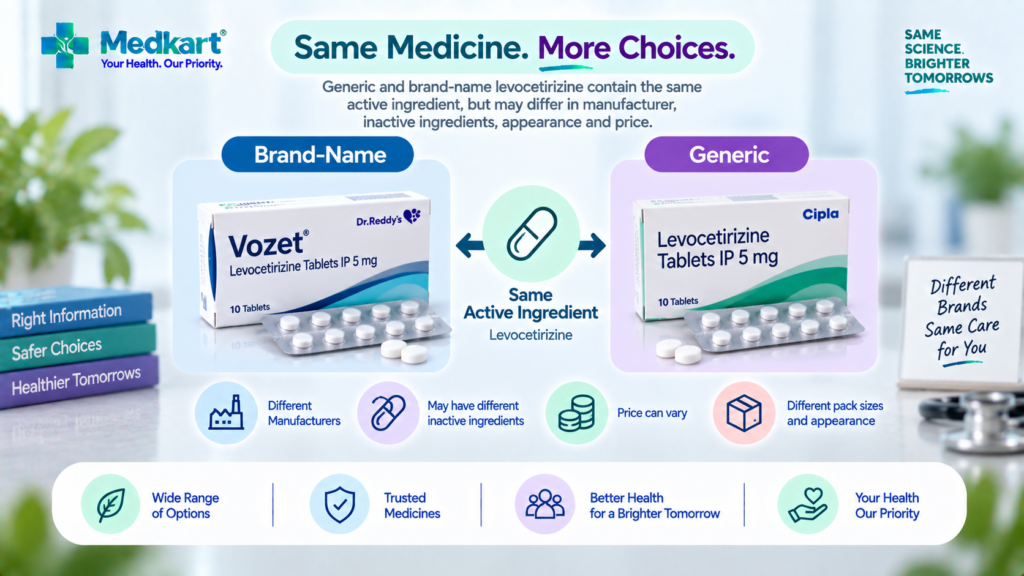
    Generic levocetirizine vs brand-name levocetirizine 

    Generic levocetirizine vs brand-name levocetirizine

    Generic and branded levocetirizine contain the same active ingredient. The US FDA[7] states that a generic medicine matches the brand-name medicine on active ingredient, strength, dosage form and route of administration, and is bioequivalent to it.

    The FDA adds that approved generics provide the same clinical benefit and risks as their brand-name counterparts. That is the U.S. FDA standard, and an India-specific regulatory source is needed before making the same claim about an Indian product.

    Products can still differ in manufacturer, inactive ingredients, appearance and price. The same active ingredient and strength alone do not prove that two products are interchangeable. A doctor or pharmacist should confirm any switch between brands.

    Buy or compare levocetirizine tablets on Medkart 

    Medkart sells levocetirizine products online in several brands and forms, and lists them as prescription items. Medkart states that the medicines it sells are sourced from WHO-GMP certified manufacturers.

    Medkart’s medicine comparison tool places products side by side, and the medicines index lists what is in stock. The details a reader can compare include:

    • Active ingredient
    • Strength
    • Dosage form
    • Manufacturer
    • Pack size
    • Current price

    Any suggested alternative should be discussed with a doctor or pharmacist before changing a prescribed medicine.

    Key takeaways 

    • Levocetirizine is an antihistamine that works by blocking the action of histamine.
    • Its approved uses include seasonal allergic rhinitis, perennial allergic rhinitis and chronic idiopathic urticaria.
    • Levocetirizine is listed at entry 285 in Schedule H of India’s Drugs Rules, 1945, which makes it a prescription drug.
    • A strength such as levocetirizine 5 mg is product information, not an instruction about how much to take.
    • Labelling gives 5 mg once daily in the evening for adults and children aged 12 and over, with smaller amounts for younger children.
    • Somnolence is the most commonly reported side effect, at 6 per cent in adults and adolescents.
    • Levocetirizine is substantially excreted by the kidneys, so reduced kidney function changes what is appropriate.
    • Generic and branded levocetirizine share the same active ingredient, but two individual products are not automatically interchangeable.

    FAQs: Common Questions About Levocetirizine 

    Q. How is levocetirizine different from cetirizine? 

    The sources used for this article do not compare the two directly. What the labelling does show is that they are treated as closely linked. DailyMed lists a known reaction to either one as a reason not to take levocetirizine. A doctor or pharmacist is the right person to ask which of the two suits a particular case.

    Q. What happens if a dose of levocetirizine is missed? 

    It depends on how close the next dose is. MedlinePlus says a missed dose should be taken as soon as it is remembered, but skipped if it is almost time for the next one. It advises returning to the regular schedule after that rather than taking two doses close together.

    Q. Can levocetirizine be taken with food? 

    Yes. MedlinePlus says levocetirizine can be taken with or without food. It also says to take it at the same time each day, which matters more for keeping the schedule steady than any particular meal does.

    Q. Is it safe to drink alcohol while taking levocetirizine? 

    It is better avoided. DailyMed advises against using alcohol or other central nervous system depressants alongside levocetirizine. The Xyzal Allergy 24HR label adds that alcohol, sedatives and tranquillisers increase drowsiness, which is the reason the combination is discouraged.

    Q. Can levocetirizine be taken for a long time? 

    That is a decision for the prescriber. MedlinePlus says levocetirizine should be taken exactly as directed, and not in larger amounts or more often than prescribed. It also notes that severe itching can develop after the medicine is stopped, particularly where it has been taken regularly for months or years.

    Q. What should someone do if too much levocetirizine is taken? 

    Get medical help. The Xyzal Allergy 24HR label says that in an overdose, medical help should be sought or a poison control centre contacted straight away. That instruction names a United States helpline, so in India the step is to contact a doctor, a pharmacist or a hospital.

    References 

    Medical disclaimer: This article provides general information and does not replace advice from a doctor or pharmacist. Levocetirizine is an antihistamine listed in Schedule H of India’s Drugs Rules, 1945, so levocetirizine products in India are prescription medicines. Brands with the same composition should only be substituted under the guidance of a healthcare professional or pharmacist because product details and approved indications can differ.

  • Jamun (Indian Blackberry): Uses, Benefits and Side Effects

    Jamun (Indian Blackberry): Uses, Benefits and Side Effects

    Jamun is the fruit of the tree Syzygium cumini. It is a small purple fruit, eaten fresh in season across India, and its leaves, seeds and bark have a long record of traditional use.

    Most of what is written about jamun concerns blood sugar. The research behind those claims is uneven, and it matters which part of the plant a given study used.

    What are the traditional uses of jamun? 

    Jamun’s Traditional Wellness Uses

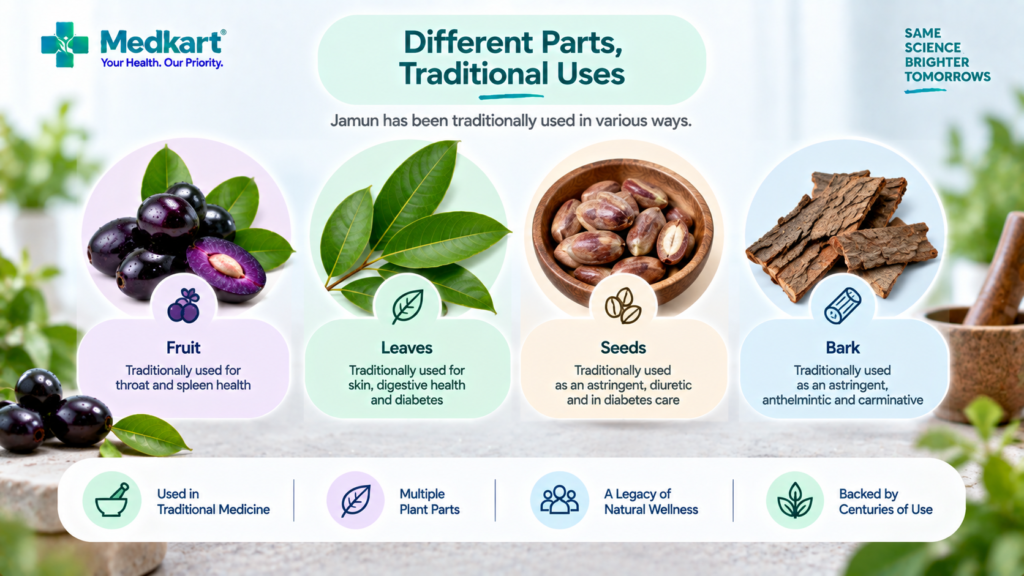
    Different parts of the plant have different traditional uses. A 2015 review in Frontiers in Pharmacology[1] records the leaves being used for skin complaints, digestive complaints, constipation and diabetes.

    The same review records the fruits being used for pharyngitis and disorders of the spleen, and the bark being used as an astringent, an anthelmintic and a carminative. It notes that the seeds are used as an astringent and a diuretic, and especially in the treatment of diabetes.

    A review of the genus Syzygium[2] records S. cumini being used for diarrhoea, dysentery, menorrhagia, asthma and ulcers. That review draws mainly on animal models rather than studies in people.

    What does jamun fruit contain? 

    Jamun’s Nutrient-Rich Goodness

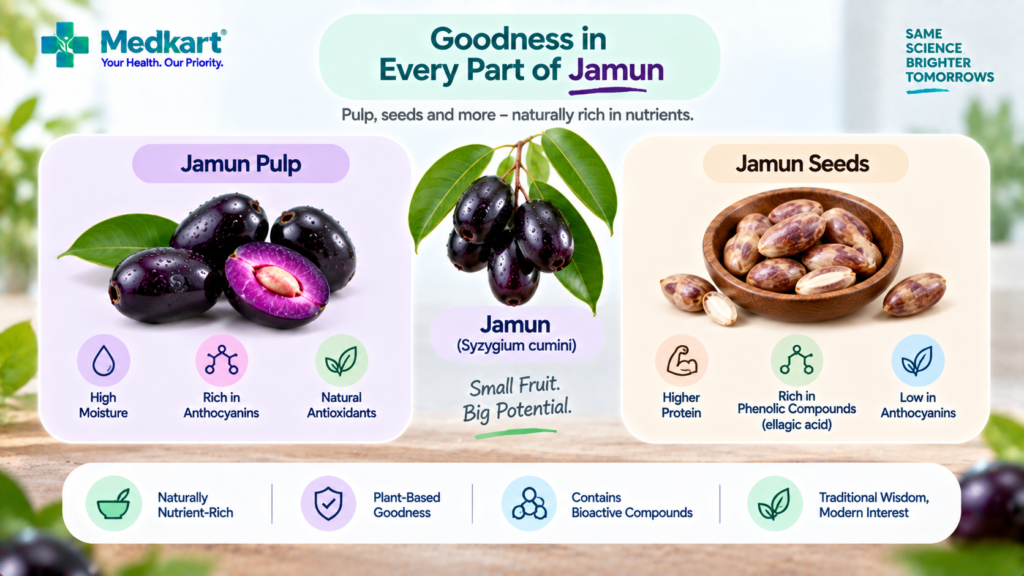
    The pulp and the seed are not the same thing. A 2020 laboratory study of jamun pulp and seed[3] separated the two and measured each.

    • Pulp: Reported at 83.51% moisture, with lower protein, lipid and carbohydrate content than the seed
    • Seed: Reported at 62.25% moisture, with 19.96% protein, 2.47% lipids and 14.95% carbohydrates
    • Phenolic compounds: Measured at 22.59 mg GAE per g in the seed against 1.56 mg GAE per g in the pulp
    • Anthocyanins: A study of anthocyanin-enriched jamun extracts[4] found malvidin, petunidin, delphinidin, cyanidin and peonidin in the pulp, and no anthocyanins in the seed

    The same anthocyanin study broke the pulp pigments down by proportion. It found malvidin at 44.4%, petunidin at 24.2%, delphinidin at 20.3%, cyanidin at 6.6% and peonidin at 2.2%. It also reported ellagic acid and ellagitannins at 0.5% in the seed against 0.17% in the pulp.

    A separate study on extracting anthocyanin from jamun pulp[5] reported a total monomeric anthocyanin content of 10.58 mg per 100 g under its optimised extraction conditions. That is an extraction result rather than a food label figure.

    Those numbers come from individual research papers, not from a national food composition table. Standard nutrient values for jamun would need an Indian food composition source.

    What does the evidence say about jamun and blood sugar? 

    Jamun and Blood Sugar

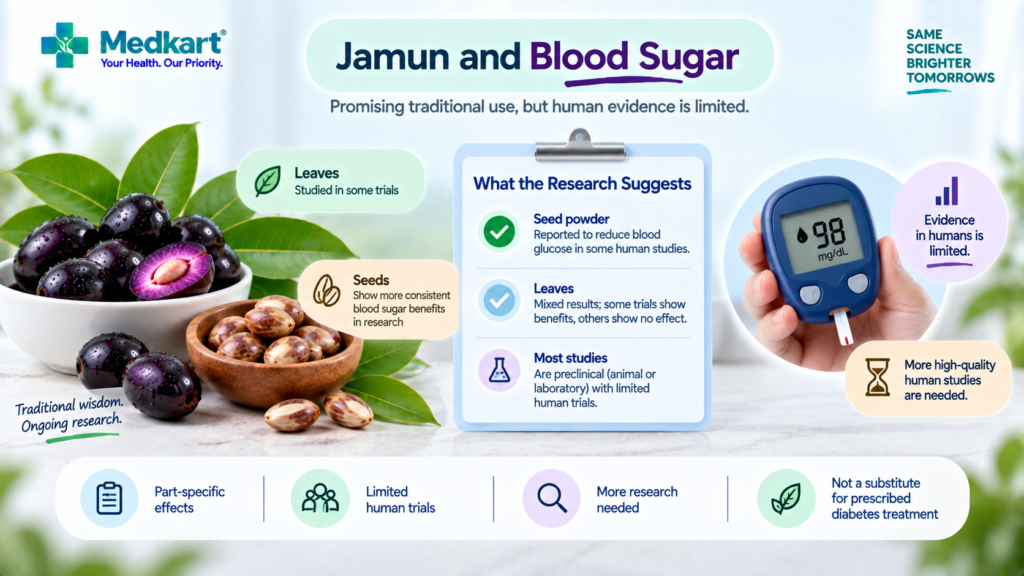
    The picture depends on which part was tested, and on whether the study was in people. The table below sets out what the retrieved sources report.

    What was tested What the evidence says
    Seed powder in people The 2015 review reports that capsuled seed powder given to patients with severe diabetes notably reduced blood glucose levels.
    Leaves in people The same review reports that a single dose of decocted dried leaves had no effect on serum glucose in young people with normal blood glucose.
    Leaves across trials A comprehensive review of guava and jamun leaves[6] reports reductions in fasting blood glucose across trials. It states the level of evidence is low, because of the small number of human studies and limitations including single-centre design, small sample sizes and poor methodological quality.
    Seed extract in animals The 2015 review describes reduced blood and urine glucose in diabetic rats given an ethanolic seed extract. Those are animal results.
    The fruit pulp The pulp research retrieved here is laboratory work on extracts, covering antioxidant and antimicrobial activity rather than blood glucose in people.

    The strongest human signal is for the seed, not for the fruit as it is eaten.

    What the research does not show 

    The clinical evidence is thin. The 2015 review states that very limited data has come from clinical trials, despite the accumulated knowledge on the pharmacological properties of the plant.

    Most of the remaining work is preclinical or laboratory based. The pulp and seed study tested extracts in vitro, and the review of the genus draws mainly on animal models.

    No source retrieved for this article sets an amount of jamun to take, a time of day to take it, or a length of time to continue. Those figures would need a pharmacopoeial or regulatory source.

    Also Read: What Is Shatavari? A Complete Guide to Its Uses and Health Benefits

    What side effects can jamun cause? 

    Use Jamun with Care

    The retrieved sources report little about side effects in people. The 2015 review states that S. cumini did not produce acute or chronic toxicity when given by mouth in the studies it surveyed.

    It describes rodent work in which a hydroalcoholic leaf extract at doses as high as 2 g per kg produced no toxic effects. In the same work, chronic treatment for up to 180 days at 50, 100 and 250 mg per kg caused no haematological, biochemical or histological changes in target organs.

    Those are animal findings. A record of side effects in people was not found in the sources retrieved for this article. Absence of a record is not the same as evidence of safety.

    Who should be careful with jamun? 

    Blood sugar is where the caution sits. The concern is not the fruit at a meal, but concentrated preparations taken alongside treatment.

    Situation What to do
    Taking diabetes medicines The 2015 review reports that seed powder reduced blood glucose in patients with severe diabetes. Anyone already taking glucose-lowering medicine should speak to a doctor before adding jamun preparations.
    Living with diabetes Blood glucose is the outcome most often studied with jamun. A doctor or pharmacist should be involved before it is used alongside prescribed treatment.
    Pregnancy or breastfeeding The sources retrieved for this article do not cover jamun in pregnancy or breastfeeding. That gap is itself a reason to ask a doctor first.
    Children The retrieved sources do not set an amount for children or report studies in them.
    Concentrated products Research used extracts and seed powder rather than the fruit as eaten. A product label and a pharmacist are the right guide for a concentrated preparation.

    If you take regular medicines, ask a pharmacist before adding a jamun preparation to them.

    Can jamun affect diabetes medicines? 

    It may. The 2015 review reports that capsuled seed powder reduced blood glucose in patients with severe diabetes, which is the same direction of effect as a glucose-lowering medicine.

    Where two things push blood glucose the same way, the combination is a question for a prescriber. It is not something to test at home by adding one to the other.

    The retrieved sources do not describe formal interaction studies between jamun and named medicines. That is a gap in the evidence rather than a reassurance.

    Where can you buy jamun products online? 

    Medkart does not sell jamun as a fresh fruit. It lists Ayurvedic preparations, and jamun appears among the ingredients of some of them.

    Ashtamrut SF Diabetes Juice lists jamun, given as Syzygium cumini, among its key ingredients alongside karela, methi and amla. The Ayurvedic products category and the Ayurvedic composition listing show what is stocked. Medkart states that the medicines it sells are sourced from WHO-GMP certified manufacturers.

    Medkart’s medicine comparison tool places products side by side, and the medicines index lists what is in stock. The details a reader can compare include:

    • Active ingredient
    • Strength
    • Dosage form
    • Manufacturer
    • Pack size
    • Current price

    An Ayurvedic preparation taken alongside prescribed treatment should be discussed with a doctor or pharmacist first.

    Key takeaways 

    • Jamun is the fruit of Syzygium cumini, known in English as the Indian blackberry.
    • Traditional use covers the leaves, seeds, fruit and bark, with the seed most associated with diabetes.
    • Laboratory work reports anthocyanins in the pulp and a much higher phenolic content in the seed.
    • Human evidence on blood sugar comes mainly from seed powder and leaves, not from the fruit as it is eaten.
    • A review of guava and jamun leaves rates the level of evidence as low.
    • A 2015 review states that very limited data has come from clinical trials.
    • No source retrieved for this article sets an amount of jamun to take or how long to take it.
    • Anyone taking diabetes medicine should speak to a doctor before adding jamun preparations.

    FAQs: Common Questions About Jamun 

    Q. What else is jamun called? 

    It has several names. The 2015 review gives jamun as the Indian name, black plum as the European one, jambolan in Spanish-speaking countries and jambolão in Brazil. The botanical name is Syzygium cumini, and older papers sometimes use Eugenia jambolana for the same plant.

    Q. Does eating the fruit do the same as the seed powder used in studies? 

    There is no evidence retrieved here that equates the two. The human results in the 2015 review come from capsuled seed powder, which is a concentrated preparation of a different part of the plant. Eating the fruit in season is not the same intervention, and no source retrieved for this article measured it that way.

    Q. Is the seed more active than the pulp? 

    By the laboratory measures used, yes. The study of anthocyanin-enriched extracts reported antioxidant capacity of 3,379 trolox equivalents per gram for the seed against 1,445 for the pulp. The 2020 study found total phenolic compounds far higher in the seed than in the pulp, though both figures come from laboratory assays rather than from people.

    Q. Can jamun replace a diabetes medicine? 

    No. Nothing in the sources retrieved for this article supports using jamun in place of prescribed treatment, and the reviews describe the clinical evidence as limited. A prescribed medicine should only be stopped or changed on the advice of the prescriber.

    Q. Why do laboratory results not always apply to people? 

    Because a compound that acts in a dish or in a rat may behave differently in the body. The reviews retrieved here make that point about jamun directly, describing the human data as very limited and rating the level of evidence as low. That is why the study type matters as much as the finding.

    Q. Is jamun safe to eat as an ordinary fruit? 

    It is eaten as a seasonal fruit across India, and the toxicity work described in the 2015 review found no acute or chronic toxicity by mouth in animals. The retrieved sources do not raise a concern about the fruit as food. Concentrated preparations are a separate question, and one for a pharmacist.

    References 

    Medical disclaimer: This article gives general information only. It does not replace advice from a doctor or pharmacist. No medicine or supplement should be started, stopped or changed without advice from the prescriber or a qualified pharmacist.

  • Ibuprofen: Uses, Dosage, Side Effects and Precautions

    Ibuprofen: Uses, Dosage, Side Effects and Precautions

    Ibuprofen is the generic name of a painkiller that also reduces inflammation. It is a prescription medicine in India, sold under several brand names as tablets and as a liquid.

    Those products are made by different companies. The active ingredient is the same across them, but the strength, pack size and price are not.

    What is ibuprofen? 

     How Ibuprofen Works


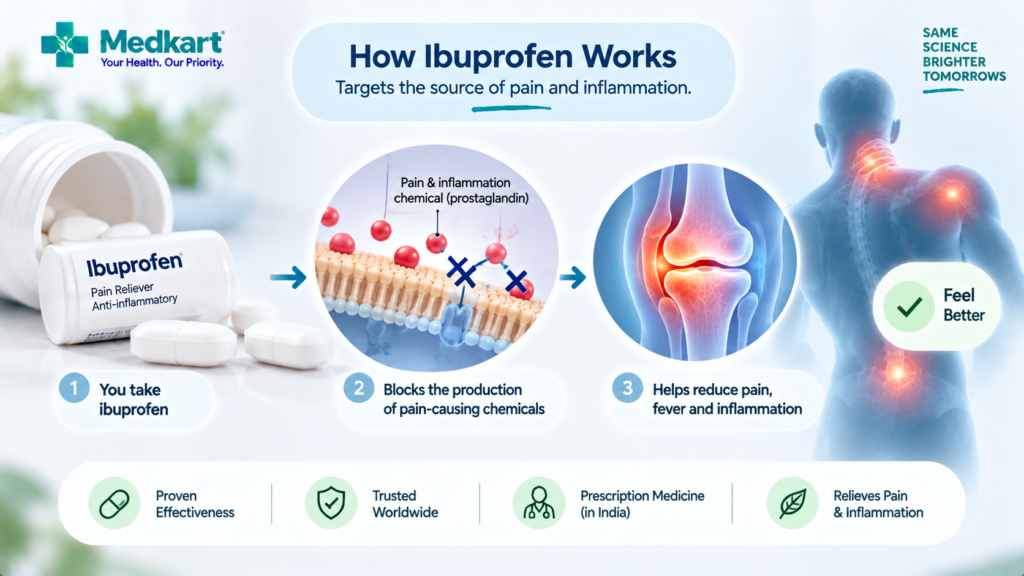
    Ibuprofen is a non-steroidal anti-inflammatory drug. MedlinePlus[1] explains that it works by stopping the body’s production of a substance that causes pain, fever and inflammation.

    The NHS[2] describes it as a painkiller that also reduces swelling and inflammation. It lists tablets and capsules, gels and sprays, liquid, and granules among the forms sold.

    Its status in India is set by the Drugs Rules, 1945[3]. Ibuprofen appears at entry 244 in Schedule H, the schedule of prescription drugs. Rule 97 requires the pack to carry the symbol Rx and a warning against retail sale without a doctor’s prescription.

    What are the main ibuprofen uses? 

    ibuprofen uses


    Ibuprofen is used for pain, fever and inflammation. The NHS names headaches and migraines, joint and muscle pain, pain after an injury, toothache, period pain and a high temperature.

    DailyMed’s prescribing information[4] lists three approved uses for the tablets. They are relief of the signs and symptoms of rheumatoid arthritis and osteoarthritis, relief of mild to moderate pain, and treatment of primary dysmenorrhoea.

    MedlinePlus separates prescription ibuprofen, used for arthritis pain and for mild to moderate pain, from non-prescription ibuprofen, used to reduce fever and relieve minor aches. That split describes United States products. In India ibuprofen sits in Schedule H, so that non-prescription category does not apply.

    Popular brands containing ibuprofen 

    Several ibuprofen brands are sold in India. The company names below are those shown on the Medkart listing for each pack.

    Brand Name Active Ingredient Available Strengths / Forms* Manufacturer / Company
    Brufen 200 Ibuprofen 200 mg tablets Abbott Health Care Private Limited
    Brufen 400 Ibuprofen 400 mg tablets Abbott Health Care Private Limited
    Ibugesic 200 Ibuprofen 200 mg tablets Cipla Pharmaceutical Company Limited
    Ibugesic RTU Ibuprofen oral solution Cipla Pharmaceutical Company Limited
    Ibuprofen Ibuprofen 400 mg tablets Torque Pharmaceuticals Pvt Ltd

    Examples of listed strengths and forms, not a complete catalogue. Product ranges can change.

    Availability and pack size differ between products. The range sold under any one brand can change.

    Ibuprofen composition and available strengths 

    Ibuprofen composition

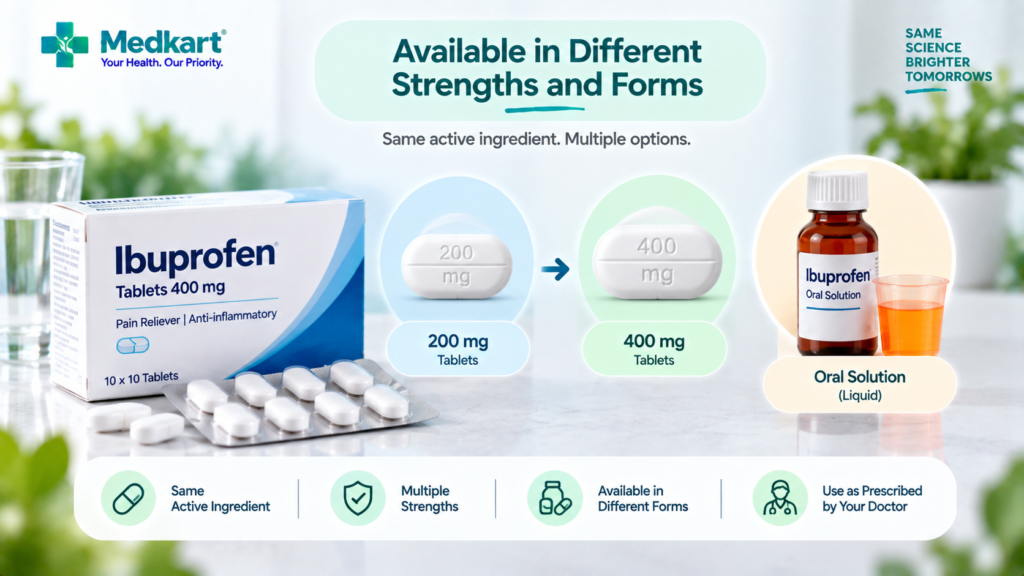
    Ibuprofen tablets are commonly sold at strengths of 200 mg and 400 mg. NHS guidance on how and when to take ibuprofen[5] describes both strengths as tablets and capsules, alongside gel, spray, liquid and granules.

    DailyMed’s prescribing information describes prescription tablets at 400 mg, 600 mg and 800 mg. Those higher strengths belong to a United States label, not to Indian products.

    A strength such as ibuprofen 400 mg describes the amount of active ingredient in that product. It is product information, not a dosing instruction.

    Medkart’s listings for ibuprofen 400 mg and ibuprofen 200 mg show tablets and an oral solution among the forms stocked.

    Also Read: Ibugesic Plus: Dosage Instructions, Benefits & Side Effects

    How is ibuprofen dosage decided? 

    There is no one dose that applies to every ibuprofen prescription. The condition, the strength and the length of treatment all come into it.

    DailyMed’s prescribing information gives 400 mg every four to six hours as needed for mild to moderate pain. For rheumatoid arthritis and osteoarthritis it gives 1,200 to 3,200 mg a day, with 3,200 mg as the maximum. It also says to use the lowest effective dose for the shortest duration.

    The NHS describes smaller amounts for the pharmacy strengths. It gives one or two 200 mg tablets up to three times a day, or one 400 mg tablet up to three times a day. It also asks for at least four hours between doses.

    Those two sets of figures describe different products in different countries. MedlinePlus advises swallowing the tablet whole rather than chewing or crushing it. What applies to one person is a decision for the prescriber.

    What are the common ibuprofen side effects? 

     ibuprofen side effects

    Stomach upset is the most commonly reported problem. NHS guidance on ibuprofen side effects[6] lists indigestion and stomach aches, feeling sick or being sick, headaches, a rash, dizziness, and diarrhoea or constipation.

    MedlinePlus lists constipation, wind, bloating, dizziness, nervousness and ringing in the ears among its common effects.

    The NHS lists serious effects that need urgent attention, including:

    • Stomach ulcers or bleeding, with tummy pain, vomiting blood, or stools that are black and tar-like
    • Kidney problems, with blood in the urine or swelling of the ankles, feet or hands
    • Shortness of breath or unusual paleness
    • A swollen throat or tongue, a raised itchy rash, or difficulty breathing

    The NHS states that the risk of serious side effects is higher on a high dose, or when ibuprofen is taken for a long time.

    Why the stomach and heart warnings matter 

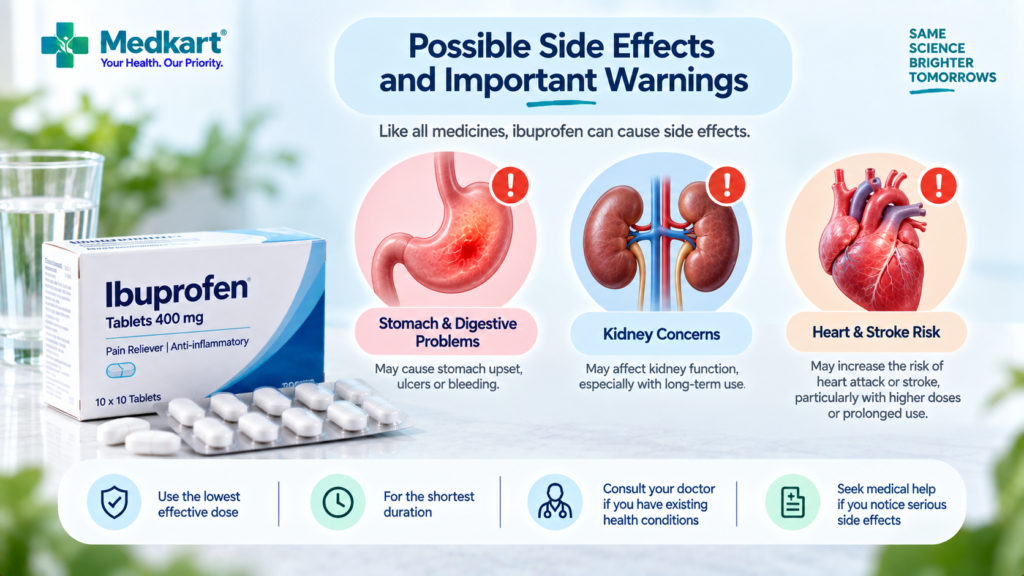
    Ibuprofen belongs to a drug class that carries two standing warnings. MedlinePlus states that people who take NSAIDs other than aspirin may have a higher risk of a heart attack or a stroke than people who do not take them.

    The same warning says NSAIDs such as ibuprofen may cause ulcers, bleeding, or holes in the oesophagus, stomach or intestine. DailyMed carries both points as a boxed warning, and adds that gastrointestinal bleeding can happen at any time during use and without warning symptoms.

    MedlinePlus notes that the risk is higher with long-term use, higher doses, older age, smoking and drinking alcohol. DailyMed adds that the cardiovascular risk may increase with the duration of use.

    Who should not take ibuprofen? 

    Several groups are told not to take it at all. NHS guidance on who can and cannot take ibuprofen[7] says most adults can use it, and then sets out the situations where it is not suitable.

    Situation What to do
    A past reaction to aspirin or an NSAID The NHS lists a previous allergic reaction to ibuprofen, aspirin or another NSAID among the situations where ibuprofen is not suitable. DailyMed contraindicates it in anyone with a history of asthma, hives or allergic reactions after aspirin or an NSAID.
    A stomach ulcer, now or in the past The NHS lists a current or past stomach ulcer among the situations where ibuprofen is not suitable. DailyMed’s boxed warning covers bleeding, ulceration and perforation of the stomach or intestines.
    Heart, liver or kidney conditions The NHS lists all three among the situations where ibuprofen is not suitable. DailyMed warns that NSAIDs can bring on or worsen high blood pressure, and that long-term use can injure the kidneys.
    Pregnancy or trying to conceive The NHS lists both among the situations where ibuprofen is not suitable. MedlinePlus advises avoiding ibuprofen at around 20 weeks of pregnancy and later.
    Heart bypass surgery DailyMed contraindicates ibuprofen for pain around the time of coronary artery bypass graft surgery.
    Other regular medicines The NHS says to check with a doctor or pharmacist before taking ibuprofen alongside anticoagulants, steroid medicines, antidepressants or blood pressure medicines.

    The NHS also says anyone who is breastfeeding should check with a pharmacist or doctor before using ibuprofen.

    Generic ibuprofen vs brand-name ibuprofen 

    Generic ibuprofen vs brand-name ibuprofen

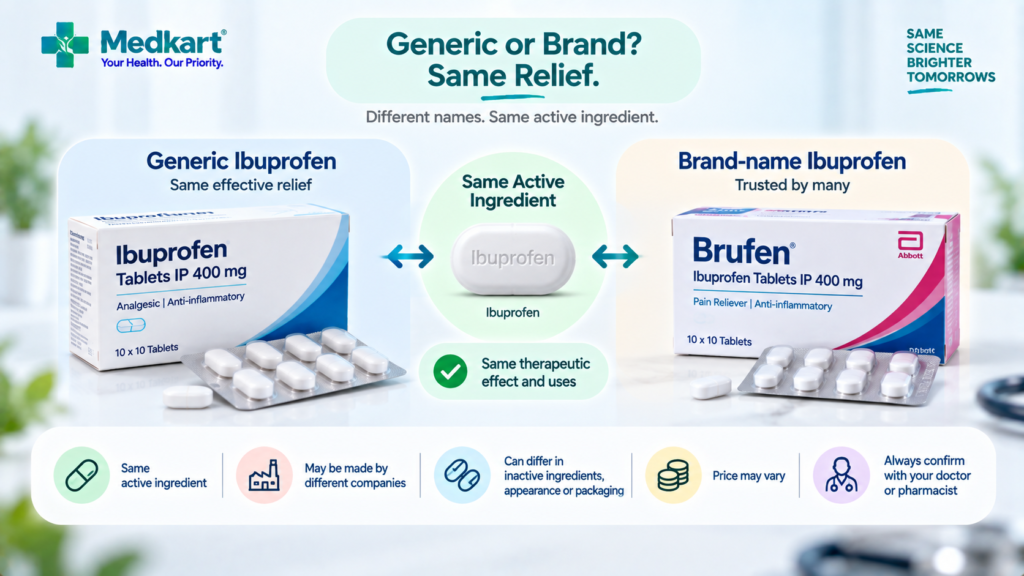
    Generic and branded ibuprofen contain the same active ingredient. The US FDA[8] states that a generic medicine matches the brand-name medicine on active ingredient, strength, dosage form and route of administration, and is bioequivalent to it.

    The FDA adds that approved generics provide the same clinical benefit and risks as their brand-name counterparts. That is the U.S. FDA standard, and an India-specific regulatory source is needed before making the same claim about an Indian product.

    Products can still differ in manufacturer, inactive ingredients, appearance and price. The same active ingredient and strength alone do not prove that two products are interchangeable. A doctor or pharmacist should confirm any switch between brands.

    Buy or compare ibuprofen tablets on Medkart 

    Medkart sells ibuprofen products online in several brands and pack sizes, including Brufen 400 mg in a pack of 15, and lists them as prescription items. Medkart states that the medicines it sells are sourced from WHO-GMP certified manufacturers.

    Medkart’s medicine comparison tool places products side by side, and the medicines index lists what is in stock. The details a reader can compare include:

    • Active ingredient
    • Strength
    • Dosage form
    • Manufacturer
    • Pack size
    • Current price

    Any suggested alternative should be discussed with a doctor or pharmacist before changing a prescribed medicine.

    Key takeaways 

    • Ibuprofen is a non-steroidal anti-inflammatory drug used for pain, fever and inflammation.
    • Ibuprofen is listed at entry 244 in Schedule H of India’s Drugs Rules, 1945, which makes it a prescription drug.
    • A strength such as ibuprofen 400 mg is product information, not an instruction about how much to take.
    • Indigestion and stomach ache are among the most commonly reported side effects.
    • NSAIDs other than aspirin carry a stated risk of heart attack and stroke.
    • The same class can cause ulcers, bleeding or perforation in the stomach or intestine, sometimes without warning symptoms.
    • The risk of serious effects rises with higher doses, longer use, older age, smoking and alcohol.
    • A past reaction to aspirin or an NSAID, a stomach ulcer and pregnancy are among the reasons ibuprofen is not suitable.

    FAQs: Common Questions About Ibuprofen 

    Q. Can ibuprofen be taken at the same time as paracetamol? 

    For adults, yes. NHS guidance on common questions about ibuprofen[9] says adults can take ibuprofen at the same time as paracetamol if needed. It adds that it is worth trying them separately first, to see whether one alone relieves the pain. That advice covers two different medicines, not two NSAIDs, which the NHS advises against combining.

    Q. How long can ibuprofen be taken for? 

    Not long without advice. The NHS says ibuprofen tablets and capsules should not be taken for more than 10 days unless a doctor advises it. It also says the smallest dose needed should be taken for the shortest time needed. Pain still there after that point is a reason to see a doctor.

    Q. Should ibuprofen be taken with food? 

    Yes. MedlinePlus advises taking ibuprofen with food to prevent stomach upset. The NHS says tablets and capsules should be swallowed with water, ideally with or after food. Neither source presents food as a substitute for the drug class precautions.

    Q. What happens if too much ibuprofen is taken? 

    It can be dangerous. The NHS advises getting advice when more than the recommended amount has been taken, because an ibuprofen overdose can sometimes cause harm. The right step is to contact a doctor, a pharmacist or a hospital straight away rather than waiting to see what develops.

    Q. Can ibuprofen be given to a child? 

    That is a decision for a doctor. MedlinePlus describes non-prescription ibuprofen being given to children and infants every six to eight hours, with no more than four doses in 24 hours. Those directions describe United States products, and the NHS keeps its advice for children on a separate page. In India ibuprofen is a Schedule H medicine, so a prescriber decides whether a child takes it at all.

    Q. Do ibuprofen gels and sprays carry the same risks as the tablets? 

    They are less likely to cause side effects. NHS guidance on ibuprofen side effects says side effects are less likely with the gel or spray than with tablets, capsules, liquid or granules. That is a statement about likelihood, not a claim that the skin preparations carry no risk. A pharmacist can say which form suits a situation.

    References 

    Medical disclaimer: This article provides general information and does not replace advice from a doctor or pharmacist. Ibuprofen is a non-steroidal anti-inflammatory drug listed in Schedule H of India’s Drugs Rules, 1945, so ibuprofen products in India are prescription medicines. Brands with the same composition should only be substituted under the guidance of a healthcare professional or pharmacist because product details and approved indications can differ.

  • Chamomile Tea: Benefits, Uses, How to Make It and Side Effects

    Chamomile Tea: Benefits, Uses, How to Make It and Side Effects

    Chamomile tea is an infusion made by pouring boiling water over the dried flower heads of the chamomile plant. In India the plant is a permitted nutraceutical ingredient, and in Europe the flower is a registered traditional herbal medicine.

    The plant behind almost all of it is Matricaria recutita, also written Matricaria chamomilla and known as German chamomile. Most human trials on chamomile tested a concentrated extract in a capsule rather than the drink.

    What is chamomile tea? 

    Chamomile tea

    Chamomile tea is an infusion of dried chamomile flower heads in hot water. The European Medicines Agency[1] defines the herbal substance as Matricaria recutita L., flos, meaning the flower and no other part of the plant.

    What people use it for is broader than what it is registered for. The National Center for Complementary and Integrative Health[2] lists the common cold, indigestion, anxiety and insomnia among the things chamomile is promoted for.

    What are the benefits and uses of chamomile tea? 

    benefits and uses of chamomile tea

    The EMA recognises chamomile flower for a small set of minor complaints, and only as a traditional herbal medicine.

    Only one of the five registered uses involves drinking the infusion. The others are a mouth rinse, a skin wash, a local irrigation and a steam inhalation.

    Use What the evidence says
    Minor digestive complaints The EMA registers the flower, taken by mouth as an infusion, for minor gastro-intestinal complaints such as bloating and minor spasms. The registration rests on long-standing use, not on trial results.
    Anxiety A trial in the Journal of Clinical Psychopharmacology[3] randomised 57 outpatients with mild to moderate generalised anxiety disorder to a standardised extract or placebo for eight weeks. Anxiety scores fell further on chamomile, at p equal to 0.047. The trial used capsules, not tea.
    Mouth and throat The EMA registers an infusion of 1 to 5 g in 100 ml of water for minor ulcers and inflammation of the mouth and throat, used for rinsing and gargling rather than swallowed.
    Skin and sunburn It also registers the flower for minor skin inflammation including sunburn, superficial wounds and small boils, applied as a wash or an impregnated dressing.
    Common cold For cold symptoms the monograph gives 3 to 10 g in 100 ml of hot water as a steam inhalation, which is not a drinking use.

    Does chamomile tea help with weight loss? 

    No. Weight is not among the uses the EMA registers. A 2021 review of chamomile in obesity and metabolic syndrome[4] states that no clinical trials of chamomile in the management of obesity were available to its authors.

    The review describes laboratory and animal work on carbohydrate digestion and energy metabolism instead. Its authors treat chamomile as a promising candidate, while noting that any effect is likely to be moderate because plant polyphenols are poorly absorbed when swallowed.

    How do you make chamomile tea? 

    chamomile tea Making Tips

    As an infusion. The EMA’s patient leaflet template for herbal teas[5] sets out the method in standard terms.

    Boiling water is poured over the flowers, and the tea is left to steep for a set period, usually 5 to 15 minutes where nothing else is specified. The vessel is kept covered with a lid and stirred at intervals. The liquid is then strained through a tea strainer.

    The same document notes that infusion suits leaves, flowers and delicate plant parts, while roots and barks are simmered or soaked instead.

    What is the recommended dosage of chamomile tea? 

    There is no one amount that applies to everyone. For the flower brewed as a tea, the monograph gives adolescents, adults and the elderly a single dose of 1.5 to 4 g in 150 ml of boiling water. It puts the frequency at 3 to 4 times a day.

    Smaller single doses are set out for children, taken 2 to 4 times a day:

    • 6 months to 2 years: 0.5 to 1.0 g
    • 2 to 6 years: 1.0 to 1.5 g
    • 6 to 12 years: 1.5 to 3.0 g

    A weight printed on a pack of tea bags describes how much flower each bag holds. It is product information, not an instruction about how much to drink.

    India regulates the ingredient rather than the brew. The Food Safety and Standards Authority of India[6] lists Matricaria chamomilla as a permitted nutraceutical ingredient in Schedule VI, Part B. The entry covers an aerial parts extract, sets no daily range, and describes a manufactured product rather than flowers brewed at home.

    When should you drink chamomile tea? 

    No source retrieved for this article gives a best time of day. The monograph sets a frequency of 3 to 4 times daily and says nothing about morning or evening.

    Does chamomile tea help with sleep? 

    Sleep is why people ask, and the sources disagree.

    The NCCIH reports that a 2019 review found only one insomnia study, and that it showed no benefit. A pilot trial in BMC Complementary and Alternative Medicine[7] gave 34 adults with chronic primary insomnia 270 mg of chamomile extract twice daily for 28 days. Total sleep time and sleep efficiency did not differ significantly from placebo, though time to fall asleep shortened by about 16 minutes.

    A trial in the Journal of Education and Health Promotion[8] found the opposite. Seventy-seven nursing home residents aged over 60 took 400 mg capsules twice daily, after lunch and after dinner, for four weeks. Sleep quality scores improved against the control group, and the authors name the absence of blinding and of a placebo group among the study’s limits.

    All three used capsules of extract, so their schedules are not schedules for a cup of tea.

    Also Read: Ashwagandha for Men: Benefits for Energy, Strength & Hormones

    How long can you drink chamomile tea? 

    The EMA sets a checkpoint rather than a maximum. If symptoms last more than one week, the monograph says a doctor or a qualified health care practitioner should be consulted. The same applies if symptoms get worse.

    No source retrieved for this article sets a limit on chamomile drunk as an ordinary beverage.

    What side effects can chamomile tea cause? 

     chamomile tea side effects

    Allergic reactions are the effect the sources single out. The EMA records hypersensitivity reactions, including severe ones, and puts their frequency at not known.

    Among the severe reactions it names breathlessness, Quincke’s disease, vascular collapse and anaphylactic shock. These were reported after mucosal contact with liquid chamomile preparations.

    The NCCIH describes chamomile as likely safe by mouth in the amounts commonly found in teas and other foods. It lists nausea, dizziness and allergic reactions as uncommon effects. The EMA adds that no case of overdose has been reported.

    Who should be careful with chamomile tea? 

    The clearest case is an allergy to plants in the daisy family. Four other situations call for care.

    Situation What to do
    An allergy to daisies, marigolds or ragweed The EMA contraindicates chamomile in anyone with hypersensitivity to it or to other plants of the Asteraceae family. The NCCIH notes that reactions are more likely in people allergic to ragweed, chrysanthemums, marigolds or daisies.
    Pregnancy and breastfeeding The sources disagree. The EMA states that safety during pregnancy and lactation has been established for the comminuted flower used as a tea, but not for the extracts, whose use it does not recommend. The NCCIH says little is known about either.
    Babies under six months The EMA has not established oral use of the herbal tea below six months of age, on general grounds of nutrition and fluid intake.
    Regular prescribed medicines Interactions have been reported for concentrated preparations. A pharmacist should be told what is being taken before chamomile becomes a daily habit.
    Hormonal contraception The NCCIH notes that chamomile may have oestrogen-like effects, and that these might reduce the effectiveness of birth control pills.
    Breathlessness, swelling or faintness after drinking it The EMA lists these among reported severe reactions. They call for stopping the tea and getting medical help the same day.

    Can chamomile tea interact with medicines? 

    Possibly, and what has been reported involves concentrated preparations rather than a cup. The EMA reports interactions based on effects on CYP450 in patients after kidney transplantation who took high doses for about two months. For skin, mouth, inhalation and bath use it reports none.

    The NCCIH reports interactions between chamomile and warfarin, a blood thinner, and with some medicines that the liver breaks down.

    Neither source describes an interaction study on chamomile tea at ordinary drinking strength.

    Where can you buy chamomile tea online? 

    Medkart is a pharmacy, so chamomile appears there mostly as an ingredient inside a formulated product.

    Periods Care tea bags from Taparia Tea Company name chamomile among their herbs. On the skin side, Dermsilk cream from Cure N Cure Pharmaceutical and Urtiplex lotion from Charak Pharmaceuticals both list chamomile extract. So does Gentle Baby Shampoo from Himalaya Wellness.

    The Ayurvedic products category and the Ayurvedic composition listing show the wider herbal range. Availability, pack size and price differ between products and can change.

    Medkart states that the medicines it sells are sourced from WHO-GMP certified manufacturers. Medkart’s medicine comparison tool places products side by side, while the medicines index and the search page show what is in stock. Points worth comparing on a herbal pack include:

    • Botanical name of the plant
    • Whether the pack is pure chamomile or a blend
    • Weight of flower per bag
    • Manufacturer
    • Pack size

    Chamomile products are sold without a prescription, so a doctor or pharmacist should be told before one joins a set of regular medicines.

    Key takeaways 

    • Chamomile tea is an infusion of the dried flowers of Matricaria recutita, known as German chamomile.
    • The EMA registers it as a traditional herbal medicine, which means the use rests on long-standing use rather than trials.
    • Only one of its five registered uses is a drink, for minor digestive complaints such as bloating and spasms.
    • The monograph gives adults a single dose of 1.5 to 4 g in 150 ml of boiling water, 3 to 4 times a day.
    • An infusion is steeped for 5 to 15 minutes under a lid, then strained.
    • No source retrieved for this article gives a best time of day to drink it.
    • The sleep and anxiety trials used capsules of concentrated extract, not the tea.
    • Allergy is the main reported risk, and it is more likely in people who react to daisies, marigolds or ragweed.

    FAQs: Common Questions About Chamomile Tea 

    Q. Is the chamomile in a tea bag the same as the chamomile in a capsule? 

    No, and the difference matters more than it looks. A tea bag holds the dried flower, while a capsule holds an extract concentrated many times over. The EMA treats them as separate preparations with separate amounts, and reaches different conclusions about them in pregnancy.

    Q. Why does the water need to be boiling? 

    For hygiene as much as for flavour. The EMA’s leaflet template notes that boiling water lowers the microbial load carried by dried plant material, which is not sterile. Water that has gone off the boil does less to that load.

    Q. Can brewed chamomile tea be kept and drunk later? 

    For a short while, and cold. The same EMA template says a herbal infusion should be drunk soon after it is made, and otherwise kept covered in the fridge for no more than 24 hours. A pot left standing at room temperature all day falls outside that advice.

    Q. Is German chamomile the same as Roman chamomile? 

    They are different plants sold under a shared name. The EMA monograph and the FSSAI listing both name Matricaria recutita, and the NCCIH says chamomile refers primarily to German chamomile. No source retrieved for this article covers Roman chamomile, so nothing here should be assumed to apply to it.

    Q. Can chamomile tea replace a prescribed medicine for anxiety or sleep? 

    No. The anxiety trial tested a standardised extract in people with mild to moderate symptoms, and its authors said the findings do not extend to severe cases. The registered use for the drink covers minor digestive complaints and nothing more. Any change to prescribed treatment is a decision for the prescriber.

    Q. Do loose flowers and tea bags need different handling? 

    Slightly. The EMA notes that herbal teas come both loose and in sachets, and gives each a different final step. Loose flowers are stirred and strained, with the residue pressed to yield more liquid. A sachet is gently squeezed instead.

    References 

    Medical disclaimer: This article gives general information only. It does not replace advice from a doctor or pharmacist. No medicine or supplement should be started, stopped or changed without advice from the prescriber or a qualified pharmacist.
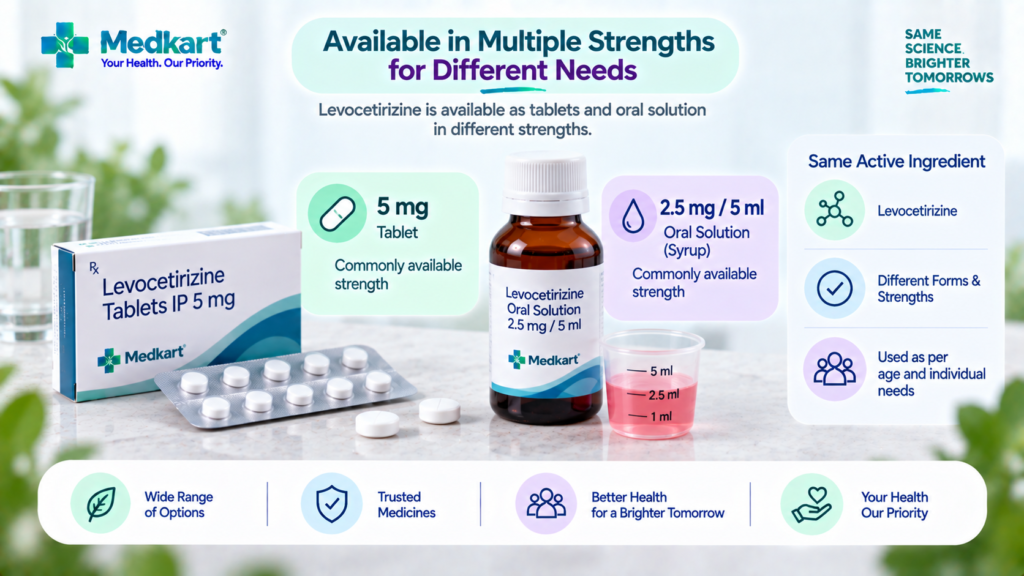
  • Gond Katira: Benefits, Uses, Side Effects and How to Take It

    Gond Katira: Benefits, Uses, Side Effects and How to Take It

    Gond katira is a dried gum that seeps from the stems of certain trees and shrubs, hardens into pale lumps, and swells a great deal when it meets water. It is sold loose in Indian shops and used to thicken food.

    The name causes more trouble than the gum does. Indian food standards recognise two different exuded gums with overlapping common names, different botanical sources and different identity numbers. Which one sits in a given packet is a question only the label can answer.

    What is gond katira? 

    A dried gum exuded from a tree or shrub. Which one depends on the pack, because Indian food standards[1] specify each of the two separately.

    • Tragacanth gum, INS 413: the dried gummy exudation of Astragalus strobiliferus or other species of Astragalus, family Leguminosae. The standard describes translucent, horny pieces 0.5 to 2.5 mm thick, white to pale yellow, odourless, with an insipid mucilaginous taste.
    • Gum karaya, INS 416: the dried gummy exudation from the stems and branches of Sterculia urens and Sterculia villosa, family Sterculiaceae. The standard lists its common names as karaya, gum karaya, sterculia, gum sterculia, kadaya, katilo, kullo and kuterra.

    The two come from different places. The EFSA panel that re-evaluated tragacanth[2] records its collection in Iran, Syria, Turkey and southwest Asia. The panel that re-evaluated karaya gum[3] records that Sterculia urens grows widely throughout the Indian subcontinent.

    Among the requirements tragacanth gum must meet is a karaya gum test.

    No source retrieved for this article establishes which of the two a packet labelled gond katira holds. The botanical name on the pack settles it.

    What are the benefits and uses of gond katira? 

    gond katira benefits and uses

    Both gums do two jobs: they thicken food and add bulk to stool.

    Use What the evidence says
    Constipation The patient leaflet for a licensed sterculia medicine[4] describes the gum as a dietary fibre that relieves constipation. EFSA records bulk-forming laxative use of karaya gum at up to 12 g a day for adults.
    A high-fibre diet The same leaflet lists use by people who need a high fibre diet, for example in diverticular disease of the colon, and by people with a colostomy or an ileostomy.
    After rectal or anal surgery The leaflet lists this use, alongside use by someone who has swallowed something sharp, to reduce the chance of damage to the gut.
    Thickening and stabilising food Both EFSA opinions describe these gums as food additives used to thicken and stabilise.
    Cooling the body in summer No source retrieved for this article tests this use, which is the most common reason the gum is bought in India.

    What is the nutritional value of gond katira? 

    Very little, and that is rather the point. Both gums are large carbohydrate molecules that mostly pass through.

    EFSA states that karaya gum is practically undigested, is not fermented by gut bacteria, and is most probably not absorbed unchanged in humans. It describes tragacanth as unlikely to be absorbed intact.

    On composition, the tragacanth opinion puts protein at about 2 per cent, within a range of 0.5 to 3.4 per cent. Its sugar units vary widely between species, with arabinose from 1 to 51 per cent and galacturonic acid from 9 to 37 per cent.

    A full nutrient profile is missing. No Indian food composition source and no United States FoodData Central entry could be retrieved for gond katira, so figures for energy, fat or vitamins are not given here.

    How do you use gond katira? 

    How do you use gond katira

    With plenty of liquid, and never dry. The licensed sterculia product’s leaflet is the clearest retrieved instruction.

    It says the dry granules are placed on the tongue from the sachet, a spoon or the hand, or sprinkled onto soft food such as yoghurt. They are swallowed with plenty of water or a cool drink, and never chewed or crushed. They are taken after meals, and not just before bed or while lying down.

    The reason sits in the swelling. EFSA records that karaya gum absorbs water and swells to more than 60 times its original volume, increasing about tenfold within the first hour. The NHS[5] advises drinking plenty of fluids with any bulk-forming laxative.

    No retrieved source describes soaking loose gum overnight and drinking it, which is the preparation gond katira is best known for in India.

    Also Read: Top 10 High Fiber Rich Foods for Better Digestion, Weight Loss & Overall Health

    What is the recommended dosage of gond katira? 

    There is no published dose for loose gum. What exists is a dose for a licensed product built on the same gum.

    The leaflet gives adults and the elderly 1 to 2 sachets, or 1 to 2 heaped 5 ml spoonfuls, once or twice a day after meals. That product is 62 per cent sterculia by weight, so the figure describes the granules rather than pure gum.

    Tolerance studies give a sense of scale rather than a dose. EFSA reports 9,900 mg of tragacanth daily for 21 days without adverse effects in five volunteers. For karaya gum it reports 7,000 to 10,500 mg daily tolerated by most people. Abdominal discomfort appeared in seven of 89 volunteers taking 7,000 mg a day for four weeks.

    A weight printed on a bag of gum is product information, not an instruction about how much to take.

    How long can you take gond katira? 

    Not long without checking. The sterculia leaflet says that if the product has not worked after four days, it should be stopped and a doctor or pharmacist seen.

    Anyone who does not feel better, or who feels worse, after four days is told to talk to a doctor.

    No retrieved source sets a duration for loose gum eaten as a food.

    What side effects can gond katira cause? 

     gond katira side effects

    Wind, bloating and stomach pain are the ordinary ones. The sterculia leaflet lists a swollen stomach, flatulence, diarrhoea, nausea and abdominal pain.

    Two entries on the same list are more serious. Blocked intestine and blocked oesophagus both appear on it.

    Allergic reactions are listed as well. Skin rash, itching and nettle rash appear, along with swollen hands, feet or ankles. The most serious is difficulty breathing or swelling of the face, lips, tongue or throat, which calls for stopping at once and telling a doctor.

    EFSA notes case reports of hypersensitivity to tragacanth, possibly linked to its protein content, and very few reports of allergy to karaya gum.

    Who should be careful with gond katira? 

    Anything that already narrows or slows the gut is the main concern. Six situations call for care.

    Situation What to do
    A known blockage in the gut The sterculia leaflet contraindicates the product in anyone told they have an intestinal blockage, faecal impaction, or total loss of muscle tone in the colon.
    Ulcerative colitis The leaflet says a doctor should be spoken to before the product is taken.
    Difficulty swallowing The gum swells rapidly and the leaflet warns that the gullet can block. It should not be taken lying down or at bedtime.
    Children The leaflet does not recommend it under 6 years, and allows 6 to 12 years only on a doctor’s instruction.
    A low-salt diet or an intolerance to some sugars The licensed granules carry 28.7 mg of sodium per 7 g sachet and contain sucrose. Other products will differ, so the pack should be read.
    Regular prescribed medicines The leaflet asks that a doctor or pharmacist be told about any other medicines being taken, including those bought without a prescription.

    On pregnancy the leaflet is reassuring but not blanket. The product can be taken while pregnant or breastfeeding, it says, and a doctor or pharmacist should be asked first.

    Where can you buy gond katira or isabgol online? 

    Gond katira is sold as a food gum rather than as a pharmacy medicine, and Medkart does not list it under that name. The bulk-forming fibre it does list is isabgol.

    Husky Isabgol Powder from Karnataka Antibiotics and Pharmaceuticals and Laxmi Isabgol Powder from Giriraj Enterprise are plain husk powders. Naturolax A from Piramal and Softovac SF from Lupin are combination powders built on isabgol husk.

    These are different substances from gond katira, with their own labels and cautions. Sharing a bulk-forming action does not make two products interchangeable.

    The ispaghula husk composition listing, the Ayurvedic products category and the Ayurvedic composition page show what is stocked. Availability, pack size and price differ between products and can change.

    Medkart states that the medicines it sells are sourced from WHO-GMP certified manufacturers. Medkart’s medicine comparison tool sets products side by side, and the medicines index and search page show current stock. Points worth comparing on a fibre pack:

    • Botanical name of the source plant
    • Whether it is a single gum or a combination
    • Amount per dose
    • Manufacturer
    • Pack size

    Anyone taking regular medicines should speak to a doctor or pharmacist before adding a fibre supplement.

    Key takeaways 

    • Indian food standards recognise two distinct gums with overlapping names, tragacanth as INS 413 and gum karaya as INS 416.
    • Tragacanth comes from Astragalus species in west Asia, while gum karaya comes from Sterculia urens, which grows across the Indian subcontinent.
    • The Indian standard for tragacanth gum includes a karaya gum test among its requirements.
    • Both gums are largely undigested and unabsorbed, so they add bulk rather than nutrients.
    • The clearest retrieved instructions come from a licensed sterculia medicine, not from loose gum.
    • That leaflet gives adults 1 to 2 sachets or 1 to 2 heaped 5 ml spoonfuls, once or twice daily after meals.
    • The gum is taken with plenty of fluid, never dry and never lying down, because the gullet can block.
    • No retrieved source tests the summer cooling use, which is the most common reason the gum is bought in India.

    FAQs: Common Questions About Gond Katira 

    Q. Is gond katira the same as gum ghatti or the other Indian gums? 

    No. The Indian standards set out several exuded gums side by side, each with its own botanical source and identity number. Gum ghatti from Anogeissus latifolia is listed separately, and the shared word gond simply means gum. Two gums that both soften into a jelly can still come from unrelated plants.

    Q. What happens if the gum is swallowed without enough water? 

    The gullet can block. The gum draws in water and expands, and if that happens before it has reached the stomach, it expands in the wrong place. The sterculia leaflet names this outcome twice: once for taking too much, once for taking too little fluid with it.

    Q. How long does a bulk-forming fibre take to work? 

    Longer than most people expect. The NHS says bulk-forming laxatives take up to three days, which is why raising the amount after one disappointing day tends to cause trouble rather than relief. Anything still not working after a few days is a reason to ask a pharmacist.

    Q. Do the two gums behave the same way in the gut? 

    Not quite. EFSA describes karaya gum as practically undigested and not fermented by gut bacteria, so it passes through largely untouched. Tragacanth is partially fermented by gut bacteria, which produces short-chain fatty acids along the way. Both add bulk rather than nourishment.

    Q. Why do stools sometimes look paler after taking a sterculia product? 

    This one is expected. The leaflet notes that it is not unusual for stools to look paler than normal. It puts this down to local contact with the sterculia itself, and says it does not indicate anything untoward. Pale stools that persist after the product is stopped are a different matter and should be mentioned to a doctor.

    Q. Is tragacanth allowed in food outside India? 

    Yes. United States federal regulations[6] affirm gum tragacanth as generally recognised as safe in food, taken from species of Astragalus, with maximum levels set by food category. Those run from 1.3 per cent in fats and oils down to 0.1 per cent in all other foods. That is a United States standard, and an Indian source is needed to make the same claim here.

    References 

    Medical disclaimer: This article gives general information only. It does not replace advice from a doctor or pharmacist. No medicine or supplement should be started, stopped or changed without advice from the prescriber or a qualified pharmacist.

  • Isabgol: Benefits, Dosage, Uses and Side Effects

    Isabgol: Benefits, Dosage, Uses and Side Effects

    Isabgol, also known as psyllium or ispaghula husk, is a fibre used mainly to relieve constipation. It absorbs water in the intestine and forms a gel-like mass that makes stool softer and increases its bulk.

    Isabgol comes from the outer covering of the seeds of Plantago ovata. Plain psyllium husk is available alongside products that contain other ingredients, so the directions can differ from one formulation to another.

    What are the benefits and uses of isabgol? 

    Constipation is the best-established use of isabgol. Psyllium holds water as it moves through the intestine, producing a softer, bulkier stool that is easier to pass.

    Its medical uses extend beyond routine constipation.

    Use What the evidence says
    Habitual constipation The European Medicines Agency[1] recognises ispaghula husk for treating habitual constipation.
    Making stools easier to pass The EMA also recognises its use where softer stools are desirable, including with anal fissures, haemorrhoids and after surgery involving the anus or rectum.
    Increasing fibre intake Ispaghula husk[2] can be used where more dietary fibre is advisable, including in people with irritable bowel syndrome who also have constipation.
    High cholesterol The EMA says it can be used with diet in people with high cholesterol. Studies reviewed by the agency found small reductions in blood cholesterol. This use requires medical supervision.
    Diarrhoea MedlinePlus[3] notes that doctors may also prescribe psyllium for diarrhoea.

    These uses do not all call for the same approach. For example, someone using psyllium for high cholesterol is using it for a different purpose from someone treating occasional constipation.

    What is the recommended dosage of isabgol?

    For adults, older people and adolescents over 12, the EMA monograph gives a daily dose of 7 to 11 g of ispaghula husk, taken in one to three doses, for habitual constipation and situations where softer stools are desirable.

    That figure refers to the ispaghula husk itself. A flavoured preparation, combination product or Ayurvedic formulation can contain other ingredients and may carry different directions.

    For powders and granules, the amount of liquid matters as much as the quantity of fibre. MedlinePlus advises mixing psyllium powder or granules with 240 ml, or 8 oz, of liquid immediately before use and drinking at least that amount of liquid with the dose. DailyMed labels for psyllium products similarly instruct users to mix the dose with a full glass of liquid, stir briskly and drink it promptly.

    A practical way to read the general guidance is:

    • Amount: For plain ispaghula husk, the EMA monograph gives 7 to 11 g a day for adults and adolescents over 12, divided into one to three doses
    • Liquid: Powder or granules should be taken with enough liquid; MedlinePlus specifies at least 240 ml with the dose
    • Preparation: Mix shortly before taking it and drink promptly before it becomes thick
    • Product directions: Follow the pack if its dose or preparation instructions differ, particularly for combination formulations

    When should you take isabgol? 

    The EMA advises taking ispaghula husk during the day and not immediately before bedtime. It should generally be separated from other medicines by at least 30 minutes to one hour.

    Some medicines need a longer gap. MedlinePlus specifically advises keeping psyllium at least three hours away from digoxin, salicylates such as aspirin, and nitrofurantoin.

    If you take regular medicines, ask a pharmacist what spacing applies to them.

    How long can you take isabgol? 

    For constipation being treated without medical supervision, ongoing symptoms deserve attention.

    The EMA advises speaking with a doctor or pharmacist if constipation has not resolved after three days. MedlinePlus advises against taking psyllium for longer than one week unless a doctor tells you to continue.

    Longer use can be appropriate in some circumstances. NHS[4] guidance for the ispaghula product Fybogel notes that a doctor may recommend extended use for more serious constipation or when ispaghula is being used to increase dietary fibre.

    Also Read: Top 10 High Fiber Rich Foods for Better Digestion

    What side effects can isabgol cause? 

    Wind and bloating are the main common side effects reported with ispaghula husk. Isabgol is generally safe for most people, but some may experience:

    • Gas and bloating
    • Stomach cramps or discomfort
    • Changes in bowel movements
    • Constipation if taken without enough water
    • Difficulty swallowing in rare cases

    To reduce the risk of side effects, take isabgol with plenty of water.

    Why enough liquid matters 

    Psyllium swells after absorbing liquid. If it is taken without enough fluid, it can expand and block the throat or food pipe. DailyMed[5] advises people with existing swallowing difficulty not to use psyllium products carrying this warning and to seek immediate medical attention for chest pain, vomiting, difficulty swallowing or difficulty breathing after a dose.

    Who should be careful with isabgol? 

    Some symptoms and health conditions need to be considered before psyllium is used.

    Situation What to do
    Difficulty swallowing or problems with the throat Speak with a doctor or pharmacist before use. Psyllium expands with liquid and can cause obstruction.
    Rectal bleeding Seek medical advice rather than continuing to self-treat constipation.
    A sudden change in bowel habits lasting more than two weeks The EMA advises against using ispaghula husk without medical assessment in this situation.
    Known intestinal blockage or narrowing Psyllium may be unsuitable and needs medical assessment.
    Regular medicines or supplements Tell the doctor or pharmacist what you take because psyllium can affect how some medicines are used or absorbed.

    MedlinePlus also advises discussing psyllium use with a clinician if you have conditions such as diabetes, heart disease, high blood pressure or kidney disease.

    Can isabgol interact with medicines? 

    Yes. Psyllium can affect some oral medicines, which is why spacing between doses may be needed.

    The EMA gives a general interval of at least 30 minutes to one hour before or after other medicines. MedlinePlus gives a three-hour interval for certain medicines, including digoxin, salicylates and nitrofurantoin.

    Medicine-specific advice takes priority, so people taking regular treatment should ask a pharmacist about the interval that applies to their medicines.

    Where can you buy isabgol online? 

    On Medkart, isabgol options currently span 50 g to 400 g pack sizes, with powder, husk churan and liquid formulations listed. The range includes plain ispaghula husk products as well as Ayurvedic isabgol formulations from different manufacturers, with manufacturing and quality credentials including GMP, Schedule M, and WHO-GMP compliance verified for relevant generic medicine manufacturers.

    That gives you several points to compare before choosing a product:

    • Ingredients and strength
    • Formulation
    • Pack size
    • Manufacturer
    • Current price
    • Stock availability

    For medicines, Medkart’s Compare Medicines tool can show price information and suggest alternatives based on similar active ingredients and therapeutic uses. Medkart advises discussing a suggested alternative with a healthcare provider before changing a medicine.

    Key takeaways

    • Isabgol, psyllium and ispaghula husk are names used for the same type of fibre.
    • Its main established use is relief of constipation.
    • The EMA monograph gives 7 to 11 g per day for adults and adolescents over 12 for habitual constipation, divided into one to three doses.
    • Psyllium powder and granules need enough liquid. MedlinePlus specifies at least 240 ml with a dose.
    • Wind and bloating are common side effects.
    • Psyllium should be kept separate from some medicines.
    • Difficulty swallowing, rectal bleeding or persistent constipation calls for medical advice.

    FAQs 

    Q. Is isabgol the same as psyllium husk? 

    Yes. Isabgol is a common Indian name for psyllium or ispaghula husk. The medicinal material comes from the seed coat of Plantago ovata[6].

    Q. How much water should you drink with isabgol? 

    MedlinePlus advises mixing psyllium powder or granules with 240 ml, or 8 oz, of liquid and drinking at least that amount with the dose. The directions on the product pack should also be followed.

    Q. Can isabgol be taken at night? 

    The EMA advises taking ispaghula husk during the day and not immediately before bedtime.

    Q. Can isabgol be taken every day? 

    It may be used regularly in some circumstances, but the duration depends on why it is being taken. MedlinePlus advises not taking psyllium for longer than one week unless a doctor tells you to, while NHS guidance notes that longer use may be recommended for some patients.

    Q. How long does isabgol take to work? 

    For the ispaghula husk product Fybogel, the NHS says it usually takes two to three days to work.

    Q. Can isabgol be taken with other medicines? 

    Psyllium needs to be separated from some medicines. The EMA advises a general gap of 30 minutes to one hour, while some medicines require longer spacing.

    Q. What happens if isabgol is taken without enough water? 

    Psyllium can swell and obstruct the throat or food pipe if taken without enough liquid. Difficulty swallowing or breathing after taking it requires immediate medical attention.

    References 

    1. https://www.ema.europa.eu/en/documents/herbal-summary/ispaghula-husk-summary-public_en.pdf
    2. https://en.wikipedia.org/wiki/Psyllium
    3. https://medlineplus.gov/druginfo/meds/a601104.html
    4. https://www.nhs.uk/medicines/fybogel-ispaghula-husk/
    5. https://dailymed.nlm.nih.gov/dailymed/drugInfo.cfm?setid=f8b1c831-6fd0-4a58-9726-4e0f986c8084
    6. https://www.ema.europa.eu/en/medicines/herbal/plantaginis-ovatae-seminis-tegumentum

    Medical disclaimer: This article gives general information only. It does not replace advice from a doctor or pharmacist. No medicine or supplement should be started, stopped or changed without advice from the prescriber or a qualified pharmacist. 

  • Azithromycin Uses, Dosage, Side Effects & Precautions

    Azithromycin Uses, Dosage, Side Effects & Precautions

    Azithromycin is the generic name of a prescription antibiotic sold under several brand names. It belongs to the macrolide group and is used for selected bacterial infections. The medicine comes in different strengths and forms. Its prescribed dose depends on the infection, the patient and the product being used.

    A prescription may show azithromycin as the active ingredient while the medicine pack carries a separate brand name. The active ingredient is the part of the medicine responsible for its medical effect. This distinction matters when patients compare brands, strengths and prices.

    What is Azithromycin?

    Azithromycin is the generic active ingredient, not a brand name. It belongs to a group of antibiotics called macrolides. MedlinePlus[1] explains that it treats bacterial infections by stopping the growth of bacteria.

    DailyMed classifies azithromycin as an azalide, a subgroup of macrolide antibiotics, and lists oral tablets containing azithromycin as the active ingredient.

    An Azithromycin generic medicine can therefore be sold under a manufacturer’s own trade name while still containing azithromycin.

    What are the main azithromycin tablet uses?

    Azithromycin is prescribed for selected infections caused by bacteria. MedlinePlus and the NHS[2] list uses that include certain chest, ear, sinus, throat and skin infections, as well as some sexually transmitted bacterial infections.

    For someone asking what is azithromycin used for, the diagnosis matters. Azithromycin is appropriate only for infections where the bacteria involved are susceptible to it.

    It does not treat viral illnesses such as the common cold or flu. DailyMed[3] states that azithromycin should be used for infections that are proven or strongly suspected to be bacterial.

    Popular Brands Containing Azithromycin

    Several Azithromycin brand names are available in India.

    The brand name identifies the commercial product. The active ingredient remains azithromycin. Manufacturer, strength, dosage form, inactive ingredients, pack size and price can differ across products.

    Azithromycin composition and available strengths

    Azithromycin composition identifies azithromycin as the active ingredient and states how much is present in a tablet or a measured quantity of liquid.

    Brand Name Active Ingredient Available Strengths / Forms* Manufacturer / Company
    Azithral Azithromycin 250 mg and 500 mg tablets; 100 and 200 liquid products Alembic Pharmaceuticals Ltd.
    Zithromax Azithromycin 250 mg and 500 mg tablets; 100 mg/5 mL and 200 mg/5 mL oral suspension Pfizer
    Azee Azithromycin 250 mg and 500 mg tablets; other oral formulations Cipla Ltd.
    Azax Azithromycin 250 mg and 500 mg tablets Sun Pharmaceutical Industries Ltd.
    Azicip Azithromycin 250 mg and 500 mg tablets; oral suspension products Cipla Ltd.
    Azibest Azithromycin 250 mg and 500 mg tablets; 100 mg and 200 mg suspension products Blue Cross Laboratories Ltd.

    *Examples of listed strengths and forms, not a complete catalogue. Product ranges can change.

    Alembic’s current price list[4] includes Azithral 250 mg and 500 mg tablets along with liquid formulations. Pfizer’s Zithromax label lists 250 mg and 500 mg tablets and two oral-suspension concentrations. Cipla identifies both Azee[5] and Azicip[6] as azithromycin products. Current listings identify Sun Pharma with Azax and Blue Cross Laboratories with Azibest.
    A strength such as Azithromycin 500 mg describes the amount of active ingredient in that product. It is product information, not a dosing instruction.

    Generic Azithromycin vs Brand-Name Azithromycin

    Patients searching for the generic equivalent of Azithromycin are usually looking for another medicine containing azithromycin in the prescribed strength and dosage form. Azithromycin itself is already the generic name of the active ingredient.

    Under India’s CDSCO[7] framework, bioequivalence compares a test medicine with a reference product by looking at the rate and extent at which the medicine is absorbed. CDSCO states that BA/BE studies are used to assess therapeutic equivalence and interchangeability, as well as the safety and tolerability of generic formulations compared with their reference products.

    Products can still differ in manufacturer, inactive ingredients, appearance, packaging and price. The same active ingredient and strength alone do not prove that two individual products are interchangeable, so a prescribed medicine should only be switched after a doctor or pharmacist has checked the products.

    How is azithromycin dosage decided?

    There is no one dose that applies to every azithromycin prescription. The amount and treatment schedule depend on the infection, the patient’s age and other clinical factors. DailyMed[8] notes that recommended doses and treatment durations vary between approved indications.

    The medicine is available in several strengths, including 250 mg and 500 mg tablets. A product labelled 500 mg tells the patient the tablet strength. The prescription determines how that strength is used.

    For how to take azithromycin, patients should follow the prescription and the instructions supplied with their particular formulation.

    What are the common azithromycin side effects?

    Nausea, diarrhoea, vomiting and stomach pain are among the side effects listed by MedlinePlus and the NHS. Headache can also occur.

    Medical attention is needed for more serious symptoms, including:

    • Difficulty breathing or swallowing
    • A severe skin reaction or swelling
    • A fast or irregular heartbeat or fainting
    • Yellowing of the skin or eyes
    • Severe, persistent or bloody diarrhoea

    Azithromycin also needs extra consideration in people with certain heart rhythm problems, liver or kidney problems, or myasthenia gravis.

    Some medicines interact with azithromycin. The NHS[9] specifically advises discussing medicines that affect heart rhythm and lists examples including digoxin, warfarin and some antacids.

    Why does antibiotic resistance matter?

    Using antibiotics where they are not needed helps resistant bacteria survive and spread. This can make bacterial infections harder to treat later.

    DailyMed advises restricting azithromycin to proven or strongly suspected bacterial infections. MedlinePlus also warns that using antibiotics for viral illnesses increases the risk of infections that resist antibiotic treatment.

    Buy or compare Azithromycin tablets on Medkart

    Medkart sells Azithromycin tablets online in different strengths from several manufacturers and highlights WHO-GMP-certified medicines and quality credentials for its generic medicine range. The current range includes 100 mg, 250 mg and 500 mg tablets, along with oral suspension formulations. Availability, pack size and price differ between products.

    For patients looking for alternate medicines for brands with similar composition, Medkart’s medicine comparison tools make it easier to check:

    • Active ingredient
    • Strength
    • Dosage form
    • Manufacturer
    • Pack size
    • Current price

    The Compare Medicines tool can also show medicines with similar active ingredients and therapeutic uses and compare their prices. Any suggested alternative should be discussed with a doctor or pharmacist before changing a prescribed medicine.

    Key takeaways

    • Azithromycin is the generic active ingredient found in several branded prescription antibiotics.
    • It is a macrolide antibiotic used for selected bacterial infections.
    • 250 mg and 500 mg describe medicine strengths, not a universal patient dose.
    • Common side effects mainly involve the digestive system.
    • Existing heart, liver or medicine-interaction concerns should be discussed with the prescriber.
    • A pharmacist or doctor should confirm any change between azithromycin products.

    FAQs: Common Questions About Azithromycin

    Q. Is azithromycin an antibiotic?

    Yes. Azithromycin is a macrolide antibiotic used for selected bacterial infections. It does not treat viral infections such as colds or flu.

    Q. Is Azithromycin a generic medicine?

    Yes. Azithromycin is the generic name of the active ingredient. Different companies sell medicines containing it under separate brand names.

    Q. Which brands contain Azithromycin?

    Examples in the client brief include Azithral, Zithromax, Azee, Azax, Azicip and Azibest. The exact strengths and formulations available under each brand can change.

    Q. Can I switch between Azithromycin brands?

    A doctor or pharmacist should confirm the switch. The active ingredient and strength need to match the prescription, and formulation or other product details can differ.

    Q. Are generic Azithromycin tablets as effective as branded ones?

    Approved generic medicines are assessed against regulatory requirements for equivalence to their reference product. The FDA states that FDA-approved generics[10] provide the same clinical benefit and risks as the corresponding brand-name medicine.

    That statement describes the U.S. FDA standard. An India-specific regulatory source is needed before making the same regulatory claim about a particular Indian product.

    References

    1. https://medlineplus.gov/druginfo/meds/a697037.html
    2. https://www.nhs.uk/medicines/azithromycin/about-azithromycin/
    3. https://dailymed.nlm.nih.gov/dailymed/fda/fdaDrugXsl.cfm?setid=7e7c2f49-449c-4ba2-98ae-0ff0c040614c
    4. https://alembicpharmaceuticals.com/assets/pdf/APL-Revised-MRP-List-GST-2.0-wef-22nd-Sep-25-V1.pdf
    5. https://www.ciplamed.com/product-index/azee-tablets/
    6. https://www.ciplamed.com/product-index/azicip-tablets/
    7. https://cdsco.gov.in/opencms/opencms/en/Home/
    8. https://dailymed.nlm.nih.gov/dailymed/drugInfo.cfm?setid=db52b91e-79f7-4cc1-9564-f2eee8e31c45
    9. https://www.nhs.uk/medicines/azithromycin/side-effects-of-azithromycin/
    10. https://www.fda.gov/drugs/generic-drugs/generic-drugs-questions-answers

    Medical disclaimer: This article provides general information and does not replace advice from a doctor or pharmacist. Azithromycin is a prescription antibiotic. Brands with the same composition should only be substituted under the guidance of a healthcare professional or pharmacist because product details and approved indications can differ.