
Category: Health & Wellness

  • Normal Body Temperature for Babies: Range by Age and Fever Signs

    Normal Body Temperature for Babies: Range by Age and Fever Signs

    A baby’s temperature is a number with conditions attached. The same child reads differently depending on where the thermometer sits, and the number that matters most changes with age rather than staying fixed.

    Two facts shape everything below. A temperature of 38C in a baby under three months is treated as urgent whatever else is happening. Above six months the height of the reading stops deciding how worried anyone should be.

    What Is a Normal Body Temperature for a Baby? 

    For newborns there is a defined band. A World Health Organization technical brief[1] describes normothermia in a newborn as 36.5C to 37.5C. It gives 36.5C to 37.4C as the safe range the warm chain is designed to hold.

    Beyond the newborn weeks the sources stop giving a single figure. The NHS[2] says a normal temperature varies from child to child, and defines the threshold for concern rather than the norm.

    Why the Reading Changes with the Thermometer Site 

    MedlinePlus[3] sets different thresholds for different sites, which tells you the sites are not interchangeable. It gives 38C measured rectally, 37.5C in the mouth and 37.2C under the arm as the points at which a child is considered to have a fever.

    A reading is therefore incomplete without the site it came from.

    What Is the Normal Temperature Range by Age? 

    The table sets out what each source states for each stage. It describes what the guidelines say and is not a tool for deciding how ill a child is.

    Age or situation What the sources say
    Newborn The WHO gives 36.5C to 37.5C as normothermia, and calls 36.5C to 37.4C the safe range.
    Under 3 months NICE[4] treats a temperature of 38C or higher as placing a baby in a high-risk group for serious illness.
    3 to 6 months NICE treats 39C or higher as placing a baby in at least an intermediate-risk group.
    Over 6 months NICE states that height of body temperature alone should not be used to identify serious illness in this group.
    Young infants in India The IMNCI chart booklet[5] treats an axillary temperature of 37.5C or above, or feeling hot to touch, as a sign to act on.
    Any age, low reading The IMNCI booklet treats a temperature below 35.5C, or feeling cold to touch, as a sign in the same group.

    What Temperature Is a Fever in a Baby or Child? 

    The NHS gives one number for children generally. It describes a high temperature as 38C or more, and notes that a normal temperature is different for every child.

    India’s programme sets its thresholds lower and by age. The IMNCI chart booklet, from the Ministry of Health and Family Welfare, uses 37.5C in the armpit as a danger sign in a young infant. It defines high fever in older children as above 38.5C.

    How Should a Baby’s Temperature Be Measured? 

    NICE is specific about both site and device. In infants under four weeks it says to measure with an electronic thermometer in the armpit.

    From four weeks to five years it allows three options. Those are an electronic thermometer in the armpit, a chemical dot thermometer in the armpit, or an infra-red tympanic thermometer in the ear.

    Two methods are ruled out. NICE says not to use the oral and rectal routes routinely in children aged nought to five years. It also states that forehead chemical thermometers are unreliable and should not be used by healthcare professionals.

    One more NICE line is worth knowing before any appointment. It states that a parent’s reported perception of a fever should be considered valid and taken seriously.

    Also Read: Roseola in the early stages

    What Are the Signs of Fever in a Baby? 

    The NHS describes what carers notice alongside the reading. It names a child who feels hotter than usual to touch on the forehead, back or stomach, who feels sweaty or clammy, or whose cheeks are flushed.

    The NHS lists poor appetite, unusual behaviour and signs of dehydration among the reasons to seek advice, separately from any figure.

    NICE puts the limit of the number plainly. Beyond six months it directs clinicians away from using the height of the temperature on its own, and towards a structured assessment of other signs.

    Can a Baby’s Temperature Be Too Low? 

    Yes, and in a newborn that is the more dangerous direction. The WHO brief describes hypothermia as the condition the warm chain exists to prevent, and names complications including low blood sugar, breathing problems and late-onset sepsis.

    The Indian programme treats it as an emergency sign. The IMNCI booklet places a temperature below 35.5C, or a baby who feels cold to touch, alongside the features that call for immediate treatment.

    Where a young infant’s temperature is below 36.5C, the booklet directs skin-to-skin contact to warm the baby while other care is arranged.

    The WHO brief defines neonatal hyperthermia as a body temperature above 37.5C in a newborn, and names incubators, radiant warmers and makeshift heat sources among its common causes.

    What Do the Guidelines Say About Managing a Fever? 

    Several familiar measures are not recommended. NICE states that tepid sponging is not recommended for treating fever, and that children with fever should not be underdressed or over-wrapped.

    The purpose of medicine is comfort rather than the number. NICE says to consider paracetamol or ibuprofen in a child who appears distressed, and not to use these agents with the sole aim of reducing body temperature.

    It is equally clear on combining them. NICE says not to give both agents at the same time, and to consider alternating them only if distress persists or returns before the next dose is due. It also records that these medicines do not prevent febrile convulsions.

    Age limits apply before any of that. The NHS advises against paracetamol for babies under two months, and against ibuprofen for babies under three months or under 5 kg. This article gives no amounts for either.

    When Should You See a Doctor? 

    Call 112 or seek urgent advice if your baby is under three months with a temperature of 38C or above, or three to six months with 39C or above. Those two thresholds do not wait for other symptoms.

    Situation What to do
    Under 3 months, temperature 38C or above Seek urgent advice. The NHS names this threshold, and NICE places these babies in a high-risk group.
    3 to 6 months, temperature 39C or above Seek urgent advice. NICE places them in at least an intermediate-risk group.
    A baby who feels cold, or reads below 35.5C Seek urgent care. The IMNCI booklet treats this alongside its other danger signs.
    Fever lasting five days or more Contact a doctor. The NHS names this duration specifically.
    Fever with a rash, poor feeding or unusual behaviour Contact a doctor. The NHS lists all three separately from the reading.
    A rash that does not fade when pressed, a stiff neck or a first seizure Call 999 or go to A&E. The NHS treats these as emergencies.
    Cold hands and feet, mottled skin, drowsiness or breathing difficulty Call 999 or go to A&E. The NHS names these among the same emergency signs.

    What This Article Cannot Tell You 

    It cannot say whether a particular fever is serious. NICE built a structured assessment for exactly that judgement, and it depends on breathing, circulation, colour and responsiveness rather than on a figure.

    It cannot give a normal figure for an individual child. The NHS says normal varies from child to child, and the WHO band above describes newborns rather than toddlers.

    It cannot tell you how much medicine to give. That depends on weight and age, and it belongs with a doctor or pharmacist.

    It also cannot describe every setting. The Indian figures here come from the older IMNCI chart booklet, because the 2023 edition is published as a scanned file with no extractable text.

    Where Can You Buy Thermometers and Fever Medicines on Medkart? 

    Medkart sells medicines online alongside health care devices, and lists a digital thermometer among them.

    Fever medicines for children are listed by composition. Products containing paracetamol include Fepanil syrup, and products containing ibuprofen include Brufen Junior from Abbott.

    Rehydration products sit alongside them, including ORS Powder from Cipla and Electral from FDC. Availability, pack size and price differ between products and can change.

    Nothing here says any of these treats the condition, and no amount for a child should be worked out from a product page. Medkart lists these products and does not test or approve them. Medkart’s medicine comparison tools can be used to compare listed options on:

    • Active ingredient
    • Strength
    • Dosage form
    • Manufacturer
    • Pack size
    • Current price

    It is also possible to search by name, browse the full medicine list, or find the nearest Medkart store.

    Key takeaways 

    • The WHO gives 36.5C to 37.5C as the normal range for a newborn, and no source gives one figure for older children.
    • MedlinePlus sets fever thresholds by site, at 38C rectal, 37.5C oral and 37.2C under the arm.
    • The NHS describes a high temperature in a child as 38C or more.
    • NICE places babies under three months with 38C or above in a high-risk group for serious illness.
    • Above six months, NICE says the height of the temperature alone should not be used to judge serious illness.
    • NICE advises an electronic thermometer in the armpit under four weeks, and rules out routine oral and rectal readings under five.
    • The IMNCI booklet treats an axillary reading of 37.5C or above, or below 35.5C, as a danger sign in a young infant.
    • NICE advises against tepid sponging, against underdressing or over-wrapping, and against giving paracetamol and ibuprofen together.

    FAQs 

    Q. Is an ear thermometer accurate enough for a newborn? 

    Not for the first four weeks, on the NICE recommendations. The guideline names the infra-red tympanic thermometer only from four weeks of age, and restricts younger infants to an electronic thermometer in the armpit. For a newborn the guideline settles on the armpit.

    Q. Are forehead strip thermometers reliable?

    The guideline is blunt about one kind. It describes forehead chemical thermometers as unreliable and says healthcare professionals should not use them. Nothing retrieved here assesses the infra-red forehead scanners sold for home use, so that question is open rather than answered.

    Q. Does a higher reading mean a more serious illness? 

    Past six months the guideline says to stop reading it that way. It directs clinicians not to use the height of body temperature on its own to identify serious illness in children older than six months, and towards other features instead. Below six months the thresholds above do carry weight on their own.

    Q. Why do the Indian and British thresholds differ? 

    They are built for different jobs. The IMNCI booklet is a field tool for health workers using armpit readings and a touch test, so it sets a lower trigger at 37.5C for young infants. The NHS figure of 38C describes children generally. Both move the threshold down as the child gets younger.

    Q. Should a feverish baby be undressed to cool down? 

    The guideline advises against both extremes. Stripping a feverish child down and piling blankets on are ruled out in the same recommendation, and cooling with a damp sponge is ruled out in the next one. Neither appears among the measures NICE supports.

    Q. What if my baby feels hot but the thermometer reads normal? 

    That is worth saying out loud at the appointment. The guideline treats what a parent has noticed as evidence in its own right, not as something a device overrules. It is part of the assessment rather than an impression to be corrected.

    References 

    • https://cdn.who.int/media/docs/default-source/mca-documents/nbh/enc-course/revised-resources/supplemental-materials/keeping-the-newborn-warm/thermalprotection.pdf
    • https://www.nhs.uk/conditions/fever-in-children/
    • https://medlineplus.gov/ency/article/003090.htm
    • https://www.nice.org.uk/guidance/ng143/resources/fever-in-under-5s-assessment-and-initial-management-pdf-66141778137541
    • https://nhm.gov.in/images/pdf/programmes/child-health/guidelines/imnci_chart_booklet.pdf

    Medical disclaimer: This article gives general information about body temperature in babies and children and is not a diagnosis. It cannot tell any parent whether a fever is serious, because that judgement needs a clinician and an examination rather than a reading. A baby under three months with a temperature of 38C or above needs urgent advice, and no medicine should be started, stopped or changed, or any amount given to a child, without advice from the prescriber or a qualified pharmacist.
  • Types of Cancer: Early Signs, Symptoms, Causes and Treatment

    Types of Cancer: Early Signs, Symptoms, Causes and Treatment

    Cancer is not one disease. The World Health Organization[1] calls it a generic term for a large group of diseases that can affect any part of the body. That is why the signs differ so much from one type to another.

    This article sets out what cancer is, which types are most common in India, what the health services list as early signs, and what raises risk. It cannot tell anyone whether they have cancer, and a section near the end says so plainly.

    What Is Cancer, and How Does It Start? 

    The National Cancer Institute[2] describes cancer as a disease in which some of the body’s cells grow uncontrollably and spread to other parts of the body. Normal cells grow when signalled to and stop when told to stop.

    Cancer cells do neither. The same source records that they grow without the signals telling them to, ignore signals to stop dividing, and evade the immune system.

    Not every growth is cancer. A benign tumour does not invade nearby tissue and usually does not return once removed. A malignant tumour invades nearby tissue and can spread.

    That spread has a name. Metastasis is the process in which cancer cells break away from where they first formed and build new tumours elsewhere. The new tumour keeps the name of the original type.

    What Are the Main Types of Cancer? 

    Types are grouped by the cell the cancer starts in, not by where the lump is found.

    Type What the sources say
    Carcinoma The NCI describes carcinomas as forming in epithelial cells, which cover body surfaces. They are the most common group.
    Sarcoma The NCI records that sarcomas develop in bone and soft tissues, including muscle, fat and blood vessels.
    Leukaemia The NCI describes leukaemia as starting in the blood-forming tissue of the bone marrow, and notes it does not form solid tumours.
    Lymphoma The NCI records that lymphoma begins in lymphocytes, the immune cells found in lymph nodes and lymph vessels.
    Melanoma The NCI describes melanoma as arising in melanocytes, the cells that make pigment.
    Brain and spinal cord tumours The NCI records that these are named by the cell type they start in and by where they sit in the central nervous system.

    Which Cancers Are Most Common in India? 

    The Indian figures come from the National Cancer Registry Programme[3]. It estimated 14,61,427 new cancer cases for 2022, a crude rate of 100.4 per 100,000, and projected a rise of 12.8% by 2025 against 2020. It reports that one in nine people are likely to develop cancer between birth and age 74.

    The leading sites differ by sex. In men they were lung at 10.6%, mouth at 8.4%, prostate at 6.1%, tongue at 5.9% and stomach at 4.8%. In women they were breast at 28.8%, cervix at 10.6%, ovary at 6.2%, and then corpus uteri and lung at 3.7% each.

    The six blocks below cover the most common of those. Each gives where the cancer starts and what the health services list as its symptoms. None of them is a test anyone can apply to themselves.

    Breast Cancer 

    The commonest cancer in Indian women. The WHO[4] records 2.4 million women diagnosed worldwide in 2024, and reports that it led in women in 164 of 186 countries that year.

    The WHO lists a breast lump or thickening, often without pain, as a sign to act on. It also names a change in the size, shape or appearance of a breast, and dimpling or redness of the skin. Changes to the nipple and abnormal or bloody fluid from it complete the list.

    Cervical Cancer 

    The second commonest in Indian women. The WHO[5] records around 604,000 new cases worldwide in 2024, and states that almost all cases are caused by infection with cancer-causing types of human papillomavirus.

    The symptoms it names include unusual bleeding between periods, after the menopause or after sex, and increased or foul-smelling discharge. It also lists persistent pain in the back, legs or pelvis, and swelling in the legs.

    Mouth Cancer 

    Mouth cancer is the second commonest site in Indian men, and tongue cancer sits fourth on the same list. The NHS[6] names a mouth ulcer lasting more than three weeks among its symptoms.

    It also lists a red or white patch inside the mouth, a lump inside the mouth or on the lip, and pain inside the mouth. Difficulty swallowing or speaking, a hoarse voice and a lump in the neck complete its list. A dentist can look at any of these.

    Lung Cancer 

    The leading site in Indian men. The NHS[7] names a cough that is not going away, breathlessness, coughing up blood, and chest or shoulder pain among the main symptoms.

    Repeated chest infections, weight loss, loss of appetite and lasting tiredness sit on the same list. The NHS asks people to see a GP about a cough lasting longer than three weeks.

    Prostate Cancer 

    Third among Indian men, and the type most likely to be silent at the start. The NHS[8] states that prostate cancer often has no symptoms at first, because it usually develops on the outer edge of the prostate.

    Where symptoms do appear they involve passing urine. The NHS names trouble starting, a weak or stop-start flow, urgency, going more often and going at night. A feeling that the bladder has not emptied sits on the same list.

    Stomach Cancer 

    Fifth among Indian men. The NHS[9] lists heartburn or acid reflux, problems swallowing, feeling or being sick, indigestion and burping, and feeling full quickly when eating.

    Loss of appetite, weight loss, a lump or pain in the upper stomach, tiredness and darker stools complete its list. The NHS advises seeing a GP where these have not settled after three weeks.

    Also Read: What are generic medicines?

    What Are the Early Signs and Symptoms of Cancer? 

    Some signs are not tied to one organ. The NHS[10] names a new lump or swelling anywhere on the body, sweating or fever that will not settle, and unusual tiredness. Unexplained bruising or bleeding, new or lasting pain and weight loss without trying sit alongside them.

    It groups the rest by area of the body, covering the skin, digestion, the mouth and throat, the lungs, and the genitals and urinary tract.

    The reassurance matters as much as the list. The NHS states directly that most of these symptoms are very common and can be caused by other conditions. Having them does not definitely mean a person has cancer.

    Its instruction is simpler than any checklist. Anything that is not normal for you, and is not settling, is worth an appointment.

    What Causes Cancer, and What Raises the Risk? 

    The WHO groups the main behavioural and dietary risks together. It attributes nearly a quarter of cancer deaths to tobacco use, alcohol, high body mass index, low fruit and vegetable intake and lack of physical activity. It adds air pollution for lung cancer.

    Infections are a separate and large group. The WHO attributes about 10% of cancers diagnosed in 2022 worldwide to cancer-causing infections. It names hepatitis B and C, human papillomavirus, Helicobacter pylori and Epstein-Barr virus.

    Some risks cannot be changed at all. The WHO names increasing age and family history among the risk factors for breast cancer. It also records that about 80% of breast cancers develop in women with no modifiable risk factor beyond being female and over 40.

    Can Cancer Be Prevented or Found Early? 

    Partly, and the WHO puts a figure on it. It estimates that about 38% of cancers can currently be prevented by avoiding risk factors.

    Two measures are specific to cervical cancer. The WHO describes HPV vaccination of girls aged 9 to 14 as highly effective against infection and against the cancer itself. It advises screening with a high-performance test every five to ten years from age 30.

    Screening and early diagnosis are not the same thing. The WHO separates screening, which tests people without symptoms, from early diagnosis, which depends on recognising symptoms and getting them looked at.

    How Is Cancer Treated? 

    Treatment is chosen after the type and stage are known. The NCI[11] states that the treatments a person receives depend on the type of cancer they have and how advanced it is.

    The main options it names are surgery, which removes the cancer, and radiation therapy, which uses high doses of radiation. Chemotherapy is the third, and it kills or stops the growth of fast-growing cells.

    Others work differently. The NCI describes immunotherapy as helping the immune system fight cancer, and targeted therapy as acting on the changes that help cancer cells grow and spread. Hormone therapy slows breast and prostate cancers that use hormones to grow.

    This article gives no amounts or schedules for any of them. Those are decided by an oncologist after the diagnosis is confirmed.

    When Should You See a Doctor? 

    See a GP if you notice any symptom that is not normal for you, or any change you are worried could be cancer. That is the NHS instruction, and it does not ask you to work out how likely it is first.

    Situation What to do
    A symptom that is not normal for you See a doctor. The NHS asks people not to wait to be sure.
    A cough lasting more than three weeks See a doctor. The NHS names this timing for lung cancer symptoms.
    A mouth ulcer lasting more than three weeks See a doctor or a dentist. The NHS lists both as able to help.
    Coughing up blood, or blood on a tissue Seek urgent advice the same day. The NHS treats this as urgent rather than routine.
    A new breast lump or thickening See a doctor. The WHO advises evaluation of any abnormal lump, while noting most are benign.
    Unusual vaginal bleeding after sex or the menopause See a doctor. The WHO lists it among cervical cancer symptoms.
    Severe breathlessness, or chest or upper back pain Go to A&E or call for emergency help. The NHS names these among its emergency signs.

    What this article cannot tell you 

    It cannot say whether any symptom is cancer. The NHS is explicit that these symptoms are common and usually have other causes, and only examination and tests separate them.

    It cannot rank anyone’s risk. The risk factors above describe populations, and the WHO’s own breast cancer figure shows how many people develop the disease with no modifiable risk factor.

    It cannot say what any individual’s treatment would be, or how it would go. That depends on the type and the stage, and belongs with an oncologist rather than a page.

    It also cannot describe every cancer. Six types are covered here because they lead the Indian registry figures, and the registry counts many more.

    Where Can You Buy Prescribed Medicines on Medkart?

    Cancer medicines are prescribed by a specialist and taken under supervision. Medkart sells medicines online and highlights quality credentials for its generic range.

    Hormone therapies are among the categories it lists. Products containing anastrozole and letrozole appear, including Anabrez from Sun Pharma, alongside bicalutamide products.

    Supportive medicines are listed separately. They include ondansetron products for sickness, such as Emeset from Cipla, and paracetamol products.

    Nothing here says any of these treats the condition, which is a judgement for the prescriber. Medkart lists these products and does not test or approve them. Availability and price can change. Medkart’s medicine comparison tools can be used to compare listed options on:

    • Active ingredient
    • Strength
    • Dosage form
    • Manufacturer
    • Pack size
    • Current price

    It is also possible to search by name, browse the full medicine list, or find the nearest Medkart store.

    Key takeaways 

    • Cancer is a group of diseases, and the WHO records that it can affect any part of the body.
    • Types are grouped by the cell they start in, which gives carcinoma, sarcoma, leukaemia, lymphoma and melanoma.
    • The Indian registry estimated 14,61,427 new cancer cases for 2022, with one in nine people affected by age 74.
    • Lung and mouth lead in Indian men; breast and cervix lead in Indian women.
    • Prostate cancer often has no symptoms at first, which is why symptoms alone are not a screen.
    • The NHS states that most cancer symptoms are common and usually caused by something else.
    • The WHO estimates that about 38% of cancers could be prevented by avoiding risk factors.
    • Treatment depends on the type and the stage, and is decided after diagnosis.

    FAQs 

    Q. Does a lump always mean cancer? 

    No, and the sources say so directly. The WHO advises that any abnormal breast lump be assessed, while noting that most such lumps are not cancerous. The point of the appointment is to find out which it is, because that cannot be settled by looking or by reading.

    Q. Can cancer be inherited? 

    Family history is one of the named risks. The WHO lists it for breast cancer, along with inherited changes in the BRCA1, BRCA2 and PALB-2 genes. Anyone with a strong family history should raise it with a doctor, because it can change what testing is offered.

    Q. Why is mouth cancer so common in India? 

    The registry places mouth second and tongue fourth among men, and tobacco is the connection the WHO draws. Its fact sheet groups tobacco with alcohol among the leading behavioural risks. No retrieved source gave an India-specific attributable fraction for mouth cancer, so that figure is missing here.

    Q. Is there a test that screens for all cancers at once? 

    Nothing retrieved for this article describes one. The WHO discusses screening as programmes aimed at particular cancers in defined age groups, such as cervical screening from age 30 and mammography between 50 and 69. Each is built around one disease.

    Q. Does the vaccine against HPV prevent cancer? 

    For cervical cancer the WHO is unambiguous. Its fact sheet puts vaccination in the age band before exposure, and names other virus-linked cancers alongside the cervical one. Screening is still advised later in life, so the two work together rather than one replacing the other.

    Q. If a cancer spreads, does it become a different cancer? 

    No, and the naming reflects that. The NCI records that a new tumour formed by cells that broke away is still named after the tissue the cancer started in. A breast cancer found in the bone is described as breast cancer that has spread, not as bone cancer.

    References 

    • https://www.who.int/news-room/fact-sheets/detail/cancer
    • https://www.cancer.gov/about-cancer/understanding/what-is-cancer
    • https://ijmr.org.in/cancer-incidence-estimates-for-2022-projection-for-2025-result-from-national-cancer-registry-programme-india/
    • https://www.who.int/news-room/fact-sheets/detail/breast-cancer
    • https://www.who.int/news-room/fact-sheets/detail/cervical-cancer
    • https://www.nhs.uk/conditions/mouth-cancer/symptoms/
    • https://www.nhs.uk/conditions/lung-cancer/symptoms/
    • https://www.nhs.uk/conditions/prostate-cancer/symptoms/
    • https://www.nhs.uk/conditions/stomach-cancer/symptoms/
    • https://www.nhs.uk/conditions/cancer/symptoms/
    • https://www.cancer.gov/about-cancer/treatment/types

    Medical disclaimer: This article gives general information about cancer and is not a diagnosis. It cannot tell any individual whether a symptom is cancer, how likely that is, or which treatment would suit them, because those decisions need a doctor and the right tests. Anyone with a symptom that is new, unexplained or not settling should see a doctor rather than wait, and no medicine should be started, stopped or changed without advice from the prescriber or a qualified pharmacist.
  • What Is a Muscle Spasm? Causes, Relief and Treatment

    What Is a Muscle Spasm? Causes, Relief and Treatment

    A muscle spasm is a muscle tightening on its own and refusing to let go. It is a symptom rather than a diagnosis, and most episodes pass within a few minutes.

    Two things are worth knowing before the rest. The word covers several events that doctors keep apart, and the familiar stretching advice has weaker evidence behind it than its popularity suggests.

    What Is a Muscle Spasm, and What Does It Feel Like? 

    MedlinePlus[1] describes a muscle cramp as a muscle that tightens without the person trying to tighten it, and then does not relax. The American Academy of Neurology[2] calls them involuntary and generally painful contractions of a muscle or muscle group.

    Feature What the sources say
    The sensation The NHS[3] describes a muscle tightening and causing sudden pain that can make movement difficult.
    Where it is felt The AAN records that idiopathic cramps are usually most prominent in the lower leg and foot muscles.
    When it happens The same review notes that cramps are more evident at night.
    What follows The NHS records that the muscle may stay sore for up to 24 hours afterwards.
    What sets it off The AAN describes cramps as caused by ectopic discharges from nerves or nerve terminals.
    What it disturbs A survey of United States adults[4] links frequent night cramps with difficulty falling asleep and difficulty staying asleep.

    Spasm, Cramp and Spasticity Are Not the Same Thing 

    The everyday word covers three events the literature separates. The AAN review excluded muscle spasms, dystonia and muscle pains from its analysis, as phenomena not consistent with muscle cramps.

    Spasticity is different again. MedlinePlus[5] describes it as stiff or rigid muscles with increased muscle tone, and names stroke, multiple sclerosis and spinal cord injury among its causes.

    How Long Does a Muscle Spasm Last? 

    The NHS gives a range of a few seconds to 10 minutes. Soreness can continue for up to 24 hours after the episode has ended.

    That range is also a threshold. The NHS lists cramps lasting longer than 10 minutes among the reasons to see a GP. Duration is one of the few features a person can use without a test.

    What Causes Muscle Spasms? 

    The retrieved causes fall into three groups. The first is the muscle itself, where MedlinePlus names overuse and injury, and the NHS names overexertion in the heat.

    The second is the internal environment. MedlinePlus names dehydration and low levels of sodium, potassium and calcium, alongside an underactive thyroid, kidney failure and alcohol use.

    The third is circumstance. Both sources name pregnancy, MedlinePlus adds menstruation, and the NHS names ageing, alcohol-related liver disease, and medicines including statins and diuretics.

    Often no cause is found. The AAN calls these idiopathic muscle cramps. The survey of United States adults states plainly that the mechanism behind night cramps is poorly understood.

    Why Do Muscle Spasms Happen During Exercise? 

    Exercise cramps are studied separately from the night-time kind. A 2025 cross-sectional study in the Brazilian Journal of Physical Therapy[6] examined 21,460 cyclists entering a South African race.

    A history of exercise-associated cramps was reported by 30.5%, and 18.6% had one in the previous year. The quadriceps were affected most often, at 47.7%, followed by the calf at 27.8% and the hamstring at 20.4%.

    Its risk factors were not the ones usually named. Reporting a chronic disease raised the prevalence ratio to 1.36, and using medication before or during the event raised it to 1.41.

    How Can a Muscle Spasm Be Relieved When It Happens? 

    The NHS describes stretching and massaging the affected muscle, and standing and putting weight on the leg. MedlinePlus describes stopping the activity and stretching the muscle that has cramped.

    Heat and cold are used in sequence rather than together. MedlinePlus describes applying heat at first, then ice once the pain improves.

    Painkillers are for afterwards, not during. The NHS is explicit that paracetamol and ibuprofen will not help while a cramp is happening, because they take too long to work. They do help with the soreness that follows.

    Also Read: Magnesium glycinate and what it is used for

    Do Stretches and Exercises Prevent Muscle Spasms? 

    Here the sources disagree, and the disagreement is worth stating. The NHS says regular calf-stretching exercises may help to reduce cramps, while adding that they may not stop them completely.

    The AAN reached a different conclusion from the same territory. A randomised trial of 191 patients compared calf stretching three times a day against a sham exercise. It found no benefit on cramp frequency or on the number of cramp-free nights.

    Its verdict was therefore a non-verdict. The review graded the evidence on calf stretching as insufficient to support or refute it, its Level U rating, and made no recommendation either way.

    Neither position says stretching is harmful. What neither offers is a promise that a prevention routine will work, and a reader who has tried one without success is not doing it wrong.

    What Treatment Is Available for Spasms That Keep Coming Back? 

    The first step is finding a cause. MedlinePlus lists blood tests of calcium, potassium and magnesium, along with kidney and thyroid function tests.

    Medicines come second and carry real caution. The AAN found quinine derivatives likely effective, its Level A rating, and still advised against routine use because of the potential for toxicity. It reserved them for very disabling cramps, where nothing else has relieved the symptoms and side effects are monitored.

    Three other options carry weaker support. Naftidrofuryl, diltiazem and vitamin B complex were rated possibly effective, at Level C, on single studies each. Magnesium preparations and gabapentin were judged probably not effective.

    This article gives no amounts for any of them. The NHS notes that a GP may consider quinine tablets where exercise has not helped, with the risks weighed first.

    When Should You See a Doctor? 

    Book an appointment if your cramps disturb your sleep, if they come with numbness or swelling, or if a single episode lasts over 10 minutes. Those are the three the NHS names.

    Situation What to do
    Cramps that wake you at night See a GP. The NHS names sleep disturbance among its reasons to seek advice.
    Numbness or swelling with the cramps See a GP. The NHS lists both alongside the cramps themselves.
    A single episode lasting over 10 minutes See a GP. This sits outside the range the NHS describes as usual.
    Back spasm with numbness in both legs Go to A&E or call 999. The NHS[7] treats this as an emergency.
    Back spasm with loss of feeling around the genitals or bottom Go to A&E or call 999. The NHS names it among the same emergency signs.
    Back spasm with a change in bladder or bowel control Go to A&E or call 999. The NHS lists it with the others.
    Spasms after starting a new medicine Speak to the prescriber rather than stopping it. Statins and diuretics are among those the NHS names.

    What This Article Cannot Tell You 

    It cannot say why any individual is getting spasms. The same symptom follows from overuse, from mineral levels, from thyroid or kidney problems, from medicines and from nothing identifiable.

    It cannot say whether a given pattern is harmless. Frequent cramps were associated with several long-term conditions in the survey of United States adults, and an association is not a cause.

    It cannot promise that a prevention routine will work, because the evidence on stretching is rated insufficient.

    It also cannot describe the Indian picture. No Indian prevalence figure for muscle cramps could be retrieved, so every number above comes from elsewhere.

    Where Can You Buy Pain Relief and Supplements on Medkart? 

    Medkart sells medicines online and highlights quality credentials for its generic range. Products containing paracetamol and ibuprofen are listed, including Brufen from Abbott, which the NHS describes as useful for the soreness afterwards rather than during.

    Among nutritional supplements, Medkart lists mineral products such as magnesium bisglycinate. The AAN review judged magnesium probably not effective for cramps, and that finding stands whatever a product page says. Rehydration options include ORS Powder from Cipla and Electral from FDC.

    Nothing here says any of these treats the condition, which is a judgement for the prescriber. Medkart lists these products and does not test or approve them. Availability and price can change. Medkart’s medicine comparison tools can be used to compare listed options on:

    • Active ingredient
    • Strength
    • Dosage form
    • Manufacturer
    • Pack size
    • Current price

    It is also possible to search by name, browse the full medicine list, or find the nearest Medkart store.

    Key takeaways 

    • A muscle spasm is a muscle contracting without being told to and not relaxing again.
    • The NHS puts the usual length at a few seconds to 10 minutes, with soreness for up to 24 hours.
    • Spasm, cramp and spasticity describe different events, and the AAN review kept them apart.
    • Named causes include overuse, heat, dehydration, low minerals, thyroid and kidney problems, pregnancy and some medicines.
    • Among 21,460 cyclists, 30.5% had a history of exercise-associated cramps, most often in the quadriceps.
    • The AAN rated the evidence on calf stretching as insufficient, against NHS advice that it may help.
    • Quinine was rated likely effective and still advised against for routine use, because of toxicity.
    • Cramps that disturb sleep, come with numbness or swelling, or last over 10 minutes need a GP.

    FAQs 

    Q. Is a muscle twitch the same as a spasm? 

    They are described separately. The AAN review names cramp-fasciculation syndrome among the conditions commonly associated with cramps, which makes twitching and cramping related rather than identical. A twitch that keeps recurring is worth mentioning to a doctor, because the review lists nerve conditions in that group.

    Q. Do mineral supplements stop night cramps? 

    The evidence retrieved here does not support that. Two trials assessed by the AAN led it to judge magnesium preparations probably not effective. Low mineral levels are still listed by MedlinePlus among the causes of cramps, which is why blood tests come first.

    Q. Are frequent cramps a sign of a serious illness? 

    They can accompany one, without proving it. The survey of United States adults found frequent night cramps to be more common in people reporting high blood pressure, heart failure, stroke, arthritis or cancer. That is an association across a population rather than a finding about any one person.

    Q. How common are cramps in older people? 

    Common enough that the reviews treat it as expected. The AAN cites a study of 365 outpatients aged 65 or over in the United Kingdom, half of whom reported frequent cramps. A review of 515 older veterans found a similar figure, with half of those affected cramping at least weekly.

    Q. Why do cramps happen in pregnancy? 

    The sources record that they do without explaining why. Both MedlinePlus and the NHS list pregnancy among the situations in which cramps occur, and the AAN notes they are frequent in late pregnancy. None of them sets out a mechanism, and the AAN excluded pregnancy cramps from its treatment analysis altogether.

    Q. Does drinking more water prevent cramps during sport? 

    It is widely done and thinly tested. The AAN states that hydration is frequently used by patients, particularly for exercise-associated cramping, and that no formal studies support its use. The 2025 cycling study pointed instead at chronic illness, medication use and recent injury.

    References 

    Medical disclaimer: This article gives general information about muscle spasms and is not a diagnosis. It cannot tell any individual what is causing their spasms, how serious they are, or which treatment suits them, because those decisions need a doctor and the right tests. Anyone with the emergency signs described here should seek immediate care rather than self-treat, and no medicine or supplement should be started, stopped or changed without advice from the prescriber or a qualified pharmacist.
  • Folic Acid: Uses, Benefits, Food Sources and Side Effects

    Folic Acid: Uses, Benefits, Food Sources and Side Effects

    Folic acid is the manufactured form of a B vitamin the body cannot store for long. It is one of the few supplements with a hard timing rule attached, because its most important job is finished before most people know they are pregnant.

    Two points shape the rest of this article. The amount that prevents a serious birth defect is small and specific, and the amount that starts causing a different problem is only a little higher.

    What is folic acid, and how is it different from folate? 

    Folate is the form found in food and folic acid is the manufactured form used in supplements and fortified staples. MedlinePlus[1] lists folate, folacin and vitamin B9 among the names for the same vitamin.

    The distinction matters on a label rather than on a plate. A tablet and a fortified packet of atta both carry folic acid, while spinach and lentils carry folate.

    Neither is stored for long. The NHS[2] records that the body does not keep folate in reserve, so it is needed regularly rather than occasionally.

    What does folic acid do in the body? 

    Two jobs are named consistently. MedlinePlus states that it helps the body make healthy new cells, and the NHS records that folate helps form healthy red blood cells.

    The second job is the one behind the pregnancy advice. The NHS states that folate reduces the risk of birth defects called neural tube defects, such as spina bifida, in unborn babies.

    Shortage shows up in the blood. The WHO[3] names folate deficiency among the causes of anaemia, alongside deficiencies of iron, vitamin A, vitamin B12 and riboflavin.

    Why is folic acid important in pregnancy? 

    Because the window closes early. The NHS advises 400 micrograms daily for anyone pregnant or trying to conceive, taken until the twelfth week of pregnancy.

    Starting before conception is the point. The NHS medicines page[4] states that supplements are ideally begun three months before conception. That is why the advice covers anyone who might become pregnant, not only those who already are.

    Some pregnancies need considerably more. The NHS records that women at increased risk are advised 5 mg daily, a strength that is a prescription decision rather than a shelf choice.

    What is the recommended daily intake for adults? 

    For adults generally the NHS gives 200 micrograms a day. That figure is for folate from food and applies outside pregnancy.

    Supplements sit under a separate ceiling. The NHS states that doses higher than 1 mg can mask the symptoms of vitamin B12 deficiency. It puts 1 mg or less daily in the range unlikely to cause harm.

    The gap between those numbers is smaller than it looks. The everyday requirement is 200 micrograms, the pregnancy supplement is 400 micrograms, and the point of concern begins at 1,000 micrograms.

    When and for how long is it taken? 

    For pregnancy the duration is defined rather than open-ended. The NHS describes the supplement running through the first 12 weeks, having ideally started three months before conception.

    Outside pregnancy the length depends on the reason. The NHS medicines page lists folate deficiency anaemia, dialysis and reducing the side effects of methotrexate among the reasons it is prescribed. Each carries its own course length.

    Taking it is straightforward. The tablets are swallowed whole with a glass of water, and a missed dose is taken when remembered rather than doubled up at the next one.

    Also Read: Diet for breastfeeding mothers

    What foods are high in folate? 

    Green vegetables and pulses carry most of it. The table gives figures from the United States Department of Agriculture database.

    Food Folate per 100 g
    Raw spinach The USDA records 194 micrograms of total folate per 100 g[5].
    Cooked lentils Boiled lentils provide 181 micrograms per 100 g[6].
    Cooked chickpeas Boiled chickpeas, or bengal gram, provide 172 micrograms per 100 g[7].
    Other leafy greens The NHS names cabbage, kale, spring greens and spinach among its folate sources.
    Other pulses It also names peas, chickpeas and kidney beans.
    Brassicas Broccoli and Brussels sprouts appear on the same NHS list.

    Cooking and portion size both matter. Those figures are per 100 g, and the NHS list is qualitative rather than numerical, so the two describe the same foods in different ways.

    Is folic acid added to food in India? 

    It is, and the amounts are set by regulation. The FSSAI fortification regulations[8] require fortified atta and fortified maida to contain added iron, folic acid and vitamin B12.

    The folic acid level is specified. For fortified atta and maida the regulations set 75 to 125 micrograms per kilogram. Iron and vitamin B12 are set in the same table at their own levels.

    Rice carries the same folic acid range. The regulations set 75 to 125 micrograms of folic acid per kilogram of fortified rice, with iron at a higher level to account for lower bioavailability.

    What are the side effects of folic acid? 

    Most are digestive and mild. The NHS medicines page names bloating, wind, feeling sick and loss of appetite among the common effects.

    Serious reactions are rare. It names anaphylaxis, with a swollen face, throat or tongue, an itchy rash and difficulty breathing, as the reaction needing emergency help.

    The most consequential effect is not a symptom at all. Doses above 1 mg can hide the signs of vitamin B12 deficiency, which is why the ceiling exists and why B12 status matters before high-dose folic acid is started.

    Who should be careful with folic acid? 

    The cautions are specific, and several concern other medicines.

    Situation What the sources say
    Vitamin B12 deficiency or pernicious anaemia The NHS lists both among the reasons folic acid may not be suitable.
    Cancer, unless advised otherwise Named by the NHS among the situations needing medical advice first.
    A coronary stent Also named by the NHS among those situations.
    Epilepsy medicines The NHS advises checking with a doctor or pharmacist before combining them.
    Methotrexate Folic acid is prescribed alongside it to reduce side effects, which is a decision made by the prescriber.
    Sulfasalazine, lithium or chloramphenicol The NHS names these among the medicines to check before starting folic acid.
    Children under 12 The NHS states multivitamins containing folic acid are not recommended for this age group.

    Anyone on long-term medicine should take that list to a pharmacist rather than assume a vitamin is neutral.

    Where can you buy folic acid on Medkart? 

    Medkart sells medicines and nutritional supplements online, and lists several folic acid products.

    Listed options include Folvite from Wyeth, Fol 5 from Zydus Lifesciences, Foliheal 5 from Healing Pharma and Folcure from USV. Fa 5 from Anthus Pharmaceuticals and Folvite Active from Pfizer are listed as well.

    Strengths differ between them, and the higher strengths are the ones a prescriber selects. Nothing here says any of these treats the condition a reader has, and Medkart lists these products rather than testing or approving them. Availability and price can change.

    Medkart’s medicine comparison tools can be used to compare listed options on:

    • Active ingredient
    • Strength
    • Dosage form
    • Manufacturer
    • Pack size
    • Current price

    It is also possible to search by name, browse the full medicine list, or find the nearest Medkart store.

    Key takeaways 

    • Folate is the form in food and folic acid the manufactured form in supplements and fortified staples.
    • The NHS gives 200 micrograms a day as the adult requirement, and the body keeps no long-term reserve.
    • Anyone pregnant or trying to conceive is advised 400 micrograms daily until the twelfth week.
    • Supplements are ideally started three months before conception, because the protective window is early.
    • Women at higher risk are advised 5 mg daily, which is a prescription decision.
    • Doses above 1 mg can mask the symptoms of vitamin B12 deficiency.
    • Raw spinach carries 194 micrograms of folate per 100 g, cooked lentils 181 and cooked chickpeas 172.
    • Indian regulations set 75 to 125 micrograms of folic acid per kilogram of fortified atta, maida and rice.

    FAQs 

    Q. Is folic acid the same as iron and folic acid tablets? 

    They are not interchangeable. An iron and folic acid tablet carries both, and the combination is used where anaemia is the concern rather than pregnancy alone. The WHO treats iron shortage and folate shortage as separate causes of anaemia, so which one a person needs depends on why their blood count is low.

    Q. Can folic acid be taken without being pregnant? 

    Yes, and several reasons for it have nothing to do with pregnancy. The prescribed uses set out above cover anaemia, dialysis and support alongside methotrexate. The everyday requirement is met from food for most people, so a supplement outside those situations is worth discussing first.

    Q. Does cooking destroy folate in vegetables? 

    The figures in the table above already separate raw from cooked foods, which is a hint that preparation changes the number. No source retrieved for this article quantifies the loss for Indian cooking methods specifically, so the honest position is that the USDA values describe the foods as they were measured.

    Q. Is fortified atta enough on its own? 

    Not for pregnancy, on these numbers. The Indian fortification level is set per kilogram of flour, which delivers a small daily top-up rather than a pregnancy supplement. Fortification and supplementation are doing different jobs.

    Q. What happens if too much folic acid is taken? 

    The concern is concealment rather than poisoning. Above 1 mg daily, folic acid can hide the blood changes that reveal vitamin B12 deficiency, allowing nerve damage to progress unnoticed. That is why the NHS sets its ceiling at 1 mg for supplements taken without medical advice.

    Q. Can it be taken alongside other vitamins? 

    Usually, with two cautions. The age limit noted in the table above applies to children, and anyone already prescribed a folic acid tablet risks doubling up by adding a multivitamin on top. A pharmacist can check the total across everything being taken.

    References 

    Medical disclaimer: This article gives general information only. It does not replace advice from a doctor, pharmacist or dietitian. Anyone who is pregnant, planning a pregnancy, being treated for anaemia, or taking methotrexate or an epilepsy medicine should get individual advice before starting folic acid, and no medicine or supplement should be started, stopped or changed without advice from the prescriber or a qualified pharmacist.
  • Guava Benefits: Uses, Nutrition, Guava Leaves and Side Effects

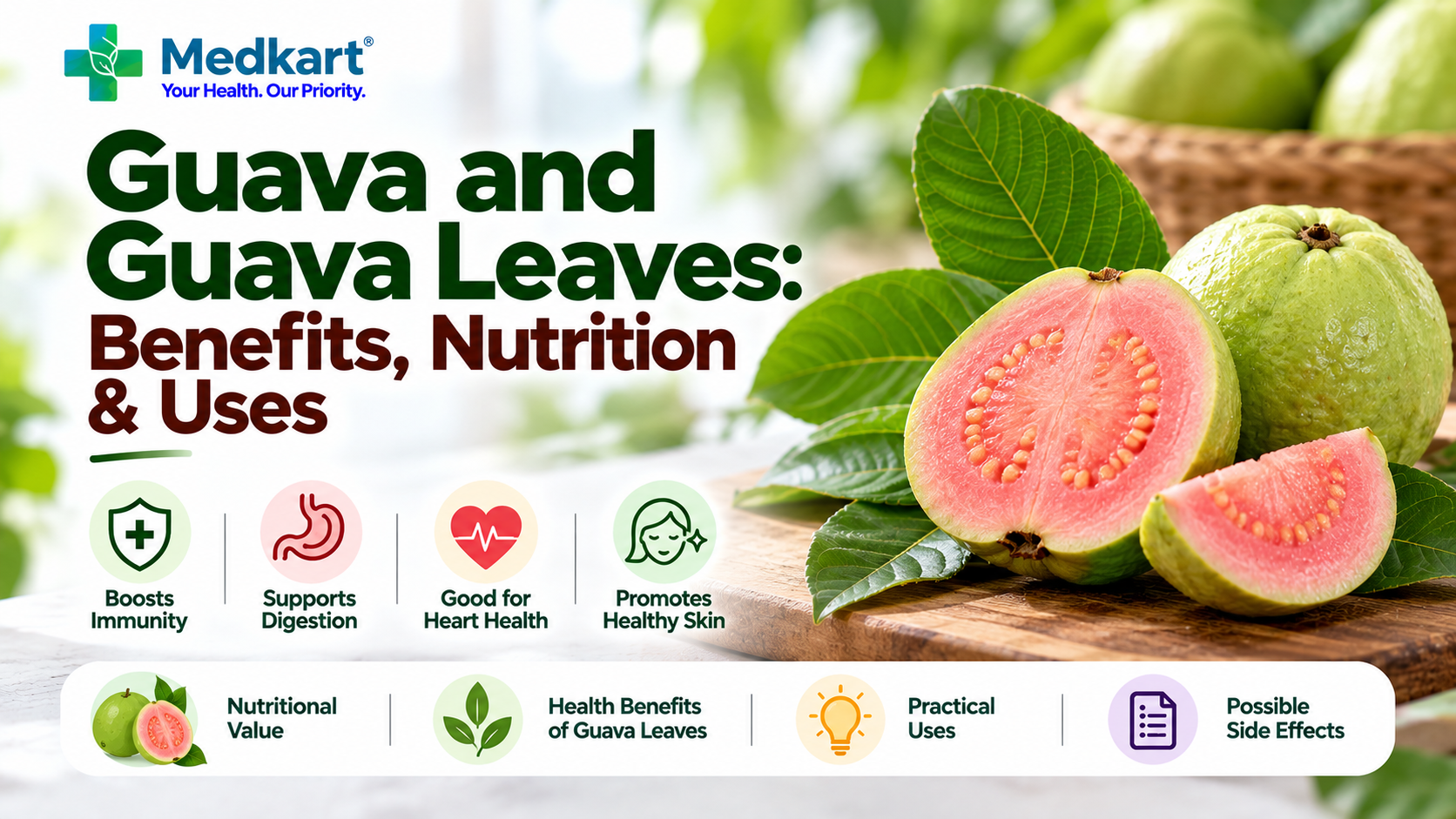
    Guava Benefits: Uses, Nutrition, Guava Leaves and Side Effects

    Guava is one of the few fruits where the leaf has been studied almost as closely as the fruit. The two behave differently, and the evidence behind them comes from different places.

    Two findings frame what follows. Guava holds more vitamin C per 100 g than most fruits sold in India. In the one Indian trial that compared them, eating guava with the peel and eating it without produced opposite results.

    What Is Guava, and Where Does It Grow in India? 

    Guava is the fruit of Psidium guajava, introduced to India in the seventeenth century. The National Horticulture Board[1] calls it the fourth most important fruit in India after mango, banana and citrus.

    It grows almost everywhere. The board names Uttar Pradesh, Bihar, West Bengal, Maharashtra, Chhattisgarh, Tamil Nadu, Karnataka, Madhya Pradesh, Gujarat and Andhra Pradesh among the major producing states.

    The season is longer than most people assume. In north India the board records peak harvesting in August for the rainy season crop. The winter crop peaks in November and December, and the spring crop in March and April.

    What Is the Nutritional Value of Guava? 

    Guava is light in energy and unusually heavy in vitamin C and fibre. The United States Department of Agriculture[2] records these figures for raw common guava.

    Nutrient What 100 g of raw guava provides
    Energy Raw guava provides 68 kcal per 100 g.
    Vitamin C Vitamin C is 228.3 mg per 100 g.
    Fibre Total dietary fibre is 5.4 g per 100 g.
    Protein Protein is 2.55 g per 100 g, which is high for a fruit.
    Carbohydrate Carbohydrate by difference is 14.32 g per 100 g.
    Potassium Potassium is 417 mg per 100 g.
    Lycopene Lycopene is 5,204 micrograms per 100 g.
    Folate Folate is 49 micrograms per 100 g.
    Water Water makes up 80.8 g of every 100 g.

    Two of those figures stand out from the rest of the fruit aisle.

    How Much Vitamin C Is in Guava? 

    The USDA figure is 228.3 mg per 100 g of raw guava. That is several times what most citrus fruit carries.

    Fibre sits alongside it at 5.4 g per 100 g. Between them, those two numbers account for most of guava’s reputation.

    What Are the Health Benefits of Guava? 

    The composition is the firm part. Beyond it, one Indian trial has measured what eating guava does.

    A 2016 randomised controlled study in the Journal of Clinical and Diagnostic Research[3] gave 45 healthy medical students in India 400 g of guava a day for six weeks. The three groups ate fruit with peel, fruit without peel, or nothing added.

    The group eating guava without the peel saw significant falls in total cholesterol, triglycerides and LDL cholesterol. That is the clearest benefit signal in the retrieved evidence.

    Also Read: Understanding blood sugar levels

    Is Guava Good for Diabetes? 

    The same trial found the opposite effect from the peel, which is worth knowing before following the common advice to eat it. In the group eating guava with the peel, fasting plasma glucose, total cholesterol and triglycerides all rose significantly.

    In the peeled group the fall in fasting glucose was not statistically significant. So on this evidence, peeling changed the direction of the result rather than the size of it.

    A separate trial tested a concentrate rather than the fruit. A 2019 double-blind randomised study in Nutrients[4] gave 31 healthy adults a guava fruit extract made by supercritical carbon dioxide extraction. It measured a smaller rise in blood glucose at 30 and 90 minutes after a glucose load.

    Its authors are careful about what that means. They note the small number of participants, and state that the effect in people with type 2 diabetes remains unknown.

    What Are Guava Leaves Used For? 

    The leaf has a long traditional use for loose motions, and a small amount of clinical testing behind it. A 2024 systematic review in the Journal of the Science of Food and Agriculture[5] screened the literature and included 23 articles, of which only three were clinical trials.

    One of those trials was run in India. A 2020 study in the Journal of Ayurveda and Integrative Medicine[6] treated 109 adults with acute infectious diarrhoea using a decoction of dried Sardar variety leaves.

    The preparation was specific. Leaf powder was boiled in 120 ml of water until it reduced to 30 ml, then split into three doses a day for five days. Separate arms used six, ten or fourteen leaves.

    The fourteen-leaf arm performed best. Patients regained normalcy in 72 hours against 120 hours in the control group, which received oral rehydration solution, and no adverse events were reported.

    Do Guava Leaves Help with Blood Sugar? 

    This is where the leaf has its strongest file. A 2010 review in Nutrition and Metabolism[7] describes Guava Leaf Tea, a hot water extract of the leaf sold in Japan. It has been approved there as a food for specified health uses and recommended for people with pre-diabetes.

    The mechanism was measured rather than assumed. The extract inhibited the enzymes that break down carbohydrate. Its 50% inhibitory concentrations were 0.6 mg/ml for alpha-amylase, 2.1 mg/ml for maltase and 3.6 mg/ml for sucrase.

    The human result is modest and real. In normal and pre-diabetic subjects, a single serving of the tea reduced the rise in blood glucose after a carbohydrate load. It cut the area under the glucose curve by about 20%.

    The review also reports the safety testing. It records no acute or chronic toxicity in rats, no genotoxicity, and no side effects during human trials lasting eight to twelve weeks.

    When Is the Best Time to Eat Guava? 

    No source retrieved for this article sets one. The trial above fed guava daily for six weeks without specifying a time of day.

    What the sources establish is the mealtime logic for the leaf. The tea was tested against a carbohydrate load, so its effect is tied to eating rather than to the clock.

    For the fruit, the question has not been studied. Advice about eating guava at a particular hour comes from outside the retrieved evidence.

    What Are the Side Effects, and Who Should Be Careful? 

    No retrieved source reports serious harm from eating ripe guava as a food. The cautions concern the peel, the leaf preparations and anyone whose blood glucose is being managed with medicine.

    Situation What To Do
    Managing diabetes with medicine Discuss guava and any leaf preparation with the prescriber. Both the tea and the extract lowered measured blood glucose.
    Eating guava with the peel Raise it with a dietitian if lipids or glucose are being monitored. The Indian trial found rises in all three markers in the peel group.
    Using guava leaf for loose motions Treat rehydration as the priority. Oral rehydration solution was what the control group received in that trial.
    Diarrhoea in a child, or lasting more than a few days See a doctor. The trial above enrolled adults aged 18 to 60 only.
    Expecting leaf preparations to be standardised Check with a pharmacist. The reviewed clinical evidence for the leaf runs to three trials in total.

    Nothing retrieved here describes guava or its leaves as a treatment for any diagnosed condition.

    Where Can You Buy Supplements and Medicines on Medkart? 

    Guava is a grocery item rather than a pharmacy one, and Medkart does not list it. Medkart sells medicines and nutritional supplements that cover some of the same ground.

    Vitamin C is the obvious overlap, and Medkart lists products such as Limcee from Abbott. For the rehydration that the diarrhoea trial used as its comparator, listed options include ORS Powder from Cipla and Electral from FDC.

    A fruit is not a substitute for a prescribed medicine such as metformin, sold as Glycomet among other brands. Medkart lists ayurvedic products as a separate category.

    Nothing here says any of these treats the condition, and Medkart lists these products rather than testing or approving them. Availability and price can change. Medkart’s medicine comparison tools can be used to compare listed options on:

    • Active ingredient
    • Strength
    • Dosage form
    • Manufacturer
    • Pack size
    • Current price

    It is also possible to search by name, browse the full medicine list, or find the nearest Medkart store.

    Key takeaways 

    • Guava is the fourth most important fruit in India after mango, banana and citrus.
    • Raw guava provides 228.3 mg of vitamin C and 5.4 g of fibre per 100 g, at 68 kcal.
    • Protein is 2.55 g per 100 g, which is high for a fruit.
    • In a six-week Indian trial, peeled guava lowered cholesterol, triglycerides and LDL significantly.
    • In the same trial, guava eaten with the peel raised fasting glucose, cholesterol and triglycerides.
    • Guava Leaf Tea cut the area under the glucose curve by about 20% after a carbohydrate load.
    • A leaf decoction shortened acute diarrhoea to 72 hours against 120 hours on rehydration alone.
    • A 2024 systematic review found only three clinical trials of guava preparations for diarrhoea.

    FAQs 

    Q. Should guava be eaten with or without the peel? 

    The one trial that compared them favoured peeling, which reverses the usual advice. Over six weeks the peeled group improved on three lipid markers while the unpeeled group worsened on three markers. That is a single study in 45 young adults, so it is a reason to ask a dietitian rather than a settled rule.

    Q. Can guava leaf tea replace a diabetes medicine?

    Nothing retrieved supports that. The Japanese product carries a health-use approval for people with pre-diabetes, not for treating diagnosed diabetes. Its measured effect was on the rise in glucose after a meal rather than on long-term control. Any change to prescribed treatment belongs with the prescriber.

    Q. How many guavas is 400 g? 

    The trial weighed the fruit rather than counting it, which is worth noting because guava size varies widely between varieties. A figure in grams is therefore more useful than a number of fruits. That amount was a research portion for six weeks rather than a daily recommendation.

    Q. Are guava leaves safe to take every day? 

    The safety testing that exists covers a specific product. The 2010 review reports no toxicity in animal testing and no side effects in human trials of eight to twelve weeks, for a standardised hot water extract. Leaves picked and brewed at home are not that product, and no retrieved source tests them for daily long-term use.

    Q. Is guava good for weight loss? 

    No trial retrieved for this article measured that. What is established is the composition, which pairs a low energy figure with a high fibre one for a sweet fruit. Whether it affects weight depends on the rest of the diet, which no study opened here examined.

    Q. Does guava cause constipation? 

    Nothing retrieved for this article reports it. The diarrhoea trial specifically recorded that no constipation was observed in any group taking the leaf decoction. The fibre content of the fruit works in the opposite direction.

    References 

    Medical disclaimer: This article gives general information only. It does not replace advice from a doctor, pharmacist or dietitian. Anyone managing diabetes should get individual advice before adding guava or a guava leaf preparation to their diet, diarrhoea that is severe or prolonged needs medical care rather than a home preparation, and no medicine or supplement should be started, stopped or changed without advice from the prescriber or a qualified pharmacist.
  • Sapota (Chikoo): Health Benefits, Nutrition and Side Effects

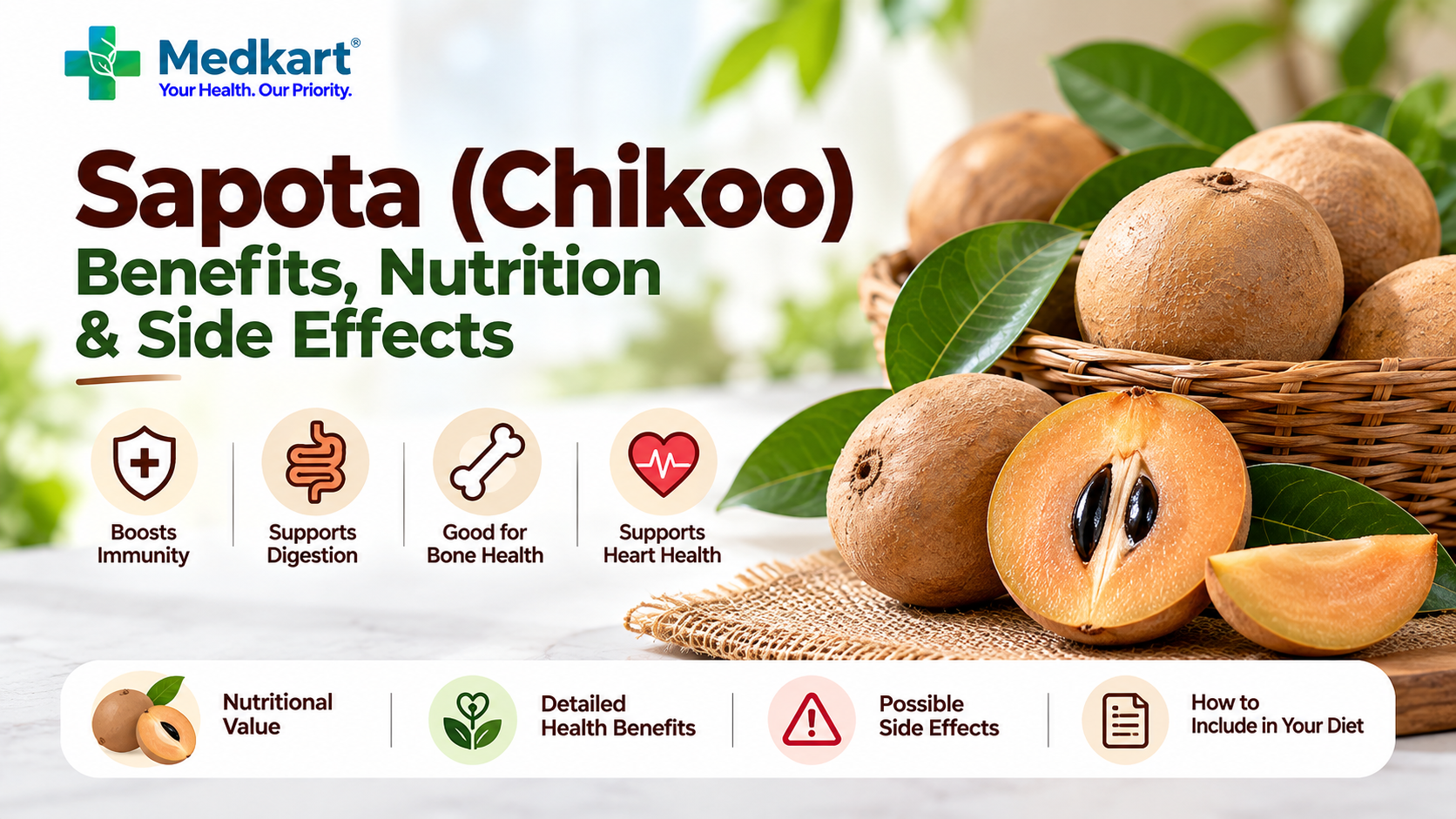
    Sapota (Chikoo): Health Benefits, Nutrition and Side Effects

    Chikoo is the Indian name for sapota, the brown grainy-skinned fruit of Manilkara zapota. It is sweet enough to be eaten as a dessert and dense enough in fibre to behave differently from most sweet fruits.

    Two things in the research are worth knowing first. The figures for its sugar and fibre content disagree between sources. The single measured study of its effect on blood glucose also carries a spread far wider than the tidy numbers circulating online.

    What Is Sapota, and Where Does Chikoo Grow in India? 

    Sapota is a tropical evergreen fruit crop grown across the warmer half of the country. The National Horticulture Board[1] records it as mainly cultivated in India for its fruit, in a warm and humid climate at around 70% relative humidity.

    Six states carry most of it. The board names Gujarat, Maharashtra, Karnataka, Tamil Nadu, Andhra Pradesh and Kerala, and the varieties include Kalipatti, Cricket ball and Calcutta round.

    The fruit is slow. The board records that a tree starts bearing from the third year after planting, with economic yields from the fifth. The fruit itself takes four months from flowering to maturity.

    What Is the Nutritional Value of Chikoo? 

    Sapota is a fibre-heavy carbohydrate fruit with very little protein or fat. The United States Department of Agriculture[2] records these figures for raw sapodilla.

    Nutrient What 100 g of raw sapodilla provides
    Energy Raw sapodilla provides 83 kcal per 100 g.
    Carbohydrate Carbohydrate by difference is 19.96 g per 100 g.
    Fibre Total dietary fibre is 5.3 g per 100 g.
    Protein Protein is 0.44 g per 100 g.
    Fat Total fat is 1.1 g per 100 g.
    Water Water makes up 78 g of every 100 g.
    Vitamin C Vitamin C is 14.7 mg per 100 g.
    Potassium Potassium is 193 mg per 100 g.
    Calcium Calcium is 21 mg per 100 g.
    Iron Iron is 0.8 mg per 100 g.

    The USDA entry carries no figure for total sugars. A 2026 review in Foods[3] gives 11% to 15% sugars for the fruit, so the sweetness is documented in the literature rather than in the food database.

    How Many Calories Are in Chikoo? 

    Around 83 kcal per 100 g, which is moderate for a fruit and comes almost entirely from carbohydrate. A single sapota weighs well under 100 g in most cases, so a fruit carries less than that figure.

    The energy is not the interesting part. Nearly a quarter of the carbohydrate is fibre, and that is what separates sapota from other fruits of similar sweetness.

    What Is Chikoo Rich In? 

    Fibre first, at 5.3 g per 100 g in the USDA record. That is high for a fresh fruit and is the most defensible single claim about it.

    Vitamin C and potassium follow, at 14.7 mg and 193 mg per 100 g. Calcium and iron are present in smaller amounts.

    The fibre figure is itself disputed. The composition table in the glycaemic study below[4] lists 9.9 g of fibre per 100 g, nearly twice the USDA figure. Fruit composition varies with variety and ripeness.

    What Are the Health Benefits of Sapota? 

    The defensible benefits are the fibre, the vitamin C and the potassium, all of which are matters of composition rather than of effect. Beyond those, the retrieved evidence thins quickly.

    The Foods review lists gallic acid, chlorogenic acid, quercetin, catechin and myricetin among the fruit’s phenolic compounds. It reports antioxidant, anti-inflammatory and antimicrobial activity for extracts, and states that this work is laboratory and animal research.

    The digestive claim sits in the same category. A 2019 study in BioMed Research International[5] tested chloroform and aqueous extracts of the fruit in animals. It reported protection against induced diarrhoea and up to 76% inhibition of induced ulcers.

    Those were extracts given to animals, not fruit eaten by people. No human trial of eating sapota was retrieved for this article.

    Also Read: Understanding blood sugar levels

    Can People with Diabetes Eat Chikoo? 

    One study has measured this, and its result is less reassuring than its headline. A 2015 paper in Food Science and Technology tested nine tropical fruits in volunteers under the FAO and WHO protocol, with each fruit tested in at least six people.

    Sapodilla came out with a glycaemic index of 37, classified as low, and a glycaemic load of 4 for a 70 g portion, also low.

    The spread is the problem. The reported standard deviation was 27.9 against a mean of 37, wider than the gap between a low and a high glycaemic index. Individual responses varied enormously.

    The portion is worth noting too. To deliver the 50 g of glycaemic carbohydrate the protocol requires, volunteers ate 312.5 g of sapodilla, far more than anyone eats at one sitting. Anyone managing diabetes should discuss portions with the clinician managing it.

    How Is Chikoo Eaten and Ripened? 

    Ripe sapota is eaten fresh, and the unripe fruit is not worth eating. The Foods review records that unripe fruits have higher levels of tannins, which make them astringent and reduce palatability.

    Commercial ripening is regulated in India, and the rules matter to shoppers. The FSSAI[6] states that calcium carbide, widely called masala, is banned for ripening fruit under the 2011 prohibition regulations.

    Its reasoning is specific. The authority records that calcium carbide carries traces of arsenic and phosphorus, that these may leave residues on fruit, and that the acetylene gas released is harmful to handlers.

    What is permitted instead is ethylene. FSSAI recognises it as a safe ripening agent, delivered through sources such as ethephon, which is the method the horticulture board describes for sapota.

    What Are the Side Effects of Sapota? 

    No retrieved source reports serious harm from eating ripe sapota as a food. The cautions that exist concern the unripe fruit and the limits of the safety testing.

    The tannins in unripe fruit are the first. Beyond astringency, no retrieved source quantifies a harm from them.

    The second is a gap rather than a finding. The Foods review notes that cyanogenic glycosides have been identified in the plant, and states that long-term toxicity studies in humans should still be conducted.

    Energy and carbohydrate are the everyday consideration. At 83 kcal and nearly 20 g of carbohydrate per 100 g, sapota is denser than a watery fruit. The glycaemic spread above means its effect is not uniform across people.

    Who Should Be Careful with Sapota? 

    The cautions are specific rather than general.

    Situation What To Do
    Managing diabetes Discuss portions with the doctor or dietitian managing it. The one measured study reported a very wide individual spread.
    Watching energy intake Weigh the portion. Sapota carries 83 kcal and 19.96 g of carbohydrate per 100 g.
    Buying fruit that ripens suspiciously fast Buy from a seller you trust. FSSAI bans calcium carbide for ripening and permits ethylene instead.
    Eating unripe fruit Leave it to ripen. The Foods review attributes the astringency of unripe fruit to its higher tannin content.
    Relying on it for a health effect Treat it as a food. The antioxidant and digestive findings come from extracts tested in laboratories and animals.

    No source retrieved for this article sets a daily amount of sapota for anyone.

    Where Can You Buy Supplements and Medicines on Medkart? 

    Sapota is a grocery item rather than a pharmacy one, and Medkart does not list it. Medkart sells medicines and nutritional supplements that cover some of the same ground.

    Fibre and iron are the relevant ones. Listed options include Laxmi Isabgol Powder, Softovac SF and iron products such as Daily Iron from Systopic. Medkart also lists ayurvedic products as a separate category.

    A fruit is not a substitute for a prescribed medicine such as metformin, sold as Glycomet among other brands. Nothing here says any of these treats the condition, and Medkart lists these products rather than testing or approving them. Availability and price can change.

    Medkart’s medicine comparison tools can be used to compare listed options on:

    • Active ingredient
    • Strength
    • Dosage form
    • Manufacturer
    • Pack size
    • Current price

    It is also possible to search by name, browse the full medicine list, or find the nearest Medkart store.

    Key takeaways 

    • Chikoo is sapota, the fruit of Manilkara zapota, grown mainly in Gujarat, Maharashtra, Karnataka, Tamil Nadu, Andhra Pradesh and Kerala.
    • Raw sapodilla provides 83 kcal and 19.96 g of carbohydrate per 100 g.
    • Fibre is the standout nutrient, at 5.3 g per 100 g in the USDA record.
    • The USDA carries no total sugars figure, while a 2026 review reports 11% to 15% sugars.
    • The two sources also disagree on fibre, at 5.3 g against 9.9 g per 100 g.
    • The one measured study gave a glycaemic index of 37, low, but with a standard deviation of 27.9.
    • Antioxidant and digestive findings come from extracts tested in laboratories and animals, not from eating the fruit.
    • FSSAI bans calcium carbide for ripening fruit and recognises ethylene as the safe alternative.

    FAQs 

    Q. How many chikoos can be eaten in a day? 

    No retrieved source sets a number. The glycaemic study used a 70 g portion to calculate its load figure, roughly one medium fruit. That was a research portion rather than a recommendation. Anyone with diabetes or a weight goal should settle the amount with a clinician rather than with a chart.

    Q. Is chikoo good for constipation? 

    The fibre content is real and the outcome evidence is not here. Sapodilla carries 5.3 g of fibre per 100 g in the USDA record, which is high for a fresh fruit. No trial testing sapota for constipation in people was retrieved for this article, so the composition figure is the honest answer.

    Q. Can the seeds be swallowed? 

    The seeds are large, black and flat, and nothing retrieved here describes them as edible. The Foods review covers the plant’s chemistry rather than seed safety, and the toxicology gap named above has not been closed. Nothing opened for this article supports swallowing them deliberately.

    Q. Why do some chikoos taste chalky or bitter? 

    That points at ripeness rather than at a bad fruit. The Foods review attributes astringency in this fruit to the higher tannin levels found before ripening. A fruit picked too early and ripened in a hurry can therefore taste sharp even when the skin looks ready.

    Q. Is sapota latex the same as chewing gum? 

    The species is the historical source of chicle, the latex once used as a chewing gum base, and the Foods review covers the plant beyond its fruit. The latex is a separate product from the flesh people eat. Nothing retrieved here describes eating the latex.

    Q. Does chikoo help with weight gain? 

    No trial retrieved for this article tested that. What is established is the energy density, at 83 kcal per 100 g. Whether that adds or removes weight depends on the rest of the diet, which no study opened here examined.

    References

    Medical disclaimer: This article gives general information only. It does not replace advice from a doctor, pharmacist or dietitian. Anyone managing diabetes or a weight goal should get individual advice before changing what they eat, and no medicine or supplement should be started, stopped or changed without advice from the prescriber or a qualified pharmacist.

  • Ashwagandha for Men: Benefits for Energy, Strength & Hormones

    Looking for a natural way to boost your energy, strength, and overall vitality? Ashwagandha, a powerful herb used in Ayurvedic medicine for centuries, may be just what you need. Known for its adaptogenic properties, Ashwagandha helps the body manage stress, supports physical performance, and promotes hormonal balance. Let’s explore how Ashwagandha can benefit men in terms of energy, strength, and hormone health.

    What Is Ashwagandha?

    Ashwagandha (Withania somnifera) is a small shrub native to India, the Middle East, and parts of Africa. Its roots and berries have been used for centuries in Ayurvedic medicine to treat a variety of health conditions. Ashwagandha is classified as an adaptogen, meaning it helps the body adapt to stress and maintain balance. The herb is rich in bioactive compounds, including withanolides, alkaloids, and flavonoids, which contribute to its wide range of health benefits.

    • Ashwagandha is a small shrub native to India, the Middle East, and parts of Africa.
    • It is classified as an adaptogen, helping the body adapt to stress and maintain balance.
    • Ashwagandha is rich in bioactive compounds, including withanolides, alkaloids, and flavonoids.

    How Ashwagandha Works

    Ashwagandha works by modulating the body’s stress response and supporting various physiological functions. The herb’s adaptogenic properties help reduce cortisol levels, the primary stress hormone, which can lead to improved energy, mood, and overall well-being. Ashwagandha also supports the production of testosterone, a key hormone for men’s health, and enhances physical performance by improving muscle strength and endurance.

    • Ashwagandha modulates the body’s stress response and supports various physiological functions.
    • It helps reduce cortisol levels, the primary stress hormone.
    • Ashwagandha supports the production of testosterone and enhances physical performance.

    Benefits of Ashwagandha for Men

    Ashwagandha offers several benefits for men, making it a valuable addition to any health regimen. Its multi-faceted approach addresses both symptoms and underlying causes, providing effective relief.

    • Boosts Energy Levels: Ashwagandha helps increase energy levels by reducing stress and fatigue, allowing men to feel more alert and focused throughout the day.
    • Enhances Physical Strength: The herb supports muscle growth and strength, making it a popular choice for athletes and fitness enthusiasts.
    • Improves Hormonal Balance: Ashwagandha helps regulate testosterone levels, which can improve libido, fertility, and overall sexual health.
    • Supports Mental Health: The adaptogenic properties of Ashwagandha help reduce anxiety and depression, promoting better mental well-being.
    • Boosts Immune Function: Ashwagandha supports the immune system, helping the body fight off infections and illnesses.
    • Improves Sleep Quality: The herb can help improve sleep quality, leading to better rest and recovery.
    • Supports Heart Health: Ashwagandha helps lower blood pressure and cholesterol levels, reducing the risk of cardiovascular diseases.

    Key Compounds in Ashwagandha

    Ashwagandha contains several bioactive compounds that contribute to its health benefits. Here are some of the key compounds and their roles:

    • Withanolides: These are the primary active compounds in Ashwagandha, responsible for its adaptogenic and anti-inflammatory properties.
    • Alkaloids: These compounds help reduce stress and anxiety, promoting better mental health.
    • Flavonoids: These antioxidants help protect the body from damage caused by free radicals and environmental stressors.
    • Steroidal Lactones: These compounds support hormonal balance and physical performance.

    How to Use Ashwagandha

    Using Ashwagandha is simple and straightforward. Follow these steps to get the best results:

    • Take Ashwagandha as directed by your healthcare provider, typically once or twice a day with a meal.
    • Swallow the tablet or capsule whole with water. Do not crush or chew the tablets.
    • Take Ashwagandha at the same time each day for consistency.
    • Stay hydrated and drink plenty of water to support overall health.
    • Monitor your progress with periodic blood tests as recommended by your healthcare provider.

    Safety and Precautions

    Ashwagandha is generally safe when used as directed. However, there are some precautions to keep in mind to ensure optimal safety.

    • Consult a healthcare professional before using Ashwagandha, especially for children, elderly patients, or those with underlying health conditions.
    • Do not use Ashwagandha if you are allergic to any of its ingredients.
    • Be aware of potential side effects, such as mild stomach upset or allergic reactions.
    • Seek medical advice if side effects persist or worsen.
    • Store Ashwagandha in a cool, dry place, away from direct sunlight.
    • Keep it out of the reach of children.
    • Do not take more than the prescribed amount, as this may lead to overdose and other complications.
    • Inform your doctor about all the medicines you use, including prescription, over-the-counter medications, and herbal supplements.

    Extra Tips for Men’s Health

    In addition to using Ashwagandha, there are several lifestyle changes that can help support men’s health.

    • Eat a balanced diet rich in fruits, vegetables, and whole grains.
    • Stay hydrated and drink plenty of water throughout the day.
    • Avoid processed foods, sugary snacks, and high-fat foods.
    • Get regular exercise to improve circulation and overall health.
    • Get enough sleep and manage stress.
    • Practice mindful eating and chew your food thoroughly.

    When to See a Doctor

    While Ashwagandha can help manage many symptoms of stress, fatigue, and hormonal imbalance, it is important to see a doctor if your symptoms are severe, persistent, or accompanied by other concerning signs. A healthcare professional can provide additional treatment options and help you manage your health.

    By understanding the benefits and usage instructions for Ashwagandha, you can support better management of energy, strength, and hormone health. For more information and trusted Ayurvedic products, visit MedKart and explore solutions that work for your needs.

  • Anjeer (Figs): Health Benefits & Ways to Include in Diet

    Looking for a delicious, nutritious fruit that can boost your health in multiple ways? Anjeer, or figs, are a powerhouse of nutrients that have been cherished for centuries in both traditional and modern diets. Whether you enjoy them fresh or dried, figs offer a wide range of health benefits, from supporting digestion to promoting heart health. Let’s explore the remarkable benefits of anjeer and discover creative ways to include them in your daily meals.

    What Are Anjeer (Figs)?

    Anjeer, commonly known as figs, are sweet, soft fruits that come in various colours, including green, purple, and black. They can be eaten fresh or dried, and both forms are packed with essential nutrients. Figs are low in calories but high in fibre, vitamins, and minerals, making them a valuable addition to a balanced diet.

    • Figs are sweet, soft fruits available in various colours.
    • They can be eaten fresh or dried.
    • Figs are low in calories but high in fibre, vitamins, and minerals.

    Health Benefits of Anjeer (Figs)

    Anjeer offers a wide range of health benefits, making it a valuable addition to your diet. Here are some of the key benefits:

    • Supports Digestive Health: The high fibre content in figs acts as a prebiotic, nourishing the beneficial bacteria in your gut and promoting a healthy microbiome. Regular consumption of figs can help regulate bowel movements, reduce inflammation, and support overall digestive health.
    • Boosts Heart Health: Figs are rich in antioxidants and potassium, which help regulate blood pressure and improve blood fat levels. Studies suggest that fig extracts may help raise HDL (good) cholesterol while lowering total cholesterol and triglycerides, contributing to a healthier cardiovascular system.
    • Strengthens Bones: Figs are a good source of calcium, magnesium, and other minerals essential for maintaining strong and healthy bones. Regular consumption of figs, as part of a balanced diet, can help prevent bone disorders such as osteoporosis, especially in older adults.
    • Improves Vision: The antioxidants and nutrients present in figs may contribute to overall eye health. The presence of vitamin A and other beneficial compounds in figs may support healthy vision, although specific studies on vision improvement are limited.
    • Boosts Immune System: The prebiotic fiber and antioxidants in figs support a healthy gut microbiome and reduce inflammation, which are crucial for maintaining a robust immune system. By promoting the growth of beneficial gut bacteria and fighting oxidative stress, figs can help strengthen your body’s natural defenses against diseases.
    • Anti-inflammatory Properties: Figs contain various anti-inflammatory compounds, including antioxidants and polyphenols, which can help reduce inflammation in the body. Chronic inflammation is linked to several health issues, and consuming figs regularly may help combat this problem, promoting overall well-being.
    • Supports Weight Management: The high fibre content in figs can help you feel fuller for longer, reducing the urge to snack on unhealthy foods. This can be beneficial for weight management and maintaining a healthy body weight.
    • Regulates Blood Sugar: Figs have a low glycemic index, which means they release sugar slowly into the bloodstream. This can help regulate blood sugar levels and prevent spikes and crashes, making it a good choice for people with diabetes or those looking to manage their blood sugar levels.
    • Enhances Skin Health: The antioxidants in figs help protect the skin from damage caused by free radicals and environmental stressors. Regular consumption of figs can help keep your skin looking youthful and radiant.
    • Supports Dental Health: The presence of phenolic compounds in figs exhibits anti-caries activity and thwarts bacteria causing dental infection. The flavonoids and phytochemicals in figs exhibit potent antibacterial activities that reduce bacterial infections, guard gums, teeth, and promote overall dental health.

    Ways to Include Anjeer (Figs) in Your Diet

    There are many creative ways to include figs in your diet. Here are some ideas to get you started:

    • Snack on Fresh Figs: Enjoy fresh figs as a healthy snack. They are naturally sweet and can be eaten on their own or paired with cheese or nuts.
    • Add Dried Figs to Salads: Chop dried figs and add them to your salads for a burst of sweetness and texture.
    • Use in Baking: Incorporate figs into your baking recipes, such as muffins, cakes, and bread. They add natural sweetness and moisture to your baked goods.
    • Make Fig Jam: Cook fresh or dried figs with a little sugar and water to make a delicious fig jam. Spread it on toast or use it as a topping for yogurt or ice cream.
    • Blend into Smoothies: Add fresh or dried figs to your smoothies for a boost of fibre and natural sweetness.
    • Use in Savoury Dishes: Figs can be used in savoury dishes, such as tagines, stews, and sauces. They add a unique sweetness and depth of flavour to your meals.
    • Make Fig Chutney: Cook figs with spices and vinegar to make a tangy fig chutney. Serve it with grilled meats or as a condiment for sandwiches.
    • Include in Breakfast Bowls: Add chopped figs to your breakfast bowls, such as oatmeal or yogurt, for a nutritious start to your day.

    Safety and Precautions

    Figs are generally safe when consumed as part of a balanced diet. However, there are some precautions to keep in mind to ensure optimal safety.

    • Consult a healthcare professional before making significant changes to your diet, especially if you have underlying health conditions.
    • Be aware of potential side effects, such as mild stomach upset or allergic reactions.
    • Seek medical advice if side effects persist or worsen.
    • Store figs in a cool, dry place, away from direct sunlight.
    • Keep figs out of reach of children.
    • Do not exceed the recommended amount, as excessive consumption can lead to digestive issues.

    Extra Tips for a Healthy Diet

    In addition to including figs in your diet, there are several lifestyle changes that can help support overall health.

    • Eat a balanced diet rich in fruits, vegetables, and whole grains.
    • Stay hydrated and drink plenty of water throughout the day.
    • Avoid processed foods, sugary snacks, and high-fat foods.
    • Get regular exercise to improve circulation and overall health.
    • Get enough sleep and manage stress.
    • Practice mindful eating and chew your food thoroughly.

    When to See a Doctor

    While figs can help manage many symptoms of various health issues, it is important to see a doctor if your symptoms are severe, persistent, or accompanied by other concerning signs. A healthcare professional can provide additional treatment options and help you manage your health.

    By understanding the benefits and ways to include figs in your diet, you can support better management of various health issues and improve your overall well-being. For more information and trusted nutritional products, visit MedKart and explore solutions that work for your needs.

  • Diet Chart for Breastfeeding Mothers: Foods for Energy & Lactation

    Feeling tired and low on energy after having your little one? You’re not alone. Breastfeeding is a beautiful journey, but it can also be exhausting. The good news? Eating the right foods can help you feel more energised, support your milk supply, and keep both you and your baby happy and healthy. Let’s explore a simple, nourishing diet that’s easy to follow and full of delicious options.

    Why Nutrition Matters for Breastfeeding Mothers

    When you’re breastfeeding, your body is working overtime to produce milk and keep you going. That means you need extra energy and nutrients to stay strong and support your little one’s growth. Eating a variety of healthy foods helps you feel your best, boosts your milk supply, and ensures your baby gets the best nutrition possible.

    • A balanced diet keeps your energy levels up and supports milk production.
    • Eating well helps you recover faster and feel more like yourself.
    • Good nutrition means your baby gets the best start in life.

    Key Nutrients for Breastfeeding Mothers

    There are a few key nutrients that breastfeeding mothers should focus on to stay healthy and support milk production.

    • Protein: Helps repair tissues and supports milk production. Good sources include lean meats, poultry, fish, eggs, dairy, beans, lentils, and nuts.
    • Calcium: Keeps your bones strong and supports milk production. Good sources include dairy products, leafy greens, fortified cereals, and calcium-rich plant-based milks.
    • Iron: Prevents anemia and keeps your energy levels up. Good sources include red meat, poultry, fish, beans, lentils, spinach, and fortified cereals.
    • Vitamin D: Supports bone health and immune function. Good sources include fatty fish, fortified dairy products, and sunlight exposure.
    • Folate: Important for cell growth and development. Good sources include leafy greens, beans, lentils, and fortified cereals.
    • Omega-3 Fatty Acids: Support brain development and overall health. Good sources include fatty fish, flaxseeds, chia seeds, and walnuts.

    Diet Chart for Breastfeeding Mothers

    Here’s a simple, everyday diet chart to help you stay nourished and energised. Feel free to mix and match based on your preferences and what’s available.

    Breakfast

    • Whole-grain cereal with milk or yogurt
    • Boiled eggs or scrambled eggs
    • Fresh fruits like bananas, apples, or berries
    • Whole-grain toast with peanut butter or almond butter

    Morning Snack

    • Fresh fruits like oranges, grapes, or mangoes
    • A handful of nuts like almonds, walnuts, or cashews
    • Yogurt or cottage cheese

    Lunch

    • Whole-grain rice or roti
    • Vegetable curry or dal
    • Lean meat, poultry, or fish
    • Leafy greens like spinach or fenugreek
    • Salad with fresh vegetables

    Afternoon Snack

    • Fresh fruits like papaya, watermelon, or pomegranate
    • Handful of nuts or seeds
    • Yogurt or buttermilk

    Dinner

    • Whole grain rice or roti
    • Vegetable curry or dal
    • Lean meat, poultry, or fish
    • Leafy greens like spinach or fenugreek
    • Salad with fresh vegetables

    Evening Snack

    • Fresh fruits like apples, bananas, or grapes
    • Handful of nuts or seeds
    • Yogurt or cottage cheese

    Before Bed

    • Warm milk with a pinch of turmeric
    • Fresh fruits like bananas or apples
    • Handful of nuts or seeds

    Extra Tips for Breastfeeding Mothers

    Here are a few extra tips to help you stay healthy and energised during your breastfeeding journey:

    • Stay hydrated and drink plenty of water throughout the day.
    • Eat small, frequent meals to keep your energy levels up.
    • Include a variety of foods to make sure you get all the nutrients you need.
    • Avoid processed foods, sugary snacks, and high-fat foods.
    • Get regular exercise to improve circulation and overall health.
    • Get enough sleep and rest to support your body’s recovery and milk production.

    When to See a Doctor

    If you’re feeling unusually tired, weak, or have any concerns about your health or milk supply, it’s always a good idea to talk to your doctor. They can provide extra support and help you manage any issues that come up.

    By following a balanced diet and taking care of yourself, you can support your energy levels and milk production while enjoying the special moments with your little one. For more information and trusted nutritional products, visit MedKart and explore solutions that work for your needs.

  • Ajwain (Carom Seeds): Benefits, Uses & Side Effects

    Ajwain, also known as carom seeds, is a staple in Indian kitchens and traditional medicine. These small, pungent seeds are valued for their unique aroma and wide range of health benefits. Ajwain is used both as a culinary spice and a natural remedy for various health issues, from digestive problems to respiratory relief. Understanding the benefits, uses, and side effects of ajwain can help you make the most of this versatile ingredient.

    What Are Ajwain (Carom Seeds)?

    Ajwain, or carom seeds, are the fruit of the ajwain herb (Trachyspermum ammi). They are slightly green to brown in color and have a pungent, bitter taste. Ajwain seeds are often sold whole but can also be ground into a powder and used as a cooking spice. They are rich in fiber, antioxidants, and other beneficial nutrients, making them a valuable addition to a healthy diet.

    • Ajwain seeds are the fruit of the ajwain herb.
    • They are rich in fiber, antioxidants, and other beneficial nutrients.
    • Ajwain seeds are used both as a culinary spice and a natural remedy.

    Key Benefits of Ajwain

    Ajwain offers several health benefits due to its unique blend of compounds and properties. These benefits include improved digestion, reduced blood pressure, better cholesterol levels, relief from respiratory issues, antibacterial properties, toothache relief, and reduced arthritis pain.

    1. Aids Digestion

    Ajwain is renowned for its digestive benefits. The active compounds in ajwain, such as thymol, enhance the secretion of digestive enzymes, which helps improve digestion and alleviate common digestive issues like indigestion, bloating, and gas. Ajwain also helps relax the muscles in the gastrointestinal tract, reducing discomfort and promoting the expulsion of gas.

    • Enhances the secretion of digestive enzymes.
    • Alleviates indigestion, bloating, and gas.
    • Relaxes the muscles in the gastrointestinal tract.

    2. Reduces Blood Pressure

    Research has shown that ajwain can help lower blood pressure. The natural compounds in ajwain, particularly thymol, help relax blood vessels and improve circulation. Regular consumption of ajwain may help normalize blood pressure levels and promote heart health.

    • Relaxes blood vessels and improves circulation.
    • Helps normalize blood pressure levels.
    • Promotes heart health.

    3. Improves Cholesterol Levels

    Ajwain has been found to lower total cholesterol, triglycerides, and LDL cholesterol while increasing HDL cholesterol. This property helps prevent arterial blockages and promotes heart health.

    • Lowers total cholesterol, triglycerides, and LDL cholesterol.
    • Increases HDL cholesterol.
    • Prevents arterial blockages and promotes heart health.

    4. Relieves Respiratory Issues

    Ajwain is a natural expectorant and can help clear mucus from the airways, providing relief from coughing, colds, and nasal congestion. The seeds also have bronchodilator properties, which means they can help widen the airways and reduce bronchial congestion. This can be particularly beneficial for individuals suffering from asthma or other respiratory conditions.

    • Clears mucus from the airways.
    • Provides relief from coughing, colds, and nasal congestion.
    • Widens the airways and reduces bronchial congestion.

    5. Antibacterial Properties

    Ajwain has powerful antibacterial and antifungal properties. The active compounds in ajwain, such as thymol and carvacrol, have been shown to inhibit the growth of bacteria and fungi, including E. coli, Salmonella, and Candida albicans. This makes ajwain effective in preventing and treating infections.

    • Inhibits the growth of bacteria and fungi.
    • Effective against E. coli, Salmonella, and Candida albicans.
    • Prevents and treats infections.

    6. Toothache Relief

    The anti-inflammatory properties of thymol and other essential oils in ajwain can help reduce pain associated with toothaches. Chewing a few ajwain seeds or using ajwain oil as a rinse can provide relief from toothache pain and improve oral health by fighting bacteria and fungi in the mouth.

    • Reduces pain associated with toothaches.
    • Improves oral health by fighting bacteria and fungi.
    • Can be used as a rinse or chewed for relief.

    7. Reduces Arthritis Pain

    Ajwain can help soothe pain and swelling associated with arthritis. Crushed ajwain seeds can be made into a paste and applied to the skin at the joints to treat arthritis pain. Alternatively, you can fill your tub with warm water and add a handful of seeds for a soothing bath.

    • Soothes pain and swelling associated with arthritis.
    • Can be applied as a paste or used in a bath.
    • Reduces joint pain and improves mobility.

    How to Use Ajwain

    Ajwain can be used in various ways to reap its health benefits. Here are some common methods:

    • Drinking ajwain water made by soaking seeds overnight.
    • Using ajwain powder mixed with warm water or honey.
    • Preparing ajwain tea by boiling the seeds for five minutes.
    • Chewing a few seeds for immediate relief from digestive issues.
    • Applying a paste of crushed seeds to the skin for pain relief.

    Safety and Precautions

    Ajwain is generally safe when used in moderation. However, excessive consumption can lead to side effects such as acidity, acid reflux, and peptic ulcers. High doses of thymol may cause dizziness or nausea. Pregnant women are advised to limit ajwain intake due to potential risks to fetal development. Always consult a healthcare professional before using ajwain for specific medical conditions.

    • Excessive consumption can lead to acidity, acid reflux, and peptic ulcers.
    • High doses of thymol may cause dizziness or nausea.
    • Pregnant women should limit ajwain intake.
    • Consult a healthcare professional before using ajwain for specific medical conditions.

    When to See a Doctor

    While ajwain can help manage many symptoms, it is important to see a doctor if your symptoms are severe, persistent, or accompanied by other concerning signs. A healthcare professional can provide additional treatment options and help you manage your health.

    By understanding the benefits, uses, and side effects of ajwain, you can make informed choices about incorporating this versatile ingredient into your diet and lifestyle. For more information and trusted health products, visit MedKart and explore solutions that work for your needs.